
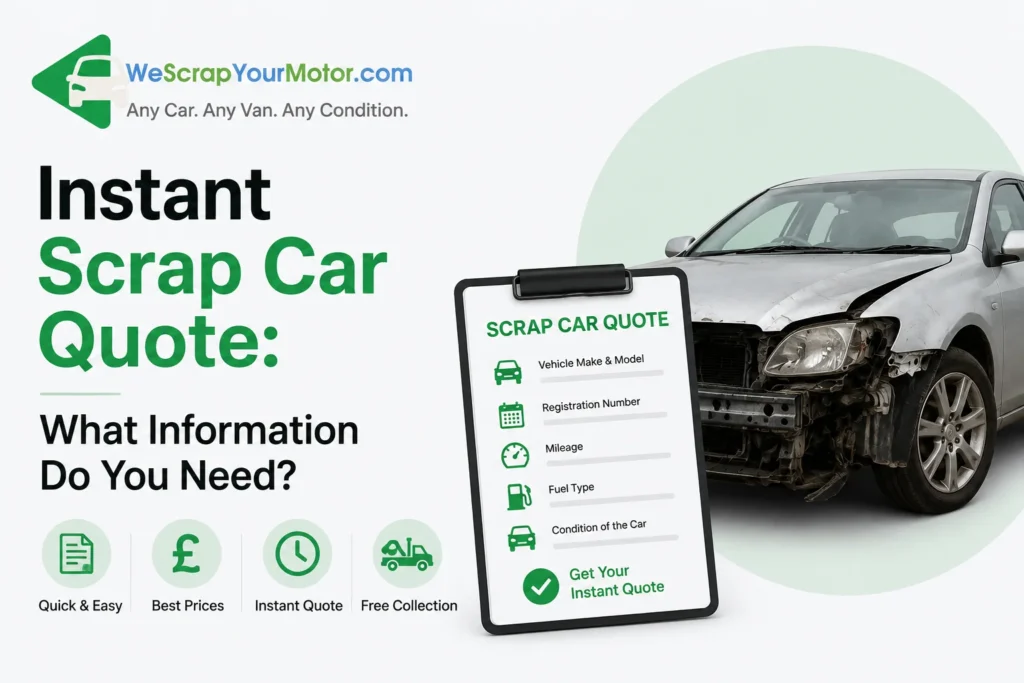
To get an instant scrap car quote, you will usually need the vehicle registration number and collection postcode. For a firm collection price, also give an accurate account of whether the car starts, rolls and steers; its mileage and damage; any missing parts; the keys and V5C status; and any access restrictions. Better information reduces the risk of a revised quote at collection.
The information behind an accurate instant quote
An instant scrap car quote should make selling an unwanted vehicle simpler, but “instant” does not mean “based on nothing”. A quote tool can identify basic vehicle data from a registration number, yet it cannot see a seized engine, a missing catalytic converter or a car trapped behind a narrow gate. Those details can change the vehicle’s value or the recovery equipment needed.
The quickest way to receive a useful quote is therefore to prepare a small set of facts before starting. You do not need specialist mechanical knowledge. You only need to describe what you know honestly, avoid guesses presented as facts and mention anything a collector would discover on arrival.
If you are ready to value an end-of-life, accident-damaged, or non-running vehicle, start with We Scrap Your Motor after working through the checklist below.
The two details most quote forms ask for first
Most online quote journeys begin with:
- The vehicle registration number. This identifies the make, model and version recorded against the registration. Check every letter and number before submitting it. A small typing error can return the wrong vehicle or no result.
- The collection postcode. The location affects which collection partner can reach the car, how far it must be transported and whether a free collection service is available there.
These inputs may produce an initial price quickly. However, an initial automated figure is only as reliable as the assumptions behind it. A responsible provider may ask follow-up questions before confirming the amount.
Vehicle identity details to check
Have the V5C registration certificate, commonly called the log book, nearby if it is available. It can help you confirm:
- registration mark;
- make and model;
- fuel type;
- body style;
- date of first registration;
- vehicle identification number, if requested for verification;
- name and address recorded for the registered keeper.
The registered keeper is not automatically the legal owner in every situation, so be ready to explain your authority to dispose of the vehicle. If it belongs to a relative, a company, an estate or a finance provider, ask the buyer what evidence they require before booking.
Do not send more personal information than the secure quote or booking process asks for. A registration and postcode are normal quoting inputs; full bank details and identity documents should not be needed merely to show a preliminary value.
Mileage and derivative
Mileage may matter because some damaged cars are bought for salvage rather than only for their metal. A lower-mileage engine, gearbox or interior can have reusable value if its condition is suitable. Give the displayed odometer reading and say if it is approximate, unreadable or believed to be inaccurate.
Trim level, engine size, transmission and body type can also distinguish two cars that look similar in a basic database. If the quote form retrieves the wrong derivative, correct it before accepting the offer.
Is the car scrap, salvage or still a used vehicle?
The words are sometimes used loosely, but the intended route can affect the price:
- Scrap or end-of-life vehicle: the car is waste and will be depolluted and treated at an Authorised Treatment Facility (ATF).
- Salvage vehicle: the car may have reusable parts or potential for lawful repair, depending on its condition and insurance category.
- Used vehicle or repair project: it may still have a realistic roadworthy resale route.
Do not label a vehicle as safe or repairable unless that has been established. Give the facts such as MOT failure, collision damage or engine failure, and let the buyer assess the appropriate route.
Condition and collection details that protect your quote
Does it start, drive, roll, steer and brake?
“Non-running” is not a complete description. A collector needs to know how the vehicle can be moved safely. Answer each point separately:
- Does the engine start and remain running?
- Can the vehicle move under its own power?
- Is it possible to select neutral?
- Do all wheels turn, or is a wheel locked?
- Does the steering operate?
- Do the brakes release?
- Are all four wheels and tyres fitted?
- Are the tyres inflated enough for loading?
A car that does not start but rolls freely may be straightforward to winch. A car with seized brakes, missing wheels or locked steering may need different equipment. Giving these details early helps the collection team plan the job and helps prevent avoidable disputes.
Never drive an untaxed, uninsured or unroadworthy car to obtain a better quote. Arrange lawful recovery instead.
Describe damage specifically
Avoid vague descriptions such as “a bit damaged” or “needs work”. Note the affected area and the effect:
- front, rear or side collision damage;
- deployed airbags;
- broken glass or insecure panels;
- fire or flood exposure;
- serious corrosion;
- engine, gearbox or clutch failure;
- electrical or hybrid-system warnings;
- contaminated interior;
- missing or detached components.
Photographs are useful when a provider accepts them. Take clear images of all four sides, the damaged area, the dashboard and the engine bay only if it is safe to do so. Photographs do not replace an honest written description, but they can reduce uncertainty.
For an electric or hybrid vehicle, declare any battery warning, impact near the battery, fire or flood exposure. Do not touch, open or remove high-voltage components yourself. The buyer must decide whether a suitably equipped collection and treatment route is required.
List missing parts and modifications
A complete car is not valued in the same way as a shell. Say whether any of these are absent, replaced or already removed:
- catalytic converter or diesel particulate filter;
- engine or gearbox;
- battery;
- wheels;
- doors, bonnet or boot lid;
- seats or interior components;
- infotainment equipment;
- aftermarket alloy wheels;
- valuable original parts supplied separately.
Removing parts after receiving a quote changes what is being sold. If you plan to keep a private registration, audio system or wheels, tell the provider before they price the car. GOV.UK also warns that an ATF may charge if essential parts such as the engine, gearbox, bodywork or wheels have been removed.
Keys, V5C and service records
State whether you have:
- the main key and any spare key;
- the V5C log book;
- service history or repair invoices;
- locking-wheel-nut key;
- manuals or security codes.
A missing V5C does not necessarily make lawful disposal impossible, but it can mean extra identity and entitlement checks. The quote and booking stages are easier when the provider knows in advance. For a fuller preparation list, see the guide to documents needed to scrap a car.
Exact collection location and access
The postcode gets the quote started; the access description gets the correct vehicle to the right place. Explain whether the car is:
- on a driveway, private car park, road or inside a garage;
- in a controlled parking area;
- behind height, width or weight restrictions;
- at the end of a narrow or unmade lane;
- blocked by other vehicles;
- underground or inside a multi-storey car park;
- on soft ground or a slope;
- at a garage that has its own opening hours or release rules.
Confirm that the collector will have permission to enter private land and remove the vehicle. If the car is on a public road, do not assume it can remain there without valid tax, insurance and MOT merely because collection is booked.
Drivers in Devon can use the local scrap my car in Plymouth when the placeholder is replaced with the correct location URL.
What information should not affect a fair quote?
A legitimate quote should be based on the vehicle, its condition, its route and collection logistics, not on how pressured you feel. You should not have to invent an emergency to receive a proper valuation. Be cautious if someone asks for unnecessary identity data at the initial quote stage, demands an upfront release payment or creates artificial urgency.
From quoted price to lawful handover
Ask whether the figure is estimated, confirmed or guaranteed
Before booking, ask what the displayed number means. Useful questions include:
- Is this an initial estimate or the confirmed collection price?
- Which condition assumptions are included?
- Is the collection free from the exact location supplied?
- Could access, missing parts or inaccurate information cause a deduction?
- How long is the quote valid?
- Who will collect the vehicle and where will it be treated?
- How and when will payment be made?
Keep the quote reference, description you submitted, photographs and written terms. A screenshot can help, but the full confirmation email or message is better because it may include conditions that are not visible beside the headline price.
Information needed at booking or handover
Once you accept an offer, the provider may reasonably need more information to arrange the transaction, including:
- your full name and address;
- contact details;
- proof of identity and address required by the applicable rules;
- evidence that you are entitled to dispose of the car;
- bank details for an electronic payment;
- the full collection address and contact person;
- V5C information for the keeper notification process.
In England and Wales, licensed scrap metal dealers must verify a seller’s name and address, and cash payment for scrap metal is prohibited. Elsewhere in the UK, legal and licensing arrangements differ; an electronic payment still provides a useful transaction record. Never accept a payment method merely because a collector says paperwork can be avoided.
Verify the lawful treatment route
If the vehicle has reached the end of its life, it must go to an ATF. GOV.UK says that an ATF should issue a Certificate of Destruction within seven days for a completely scrapped car, light van or qualifying three-wheeled vehicle. The certificate is an important record that the vehicle has entered the official destruction process.
The company giving the quote may be a collection or purchasing service rather than the treatment site itself. Ask for the receiving ATF’s details and check the relevant environmental regulator’s register. In England, GOV.UK provides a vehicle-scrapyard finder; Wales, Scotland and Northern Ireland have their own regulator routes.
You remain responsible for notifying DVLA that the vehicle has been taken to an ATF. GOV.UK states that failing to tell DVLA can lead to a fine of up to £1,000. When DVLA is notified, vehicle tax is cancelled and any full remaining months are normally refunded.
Five-minute instant quote checklist
Before pressing “get quote”, confirm that you have:
- entered the correct registration;
- supplied the vehicle’s collection postcode;
- checked the make, model, fuel, transmission and derivative;
- recorded the mileage or marked it as unknown;
- explained whether the vehicle starts, drives, rolls, steers and brakes;
- listed damage, warning lights and missing parts;
- stated whether keys and the V5C are available;
- described difficult collection access;
- disclosed hybrid or electric battery concerns;
- checked whether the figure includes collection;
- saved the offer and its conditions.
Frequently asked questions
Can I get an instant scrap car quote with only my registration?
You may receive an initial figure from a registration and postcode, but a confirmed price normally depends on condition, completeness and access. If the form assumes a complete vehicle that rolls freely and yours does not, tell the provider before booking.
Does an instant quote mean I must accept it?
No. A quote should be free and without obligation unless the terms clearly say otherwise. Read the validity period and cancellation terms before booking collection.
Will the quote change if my car does not start?
It can. Non-running cars are commonly collected, but value and logistics depend on whether the car rolls, steers and brakes and whether special recovery equipment is needed. Accurate answers help the provider price it correctly.
Can I get a quote without the V5C?
Often, yes. Tell the provider that it is missing. They may require alternative evidence of identity and entitlement, and you still need to follow the correct DVLA process.
Do I have to disclose a missing catalytic converter?
Yes. A missing high-value or essential component can materially affect an offer. Failure to disclose it may lead to a justified revision when the car is inspected.
What if the collector lowers the price on arrival?
Ask for the precise reason and compare it with the information you supplied. You do not have to accept an unexplained deduction. Keep possession of the vehicle and documents until you understand and accept the final terms.
Conclusion
An instant process works best when it is built on complete facts. Start with the registration and postcode, then describe conditions, missing parts, keys, paperwork and access as clearly as possible. Ask what the quote includes, keep the written terms and verify the legal treatment route before the car leaves.
That preparation may take five minutes, but it can prevent wasted collection journeys, last-minute deductions and paperwork problems. The most useful instant scrap car quote is not simply the fastest number on a screen; it is a transparent offer that matches the car being collected.