
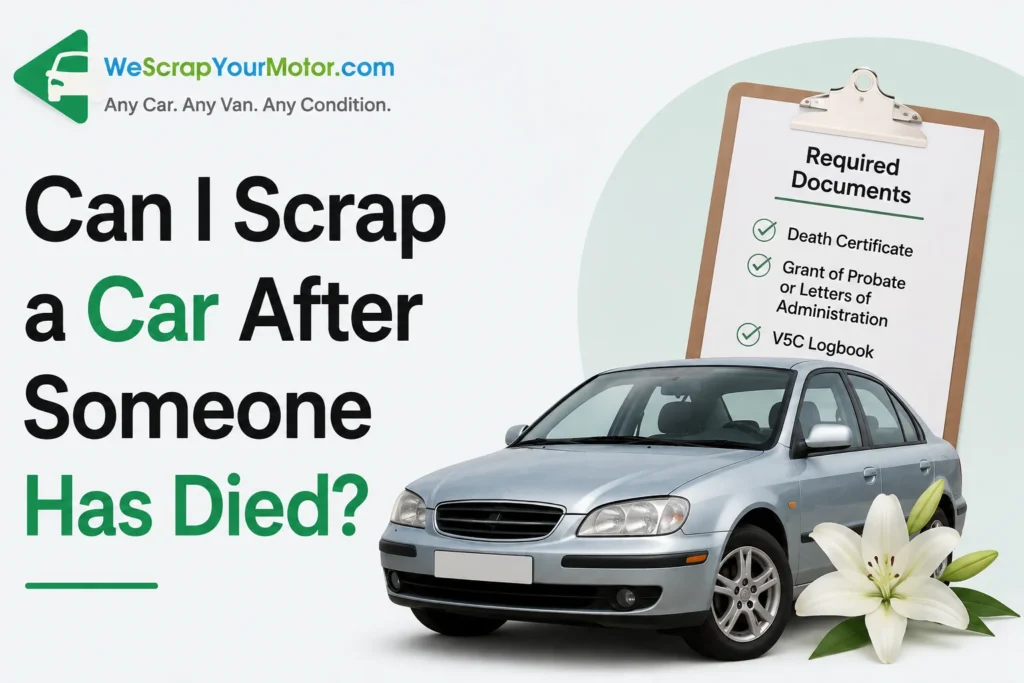
It is usually possible to scrap a car after death, but the person arranging it must have authority to deal with the deceased person’s estate. Establish who may act, check finance and insurance, follow DVLA’s bereavement instructions and use an Authorised Treatment Facility. Keep copies of every document; never sign the deceased person’s name or use an ordinary online process inaccurately.
Work out who has the right to deal with the vehicle
Start with the estate, not the V5C
A vehicle does not become available to any relative simply because its registered keeper has died. It forms part of the person’s estate unless another owner, finance company or insurer has a better claim. The person who may handle it depends on the will, the estate-administration position and the laws that apply.
In England and Wales, the relevant person may be an executor named in a will or, where there is no will, an administrator. Scotland and Northern Ireland use different estate terminology and procedures. A surviving joint owner, attorney or family member may have a role, but that role should not be assumed.
A power of attorney normally ends on the donor’s death. Someone who managed the person’s affairs while they were alive should not continue using that authority as though nothing changed. They may separately become an executor or estate representative, but that is a different legal basis.
If there is disagreement about the estate, uncertainty over ownership or no clear representative, pause the disposal and obtain probate or legal advice. A scrap-car provider cannot decide a family ownership dispute.
Identify whether the car was actually owned outright
Check the deceased person’s records for:
• a purchase invoice or receipt;
• hire-purchase, personal contract purchase or lease documents;
• a recent finance settlement;
• an insurance total-loss claim;
• a company-car or mobility arrangement;
• evidence of joint ownership;
• a private registration retention document;
• a will or letter of wishes mentioning the vehicle.
The V5C records the registered keeper and is not proof of ownership. If the vehicle was leased, the leasing company may require its return. If finance remains, contact the provider for the settlement and disposal instructions. If an insurer took ownership after a claim, the insurer may control the salvage.
Do not spend estate money on recovery or repairs until authority and ownership are clear.
Decide whether scrapping is the right outcome
The estate representative has a duty to deal with assets properly. Before permanently destroying the car, compare realistic options:
• sale as a usable vehicle;
• sale as repairable salvage;
• return to a finance or lease provider;
• transfer to a beneficiary;
• complete scrapping at an ATF.
Record why scrapping was chosen. Useful evidence includes an MOT history, repair estimate, condition photographs and two comparable written valuations. The highest headline offer is not always the best estate outcome if it carries hidden charges or an uncertain treatment route, but the representative should be able to explain the decision.
Once authority is established, the representative can request a written, no-obligation valuation from We Scrap Your Motor and state that the vehicle belongs to an estate. This allows the document requirements to be checked before collection.
Prepare an estate authority pack
The exact documents depend on the estate and the provider. A buyer may reasonably request some combination of:
• the V5C, if available;
• a certified copy or clear evidence of the death certificate;
• the representative’s photographic identity and proof of address;
• the will naming an executor;
• the grant of probate, letters of administration or the equivalent document;
• a solicitor’s letter or other evidence of the representative’s authority;
• ownership, finance and insurance records;
• a signed instruction identifying the vehicle and payment destination.
Ask what is needed and why. Share sensitive documents through a verified process and provide only what is necessary. A death certificate contains personal information and should not be sent to an unknown mobile number merely to obtain an initial quote.
Follow the DVLA and collection process carefully
Step 1: Protect a personalised registration
Check whether the vehicle has a private number plate and whether the estate wishes to retain or transfer it. Apply before destruction. Once the vehicle has been scrapped, it may be too late to recover the registration.
Confirm that the car meets the eligibility rules for retention or transfer. Do not promise a beneficiary that the plate can be kept until DVLA has approved the application.
Step 2: Use DVLA Sensitive Casework instructions
GOV.UK has a specific guide for telling DVLA after someone dies. When a vehicle is sold to a motor trader and the V5C is available, the trader completes the yellow “sell, transfer or part-exchange your vehicle to the motor trade” section. The representative sends that perforated section with a letter to the DVLA Sensitive Casework Team and gives the rest of the V5C to the trader.
The letter should explain:
• the representative’s relationship to the person who died;
• the date of death;
• who should receive any vehicle-tax refund;
• the relevant sale or disposal information.
Follow the current GOV.UK page for the exact documents and address. At the time of this review, the published Sensitive Casework Team address for selling a vehicle is DVLA, Swansea, SA99 1ZZ.
If there is no V5C, the representative still writes to Sensitive Casework. GOV.UK says the letter should include the sale date, relationship, date of death, tax-refund recipient, and buyer’s name and address. The official page explains that a buyer applying for a V5C uses form V62 and pays the current fee. A complete scrapping case may also involve the ATF destruction notification, so ask DVLA and the ATF how the records will be connected.
Do not sign the deceased person’s signature, change the date or use the normal online service as though they were alive. The special route exists to keep the record accurate.
Step 3: Obtain a written estate quotation
Give an honest condition and access description. State whether the car starts, rolls, steers and brakes; whether the keys and V5C are available; and whether parts are missing. Include photographs.
The quote should identify the registration, amount, collection location, included fees, expiry date, permitted reasons for revision, payment method and destination. Payment should go to the estate account or another recipient properly authorised by the representative and accepted by the dealer.
If the representative is arranging collection in Devon, the provider’s scrap car collection in Plymouth page can be used as the location service link while the estate documents are checked separately.
Step 4: Verify the lawful treatment route
An end-of-life vehicle must go to an Authorised Treatment Facility. Ask who is buying the vehicle, who will collect it and which ATF will carry out depollution and destruction. Check the official register for the UK nation in which the facility operates.
Do not rely only on a company number, website badge or review score. Verify the business identity, licence or carrier role and ATF destination. This is especially important when a family is clearing property under time pressure.
Step 5: Prepare the car without removing value or evidence
Remove personal possessions carefully. Check the glovebox, boot, door pockets, under-seat areas and paired infotainment devices. Return documents, photographs or sentimental belongings to the appropriate family or estate file.
Photograph the vehicle before collection. Record mileage, keys and any items removed. Do not remove major components merely to sell them separately unless the representative has assessed the effect on estate value and the environmental work will be done lawfully. GOV.UK notes that an ATF can charge if essential parts such as the engine, gearbox, bodywork or wheels are missing.
Step 6: Control the handover
The authorised representative or named agent should meet the collector. Check the registration, booking reference, collector identity and final price. Obtain a dated receipt naming the buying business and estate representative.
If another family member attends, give them written authority for the limited handover tasks. They should not make new estate decisions at the roadside unless empowered to do so.
Never accept pressure based on the family’s circumstances. If the amount changes without a specific, evidenced difference in vehicle condition, the representative can pause the collection and compare the agreed terms. The information required for an instant scrap car quote can also be used as a pre-collection condition checklist.
Step 7: Secure the final records
For an eligible car or light van that is completely scrapped, the ATF should issue a Certificate of Destruction within seven days. Keep it with:
• the estate authority documents;
• copy of the V5C section and Sensitive Casework letter;
• proof of posting or DVLA acknowledgement;
• the quote and collection receipt;
• vehicle photographs;
• payment evidence;
• finance or insurer clearance.
The CoD proves destruction; the collection receipt proves handover; the DVLA evidence shows the keeper record was addressed. One document does not replace the others.
Handle the difficult variations without guesswork
There is no will
Do not assume the closest relative can immediately dispose of the car. The person entitled to administer an intestate estate depends on the legal rules and may need formal authority. Seek probate guidance before accepting an irreversible transaction.
Probate has not been granted
Some organisations may accept evidence from an executor before a grant, while others require the formal grant or letters of administration, particularly where authority is unclear or value is material. There is no safe universal shortcut. Ask the ATF what it requires and obtain legal advice on the representative’s power at that stage.
The car is on finance
Contact the lender with the death and estate details. Request the settlement or return process in writing. Do not use scrap proceeds first and plan to tell the lender later. The finance provider may own the vehicle or hold rights that prevent disposal.
The car is SORN, untaxed or has no MOT
It can still be collected for lawful scrapping. Do not drive a SORN, untaxed, uninsured or unroadworthy vehicle to the yard. Arrange recovery from private land and describe access accurately.
The V5C cannot be found
Use the specific GOV.UK bereavement instructions. Do not apply in the deceased person’s name or copy a reference from old paperwork without advice. The Sensitive Casework letter and buyer or ATF process should reflect that the V5C is missing.
The vehicle is being left to a beneficiary
Transfer and tax rules apply if the beneficiary will keep or use the vehicle. GOV.UK provides a separate “keeping a vehicle” bereavement page. Do not scrap a car that the will clearly gives to someone without resolving their interest.
Family members disagree
Stop the disposal. Store the vehicle securely and ask the executor, administrator or solicitor to resolve the dispute. A high scrap quote does not give one relative authority over another.
Estate vehicle checklist
Before booking, the representative should be able to answer yes to each point:
1. I can explain my authority to act for the estate.
2. I have checked the will, ownership, finance and insurer position.
3. I have considered sale, salvage and scrap value.
4. I have protected any private registration required.
5. I know which DVLA Sensitive Casework steps apply.
6. I know who will receive the payment.
7. I have verified the buyer, collector and ATF.
8. The condition and collection access are documented.
9. A receipt, DVLA evidence and CoD will be retained.
Final answer
Yes, an authorised estate representative can usually scrap a car after death. The safe sequence is to establish estate authority, confirm ownership and finance, follow DVLA Sensitive Casework instructions, obtain a documented valuation and use an ATF.
Frequently asked questions
Can the deceased person’s spouse scrap the car?
Only if the spouse owns it or has authority to act for the estate. Marriage alone does not settle the estate-administration or ownership question.
Do I need probate to scrap the car?
It depends on the estate, the representative’s authority and the provider’s checks. Some cases may proceed with other evidence; disputed or unclear estates may require a grant. Seek probate advice rather than assuming.
What happens if the V5C is missing?
Follow GOV.UK’s bereavement route and write to DVLA Sensitive Casework with the required sale and relationship details. Ask the ATF what supporting ownership and authority evidence it needs.
Where should the scrap payment go?
Normally to the estate account or another recipient properly authorised by the estate representative. Keep the payment record with the asset-disposal accounts.
Who issues the Certificate of Destruction?
The receiving ATF issues it for an eligible car or light van that is completely scrapped. GOV.UK says it should be provided within seven days.