
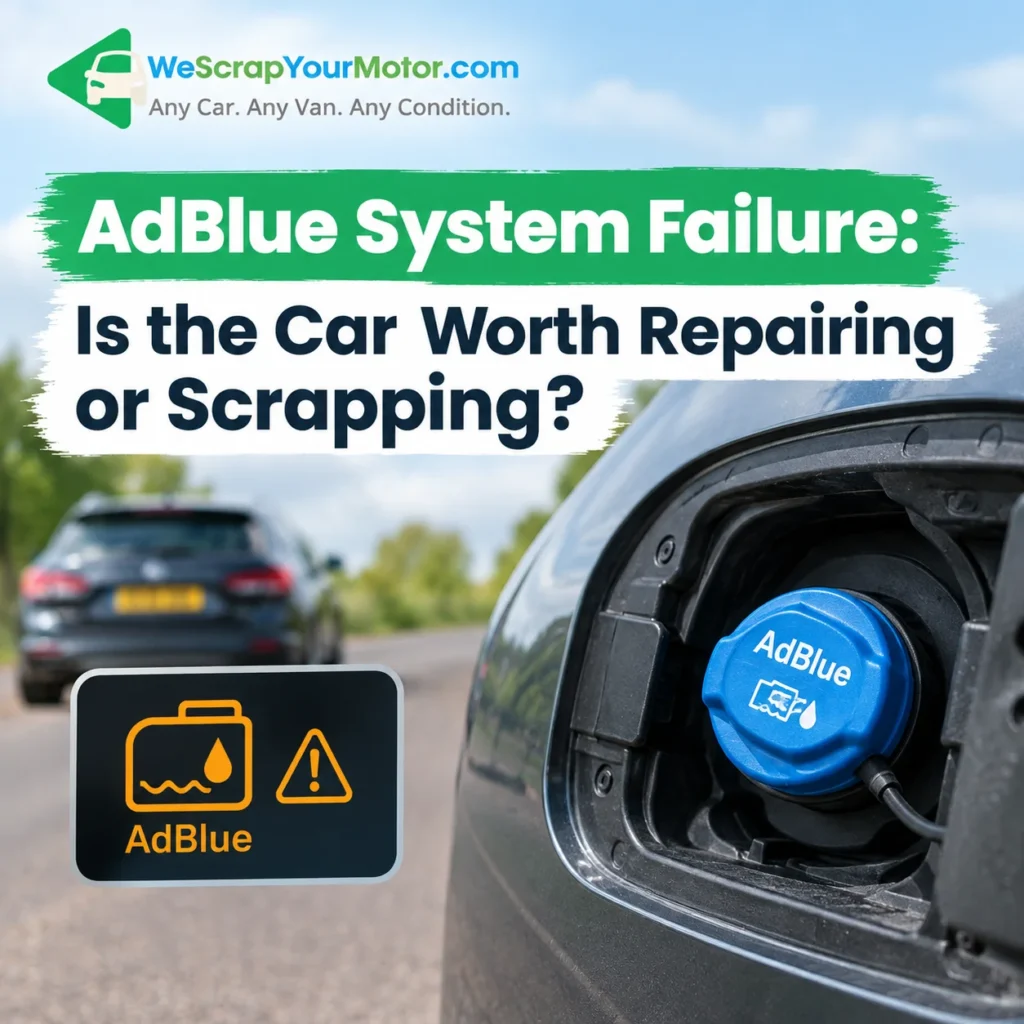
A diesel can appear to drive normally while displaying an emissions warning and a countdown before the engine will no longer restart.
That combination creates urgency, but it does not tell you which component has failed or how much a proper repair should cost.
AdBlue System Failure is not an automatic reason to scrap a car. First distinguish a low-fluid message from a system malfunction, obtain a suitable diagnosis and check whether repair coverage or manufacturer support applies. Then compare the complete cost with the condition and usefulness of the vehicle.
This guide uses a sequence of decision gates. Each gate answers a question that can change whether you repair, sell or dispose of the car.
The aim is to avoid two expensive mistakes: authorising a major assembly before the cause is confirmed, or paying repeatedly for temporary actions that leave the underlying fault unresolved.
Follow the exact vehicle handbook and professional advice. This is not a fluid-system repair or software-bypass tutorial.
What Does The Display Actually Say?
Photograph the message and record its wording.
A low-level warning, system-malfunction message and no-restart countdown describe different conditions.
Do not report only that “the emissions light came on”. The exact information helps a workshop understand the starting point.
AdBlue System Failure is commonly used as an umbrella phrase, but the car may provide more specific detail.
Also note whether the engine warning light is present, whether the message is intermittent and whether it appeared before or after a refill or repair.
Those observations support diagnosis without replacing it.
If the car already will not restart, say that before booking. A working vehicle and an immobilised one need different planning.
The first useful decision is therefore administrative: collect the message, symptoms and timeline so the next business does not have to begin with a vague description.
Is It a Level Warning Or a Malfunction?
AdBlue is used by the selective catalytic reduction system to help control nitrogen-oxide emissions. It is separate from the vehicle’s diesel fuel supply.
A level warning may indicate that the remaining quantity needs attention. A malfunction message may require assessment of system operation.
Ford owner guidance distinguishes these categories and describes starting restrictions associated with specified low-level or fault conditions.
For AdBlue System Failure, this distinction prevents an unnecessary leap from warning to major replacement.
Consult the handbook for the exact vehicle and message.
Do not repeatedly add fluid simply because a warning remains. If the issue is not level, more fluid is not a diagnosis.
Similarly, do not assume a correct refill must immediately resolve every malfunction. Establish which condition the vehicle is reporting before authorising further spending.
Is a Starting Restriction Approaching?
Some vehicles display a remaining distance before a starting restriction applies.
That should not be interpreted as a prediction of sudden mechanical engine destruction at the stated number. However, it still requires prompt planning and assessment.
Tell the workshop about the countdown and ask what to do if the car cannot restart before its appointment.
Do not rely on the remaining distance as permission to delay until the last moment.
For AdBlue System Failure, a starting restriction can turn a planned workshop visit into a recovery booking.
Parts availability, appointment delays and changes in the warning can all affect the timetable.
Do not leave the engine running to evade the restriction or seek an unverified bypass.
The sensible response is to arrange professional advice early and confirm a transport plan if needed. That helps control downtime without concealing the fault.
Has The Failed Function Been Identified?
An SCR system contains more than a fluid tank.
Depending on the vehicle, relevant functions include storage, delivery, dosing, heating, monitoring, wiring and control.
Some parts are integrated into larger assemblies. That can affect the repair route, but it does not remove the need to identify the failed function.
An AdBlue System Failure quote should explain what has been established and why the recommended work addresses it.
If a complete tank assembly is proposed, ask whether the failed function has been confirmed and whether that assembly is the appropriate supported replacement.
If a sensor is recommended, ask which checks support that conclusion.
The customer does not need to diagnose the car. The workshop does need to connect its recommendation to evidence.
A clear explanation can be brief, provided it distinguishes a reported condition from an identified failure.
Are Sensors And Supporting Systems Part Of The Assessment?
Emissions monitoring helps the control system understand how treatment is performing.
HELLA explains the role of NOx sensors in SCR operation and how deviations can affect control and dosing.
This is why a code associated with emissions efficiency should not automatically become a shopping list.
The workshop needs to consider measurements and relevant system checks together.
For AdBlue System Failure, ask whether the quoted replacement follows testing or only the wording of a diagnostic code.
Also ask how the correct operation will be verified afterwards.
A cleared code is not the same as a demonstrated repair outcome.
A legitimate repair may involve manufacturer-specified software or adaptation procedures, but the business should explain their purpose. That differs from simply suppressing a warning while leaving the underlying issue unresolved.
Could Recent Events Explain The Warning?
Prepare a short history.
Include recent refills, previous repairs, conventional-battery issues, software work and any accidental use of the wrong fluid.
If the wrong fluid has been added to a tank, seek professional guidance before attempting to operate or correct the vehicle yourself.
Retain receipts and diagnosis summaries from earlier work.
AdBlue System Failure shortly after a repair raises different questions from a first warning on a vehicle with no related history.
Contact the original repairer and check its terms before paying for duplicate work.
Do not assume the first repair was necessarily incorrect, but do not discard the possibility that a covered recurrence needs assessment.
A clear timeline can make the next investigation more efficient. It also supports a later warranty or consumer discussion if the cause is disputed.
Is Diagnostic Spending Defined?
Ask for a staged investigation rather than open-ended authorisation.
Confirm the initial charge, expected scope and point at which the workshop will request further approval.
A useful findings summary identifies symptoms, established faults, uncertainty and the proposed repair.
For AdBlue System Failure, diagnosis is worth paying for when it changes the decision or prevents unnecessary replacement.
More investigation is not automatically better.
Ask what the next test would establish and how its result affects the repair choice.
A spending limit gives you a point to reassess before costs escalate.
Also ask about storage charges if the car cannot be driven away.
An owner should not discover only after several days that diagnostic approval also led to accumulating storage costs or a commitment to unrelated work.
Does Any Coverage Apply?
Before approving a substantial bill, check relevant warranty terms, previous-repair coverage and manufacturer information.
Use the VIN, service history and diagnosis when contacting the manufacturer or its representative.
Ask about outstanding recalls, applicable campaigns and any discretionary support.
These categories are different. A recall does not mean every similar fault is covered, and goodwill assistance for another owner does not establish your entitlement.
If AdBlue System Failure has been diagnosed, provide the findings where requested and obtain a clear answer.
Avoid assuming either that all support is unavailable or that a particular brand must pay.
If the vehicle was recently bought or repaired, appropriate consumer advice may also be useful.
The point is to establish your actual position before treating the entire quote as an unavoidable personal cost.
Is The Repair Quote Complete?
Request an itemised installed price.
It should identify relevant parts, labour, diagnosis, required associated work and verification. Confirm whether taxes are included.
Ask what is conditional and what requires additional approval.
For AdBlue System Failure, a parts price alone is not enough for comparison.
A proposed assembly may require installation and vehicle-specific procedures. A sensor quote may include further checks or supporting repairs.
Also clarify warranty responsibility.
If you supply a part independently, ask how the workshop handles compatibility or a faulty component. The cheapest purchase route can create divided responsibility.
Compare quotes for the same outcome, not merely the same component name.
A lower amount may exclude important work, while a higher amount may include it. Scope and terms explain whether the difference is meaningful.
Is The Car Otherwise Worth Keeping?
Look beyond the warning.
Review documented corrosion, transmission issues, engine condition, current MOT defects and upcoming maintenance.
A sound vehicle with a single confirmed system fault may be worth repairing. A car with several major problems may not justify the same expenditure.
AdBlue System Failure should be one line in the wider assessment.
Do not assume age or mileage alone determines reliability.
A known older car with good history can be a more understandable proposition than an unfamiliar replacement. Equally, a newer car with repeated unresolved faults can create substantial practical cost.
Use evidence rather than optimism.
Ask which other repairs are immediate and which can be monitored. This avoids both understating the bill and treating every advisory as an urgent replacement.
The decision belongs to the whole vehicle, not only its emissions system.
Are You Keeping It Or Repairing To Sell?
Repairing for continued use and repairing for resale have different break-even points.
If keeping the car, compare the complete repair with the actual cost of acquiring a suitable replacement.
If selling afterwards, compare realistic proceeds after repair and selling costs with current as-is offers.
For AdBlue System Failure, a repair can preserve useful transport without adding enough sale value to justify repair solely for resale.
Our guide to deciding whether to repair or scrap a car covers the wider comparison.
Use realistic sale values rather than the highest asking price.
Separate costs already incurred from additional spending.
You should not approve a poor-value repair merely because diagnosis has already cost money. The relevant question is what the next expenditure is expected to achieve.
What Would The Replacement Really Cost?
Changing cars can involve more than the advertised purchase price.
Inspection, servicing, tyres, transport and immediate maintenance may need to be considered.
A replacement can also carry an unfamiliar history and its own repair risks.
Compare it with the usefulness and condition of the vehicle you already know.
For AdBlue System Failure, neither “repair is cheaper” nor “buy another car” should be accepted without the figures.
A hypothetical example illustrates the method: if a complete repair costs £1,100 and a suitable replacement requires £4,500 plus initial work, repair may deserve consideration on a sound car.
Change the existing car’s condition to include several major defects and the answer may change.
These figures are illustrative arithmetic, not market-price claims. Use actual quotations for your vehicle and realistic alternatives.
Can You Tolerate The Downtime?
A repair may be economically sensible but practically difficult.
Ask about workshop availability, parts lead time, installation and verification.
If a starting restriction has applied, clarify where the vehicle will stay and what transport is needed.
AdBlue System Failure can affect essential travel even when the engine is mechanically intact.
Include recovery, storage and temporary transport separately in your comparison.
Do not assume a one-day labour estimate means the car will be returned tomorrow. Parts and scheduling may extend the calendar time.
Conversely, do not reject a useful repair solely because it takes several days if temporary transport is affordable.
The best choice fits both your finances and transport needs.
Get the expected timetable in writing where practical and ask how the business will communicate delays or additional findings.
Is The Proposed Solution a Genuine Repair?
Repeated top-ups and temporary resets are not a strategy for an unresolved malfunction.
Ask what fault is being corrected and how the operation will be confirmed.
A manufacturer-specified update or procedure may legitimately form part of repair. A delete or bypass does not restore the original system’s intended function.
For AdBlue System Failure, compare genuine repair with an honestly described sale or responsible disposal.
Do not assume a claim about passing an MOT establishes road legality.
DVSA’s inspection guidance addresses emissions-control equipment and applicable defects. A modification needs more scrutiny than whether the dashboard light is absent during one test.
If the vehicle already has unknown modifications, disclose them. Establishing configuration may be part of the assessment.
The useful outcome is appropriate operation, not simply a quieter display.
Is an As-Is Sale Worth Comparing?
A buyer considering repair may value the vehicle differently from a recycler.
That does not guarantee an offer above scrap value, but it is worth distinguishing the routes.
Describe the warning, countdown, diagnosis and previous work accurately.
AdBlue System Failure does not make the rest of the car disappear as an asset, but uncertainty can affect offers.
Ask whether the price is conditional on further inspection and whether collection is included.
Do not remove valuable components before comparing offers for an intact vehicle.
If the car cannot restart, make sure the buyer knows recovery is needed.
A transparent sale can be practical where you do not want to fund repair, even if repair may be viable for another business.
The transaction should reflect the actual condition and intended route.
What If Further Spending Does Not Make Sense?
If the complete repair and wider costs offer poor value, request an accurately described vehicle offer.
Contact We Scrap Your Motor with the registration, warning information, diagnosis and collection location.
Tell the collector whether the car starts, rolls and steers, and disclose access restrictions.
AdBlue System Failure should be part of the quotation description, especially where a starting restriction applies.
Confirm payment, required documents and whether the vehicle is intended for permanent destruction or potential repair.
If it is at a garage, arrange release and clarify charges.
Keep the receipt and complete the applicable keeper-notification process. A disposal decision should end with a documented transfer, not merely removal from the driveway.
Questions Owners Ask Before Choosing
Does The Warning Mean The Engine Has Failed?
Not necessarily. A starting restriction can be associated with the emissions system without mechanical engine destruction. The actual malfunction still needs diagnosis.
Will a Refill Always Fix It?
No. The response depends on whether the issue is fluid level or a system fault. Follow the exact handbook guidance and obtain assessment where needed.
Is a Complete Tank Always Required?
No universal answer applies. System design varies, and integrated assemblies can affect repair options. The proposal should follow diagnosis.
Can I Sell a Car With The Warning?
Potentially. Describe the message and any starting restriction honestly. Confirm the buyer accepts the condition and arrange suitable transport.
Should I Obtain a Second Opinion?
A second opinion can help when the quote is substantial, incomplete or uncertain. Compare findings, scope, warranty and verification.
Can I Wait Until The Countdown Ends?
That risks avoidable immobilisation and recovery. Arrange advice and assessment promptly rather than using the countdown as a postponement plan.
Make The Next Appointment With a Decision-Ready Record
Prepare the exact warning, timeline, refill history, previous invoices, known defects and current location.
Then choose a defined next step: limited diagnosis, a coverage enquiry, a complete repair quote or an as-is offer.
AdBlue System Failure is easier to assess when each option explains its costs and uncertainty.
Repair when the evidence and wider vehicle condition support it. Choose sale or disposal when further spending does not provide useful value.
Either route should be based on confirmed information, clear terms and records. A promise to make a warning disappear is not a substitute for a repair outcome or a transparent transaction.