
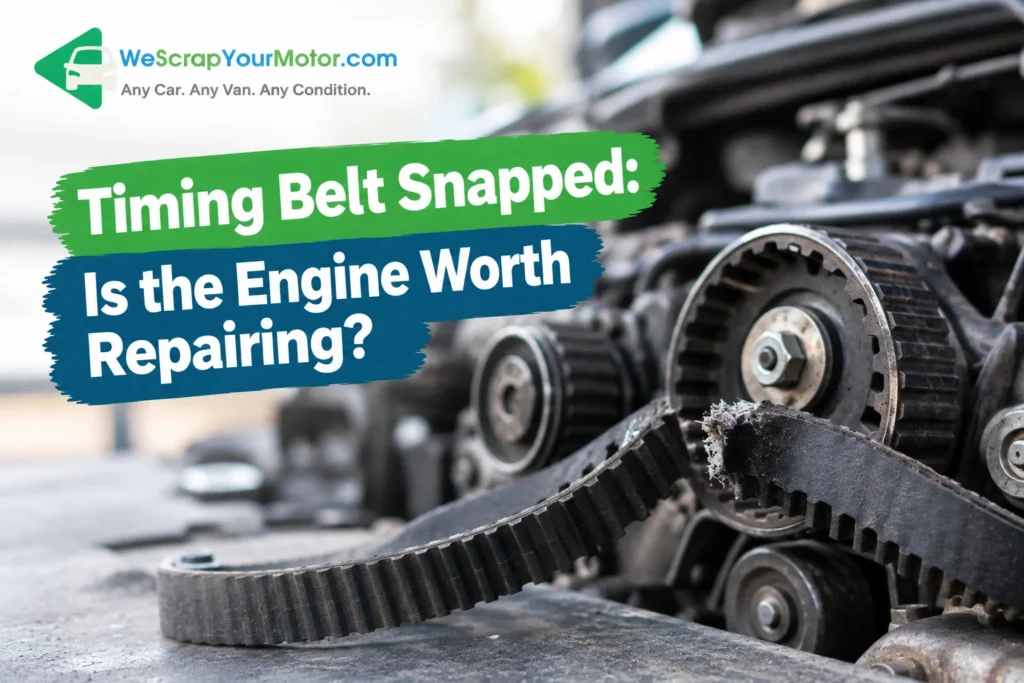
If your timing belt snapped, the engine may be repairable, but the damage must be assessed before a useful financial decision can be made. Engine design, the circumstances of failure, related components and the rest of the vehicle all affect whether repair is worthwhile.
The initial news can sound final: the engine stopped, the car needs recovery and a garage mentions possible internal damage.
However, “possible damage” and a confirmed repair bill are different stages.
A broken belt does not produce an identical result in every engine. Some designs have particular risks of internal contact when timing is lost. Others provide more clearance, although the failure still needs proper assessment.
This article is organised around the evidence needed to authorise repair. It explains how to limit diagnostic spending, compare rebuild and replacement proposals, consider recent-repair records and evaluate an as-is sale.
It is not an engine-repair tutorial. Inspection and repair should follow the exact engine’s requirements and be carried out by competent professionals.
Confirm Which Belt Or System Failed
The timing belt helps synchronise the crankshaft and camshaft so valves operate at the appropriate points in the engine cycle.
It is different from an external auxiliary belt that drives accessories.
Depending on the engine, its system may include tensioners, idlers and other driven components.
If a timing belt snapped, the problem involves loss of the intended timing relationship. That can have substantial consequences.
However, do not establish the diagnosis solely from a loose rubber fragment or a roadside description.
Ask the workshop to confirm the failed system and relevant engine specification.
This protects against confusing an accessory-drive problem with timing failure, or overlooking a timing problem because another belt is visible.
The first reliable piece of evidence is therefore not a guessed repair cost. It is an identification of what failed on this particular engine.
Establish The Engine’s Design
Interference and non-interference designs respond differently to lost timing.
In an interference engine, valves and pistons may occupy overlapping space at different moments when timing is correct. If that relationship is lost, contact may occur.
A free-running design provides more clearance, reducing that particular risk.
Gates explains this distinction and the damage risk associated with lost synchronisation in interference engines.
When a timing belt snapped, ask the workshop to identify the exact engine rather than relying on the car’s model name alone.
Different years and variants can use different engines.
Do not use an old online list as the only basis for deciding that the engine must be ruined or cannot be damaged.
VIN information, engine details and appropriate technical data provide a stronger foundation for the assessment.
Record The Failure Timeline
Write down what happened while it is still clear.
Was there unusual noise before the engine stopped? Did overheating or warning lights appear? Has recent repair work taken place?
Record approximate mileage and the last documented timing-system replacement.
Also mention previous oil leaks, cooling problems or related workshop recommendations.
A timing belt snapped soon after replacement raises different questions from failure on a vehicle with unknown service history.
Keep the account factual.
“The engine stopped during normal driving and did not restart” is useful. “Every valve must be damaged” is a conclusion that still needs evidence.
Tell the workshop about any starting attempts already made.
The history supports diagnosis and may assist a warranty discussion. It should not be used to decide the cause without appropriate inspection.
Avoid Using Starting Attempts As Diagnosis
Once timing-system failure is suspected, repeated starting attempts are not a useful owner-level test.
The workshop should decide the appropriate inspection process.
If the timing belt snapped while driving, arrange safe professional recovery rather than trying to continue.
Tell the operator whether the car rolls, steers and has accessible keys. A non-running vehicle can still have movement limitations.
Do not authorise installation of a new belt merely to see whether the engine will start.
That approach can overlook damage and the cause of failure.
The useful first expenditure is assessment with a defined scope.
An owner does not need to prove internal damage by experimenting with the ignition. The aim is to preserve a clear investigation and obtain evidence sufficient to compare repair with sale or disposal.
Distinguish Preliminary Findings From Confirmed Damage
A workshop may confirm timing failure before it can establish the full internal condition.
That is reasonable if the uncertainty is explained.
Ask what has already been checked and which additional stage is proposed.
Will it require dismantling? What will that cost? What findings would change the recommendation?
For a timing belt snapped decision, useful evidence includes the failed components, extent of established damage, repair feasibility and unresolved uncertainty.
Do not expect every hidden component to be guaranteed at the first appointment.
Do expect the garage to distinguish an initial opinion from a final repair proposal.
Request a written summary or photographs where practical.
Those records can help with a second opinion, a discussion with a previous repairer or an accurately described as-is offer.
Define The Investigation Budget
Engine diagnosis can become expensive.
Agree an initial scope, spending limit and point at which further approval is needed.
Ask about storage, dismantling, reassembly and release charges.
If you decide not to proceed, can the car be collected in its current condition? Will removed components accompany it?
When a timing belt snapped, staged assessment helps prevent a diagnostic appointment becoming an open-ended rebuild authorisation.
A practical arrangement may separate initial inspection, deeper investigation and repair approval.
Each stage should explain what information it is expected to provide.
If another inspection would not change the decision because the whole vehicle is already uneconomical to repair, it may not offer useful value.
Control spending by asking what the next piece of evidence will enable you to choose.
Identify The Cause Beyond The Broken Belt
A complete repair needs to address why the timing system failed.
The belt may not be the only relevant component.
Tensioners, idlers and system conditions require consideration. Gates notes the importance of associated timing components in preventing premature failure.
If your timing belt snapped, ask whether the quote corrects the cause and includes the components required for that engine.
Depending on design, other driven parts may be relevant.
Do not insist every engine uses the same kit or replacement list.
The workshop should connect its findings to the proposed scope.
A new belt fitted over an unresolved underlying problem is not a convincing complete repair.
The owner’s question is simple: “What failed first, and what work prevents that condition from remaining after the engine is restored?”
Understand The Repair Route Being Proposed
“Engine repair” can cover very different jobs.
One proposal may involve limited work. Another may require cylinder-head restoration, a broader rebuild or replacement.
| Proposed Route | What You Need To Establish |
| Limited repair | Why damage is considered limited |
| Cylinder-head repair | Inspection, machining and replacement scope |
| Engine rebuild | Renewed parts, reused parts and exclusions |
| Used engine | Compatibility, history and warranty |
| Remanufactured engine | Specification and installed terms |
| As-is sale | Current-condition assumptions and collection |
When a timing belt snapped, compare complete outcomes rather than labels.
Ask what evidence supports the selected route and what alternatives were considered.
A rebuild and a used-engine installation may both return the car to service, but their uncertainty and terms can differ.
The cheapest headline price is not enough to establish the best value.
Compare Complete Installed Prices
An engine’s advertised purchase price is not the full cost of putting it into your car.
Removal, installation, timing-system work, fluids, associated parts and final checks may need to be included.
Ask whether taxes and diagnosis are part of the total.
If the timing belt snapped, a useful quotation should state what is covered and which discoveries could require further approval.
Also clarify responsibility.
Does the workshop supply the replacement engine? If you purchase it, who deals with incompatibility or a faulty unit?
A divided arrangement can make a lower initial price less attractive.
Compare quotes for the same installed outcome.
One business may include preparation and warranty support that another excludes. Reading the scope prevents a misleading comparison based solely on the largest number at the bottom.
Assess The Uncertainty Of a Used Engine
A used engine may be viable, but its history and condition matter.
Compatibility should be established for the exact vehicle and engine specification.
Ask what evidence supports claimed mileage and condition, and read the warranty terms.
A used unit does not automatically arrive with documented maintenance or renewed timing components.
If your timing belt snapped and the proposed replacement uses a belt-driven system, ask how its timing maintenance will be handled before installation.
Also clarify which accessories or components are included.
An engine listed online may not be supplied in the configuration needed for a complete installation.
The useful comparison is between a defined outcome and its total uncertainty.
A low purchase price does not eliminate the possibility of extra labour, incompatible parts or a later warranty disagreement.
Inspect The Wider Vehicle Condition
A restored engine does not repair corrosion, transmission trouble or worn running gear.
Review the latest MOT findings, service history and current recommendations.
Ask which issues are urgent and which need monitoring.
When a timing belt snapped, the shock can focus all attention on the engine. The financial decision still belongs to the whole car.
A vehicle with good body condition, useful remaining service life and a clear repair proposal may deserve saving.
A car with several documented major defects may not justify the same expenditure.
Do not invent future failures solely because the car is old.
Equally, do not ignore existing faults because you recently spent money on tyres or brakes.
Current conditions and additional costs should drive the comparison, rather than the desire to recover past expenditure.
Decide Whether You Are Keeping Or Selling
Repair-to-keep and repair-to-sell use different calculations.
If keeping the car, compare the complete repair with obtaining a suitable replacement and its likely immediate costs.
If selling after repair, compare realistic proceeds after repair and selling expenses with current as-is offers.
A timing belt snapped does not create a universal percentage threshold.
A repair may preserve useful transport without adding enough sale value to make repairing solely for resale attractive.
Use realistic values for the actual condition.
The highest asking price on an advertisement is not guaranteed proceeds.
Separate money already spent from the additional spending still required.
A diagnostic invoice should not force repair approval. The relevant question is whether the next expenditure provides a sensible outcome compared with the options available today.
Work Through a Financial Example
Consider a hypothetical car with a complete repair quote of £2,300.
A suitable replacement would cost £5,200 before initial maintenance, and an as-is buyer offers £800.
If the existing car is otherwise sound and the repair terms are clear, keeping it may deserve consideration.
Now add £1,700 of documented additional work and significant reliability uncertainty. The comparison becomes less favourable.
These are illustrative figures, not claims about current UK repair prices.
The purpose is to organise the timing belt snapped decision around complete alternatives.
Use your own quotations, inspection findings and replacement costs.
Also consider how long you need the vehicle and whether the repair timescale fits.
A written comparison helps prevent the first frightening bill from becoming the only information influencing your choice.
Check Recent-Repair Records
If the timing system was replaced recently, gather the invoice, date, mileage and terms.
Contact the repairer promptly and explain the failure.
Do not assume the event proves negligence, and do not assume every later charge is automatically covered.
The cause needs assessment.
When a timing belt snapped after recent work, ask the original business how it wants to inspect the situation and confirm the arrangement in writing.
Preserve relevant documents and discuss evidence before authorising extensive dismantling elsewhere.
If the car was recently purchased, suitable consumer advice may also be useful.
A technical diagnosis provides a stronger basis than accusations or guesses.
The records help establish what work was performed, what terms applied and which support or responsibility may be relevant to the actual failure.
Compare Honest As-Is Offers
A non-running car may interest a salvage buyer, repair business or appropriate recycling operator.
Describe the timing failure and state what has been established about damage.
If the engine is partly dismantled, disclose that and identify missing components.
A complete-car quote should not be assumed to apply after major parts have been removed.
Our guide to scrapping a car with engine failure covers the disposal side of the problem.
If your timing belt snapped, do not advertise “just needs a belt” unless a competent assessment supports it.
A buyer can consider uncertainty, but it needs an honest description.
Clear wording reduces the risk of a rejected collection or changed offer and allows you to compare genuine options for the vehicle’s current state.
Confirm The Cost Of Waiting
A vehicle left at a garage can generate costs while you decide.
Ask about storage, release and the time allowed to arrange collection.
Also consider temporary transport and the practical effect of repair lead time.
When a timing belt snapped, an otherwise sensible repair may still be difficult if parts or workshop availability cause prolonged downtime.
Get a realistic calendar estimate rather than relying only on quoted labour hours.
If you decide against repair, arrange transfer promptly once charges and ownership are clear.
Waiting does not improve the evidence unless a specific assessment is underway.
The decision should have a defined next step and date.
This helps control the total cost and prevents indecision from becoming another substantial line in the eventual repair or disposal calculation.
Questions Owners Ask About Broken Timing Belts
Does Every Broken Timing Belt Destroy The Engine?
No. Engine design and failure circumstances matter. Interference engines have particular risks, but the actual condition needs assessment.
Can a Belt Replacement Be Enough?
Possibly in some circumstances, but it should follow appropriate inspection and correction of the cause. A belt-only assumption can overlook damage.
Is a Replacement Engine Always Better Than a Rebuild?
No. Compare compatibility, scope, total cost, warranty and uncertainty. The rest of the vehicle also matters.
Can I Sell Before Full Diagnosis?
Potentially. Describe the timing failure and uncertainty accurately. A buyer may account for unknown damage in its offer.
Does Low Mileage Rule Out Belt Failure?
No. Maintenance requirements and conditions cannot be reduced to mileage alone. Use the manufacturer’s current guidance for the exact engine.
Should I Repair Because The Car Has New Tyres?
New tyres improve its condition but do not make engine repair automatically worthwhile. Compare the additional costs and choices available now.
Authorise Repair Only When The Proposal Is Clear
Before approving major engine work, request the findings, scope, total price, uncertainty and warranty in writing.
Ask what caused the failure, what damage is established and how the completed repair will be checked.
If the proposal does not offer useful value, request an accurately described offer from We Scrap Your Motor.
For local collection, see Scrap My Car in Salisbury and explain non-running condition, access and any dismantling.
If your timing belt snapped, the best decision is the one supported by evidence and a complete comparison.
A properly scoped repair can preserve a useful car. A transparent sale or disposal can prevent further uneconomical spending.
Either outcome should be agreed clearly, with records showing what was authorised or transferred.