
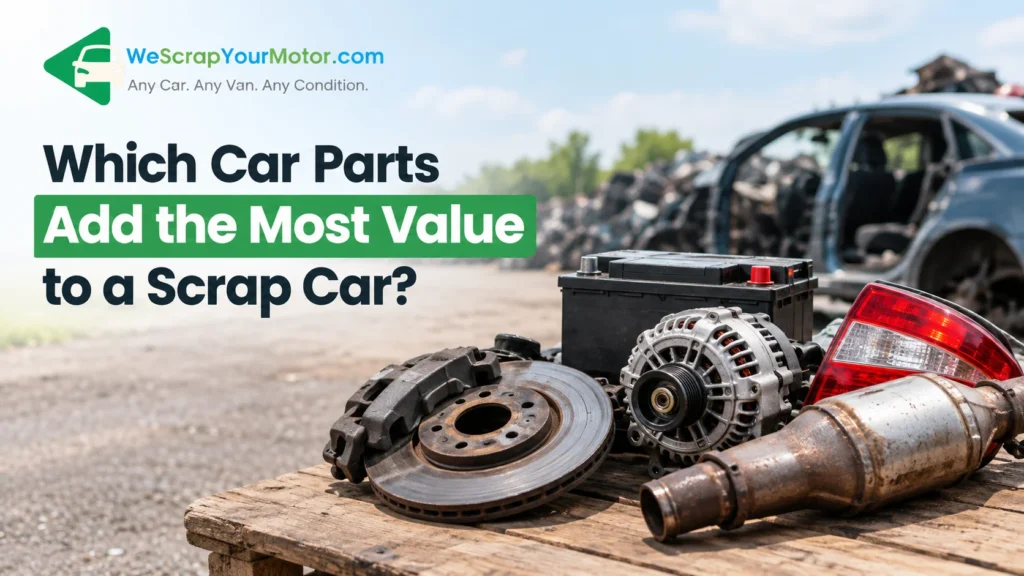
The most valuable parts in a scrap car are not necessarily the parts that cost the most when the vehicle was new. At the end of a vehicle’s life, value depends on whether a component can be reused, dismantled for materials or efficiently recycled.
Catalytic converters, engines, gearboxes, alloy wheels, batteries and certain electronic or body components can all influence the recoverable value of a vehicle.
However, motorists should understand an important distinction.
The most valuable component to a recycler is not necessarily a component you should remove before selling your scrap vehicle.
Removing valuable parts can reduce the quotation for the remaining car.
What Are the Most Valuable Parts in a Scrap Car?
Depending on the vehicle, the most valuable parts in a scrap car can include:
| Component | Why It Can Have Value |
| Catalytic converter | Contains recoverable materials and is identified by the Environment Agency as a higher-value item |
| Engine | Large metal component; some units may have reuse potential |
| Gearbox | Material and possible reuse value |
| Alloy wheels | Aluminium content and possible reuse |
| Battery | Recyclable materials |
| Electronics | Certain usable modules can have parts value |
| Body panels | Potential reuse when undamaged |
| Doors and mirrors | Potential second-hand demand |
| Starter motor/alternator | Recoverable metals and possible reuse |
| Complete vehicle shell | Large quantity of recoverable metal |
There is no fixed ranking applicable to every car because vehicles differ enormously.
Why the Catalytic Converter Matters
When discussing the most valuable parts in a scrap car, the catalytic converter deserves particular attention.
The Environment Agency describes catalytic converters as one of the higher-value items on an end-of-life vehicle and notes that they are removed during dismantling in preparation for recycling.
Catalytic converters are part of a vehicle’s exhaust emissions system.
Their recoverable value varies by converter, vehicle and market conditions. Some cars also use more than one emissions-treatment component.
Therefore, online claims that “every catalytic converter is worth £X” should be treated cautiously.
Your registration and exact vehicle specification are much more useful.
Is the Engine Valuable?
An engine is one of the largest and most material-intensive components in a conventional car.
Its value can come from two directions.
First, the engine contains recoverable metal.
Second, depending on the vehicle, condition and recycler, a usable engine may potentially have value as a replacement component.
A seized engine will obviously have different reuse potential from a tested working engine.
But even an engine that no longer runs contains recyclable material.
If your car has major engine damage, you can still request a quote through We Scrap Your Motor rather than assuming the whole vehicle is worthless.
Does the Gearbox Add Value?
The gearbox can also be an important component.
Like an engine, it contains metal and may have reuse potential if it remains serviceable.
Automatic transmissions can be complex and expensive to repair or replace, while manual gearboxes can also develop failures that make an older vehicle uneconomical to keep.
If the gearbox is missing completely, however, the vehicle is less complete than an equivalent car containing all of its major components.
That may be reflected in the quotation.
Are Alloy Wheels Valuable on a Scrap Car?
Alloy wheels can contribute value because they are commonly made primarily from aluminium alloys.
They may also have reuse potential when they remain in acceptable condition.
But there is another practical consideration: collection.
A car that still has four rolling wheels is generally easier to recover than a shell sitting on blocks.
Before removing wheels, ask how doing so would change your vehicle quote and whether the collector can still recover it from its location.
Does the Battery Have Scrap Value?
Vehicle batteries contain recoverable materials, but they also require appropriate handling.
Government ELV guidance requires batteries to be removed as part of proper vehicle depollution, and Environment Agency guidance states that batteries must be removed or disconnected as soon as practicable after an ELV arrives and before stockpiling.
This illustrates why end-of-life vehicles need professional treatment.
The most valuable parts in a scrap car are not simply household items that can all be discarded independently without considering environmental rules.
What About Electric and Hybrid Batteries?
Electric and hybrid vehicles are different from conventional petrol and diesel cars.
Their high-voltage battery systems require specialist knowledge and appropriate processing.
The presence of a traction battery fundamentally changes how the vehicle must be handled and should be disclosed when arranging collection.
Never treat a high-voltage EV battery as an ordinary 12-volt car battery.
Are Car Electronics Valuable?
Modern vehicles contain increasing amounts of electronic equipment.
Depending on the model and condition, reusable components may include:
- infotainment equipment
- displays
- control modules
- sensors
- lighting units
- electric window motors
- alternators
- starter motors
Whether these components add meaningful value depends on demand, condition and the dismantler.
A rare module with strong second-hand demand may have more reuse potential than an extremely common part with little demand.
Are Doors and Body Panels Worth Anything?
Potentially.
A clean, undamaged door, bonnet, boot lid, wing, bumper or mirror may have second-hand parts value.
But this is highly dependent on:
- vehicle model
- age
- colour
- condition
- demand
- storage costs
- dismantling labour
A badly rusted panel is unlikely to have the same reuse potential as a clean original component.
For many end-of-life vehicles, material recovery may be more practical than trying to resell every individual panel.
Why Vehicle Completeness Matters
Here is where owners sometimes make a mistake.
After researching the most valuable parts in a scrap car, they begin removing everything that appears valuable.
The remaining vehicle might then have:
- no wheels
- no engine
- no gearbox
- no battery
- no catalytic converter
- missing body panels
That changes the vehicle being quoted.
A complete 1,400 kg car is not equivalent to a stripped shell.
Before dismantling anything, obtain a quotation for the complete car.
Should You Sell the Parts Separately?
Sometimes selling parts individually can generate more gross revenue.
But gross revenue is not the same as profit.
Consider the costs involved:
- Time: Parts must be removed, photographed, advertised and sold.
- Tools: Proper dismantling may require specialist equipment.
- Storage: Engines, wheels, doors and gearboxes take up significant space.
- Unsold inventory: There is no guarantee every part will sell.
- Collection: A stripped shell may become harder to move.
- Reduced vehicle quote: Removing components can reduce the amount offered for the remaining car.
For many owners, selling the complete vehicle is significantly simpler.
Which Metals in a Car Are Valuable?
The most valuable parts in a scrap car are only one part of the recycling equation. The materials throughout the vehicle also matter.
Cars can contain:
- Steel: Used extensively in structural components.
- Aluminium: Used in wheels, engines, body structures and other components depending on the model.
- Copper: Found in wiring, motors and electrical systems.
- Other metals: Used in smaller quantities in specialised components.
Vehicle design has become increasingly complex, so the material composition differs between models and generations.
Why Weight Still Matters
Imagine two end-of-life vehicles.
Vehicle A weighs approximately 950 kg.
Vehicle B weighs approximately 1,700 kg.
Assuming similar circumstances, Vehicle B provides considerably more total material to process.
This is why large saloons, SUVs and vans may receive higher quotations than very small city cars.
It does not mean that every heavier vehicle will always be worth more. It means weight provides an important starting point.
Our guide to scrap car prices per ton explains why vehicle weight and market conditions matter.
What Must an Authorised Treatment Facility Remove?
A scrap car contains hazardous liquids and components and cannot simply be crushed immediately.
Government guidance says the depollution process includes removing or dealing appropriately with batteries, fuel, wheels and tyres, coolant, antifreeze, brake fluid, air-conditioning gas, oils, filters and specified hazardous components.
This process protects both people and the environment.
After depollution, further dismantling and material recovery can take place.
Why Reuse Can Be Better Than Immediate Material Recycling
Suppose a functioning alternator is removed from an end-of-life vehicle.
If it can safely and economically be reused, its useful life may continue.
This can avoid the need to manufacture an immediate replacement.
Government ELV policy encourages reuse, recycling and recovery, rather than treating an entire vehicle as undifferentiated waste.
That is why a modern dismantling operation can involve much more than crushing a car.
What Happens to the Remaining Shell?
Once reusable parts and required materials have been removed and the vehicle has been appropriately depolluted, the remaining structure can move through further treatment.
Metals can be separated and returned to material supply chains.
Other materials may also be recovered where technically and economically viable.
Environment Agency guidance requires permitted facilities to optimise reuse, recycling or other recovery and to properly manage residues.
Does a Missing Catalytic Converter Reduce the Quote?
It can.
Because catalytic converters can be higher-value components, a car without its original converter is different from a complete equivalent.
Never hide missing components when requesting a quotation.
Describe the vehicle accurately so the price is based on its actual condition.
Does a Missing Engine Reduce Scrap Value?
Potentially, yes.
Removing an engine removes a substantial component and a considerable amount of material.
The remaining shell also differs from the specification associated with the registration.
If your car has already been partially dismantled, tell the buyer exactly what remains.
What If the Car Has No Wheels?
It may still be possible to collect a vehicle without wheels, but recovery can become more complicated.
Equipment and access requirements can differ.
Again, disclose the condition before the collector arrives.
For motorists in the region, Scrap My Car in Kent provides a route to request a location-specific quote.
How to Protect the Value of Your Scrap Car
If you want to preserve as much value as reasonably possible, follow a straightforward principle:
Keep the vehicle complete until you have compared the complete-car quote against your alternatives.
Do not automatically remove components because an online article describes them as valuable.
Your particular component may not have the resale value you expect, while its removal may reduce the complete vehicle quotation.
FAQs About Valuable Scrap Car Parts
What Is Usually One of the Highest-Value Parts of a Scrap Car?
Catalytic converters are specifically identified by Environment Agency guidance as higher-value vehicle items, although actual values vary by vehicle and unit.
Is an Engine Worth Money If It Is Broken?
A broken engine still contains recyclable material, although its reuse value can be substantially lower than a functioning unit.
Are Alloy Wheels Worth More Than Steel Wheels?
Aluminium alloy wheels can have material and potential reuse value, but the exact effect on the complete car quote varies.
Should I Remove the Catalytic Converter Before Scrapping My Car?
Do not assume this will leave you financially better off. Ask for the value of the complete vehicle first and compare it against any legitimate alternative.
Is a Car Worth Less Without an Engine?
It can be because a major component and significant amount of material are missing.
Can a Car Be Scrapped If Parts Are Missing?
Yes, incomplete vehicles may still be accepted, but missing components can affect collection arrangements and valuation.
Value the Complete Car Before Removing Its Best Parts
Understanding the most valuable parts in a scrap car is useful because it explains why two apparently similar end-of-life vehicles can receive different quotations.
Catalytic converters, engines, gearboxes, wheels, batteries, electronics and reusable body components can all contribute to recoverable value. But the complete vehicle also has value as an integrated collection of recyclable materials.
Before dismantling anything, find out what the complete vehicle is worth. In many cases, that is the simplest way to avoid turning a straightforward scrap collection into a time-consuming parts-selling project.