
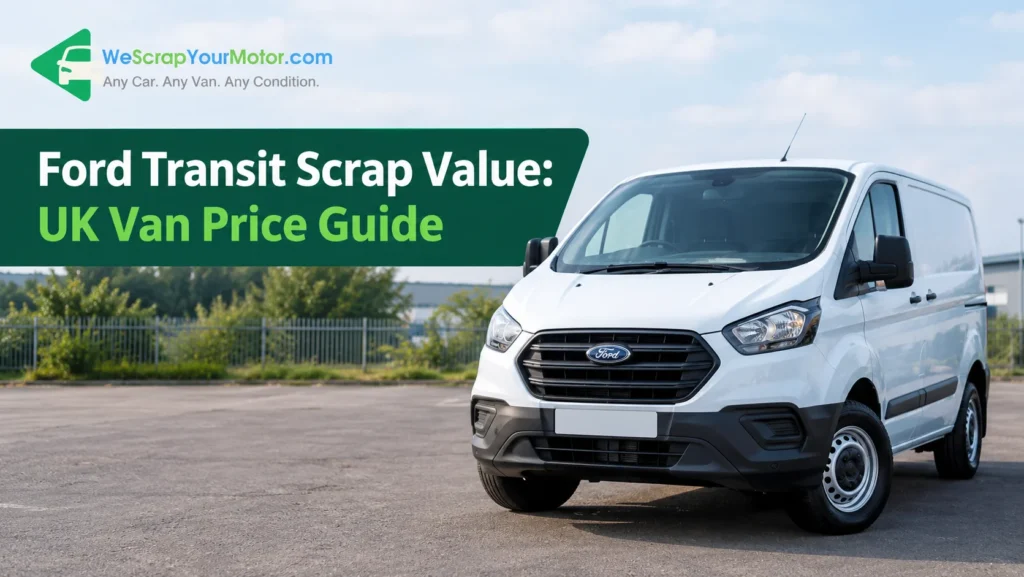
A Transit can be an essential working vehicle one month and an expensive problem the next. An MOT failure, engine fault or collision may leave you deciding whether to repair it, sell it as a damaged van or arrange collection for scrap. Before accepting an offer, you need to know what the buyer is pricing and whether the quote reflects the Transit’s real condition.
There is no trustworthy single price for every Ford Transit. The name covers vans with different sizes, bodies and configurations, while individual vehicles vary in completeness and collection requirements. This guide shows you how to obtain a useful quote, compare your options and handle the paperwork if the van is scrapped.
For a vehicle-specific offer, start at Scrap My Car UK with your registration, collection postcode and a description of the van. An accurate quote is more useful than a broad online price range that does not account for your vehicle.
The Short Answer: What Is a Transit Worth?
Ford Transit scrap value is the amount a buyer will offer for a particular van in its current condition, with collection terms taken into account. It is not a fixed amount attached to the Transit badge.
A complete van that rolls freely and is parked where a recovery vehicle can reach may be assessed differently from one with its engine removed or its wheels missing. A running van may also have a viable route as a used or repairable vehicle. That route should be compared with a scrap offer before you decide.
If you need an answer today, request written quotes using the same description for every buyer. Ask each one:
- How much will I receive after any collection costs?
- Is the offer for the van in the condition I described?
- What could cause the amount to change at collection?
- When and how will payment be made?
- Where will the vehicle go if it is being scrapped?
The resulting figures are meaningful because they relate to your Transit on a particular date. An undated “average scrap price” cannot tell you what a buyer will pay for a van with your faults, body type and postcode.
Identify the Transit Before Comparing Offers
“Ford Transit” is a useful starting point, but buyers need to identify the actual vehicle. Check the registration and V5C, then describe the body and any conversion or equipment that changes the van’s condition or collection needs.
For example, a standard panel van is not the same collection job as a van fitted with a specialised body. A vehicle used as a camper, workshop or delivery van may contain additions that the buyer needs to know about. Do not assume that fittings automatically increase the scrap offer. Some may have separate resale potential, while others may complicate collection or processing.
Tell the buyer whether the van is a Transit, Transit Custom, Transit Connect or another related model. Owners sometimes shorten all of these names to “Transit,” even though they are different vehicles. Supplying the registration reduces that confusion.
Also check the vehicle’s recorded maximum authorised mass. Rules on end-of-life vehicles and certificates of destruction distinguish light vans from other vehicle types. GOV.UK describes the relevant end-of-life vehicle framework as covering small vans of up to 3.5 tonnes, so do not assume the paperwork for every large commercial vehicle is identical.
Build an Accurate Quote From Five Facts
Think of a scrap quote as the result of five pieces of information. If one is wrong or missing, the buyer may need to revise the offer.
1. The Van’s Identity
Provide the registration, model and body description. If the registration does not reflect a significant conversion, explain the conversion separately. Mention whether the van has an unusually long, high or specialised body where that affects access or loading.
The purpose is accuracy. It is not necessary to guess the van’s material weight from a photograph or use a weight listed for a different Transit.
2. Its Mechanical State
“Non-runner” is too vague for collection planning. Say whether the engine starts, whether the van can move under its own power, and whether it rolls and steers when pushed or recovered.
If a garage has identified an engine, gearbox or other fault, share the diagnosis. If you do not know the cause, describe the symptoms instead: for example, “engine turns over but will not start” or “vehicle starts but cannot select a gear.” Avoid presenting an unconfirmed diagnosis as fact.
A van that does not drive may still be collectable. The important question is what equipment and access the collector will need.
3. Its Completeness
List any missing major parts. An offer made for a complete van may change if the buyer later discovers that the engine, gearbox, wheels, battery or emissions equipment has been removed.
If you have dismantled part of the vehicle during a repair, tell the buyer what remains and whether detached components are included. Send photographs when the description alone might be unclear.
Do not remove parts solely because you assume you will earn more by selling them separately. First compare the likely proceeds, your time and the effect on the whole-vehicle quote. A less complete van can also become harder to collect.
4. Its Location and Access
The collection postcode matters, but the precise parking position matters too. Tell the buyer whether the Transit is on a driveway, at a garage, in a depot or on a road. Describe gates, low entrances, narrow access and other vehicles that block the route.
This is especially important for a larger van. Confirm whether there is enough room for the recovery vehicle to approach and load it. If the Transit has flat tyres, seized brakes or no wheels, say so at the quotation stage.
A quote that accounts for collection is more useful than a headline amount that may change when access problems become apparent.
5. Its Intended Route
Ask whether the buyer is purchasing the Transit for scrap, repair or another permitted route. The distinction affects your expectations about disposal paperwork.
GOV.UK says an authorised treatment facility issues a Certificate of Destruction for a car or light van that has been completely scrapped. It also says you will not receive that certificate if the facility decides to repair and sell the vehicle. Establish what transaction is being proposed instead of assuming that every collected van will produce the same certificate.
Three Transit Situations and What to Check
The decision to scrap often starts with a specific event. The examples below are decision frameworks, not quoted prices or claims about an actual customer’s vehicle.
The MOT Failure
Imagine that your working Transit has failed its MOT. Read the failure report before requesting a scrap quote. Separate items that a garage can price confidently from faults needing further inspection. Ask for a written estimate and consider other maintenance the van is likely to need.
Then compare the total likely repair cost with what the van could reasonably be worth after repair and what a buyer offers for it now. A relatively small repair may make scrapping premature. Several expensive items together may change the calculation.
If you request collection, tell the buyer that the van has failed its MOT and whether it can move safely. Do not drive an unsafe vehicle to a scrapyard simply to avoid a pickup charge.
The Engine Fault
An engine warning, loss of power or failure to start does not identify a repair cost by itself. Get a diagnosis if it could change your decision. If a repair is quoted, ask whether it addresses the known problem fully and whether other substantial work is required.
When requesting Ford Transit scrap value quotes, give buyers the facts you have: the last time the engine ran, what happens when you try to start it, and any garage findings. “Needs a new engine” should only appear in your description if that has actually been established.
A damaged van might also attract interest from a buyer intending to repair it. Compare the net amount and the paperwork for each route. Do not treat an unconfirmed advertised price as money you have already been offered.
The Accident-Damaged Van
If an insurer is handling a claim, confirm ownership and disposal rights before arranging collection. An insurance settlement can affect who is entitled to the vehicle. Follow the insurer’s instructions and retain the relevant documents.
For an accident-damaged Transit outside an active claim, photograph the damage and disclose whether it affects steering, wheels or loading. Damage that appears limited from the front may still change what equipment is required for recovery.
Do not rely on “accident damaged” as the full description. A buyer needs to know whether the van is complete, accessible and able to roll.
When Repair or Resale May Beat Scrap
A quote provides a baseline, not necessarily the best route. Work through the available choices before committing the van to destruction.
- Repair may make sense when the fault is understood, the estimate is reliable and the van will remain useful after the work. Consider downtime as well as the bill. For a business, an extended period without a vehicle can carry costs that a repair estimate does not show.
- Selling as a faulty van may be an option if you can describe its condition accurately and find a buyer. Allow for enquiries, inspections and the possibility that a proposed sale falls through. If the van cannot be driven, agree how it will be moved.
- Scrapping may be the practical choice when repair costs are hard to justify, the Transit has several serious issues, or you need to clear it from a site. For a closer look at the mechanical decision, read Should I Scrap a Car With Engine Failure? The article’s title says “car,” but the comparison between repair cost and residual value can help frame a van decision too.
Use figures you can support. A useful comparison is:
| Route | Amount to Establish | Other Factors |
| Repair and keep | Written repair estimate | Downtime and other expected work |
| Repair and sell | Repair cost and realistic sale price | Time and uncertainty |
| Sell as faulty | Actual buyer offer | Honest disclosure and collection |
| Scrap | Confirmed net quote | Collection and disposal paperwork |
If you own several vehicles, avoid making the decision solely on what you paid for the Transit years ago. That money has already been spent. Compare the costs and returns from today onward.
Why Two Buyers Might Quote Different Amounts
Different offers do not automatically mean one buyer is wrong. Buyers may have different collection coverage, processing arrangements and demand for a vehicle or its components. They may also be pricing different assumptions without making those assumptions obvious.
Ask both buyers to confirm the details on which they based their offers. One quote may assume a complete van on an accessible driveway; another may account for its missing gearbox and difficult location. You cannot compare the figures fairly until the assumptions match.
Check the date and duration of each offer. A figure quoted previously may have expired. If you delay collection or remove parts after obtaining the quote, request an updated amount.
Read any conditions attached to an “instant” quote. The information entered into a form must match what the collector finds. Clear photographs and a short written list of faults can help keep expectations aligned.
Prepare the Van Before Collection
A commercial van can contain years of work materials and records. Set aside time to empty it thoroughly. Check the cab, glovebox, door pockets, overhead storage, load area and any fitted compartments. Remove tools, stock, documents, access cards and anything belonging to a customer.
If the Transit has business branding, note that in your collection discussion. Remove what you can appropriately remove and avoid leaving business documents or account information in the vehicle. If equipment is permanently fitted, tell the buyer whether it is included.
Collect the keys and V5C if available. If the van belongs to a business, make sure the person arranging disposal has authority to do so and knows how payment should be recorded. Keep the agreed quote and buyer details with the business’s vehicle records.
Take photographs of the Transit shortly before handover, including its registration and general condition. They provide a record of the vehicle that was collected and can help resolve a disagreement about missing parts or pre-existing damage.
If you want to retain a private registration, deal with that through DVLA before the vehicle is destroyed. Check the applicable eligibility and process in advance; do not leave it for collection day.
Collection and Certificate Rules for Light Vans
A vehicle intended for scrap should go to an authorised treatment facility, commonly called an ATF. You can use GOV.UK’s scrapyard finder to check facilities in England. Ask the collector which facility will process the Transit if the collector and the ATF are different organisations.
Where a light van is completely scrapped, GOV.UK says the ATF will provide a Certificate of Destruction within seven days. The certificate is evidence that the vehicle was handed over for scrap. Keep it with the collection and payment records. For a Transit outside the light-van category, confirm the applicable disposal paperwork with the authorised facility rather than assuming a Certificate of Destruction is required for every vehicle class.
Follow the current DVLA instructions for notifying it about the vehicle. GOV.UK says to give the ATF the V5C while keeping the yellow section for notifying DVLA of a sale, transfer or part exchange to the motor trade. Retain confirmation that you made the required notification.
Any refund of remaining vehicle tax is calculated from the date DVLA receives the relevant information. Do not assume that booking a collection has, by itself, dealt with the tax record.
For a scrap transaction in England and Wales, a scrap metal dealer cannot pay cash. Confirm the permitted payment method and when you should expect payment. GOV.UK identifies electronic transfer and non-transferable cheque as permitted methods in its guidance.
Getting a Transit Collected in Plymouth
For a van in Plymouth or the surrounding service area, begin by sharing the registration and exact pickup postcode through Scrap My Car in Plymouth. Add the details that matter especially for a van: its body type, whether it moves, and the space available for recovery.
If it is at a workshop, check who holds the keys and who can authorise release. If it is in a business yard, confirm opening hours and any access arrangements. A collector cannot assume that a van can be loaded at any time simply because the business address is known.
Ask for a written confirmation of the net amount and collection date. If you discover a missing part or an access problem after receiving the quote, tell the provider beforehand. That gives them a chance to confirm whether the arrangements still work.
Ford Transit Scrap Value FAQs
Is Every Ford Transit Worth the Same Amount as Scrap?
No. Ford Transit scrap value depends on the particular vehicle, its completeness, condition and collection arrangements. Get a quote using the registration and an accurate description instead of applying a figure from another van.
Does the Van Need a Valid MOT?
You can request a scrap quote for a Transit that has failed its MOT. Tell the provider whether the van can move and what the failure report says. Do not assume it can be driven to a facility.
Can a Transit Be Collected if It Has No Keys?
Tell the collection provider at the start. Missing keys may affect loading and the quote. The provider can assess the vehicle’s position and condition before confirming whether collection is possible.
Will a Buyer Collect a Transit With No Wheels?
It may be possible, but it is a different recovery job from collecting a van that rolls. Disclose exactly which wheels are missing, where the vehicle is parked and whether equipment can reach it. Ask for a confirmed quote based on those facts.
Do I Always Get a Certificate of Destruction?
A car or light van that is completely scrapped receives a Certificate of Destruction from the ATF under GOV.UK guidance. Other vehicle types and a vehicle that is repaired and resold may follow a different paperwork route. Confirm the Transit’s classification and intended outcome before collection.
Should I Remove Useful Parts First?
Compare the realistic proceeds with the effect on the whole-van offer and collection. Tell the buyer about anything already removed. Do not present a partly dismantled Transit as complete.
Can I Accept a Quote Without Knowing the Engine Fault?
Yes, provided you describe what you know accurately. Explain the symptoms and say when the van last ran. Do not invent a diagnosis to make the description sound more certain.
Make the Decision With a Confirmed Offer
To establish your Ford Transit scrap value, identify the exact van, describe its faults and completeness, and explain how a collector can reach it. Obtain a written net quote, then compare it with any credible repair estimate or offer for the vehicle as a faulty van.
Before handover, clear your belongings, confirm the buyer’s payment and paperwork process, and establish which authorised facility will receive a Transit destined for scrap. That leaves you with a decision based on the real vehicle and a record of what happened to it.