
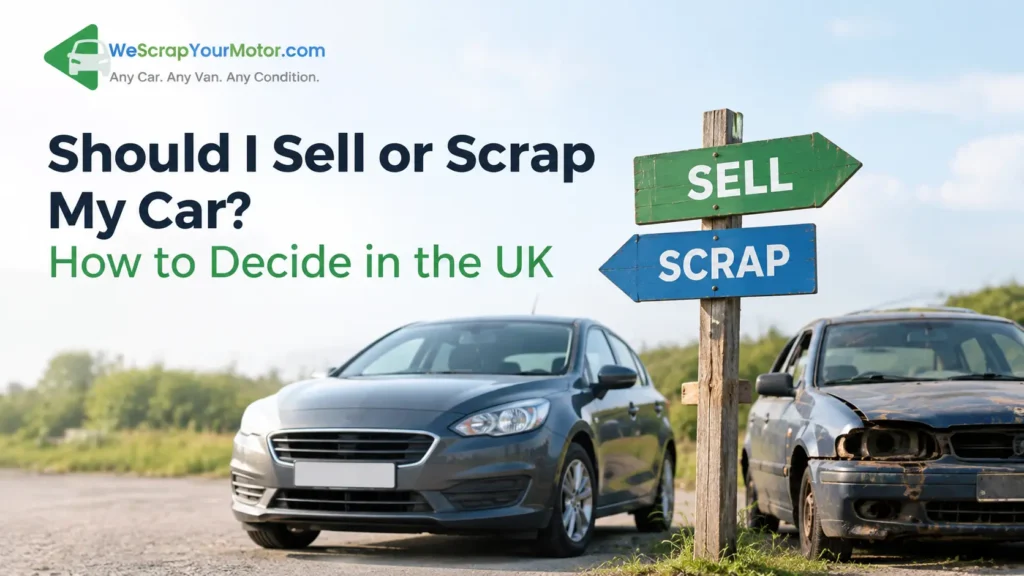
If you are asking to sell or scrap my car, the best choice depends on more than which option produces the biggest headline price. A roadworthy vehicle with useful life remaining will often have a stronger resale market, while a severely damaged, unreliable, non-running, or uneconomical vehicle may be more practical to scrap.
The important step is to compare what your car is realistically worth today against the money, time, risk, and effort required to sell it.
A car advertised privately for £2,000 is not necessarily worth £2,000 to you if it first needs expensive repairs, weeks of advertising, recovery, an MOT, or repeated negotiations. Equally, a car should not automatically be scrapped simply because it is old.
This guide gives UK vehicle owners a practical way to compare the options before making a decision.
The Short Answer To Sell Or Scrap My Car
For most owners wondering sell or scrap my car, start by obtaining three figures:
- The car’s realistic value in its current condition.
- The likely cost of making it saleable or roadworthy.
- Its current scrap or end-of-life value.
Selling may make more sense when the car is roadworthy, desirable, reasonably reliable, and worth significantly more than the costs needed to prepare it for sale.
Scrapping may make more sense when the vehicle has serious mechanical failure, extensive corrosion, major accident damage, repeated MOT problems, or repair costs that are difficult to justify against its current value.
There is also a middle ground. A damaged vehicle might have salvage or repairable-car value even when it is not suitable for an ordinary private sale.
That is why you should compare genuine offers instead of deciding from the vehicle’s age alone.
Start With the Value of the Car Today
Do not begin with what you paid for the vehicle.
That money has already been spent.
Instead, estimate what another buyer would reasonably pay for the car in its current condition.
Consider:
- make and model;
- registration year;
- mileage;
- service history;
- MOT history;
- mechanical condition;
- body condition;
- tyres and brakes;
- warning lights;
- accident history;
- number of keys;
- demand for that model;
- whether the vehicle starts and drives.
A clean, roadworthy ten-year-old hatchback can have a completely different resale position from an identical car with gearbox failure, corrosion and six weeks of MOT remaining.
Owners asking to sell or scrap my car should therefore avoid relying only on classified-ad asking prices. Those advertisements show what sellers hope to receive, not necessarily what comparable cars ultimately sell for.
Calculate the Real Cost of Selling
A private-sale price can look attractive until you calculate what must happen before the money reaches your bank account.
You may need to pay for:
- mechanical repairs;
- an MOT;
- servicing;
- tyres;
- bodywork;
- professional cleaning;
- advertising;
- recovery or transport;
- storage;
- replacement documents;
- time dealing with enquiries.
Not all of those expenses apply to every vehicle, but the comparison should be based on net return, not the highest possible sale price.
For example, imagine a car could potentially sell for £2,000 after repairs. If it requires substantial work first, the important number is what remains after the repair bill and other costs, not £2,000.
The same principle applies if the vehicle already has several unresolved problems. Fixing one fault does not guarantee there will not be another bill shortly afterwards.
Use a Simple Decision Calculation
A useful comparison is:
- Expected Sale Price
- Minus Required Repairs
- Minus Selling Costs
- Minus Recovery Or Transport Costs
- Equals Estimated Net Sale Return
Then compare that figure with a confirmed scrap or salvage offer.
This does not guarantee which route is right, but it prevents emotional decision-making.
When people search, sell or scrap my car, they are often comparing a scrap quotation against the best-condition retail value of their vehicle. Those are not equivalent figures.
Compare like with like.
A damaged car should be compared with the likely selling price of a damaged car, not with a dealer’s asking price for a fully prepared example.
When Selling the Car Usually Deserves Consideration
Selling is worth investigating when most of the following are true:
- The vehicle starts and drives normally.
- It is roadworthy.
- It has meaningful private-sale or dealer demand.
- Repairs are minor.
- The MOT position is reasonable.
- There is no severe structural corrosion.
- You can describe its condition confidently.
- You have enough time to advertise and deal with buyers.
- Its likely selling price is comfortably above its scrap value.
Age by itself is not enough reason to scrap.
Some older cars remain useful because they are mechanically sound, economical to operate, easy to repair, or sought after by particular buyers.
A well-maintained older vehicle may therefore remain a perfectly reasonable used car.
When Scrapping Becomes More Practical
The case for scrapping becomes stronger when the car has reached a genuine end-of-life condition.
Examples can include:
- serious engine failure;
- major gearbox failure;
- extensive corrosion;
- severe accident damage;
- repeated electrical problems;
- significant flood or fire damage;
- multiple expensive MOT defects;
- a combination of high mileage and major faults;
- missing major components;
- repair costs that are disproportionate to the vehicle’s value.
If your search to sell or scrap my car was triggered by a large garage estimate, ask the garage to separate urgent safety or roadworthiness work from optional work.
You can then compare the necessary repair cost against the car’s realistic post-repair value.
Do Not Use a Fixed Percentage Rule Blindly
You may see advice claiming that a car should always be scrapped when repairs equal a particular percentage of its value.
That can be a useful warning sign, but it should not become an automatic rule.
Suppose one reliable car worth £3,000 needs a one-off £900 repair and is otherwise in excellent condition.
Another car worth £3,000 needs £900 immediately but also has corrosion, worn tyres, an unreliable gearbox and an MOT due shortly.
The same repair-to-value percentage produces two very different decisions.
Consider the whole condition of the vehicle, not one invoice in isolation.
Compare Future Costs As Well As Today’s Repair
The question is not simply, “Can this fault be repaired?”
The better question is:
What is the likely financial position of this car after I spend the money?
Look at:
- upcoming MOT requirements;
- timing belt or timing chain history;
- clutch condition;
- gearbox behaviour;
- tyre condition;
- brakes;
- suspension;
- corrosion;
- warning lights;
- oil or coolant leaks;
- battery condition;
- previous recurring faults.
If several expensive jobs are approaching, paying for one major repair may only postpone the same sell or scrap my car decision.
For a broader repair-versus-disposal assessment, compare your situation with our guide explaining How Is Scrap Car Value Calculated?.
Consider the Time Value of a Private Sale
Money matters, but so does time.
Selling privately may involve:
- preparing the car;
- taking photographs;
- writing an accurate advert;
- responding to messages;
- arranging viewings;
- negotiating;
- dealing with potential no-shows;
- completing the ownership transfer.
A straightforward, desirable used car may sell quickly.
A heavily damaged, non-running or unusual vehicle may take considerably more effort.
Scrapping, by contrast, can provide a defined route for an end-of-life car when the service includes collection.
If convenience matters, include it in your comparison rather than treating your own time as having no value.
Check Whether Salvage Is a Better Third Option
The decision is not always limited to private sale or metal recycling.
A vehicle with:
- desirable reusable components;
- localised accident damage;
- a repairable mechanical fault;
- good bodywork;
- a valuable specification;
- strong parts demand
may have salvage value.
This matters because some vehicles are worth more complete than their basic recyclable-metal value would suggest.
If you are asking to sell or scrap my car, obtain enough information to understand whether an offer is for permanent scrapping, salvage, repair or resale.
That distinction affects what happens to the vehicle afterwards and what documentation you should expect.
Understand What Legal Scrapping Means
If a vehicle is permanently scrapped, GOV.UK says it must be taken to an Authorised Treatment Facility, commonly shortened to ATF.
An ATF may completely scrap a vehicle or decide that it can be repaired and sold. Where an eligible car, light van or certain three-wheeled vehicle is completely scrapped, the ATF should issue a Certificate of Destruction within seven days.
The certificate provides important evidence that the vehicle has entered the formal end-of-life process.
GOV.UK also states that cash payment for a scrapped vehicle is illegal in England and Wales; payment must instead be made using a permitted traceable method such as bank transfer or cheque.
These requirements are one reason price should not be the only factor used to select a buyer.
Tell DVLA When the Vehicle Changes Hands
Whether you sell, transfer or dispose of the vehicle through the appropriate route, make sure the keeper record is dealt with correctly.
GOV.UK provides an online service for telling DVLA that a vehicle has been sold or transferred. Once DVLA is notified, vehicle tax is cancelled and any refund due for full remaining months is processed.
Keep confirmation and relevant paperwork.
Do not simply hand over the keys and assume every administrative step has automatically been completed on your behalf.
Compare the Four Main Routes
| Option | Usually Worth Considering When | Main Trade-Off |
| Private sale | Car is roadworthy and has normal used-car demand | More time and buyer interaction |
| Dealer or trade sale | Car has resale value but you want convenience | Offer may differ from retail value |
| Salvage sale | Vehicle is damaged but retains repair or parts value | Valuation requires accurate condition details |
| Scrapping | Car has reached end-of-life condition | Vehicle leaves normal used-car market |
This table gives a better answer to sell or scrap my car than age alone.
How Vehicle Completeness Changes the Decision
Before removing parts from the car, obtain a quote for it complete.
Removing the:
- catalytic converter;
- engine;
- gearbox;
- battery;
- alloy wheels;
- electronic modules
can change the value and may also make collection more complicated.
A part can be individually valuable while still being more useful financially as part of the complete vehicle.
If you intend to dismantle the vehicle yourself, compare expected parts revenue against your time, storage requirements, tools, unsold parts, and the reduced value of the remaining shell.
What About a Failed MOT?
An MOT failure does not automatically make a car scrap.
Read the failure notice carefully.
A modest list of defects on a valuable vehicle can justify repair.
The picture changes when the car has significant corrosion, multiple safety-related defects and further mechanical problems.
Calculate:
post-repair value – essential repair bill – other near-term costs
and compare the result against the vehicle’s alternative values.
That is much more useful than reacting to the words “MOT failure” alone.
What About a Non-Running Car?
A car that does not start may still have value.
The fault might be minor, or it might involve an engine, gearbox, electrical system or accident damage.
Before deciding, obtain a diagnosis where doing so is safe and economically sensible.
Then compare:
- faulty-car value;
- salvage value;
- scrap value;
- realistic repair cost.
If you need a quote for an end-of-life vehicle, you can start through Scrap My Car UK and provide an accurate description of the condition.
Why Location And Recovery Matter
A car that cannot move under its own power requires suitable recovery.
Tell the collector if the vehicle:
- will not start;
- will not roll;
- has locked wheels;
- has flat tyres;
- has no keys;
- is underground;
- is behind a narrow access point;
- is at a garage or recovery yard.
Those details should be disclosed before the collection date.
For motorists in Berkshire, the Scrap My Car In Reading explains the local collection route.
A Seven-Question Test Before You Decide
If you are still thinking sell or scrap my car, answer these questions honestly:
1. What Is It Worth Today?
Use its actual condition, mileage and history.
2. What Will It Cost To Make Saleable?
Include necessary repairs rather than only the obvious fault.
3. What Other Work Is Approaching?
Look at MOT history and known wear items.
4. Does the Car Have Genuine Buyer Demand?
A usable car is easier to sell than a specialist repair project.
5. What Is the Scrap Or Salvage Quote?
Get a real figure rather than guessing.
6. How Much Time Are You Willing To Spend?
Private selling requires effort.
7. Which Route Leaves the Best Net Outcome?
Compare money, time, risk and convenience together.
Common Mistakes To Avoid
Spending Money Before Getting Alternative Quotes
Do not authorise a major repair before understanding the vehicle’s other values.
Comparing Scrap Value To Retail Asking Prices
A dealer-prepared retail vehicle is not equivalent to a faulty private vehicle.
Hiding Damage
Accurate information produces a more meaningful quote.
Stripping the Vehicle Too Early
Removing useful components can reduce the complete-car offer.
Ignoring Paperwork
Keep DVLA and disposal documentation in order.
Choosing Only By the Highest Headline Quote
Confirm whether the collection is included and what could change the price.
Frequently Asked Questions
Should I Sell Or Scrap My Car If It Still Runs?
If it is roadworthy, reasonably reliable and has meaningful used-car value, selling should normally be investigated before permanent scrapping. Compare its actual sale value with any immediate costs required.
Should I Sell Or Scrap My Car After an MOT Failure?
It depends on the defects, repair estimate, car value and other upcoming work. A small repair on a valuable car is very different from extensive corrosion on a low-value vehicle.
Is an Old Car Automatically a Scrap Car?
No. Condition and economic value matter more than age alone.
Can I Scrap a Car That Does Not Start?
Yes, a non-running vehicle can enter the legitimate scrap process. Appropriate collection arrangements may be needed.
Is Scrap Value Based Only On Weight?
No. Weight can be important, but completeness, vehicle type, reusable components, market conditions and logistics can also affect valuation.
Make the Decision From Real Numbers, Not the Car’s Age
The most useful response to sell or scrap my car is not a universal yes or no.
First establish the vehicle’s realistic current-condition value. Then obtain repair estimates, a scrap or salvage quotation, and consider the time and costs involved in selling.
A roadworthy vehicle with useful life remaining may deserve to stay in the used-car market. A vehicle with serious faults, extensive damage or poor economics may have reached the point where an authorised end-of-life route is more practical.
Making those comparisons before spending money gives you the strongest chance of protecting whatever value remains in the car.