
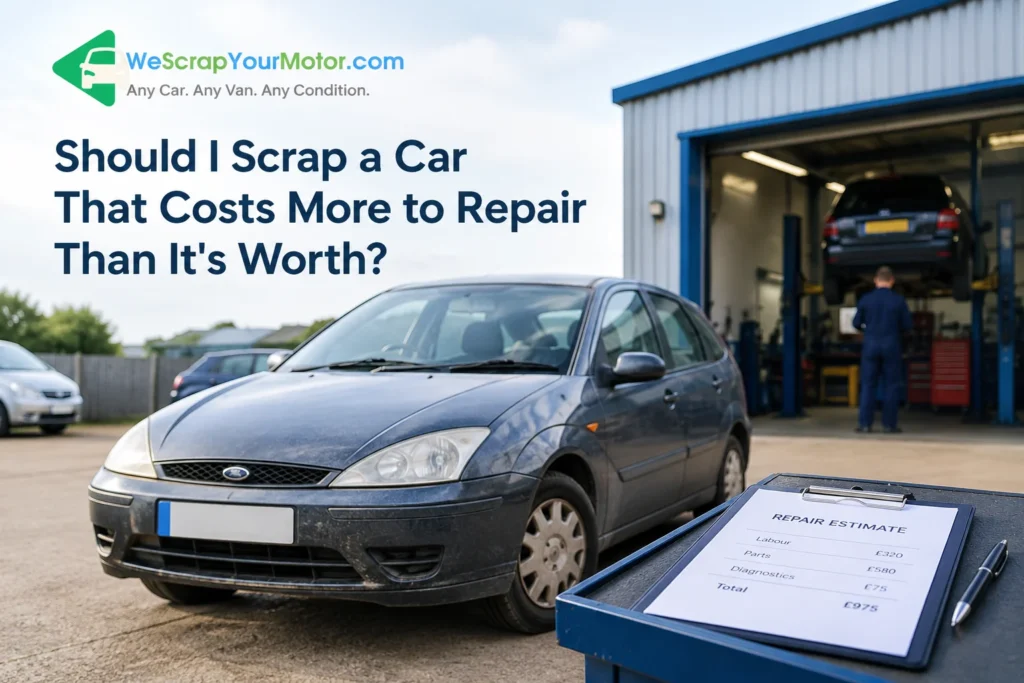
The garage has called.
Your vehicle may be worth around £1,500 in working condition, but the repair estimate is £1,800.
What should you do when your car costs more to repair than it’s worth?
The obvious answer appears to be scrapping it.
Sometimes that is exactly the right decision.
However, market value is only one part of the calculation.
You should also consider the cost of replacing the car, how reliable it would be after repair, what other work is approaching, what it is worth in its current condition and how long you intend to keep it.
A £1,200 repair on a £1,000 car can occasionally make more financial sense than replacing it with a £5,000 vehicle.
At the same time, spending £1,000 on a £2,000 vehicle with severe corrosion, gearbox problems and repeated breakdowns can be a poor decision.
This guide provides a practical framework for UK owners who need to choose between repair, sale, salvage and scrapping.
Start by Confirming the Car’s Real Value
Before deciding what to do when your car costs more to repair than it’s worth, confirm that your valuation is accurate.
Compare vehicles that match your car as closely as possible.
Look at:
- Age
- Mileage
- Engine
- Trim Level
- MOT Length
- Service History
- General Condition
Do not compare your faulty private car with the highest-priced dealer example.
Ask what your vehicle would realistically sell for after the repair.
That is the number you should use.
Confirm the Full Repair Bill
The first estimate may not include every expense.
Ask whether the quote includes:
- Labour
- Parts
- VAT
- Diagnostic Work
- Fluids
- Coding
- Calibration
- Related Components
- Additional MOT Work
For major engine or gearbox repairs, ask whether the estimate could increase once dismantling begins.
A £1,200 quotation that may become £2,000 is very different from a fixed £1,200 repair.
Understand Why the Simple Percentage Rule Can Fail
You may hear advice such as:
“Do not spend more than 50% of the car’s value.”
That can be useful as a warning point.
It is not a universal financial law.
Consider a £1,000 vehicle requiring a £500 repair.
The repair equals 50% of its value.
If the repair provides two more years of reliable transport and replacing the vehicle would cost £4,000, £500 could be excellent value.
Now consider a £6,000 vehicle requiring a £2,000 repair while several other major problems are developing.
The percentage is lower, but the risk can be greater.
When a car costs more to repair than it’s worth, context matters.
Use a Future-Cost Formula
Instead of comparing only repair cost with market value, compare the future cost of each option.
Cost Of Keeping the Vehicle
Add:
- Immediate Repair
- Expected Maintenance
- Known MOT Work
- Likely Near-Term Repairs
Cost Of Replacing the Vehicle
Add:
- Replacement Purchase Price
- Immediate Servicing
- Necessary Repairs
- Insurance Changes
- Other Switching Costs
Then subtract the money you receive from disposing of your current vehicle.
This produces a more realistic comparison.
Example One: Repair Can Still Work
Imagine your car has a roadworthy value of £1,800.
The repair costs £2,000.
Your car costs more to repair than it’s worth.
However:
- The body is structurally sound
- The gearbox is healthy
- New tyres were fitted recently
- Suspension work was completed last year
- MOT history is clean
- Replacement with a reliable equivalent would cost £6,000
If the £2,000 repair is well diagnosed and likely to provide substantial additional life, repairing can still deserve consideration.
You are not only buying market value.
You are buying continued transport.
Example Two: Scrapping Becomes More Attractive
Now imagine another £1,800 car requiring the same £2,000 repair.
However:
- The gearbox is noisy
- Structural corrosion is developing
- Tyres need replacing
- Several warning lights are present
- MOT advisories are increasing
- Electrical problems are recurring
The repair does not return the vehicle to good condition.
It simply fixes one expensive problem.
In this situation, the fact that the car costs more to repair than it’s worth becomes far more important.
Find Out What the Broken Car Is Worth
Do not approve major repairs until you know the vehicle’s current as-is value.
Suppose:
Roadworthy value = £2,000
Repair cost = £2,200
Current salvage value = £700
Repairing to sell would leave:
£2,000 minus £2,200 = negative £200
Selling as-is would produce approximately £700.
That is a £900 difference before accounting for your time.
An as-is quotation creates a useful benchmark.
You can obtain that baseline through Scrap My Car UK.
Repairing To Keep Is Different From Repairing To Sell
This distinction is important.
If your car costs more to repair than it’s worth but you intend to keep it for several years, the repair may create value through continued use.
If your only intention is to sell the car immediately afterwards, the calculation changes.
For resale, compare:
Expected Sale Price After Repair – Repair Cost
Against:
Current As-Is Offer
Do not spend £1,500 to increase the selling price by only £800.
Look at the Nature Of the Failure
Some repairs are relatively predictable.
Others carry substantial uncertainty.
Be particularly careful with:
- Engine Replacements
- Gearbox Rebuilds
- Serious Overheating
- Timing Belt Damage
- Extensive Welding
- Complex Electrical Faults
- Multiple Emissions Problems
Ask whether the repair fixes the underlying issue or only one symptom.
Add Upcoming MOT Work
A major mechanical repair is not the only bill that matters.
Suppose the engine repair costs £900.
That could seem manageable.
But the car also needs:
- Two Tyres
- Brake Work
- Suspension Repairs
- MOT Preparation
Your total near-term expense could exceed £1,800.
Evaluate the entire vehicle rather than one invoice.
For a broader comparison, read Should I Repair Or Scrap My Car?
Calculate the Cost Per Month
Suppose the repair costs £1,200.
You realistically expect two more years of reliable use.
£1,200 divided by 24 months equals £50 per month.
That may be excellent value compared with replacing the car.
Now suppose you expect the repair to provide only six months before another major problem.
The equivalent cost is £200 per month before any additional maintenance.
This simple calculation can help when a car costs more to repair than it’s worth.
Replacement Vehicles Are Not Risk-Free
Buying another used car does not eliminate repair risk.
A replacement may have:
- Unknown Service History
- Worn Clutch
- Old Tyres
- Cooling Problems
- Missed Timing Belt Maintenance
- Hidden Accident Repairs
- Electrical Faults
Do not compare your known vehicle with an imaginary perfect replacement.
Compare it with what your real budget can buy.
Consider Your Ownership Period
How long do you intend to keep the car?
If you plan to replace it in three months, a £1,500 repair may be difficult to justify.
If you plan to keep it for three more years and the repair is likely to restore dependable service, the same bill may make more sense.
Time changes the value of the repair.
Reliability Is Part Of the Financial Calculation
A cheap car that breaks down frequently is not necessarily cheap transportation.
Unreliability can create:
- Recovery Charges
- Taxi Costs
- Hire Vehicle Costs
- Missed Work
- Emergency Repairs
- Lost Appointments
These indirect expenses matter.
Safety Comes Before Market Value
If the vehicle has serious problems affecting brakes, tyres, steering or structural integrity, do not continue driving simply because repair is expensive.
Roadworthiness responsibilities still apply even when a vehicle has a valid MOT.
Financial calculations should determine whether you repair, replace or dispose of the vehicle.
They should not justify using an unsafe car.
Do Not Chase Previous Spending
A common problem occurs when owners say:
“I have already spent £2,000 on this car, so I cannot scrap it.”
Previous spending should not control the next decision.
Imagine you replaced the clutch six months ago.
The engine now requires another £2,000 repair.
The clutch money cannot be recovered regardless of what you do next.
When your car costs more to repair than it’s worth, ask whether today’s proposed spending makes sense from today forward.
Consider Salvage Before Assuming Pure Scrap
A broken vehicle may contain useful components.
Potential value can remain in:
- Engines
- Gearboxes
- Body Panels
- Wheels
- Interior Components
- Electronic Modules
- Catalytic Converters
A relatively modern vehicle with one major fault may therefore have more salvage value than basic scrap value.
Get quotations before removing parts yourself.
What If Repairs Are More Than 100% Of the Vehicle Value?
This should trigger a strict review.
Repair can still make sense in unusual circumstances where:
- Replacement Cost Is Much Higher
- The Rest Of the Vehicle Is Excellent
- The Repair Has a Strong Warranty
- Long-Term Ownership Is Planned
- The Failure Is Isolated
For an ordinary low-value car with several developing problems, however, repairing beyond the entire market value becomes increasingly difficult to justify.
What If Repairs Are 30% To 50% Of the Value?
This range alone cannot decide the issue.
A £500 repair on a £1,000 dependable vehicle can be reasonable.
A £2,000 repair on a £6,000 vehicle may be poor value if another major failure is expected.
Focus on what the repair achieves.
What If the Vehicle Is in a Garage?
If your car costs more to repair than it’s worth and is already at a garage, ask about storage.
Confirm:
- Daily Storage Charges
- Diagnostic Fees
- Vehicle Release Requirements
- Collection Access
- Whether the Vehicle Rolls
- Whether Major Parts Are Removed
Storage charges can rapidly reduce the amount you recover.
Ask the Garage Five Important Questions
Before approving major work, ask:
- What exactly has failed?
- Is the diagnosis confirmed?
- Is the repair price fixed?
- What other major problems are visible?
- What warranty is included?
These answers improve your financial comparison.
When Scrapping Can Become the Cleaner Option
Permanent disposal deserves serious consideration when:
- Repair Cost Substantially Exceeds Market Value
- Several Major Faults Exist
- Structural Corrosion Is Advanced
- MOT History Is Deteriorating
- Reliability Is Poor
- Another Expensive Repair Is Likely
- Resale Demand Is Low
If you live in Berkshire, compare your current as-is value through Scrap My Car In Reading before approving a large repair.
Follow the Correct Scrapping Process
If you decide that the vehicle has genuinely reached the end of its useful life, use an Authorised Treatment Facility.
GOV.UK states that vehicles being permanently scrapped must be handled through an ATF.
A qualifying fully scrapped vehicle receives a Certificate of Destruction.
Make sure the DVLA is correctly notified.
Frequently Asked Questions
Should I Repair a Car If the Repair Costs More Than Its Value?
Sometimes. Compare replacement cost, likely future reliability, current as-is value and other upcoming repairs first.
Is It Worth Spending £1,000 On a £1,000 Car?
It can be if the repair restores dependable transport and replacing the vehicle would cost substantially more.
Should I Repair the Car Before Selling It?
Only when the expected increase in selling price comfortably exceeds the repair cost and associated risk.
Should I Scrap a Car That Still Runs?
Possibly. Running conditions alone does not determine whether continued ownership is financially sensible.
What If the Garage Finds More Damage?
Ask for approval before additional work begins and recalculate the entire decision using the new total.
Should I Get More Than One Repair Quote?
For expensive work, a second professional assessment can be useful, particularly where diagnosis is uncertain.
Spend the Next Pound Where It Creates the Most Value
When your car costs more to repair than it’s worth, do not let one number make the entire decision.
Compare the roadworthy value.
Calculate the full repair cost.
Get an as-is quotation.
Estimate upcoming maintenance.
Calculate realistic replacement cost.
Then decide where your next pound creates the greatest benefit.
Repair can still make sense when it buys years of dependable transportation for substantially less than replacement.
Scrapping or selling may make more sense when a large repair only postpones the next expensive failure.
The money already spent on the car cannot be changed.
The money you spend next can.