
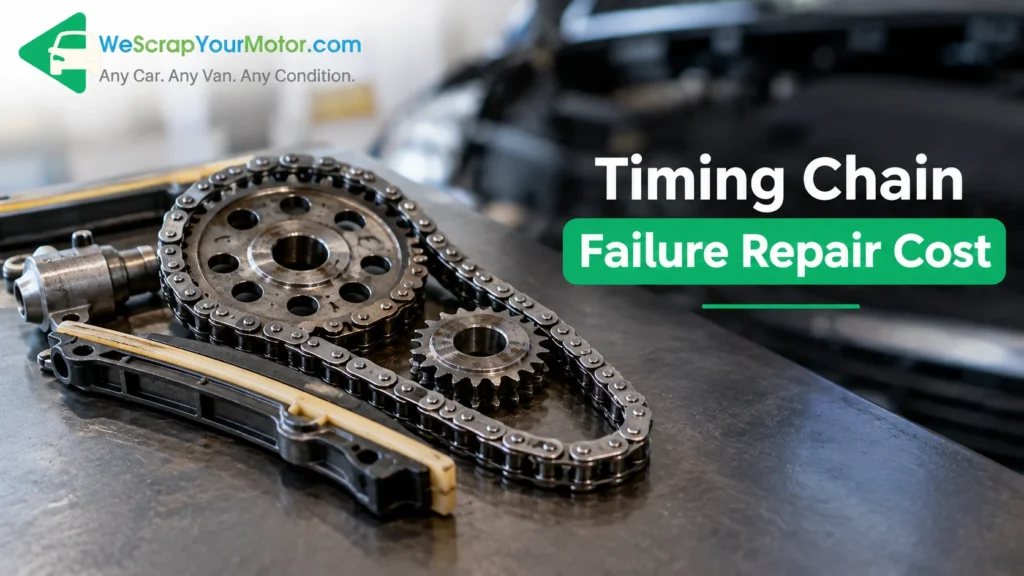
A timing chain problem can start with a light rattle and end with an engine that will not run. For a UK car owner, that creates a difficult question. Should you pay to repair the engine, or would you be putting more money into a car that is already worth less than the repair?
The timing chain failure repair cost can vary enormously because there is a major difference between replacing a worn chain before it breaks and repairing an engine after the chain has jumped or snapped.
According to RAC guidance published in July 2026, a timing chain replacement typically costs around £750 to £1,000 in the UK. Costs vary by manufacturer, with RAC reporting averages of about £770 for Ford, £877 for Vauxhall, £859 for Nissan, £1,159 for Audi and £1,232 for BMW based on July 2026 data.
Those figures are useful starting points, but they do not tell you whether your particular car is worth fixing.
This guide will help you work that out.
Should You Repair Or Scrap a Car with Timing Chain Failure?
Repairing usually makes sense when the chain problem has been found early, internal engine damage has not occurred, and the car is otherwise reliable and worth substantially more than the repair bill.
Scrapping or selling the vehicle as damaged becomes more sensible when the chain has caused serious internal damage, the engine needs rebuilding or replacing, and the car already has high mileage or other expensive faults.
The smartest way to evaluate the timing chain failure repair cost is to compare four numbers:
| Figure To Check | Why It Matters |
| Confirmed repair quote | Shows what you need to spend now |
| Value after repair | Shows what the car could realistically be worth |
| Other repairs due soon | Reveals hidden future spending |
| Current damaged or scrap value | Shows what you can recover without repairing |
Do not decide based only on what you have already spent on the vehicle.
Money already spent cannot be recovered. Your decision should be based on what happens financially from today.
What Does a Timing Chain Actually Do?
The timing chain synchronises the crankshaft and camshaft so that the engine’s valves and pistons operate at the correct time.
Unlike a rubber timing belt, a chain is made from metal and can potentially last for a very long time. That does not make it maintenance-free.
Correct engine oil, oil pressure, tensioners, guides and sprockets all help the chain operate properly.
RAC explains that a worn or stretched timing chain can cause rattling, misfires and potentially severe engine damage.
That is why ignoring the early signs can turn a manageable timing chain failure repair cost into one of the most expensive mechanical problems an older car can develop.
Why Timing Chain Problems Become Expensive
The chain itself may not be the most expensive part of the job.
Labour is often significant because the mechanic may need to remove covers, auxiliary components, engine mounts and other parts simply to reach the timing system.
Some engines have timing chains positioned in especially difficult locations. The vehicle’s design can therefore make two apparently similar repairs cost very different amounts.
A proper chain replacement may also involve new tensioners, guides, seals, gaskets, bolts, fluids and related components.
If the chain has already jumped or broken, the timing chain failure repair cost can increase dramatically.
The mechanic may then need to inspect valves, pistons, camshafts, the cylinder head and other internal engine parts.
Warning Signs That Should Not be Ignored
A timing chain does not always fail without warning.
One of the best-known symptoms is a metallic rattling sound, particularly when the engine is first started.
Other signs can include rough running, misfires, reduced power, difficult starting, an engine-management warning and unusual mechanical noises.
RAC also highlights chain stretch, tensioner problems, lubrication issues and worn sprockets as possible timing-chain faults.
If you notice these symptoms, arranging a diagnosis early can make a major difference to the final timing chain failure repair cost.
Continuing to drive until the chain completely fails may change a chain replacement into an engine repair.
How Much Does Timing Chain Replacement Cost In the UK?
RAC currently gives a typical timing chain replacement range of approximately £750 to £1,000.
Your quotation may be higher or lower.
A straightforward job on an accessible engine may sit toward the lower end. A complicated engine where significant dismantling is required can cost much more.
The important distinction is between replacement and failure.
Replacing a worn chain before major damage occurs is not the same as repairing an engine after the timing has failed.
When comparing the timing chain failure repair cost, ask the garage whether its figure covers only the timing system or whether it includes confirmed internal engine damage.
What Happens When the Timing Chain Jumps?
A timing chain can stretch or lose tension until it moves out of its correct position.
If it jumps one or more teeth on a sprocket, the relationship between the crankshaft and camshaft changes.
The engine may run badly, stall or refuse to start.
Depending on engine design and how far the timing moved, internal components may also collide.
That possibility is why repeated attempts to start a badly timed engine are not a good idea.
Get the vehicle inspected before turning a potentially repairable fault into something worse.
What Happens If the Timing Chain Snaps?
A snapped timing chain is more serious than a chain that has simply become noisy.
On some engines, valves can be damaged when timing is lost. Pistons, valve guides, camshafts or the cylinder head may also be affected.
The mechanic may need to perform compression checks or investigate inside the engine before giving a reliable price.
At this point, the timing chain failure repair cost could include cylinder-head work, replacement valves, machining or even another engine.
That does not automatically mean the car should be scrapped.
It does mean the financial calculation needs to become much stricter.
When Repairing the Car Usually Makes Sense
Consider a vehicle worth £6,500 in good running condition.
It has a solid MOT history, reasonable mileage, a clean body, a reliable gearbox and no serious electrical problems.
The timing chain begins rattling and a specialist quotes £1,100 to replace the complete timing set before further damage occurs.
Paying £1,100 to preserve a £6,500 asset may make financial sense.
The timing chain failure repair cost represents a relatively small proportion of the car’s value.
You also already know the vehicle’s history.
Replacing it with another used car can introduce unknown problems, dealer margins and additional buying costs.
When Repairing Starts To Look Risky
Now consider a different vehicle.
It is worth around £2,200 when running properly.
The timing chain has failed completely. The garage believes valves are damaged and estimates £2,000 to £2,800 depending on what it finds after removing the cylinder head.
The car also has 145,000 miles, two worn tyres, suspension advisories and an oil leak.
The financial situation is completely different.
Even if the engine can technically be repaired, the total amount being invested could exceed the value of the finished vehicle.
This is where comparing the timing chain failure repair cost with the car’s overall condition becomes essential.
Calculate the Real Repair Value
A useful calculation is:
Expected Car Value After Repair – Confirmed Repair Cost – Essential Work Due Soon = Practical Remaining Value
Imagine your car would be worth £4,000 once repaired.
The timing-chain repair costs £1,700.
The MOT is also likely to require £500 of work.
That leaves around £1,800 of practical vehicle value after planned spending.
You can then compare that result with what you could receive by selling or scrapping the car now.
If you need a current disposal comparison, get a quotation through Scrap My Car UK.
This approach gives the timing chain failure repair cost proper context.
Do Not Forget the Next Twelve Months
A major mechanical repair should never be assessed in isolation.
Look at what else the car may need soon.
A vehicle might have a repairable engine but also be approaching a clutch replacement, DPF issue, major service, brake work or expensive MOT repairs.
Check the MOT history for recurring advisories.
Look at service records and ask whether any large maintenance items are overdue.
If another £1,500 of work is likely after the chain repair, include it before deciding.
Our guide to Should I Repair Or Scrap My Car? explains how to compare the wider costs.
Ask For Evidence of Engine Damage
Do not authorise a complete engine replacement simply because somebody says the timing chain has failed.
Ask what has actually been tested.
Has compression been checked?
Has the timing position been verified?
Has the engine been inspected internally?
Is cylinder-head damage confirmed or only suspected?
A reliable garage should be able to explain what it knows and what remains uncertain.
This matters because the difference between suspected and confirmed damage can change the timing chain failure repair cost by thousands of pounds.
Get an Itemised Quotation
Ask the garage to separate the price into parts, labour, fluids, diagnosis, machining work where required and VAT.
Check whether the quote includes a complete chain kit.
Ask whether tensioners and guides are included.
Also confirm what warranty applies to the repair.
An unusually cheap quotation can sometimes exclude work another garage considers necessary.
The cheapest initial number is not always the cheapest completed repair.
Is a Replacement Engine a Better Option?
If the original engine has suffered serious damage, a replacement engine may sometimes cost less than rebuilding it.
However, there are important questions.
- What is the mileage of the replacement engine?
- Where did it come from?
- Is there a warranty?
- Will the timing components be checked before installation?
- How much does fitting cost?
- Are fluids and additional parts included?
A replacement unit can reduce the timing chain failure repair cost, but it still needs to make sense relative to the vehicle’s overall value.
Does High Mileage Mean You Should Scrap the Car?
Not automatically.
Mileage is only one part of the picture.
A well-maintained vehicle with 120,000 motorway miles can be a better repair candidate than a neglected car with 70,000 miles.
Service history, corrosion, transmission health, MOT condition and overall reliability matter just as much.
Instead of asking whether the mileage is too high, ask whether the repaired car is likely to provide enough useful life to justify the money being spent.
Does Vehicle Age Matter?
Yes, but age should not be used by itself.
Some older cars retain strong resale values.
Others have very little market value even when running perfectly.
A ten-year-old vehicle worth £7,000 may comfortably justify a £1,000 repair.
A fifteen-year-old vehicle worth £1,500 may not justify the same repair if another expensive issue is approaching.
The timing chain failure repair cost becomes meaningful only when compared against realistic market value.
What If the Car Is Stuck At a Garage?
You do not necessarily need to repair a non-running car just to move it.
Ask the garage whether storage charges apply and when they begin.
Also check whether an external collection company is allowed to collect directly from the premises.
This is important because delaying your decision can create additional daily charges.
For owners in Essex, a local comparison can be made through Scrap My Car in Colchester.
Can a Car with Timing Chain Failure Still Have Scrap Value?
Yes.
A failed engine does not make every other part of the vehicle worthless.
Value may still come from the vehicle’s weight, catalytic converter, alloy wheels, body panels, electronics and reusable components.
Make, model, age, completeness and current metal prices can also influence the offer.
Removing major components before obtaining quotes can reduce what some buyers will pay.
What Happens If You Decide To Scrap the Car?
UK owners should use an authorised treatment facility when a vehicle has reached the end of its useful life.
GOV.UK states that an end-of-life vehicle must be scrapped through an ATF. It also states that qualifying cars that are completely scrapped receive a Certificate of Destruction within seven days.
You must tell DVLA that the vehicle has been taken to an ATF. GOV.UK warns that failing to notify DVLA can result in a fine of up to £1,000.
In England and Wales, payment for a vehicle that is actually being scrapped cannot legally be made in cash. Payment must be made by bank transfer or cheque.
Frequently Asked Questions About Timing Chain Failure
Is a Timing Chain Worth Replacing?
Yes, when the car is otherwise healthy and the chain is replaced before major internal engine damage occurs.
The repair becomes harder to justify when the vehicle has little remaining value or several other expensive faults.
Can You Drive with a Failing Timing Chain?
Driving with known timing-chain problems can increase the risk of additional engine damage.
Have the fault investigated as soon as possible.
Does a Broken Timing Chain Mean the Engine Is Finished?
Not necessarily.
Some engines suffer major internal damage while others may escape with less serious consequences.
Inspection is needed before the engine should be written off.
What Is the Average Timing Chain Replacement Price?
RAC currently reports a typical replacement cost of approximately £750 to £1,000, although manufacturer-specific averages vary.
Can I Scrap a Car That Does Not Start?
Yes.
A vehicle does not need to run to be collected for legal disposal.
The condition should be accurately described when requesting a quote.
Choose the Option That Protects Your Car Budget
Timing-chain trouble does not automatically mean your vehicle belongs in a scrapyard.
The right decision starts with diagnosis.
Find out whether the chain is simply worn or whether internal engine damage has already occurred. Get a detailed written quote and compare the timing chain failure repair cost with the realistic value of the car after repair.
Then look beyond today’s fault.
Check the MOT history, mileage, body condition, tyres, brakes, gearbox and other repairs likely to arrive during the next year.
When a relatively contained chain repair restores an otherwise healthy and valuable vehicle, repair can be the sensible choice.
When severe engine damage combines with low vehicle value and further expensive faults, continuing to spend may not be financially sensible.
The best decision is not the cheapest option today.
It is the option that leaves you in the strongest position after all of the costs are counted.