
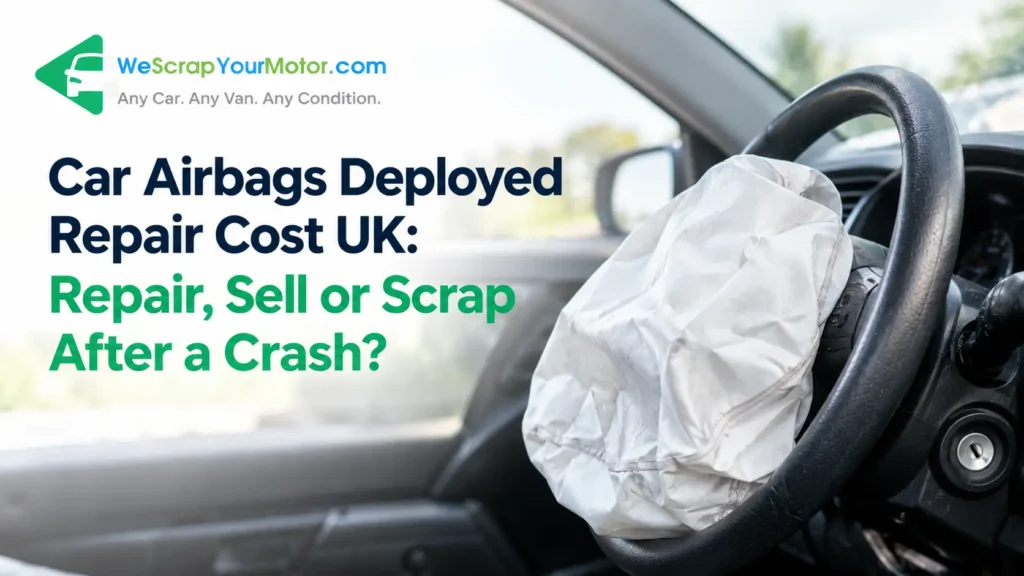
Your car has been involved in an accident, and the airbags have deployed. Although the visible damage might seem relatively minor, the repair estimate could tell a completely different story.
Replacing a damaged bumper or headlight is one thing. Restoring a vehicle’s airbag system, seatbelt equipment, interior trim and accident-damaged structure can be considerably more complicated.
So, what happens next?
The car airbags deployed repair cost in the UK can reach several thousand pounds, particularly when multiple airbags, seatbelt pretensioners, dashboard sections and other safety components require replacement.
But deployed airbags do not automatically mean a car must be scrapped.
Some vehicles can be professionally repaired and returned to the road. Others are declared insurance write-offs because the overall repair cost is too high compared with their value.
Before choosing between repair, sale and scrapping, you need to understand what the complete damage assessment includes.
This guide explains the costs, UK insurance categories, hidden expenses, and financial decisions involved after airbag deployment.
What Happens When Car Airbags Deploy In an Accident?
Airbags are part of a vehicle’s supplementary restraint system, commonly called SRS.
They are designed to work alongside seatbelts and other occupant protection systems.
During certain collisions, vehicle sensors detect the impact and send information to the appropriate safety-control systems.
Depending on the crash direction and severity, one or more airbags may deploy.
The deployed airbag then deflates rapidly after cushioning the occupant.
Airbag systems are designed to operate under specific crash conditions. A collision does not necessarily activate every airbag in the vehicle.
For example, a frontal accident might trigger the driver’s steering-wheel airbag and other relevant restraints without deploying every curtain or side airbag.
The important point is that deployment is a safety-system event, not merely cosmetic damage.
RAC guidance confirms that deployed airbags require replacement and that professional attention is essential.
How Much Does It Cost to Repair Deployed Airbags In the UK?
There is no single reliable national price for restoring a vehicle after its airbags have deployed.
The cost depends on the number and type of airbags, manufacturer requirements and additional damage.
A vehicle with one deployed steering-wheel airbag may require much less work than one with several activated airbags and damaged interior components.
Illustrative Airbag Repair Budget
| Repair Component | Indicative Planning Allowance |
| Driver airbag assembly replacement | £400–£1,000+ |
| Passenger airbag assembly replacement | £500–£1,500+ |
| Side or curtain airbag replacement | £400–£1,200+ each |
| Seatbelt or pretensioner replacement | £150–£500+ each |
| SRS diagnostic and verification work | £80–£250+ |
| Dashboard, steering-wheel or interior trim | Highly vehicle-dependent |
These are illustrative budgeting ranges, not verified national averages or fixed garage prices. Manufacturer-approved component pricing and fitting requirements may be substantially different.
Structural repairs, bodywork and paint are additional expenses.
This distinction matters because an estimate showing only the airbag replacement price may not represent the complete cost of making the car roadworthy again.
The best starting point is a professional accident-damage assessment with an itemised quotation.
Why Is Full Repair More Expensive Than Replacing an Airbag?
Imagine an accident in which the driver’s airbag deploys.
You might assume the garage simply needs to install another airbag in the steering wheel.
However, the inspection may identify several additional components requiring attention.
The driver’s seatbelt pretensioner may have activated.
The steering-wheel assembly may contain damaged trim or related parts.
The airbag control system may need manufacturer-specified replacement, configuration or verification work.
There may also be damaged sensors or wiring.
A qualified repairer must determine the correct requirements for that exact vehicle.
This makes the car airbags deployed repair cost fundamentally different from the price of a single replacement part.
It is also why a repair estimate should never be based solely on the number of visible airbags.
The Hidden Costs That Accident-Damaged Car Owners Often Miss
The most expensive parts of a collision repair are not always immediately visible.
Seatbelt Pretensioners and Restraint Components
Many vehicles use pretensioners that tighten seat belts during certain serious collisions.
These components may activate alongside airbags.
If a pretensioner has deployed, it generally requires replacement according to the relevant manufacturer procedures.
The seat belt assembly may also have sustained damage that is not obvious during a basic visual inspection.
A professional repair estimate should address these components rather than focusing only on the deployed airbag.
Dashboard and Interior Damage
Passenger airbags are often installed behind or within dashboard assemblies.
When they deploy, dashboard components can be damaged.
Curtain airbags may also affect roof-lining and pillar trim.
Depending on the vehicle, replacing these components may involve substantial labour and specialist parts.
The repairer must ensure that replacement trim is compatible with the vehicle’s safety systems.
Accident-Damaged Sensors and Electronics
Modern restraint systems contain sensors, wiring and electronic control modules.
These components must be assessed after a collision.
The correct repair procedure depends on the make, model, year and manufacturer’s instructions.
A properly restored system should be professionally checked to confirm that the relevant components operate as intended.
An extinguished dashboard warning light alone is not sufficient evidence that collision repairs have been completed safely.
Structural and Suspension Damage
The car might have damage beneath the bumper that is not immediately apparent.
Impact absorbers, suspension components, steering parts or structural sections may need professional evaluation.
A vehicle can appear repairable externally while having more expensive underlying damage.
Before spending money on replacement airbags, establish whether the car’s structure and mechanical systems are suitable for safe restoration.
A Realistic Example of How the Repair Bill Grows
Consider a hypothetical 2016 family hatchback involved in a frontal collision.
The car was worth approximately £4,000 before the accident.
The driver’s and passenger’s airbags deployed, and the front bumper, bonnet and headlight were damaged.
A bodyshop prepares the following illustrative estimate.
| Repair Work | Example Estimate |
| Restraint-system parts and fitting | £1,800 |
| Additional seat belt-related repairs | £400 |
| Front bodywork and paint | £1,200 |
| Diagnostic and verification work | £200 |
| Total | £3,600 |
The total repair quotation is already approaching the car’s pre-accident value.
There may also be recovery charges, additional hidden damage or other insurer-related costs.
The owner now faces an important question.
Is paying £3,600 worthwhile to restore a car worth roughly £4,000?
If the insurer is involved, it will assess the claim under the relevant policy and its economic repair criteria.
The numbers in this example are hypothetical and should not be used as a price quotation.
Does Airbag Deployment Automatically Write Off a Car?
No.
Airbag deployment alone does not automatically make a vehicle an insurance write-off.
A vehicle can be repairable even when several airbags have activated.
The insurer’s decision depends on the complete damage assessment, the value of the vehicle and other relevant financial and safety considerations.
For an expensive, relatively new vehicle, replacing several airbags might still be economically justified.
For an older car worth £1,500, the same repairs could cost substantially more than the vehicle itself.
This is why the car airbags deployed repair cost must be assessed alongside the car’s pre-accident market value.
It is possible for a car to be technically repairable but uneconomical for an insurer to repair.
These are two different considerations.
Understanding UK Insurance Write-Off Categories
The UK uses four main insurance salvage categories.
Each category has different implications for repairing or disposing of a vehicle.
| Category | Meaning | Can the Complete Car Return to the Road? |
| Category A | Vehicle must be crushed | No |
| Category B | Body shell must be crushed, though certain parts may be salvaged | No |
| Category S | Repairable structural damage | Yes, once properly repaired and roadworthy |
| Category N | Repairable non-structural damage | Yes, once properly repaired and roadworthy |
These categories are explained in the official GOV.UK insurance write-off guidance.
Category A and Category B
A Category A vehicle cannot return to the road and must be crushed in its entirety.
For Category B, the body shell must be crushed, although certain components may be recoverable.
Owners cannot simply pay a garage to repair these vehicles and legally return them to normal road use.
Category S and Category N
Category S means the vehicle has sustained structural damage but may be repaired.
Category N means the insurer has classified the vehicle as having repairable non-structural damage.
Neither category guarantees that the repair is affordable or straightforward.
A vehicle in either category must be properly repaired to a roadworthy condition before being used again.
If your insurer classifies the car, follow its instructions before arranging independent repairs, sale or scrappage.
Should You Claim Insurance or Pay for Repairs Yourself?
After an accident, your insurance arrangements are an important part of the decision.
If the incident is covered, your insurer may arrange inspection, repairs or a write-off settlement.
The outcome depends on the policy, circumstances of the claim and damage assessment.
You should notify your insurer as required by your policy before making decisions that could affect the claim.
Do not authorise dismantling or dispose of the damaged vehicle while the insurer needs to inspect it or confirm salvage ownership.
If you are considering paying privately, compare the full repair cost with your policy excess, the vehicle’s value and any relevant insurance implications.
Remember that restoring a deployed restraint system safely may involve specialist repairs even when the collision initially appears minor.
Is It Cheaper to Repair One Deployed Airbag?
Usually, replacing one airbag involves less work than replacing several, but the total cost can still vary considerably.
For example, a single driver’s airbag deployment may also involve seatbelt or control-system work.
A single curtain airbag can require interior trim replacement.
The location of the deployed airbag matters just as much as the number of airbags involved.
Another factor is parts availability.
Manufacturer-approved components for an older or less common vehicle may be expensive or difficult to source.
Before comparing prices, ask the repairer to confirm every part required under the manufacturer’s collision-repair procedures.
A quote based on only the visible deployed airbag can underestimate the full job.
Can You Use Second-Hand Airbags to Reduce Repair Costs?
There are businesses selling used airbag components, but suitability and safety cannot be assumed.
Restraint-system parts are safety-critical, and their history, condition and compatibility may be difficult to verify.
Installation requirements vary by manufacturer and vehicle.
Using an unsuitable component could leave the system unable to provide its intended protection in another collision.
A repairer should follow the manufacturer’s specifications and use appropriately sourced, approved components.
Do not attempt to restore a deployed airbag, substitute warning-light devices or bypass the restraint system.
Any proposed repair should include professional verification of the complete SRS system.
Saving money is important, but it should not come at the expense of occupant safety.
Will a Car Pass Its MOT After Airbag Deployment?
A vehicle with deployed or obviously inoperative original airbags is unlikely to satisfy the relevant MOT requirements.
The DVSA inspection manual identifies several Major defects involving airbags and restraint systems.
These include original airbags that are obviously missing or inoperative, deployed seatbelt pretensioners and an SRS warning light indicating a malfunction.
However, passing an MOT does not guarantee that every possible collision-related problem has been identified.
An MOT inspection is not a substitute for comprehensive structural and manufacturer-specific accident repairs.
For that reason, a vehicle repaired after significant airbag deployment should receive appropriate professional safety inspections.
Can You Sell a Car With Deployed Airbags?
Potentially, yes, subject to the vehicle’s legal status, ownership and any insurance restrictions.
Some buyers specialise in damaged vehicles or repairable salvage.
However, not every damaged car is eligible for ordinary resale or future road use.
Category A and B vehicles cannot return to the road as complete cars.
For repairable vehicles, accurate disclosure of the damage and write-off history is important.
Prospective buyers should understand that the airbag system has deployed and that professional repairs will be necessary.
The amount offered will depend on the vehicle’s condition, value before the accident, repairability and potential resale demand.
A salvage buyer may offer more than scrap value for a desirable, repairable vehicle.
Compare both options before accepting an offer.
When Is Scrapping Better Than Repairing a Crash-Damaged Car?
Scrapping can be the more practical choice when the repair quotation is disproportionate to the car’s value.
For example, spending £3,500 to restore a high-mileage vehicle worth £2,000 is unlikely to be financially attractive unless there are unusual personal or practical reasons to keep it.
The decision becomes clearer if the car also has existing mechanical problems.
A failing gearbox, expensive MOT advisories or substantial corrosion can make an already costly accident repair even harder to justify.
However, do not assume that a damaged car is worth only its metal weight.
Some repairable vehicles may have salvage value above a basic scrap quotation.
The best decision is to compare the amount you would receive through insurance, salvage sale or scrappage after accounting for any ownership and settlement conditions.
How to Compare Repair, Sale and Scrap Offers
Consider three possible outcomes.
Repair: You pay to restore the vehicle, retain it or sell it after the work is complete.
Sell as damaged salvage: A buyer purchases the vehicle in its current condition, subject to its legal salvage status.
Scrap: The vehicle is disposed of through the appropriate authorised recycling process.
Here is a hypothetical comparison for a car worth £3,000 before its accident.
| Option | Example Financial Result |
| Repair for £2,800 and keep | Car restored, with £2,800 repair spending |
| Sell damaged vehicle for £800 | Receive £800, without funding repairs |
| Accept a £300 scrap quotation | Receive £300, with the vehicle disposed of |
These examples exclude any insurance claim settlement and assume the owner is entitled to dispose of the car.
They show why a damaged-vehicle valuation is worth obtaining before committing to expensive repairs.
What If the Insurance Company Has Already Written Off Your Car?
First, find out the write-off category and who legally owns the vehicle following settlement.
Your insurer will explain whether the vehicle can be retained and what conditions apply.
For Category S and N vehicles, retention may be possible under the relevant arrangements.
If the insurer is keeping the salvage, you cannot independently sell or scrap it.
If you retain an eligible vehicle, you can explore professional repair or a lawful sale.
You should also check DVLA notification requirements.
GOV.UK states that a vehicle owner must tell DVLA when a vehicle has been written off, even if the insurer is managing other aspects of the claim.
Never assume that accepting an insurance settlement automatically completes every required administrative step.
How to Scrap an Accident-Damaged Car In the UK
Once you have confirmed that you are entitled to dispose of the vehicle, arranging a quotation is straightforward.
We Scrap Your Motor accepts enquiries for damaged and non-running vehicles.
Through our Scrap My Car, you can provide details of the car and request an offer.
Explain the type of accident damage, which airbags have deployed and whether the vehicle can be moved safely.
Also disclose any insurance write-off category.
This information helps determine whether the vehicle is suitable for purchase and what collection arrangements are required.
If the car is being completely scrapped, it must be handled through an Authorised Treatment Facility.
Under GOV.UK guidance, eligible fully scrapped vehicles receive a Certificate of Destruction from the ATF. In England and Wales, payment for a scrapped vehicle cannot legally be made in cash.
Accident-Damaged Vehicle Collection In Plymouth
Drivers in Plymouth and nearby areas can explore our Scrap My Car in Plymouth service.
If the vehicle has deployed airbags, damaged suspension or other serious collision problems, do not attempt to drive it for collection.
Instead, explain its condition when requesting a quotation.
The collection provider can then establish the appropriate recovery arrangements.
Questions Drivers Ask After Airbag Deployment
Does Airbag Deployment Mean the Car Is Totalled?
Not necessarily. The insurer considers the full damage assessment and vehicle value. Some cars with deployed airbags are professionally repairable, while others are declared uneconomical to repair.
How Much Does It Cost to Replace Two Deployed Airbags?
The price can reach thousands of pounds once the required restraint-system components, labour, diagnostics and associated damage are included. Obtain a vehicle-specific written quotation rather than relying on a fixed national estimate.
Can a Car Be Driven After the Airbags Deploy?
A car with deployed airbags should not be treated as safe to drive. Other restraint, steering, braking or structural damage may be present. Arrange professional assessment and suitable recovery rather than attempting to drive the vehicle.
Is a Car With Deployed Airbags Worth Anything?
Yes. Depending on its condition and legal salvage category, it may still have repairable salvage value or scrap value. A vehicle-specific assessment is needed to determine an appropriate offer.
Can You Sell a Category N Car With Deployed Airbags?
A Category N vehicle may be sold as repairable salvage, subject to ownership and insurance conditions. Its condition and write-off status should be accurately disclosed, and it must be properly repaired before returning to road use.
Does Insurance Cover Airbag Replacement?
Insurance may cover airbag replacement when it is part of a valid insured accident claim. Coverage depends on the policy and circumstances. Wear, unrelated mechanical faults and excluded incidents may be treated differently.
Can You Scrap a Car Before the Insurance Claim Is Settled?
You should not dispose of the vehicle without confirming that doing so is permitted. The insurer may need to inspect it, retain salvage or settle ownership arrangements first.
What If Only the Seatbelt Pretensioners Activated?
The vehicle still needs professional assessment. Activated pretensioners are safety-system components requiring appropriate replacement or repair under manufacturer procedures. Other collision damage may also be present.
Make a Financially Sensible Decision After Airbag Deployment
After a collision, the most important question is not simply how much a replacement airbag costs.
It is how much the entire vehicle will cost to restore to a safe, roadworthy condition.
For a relatively valuable car with limited additional damage, professional repairs may be worthwhile.
For an older vehicle with multiple deployed airbags, substantial body damage and a low market value, selling or scrapping may be more practical.
Before deciding, obtain a proper assessment, clarify your insurance position and compare realistic offers.
You can also explore our guide to scrapping a car with accident damage for further information about the disposal process.
A deployed airbag does not always mean a car is beyond repair, but the complete repair cost should determine whether keeping it makes financial sense.