
You turn the key before work. The dashboard lights come on, but the engine doesn’t turn over. Perhaps you hear one click. Perhaps there’s silence. When your car is already 12 or 15 years old, the next question can be more worrying than the breakdown itself: how much will it cost, and is it still worth fixing?
In the UK, starter motor repair cost is often shorthand for replacing the starter assembly. Checkatrade’s October 2026 guide puts a typical replacement at £150–£450 including parts and labour, with an average of about £330. RAC also reports an average of £330, based on quotations from its mobile mechanics between January and March 2025. Neither figure is a guaranteed price for your vehicle.
A starter fault alone rarely proves that a car should be scrapped. A dependable vehicle needing one confirmed repair is very different from a car with corrosion, a failing clutch and another MOT approaching.
Below, you’ll learn what a proper quote includes, how to avoid paying for the wrong repair and how to calculate whether keeping your car makes financial sense.
How Much Does a Starter Motor Repair Cost in the UK in 2026?
The amount depends on the car’s engine layout, the type of replacement unit and local labour rates. Some starter motors are relatively accessible. Others are tucked away where removing surrounding components makes the job longer.
A garage also needs to establish that the starter itself is faulty rather than the battery or wiring. Comparing starter motor repair cost figures without that diagnosis can lead you to budget for a repair you do not need.
| UK Price Reference | Published Figure | What It Represents |
| Checkatrade, October 2026 | £150–£450 | Typical complete starter replacement |
| Checkatrade, October 2026 | About £330 | Stated average replacement price |
| RAC, January–March 2025 data | £330 | Average mobile-mechanic quotation |
| RAC, same quotation sample | £317 Ford, £329 Vauxhall, £394 BMW | Examples by manufacturer, not model-specific quotes |
The RAC figures were published in January 2026 using its earlier quotation sample. Checkatrade’s guide was updated in October 2026. These dates matter: published averages are not live offers or prices that every local garage must honour.
A sensible starting point for the starter motor repair cost is therefore a written quote for your registration number, not an internet average. Ask whether diagnosis, VAT, the replacement unit and labour are included. If recovery is required, establish whether that is a separate charge.
What Does the Starter Motor Actually Do?
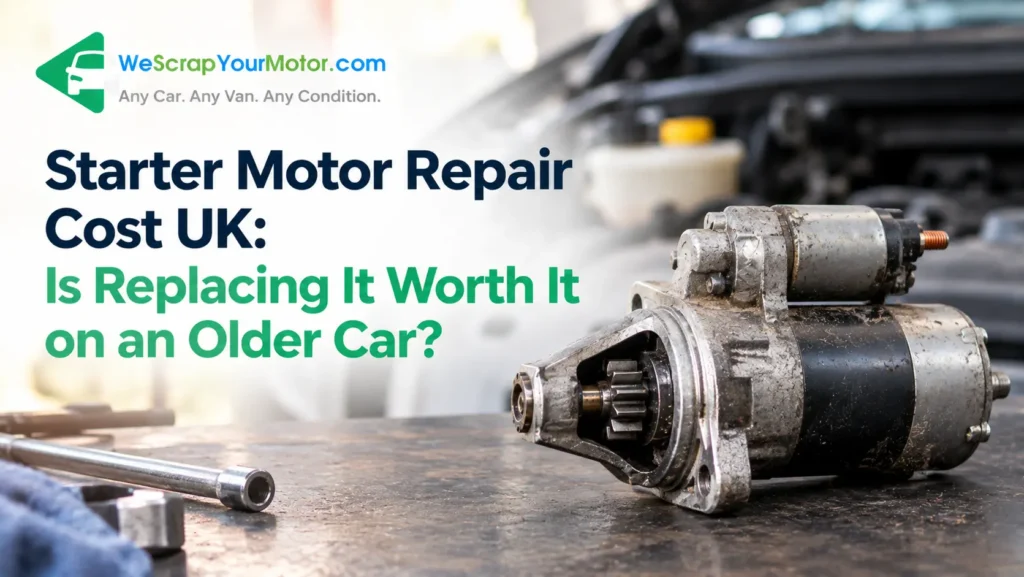
The starter is a powerful electric motor that briefly turns the engine when you use the ignition or start button. It works with the battery, control circuit and starter solenoid. Once combustion begins and the engine runs under its own power, the starter stops driving it.
That makes it different from the alternator, which helps charge the battery while the engine is running. It’s also different from the battery, which stores the energy needed for starting. When a car refuses to crank, several components in this chain could be responsible.
This distinction has financial consequences. Buying a replacement starter when the real issue is a discharged battery does not cure the fault. Similarly, a car that cranks normally but won’t fire may have a fuel, ignition or engine-management problem, rather than a starter problem.
The starter motor repair cost only becomes relevant once a competent diagnosis identifies the component that needs work. Until then, treat any price as provisional.
Signs Your Starter Motor May Be Failing
A faulty starter can sometimes work intermittently before it stops altogether. Owners may notice that starting takes several attempts, or that the fault happens more frequently after the car has been driven and parked again. The precise pattern depends on the defect.
Clicking during an attempt to start is a common clue, but it is not proof. A weak battery or a poor electrical connection can create a similar sound. Grinding or unusual engagement noises may also require investigation, particularly if they occur when the ignition is operated.
A complete lack of cranking is another possibility. If you are researching starter motor repair cost because of this symptom, remember that several other electrical faults can produce it.
But if the engine is already turning over at normal speed, the starter is doing at least its basic job. In that situation, paying for a replacement without further testing could be wasteful.
If you notice burning smells, smoke or abnormal electrical behaviour, stop attempting to start the vehicle and arrange professional assistance. Repeated attempts against a suspected mechanical or electrical fault can make the situation worse.
Starter Motor, Battery or Alternator: What Is the Difference?
One of the most expensive mistakes is interpreting every no-start condition as a failed starter. A mechanic should establish whether the fault lies in the power supply, starter circuit or engine itself.
| What You Notice | Possible Explanation | What to Ask the Garage |
| Rapid clicking or noticeably dim lights | Weak battery or electrical supply issue | Has the battery and connection condition been checked? |
| Single click but no engine cranking | Starter circuit, solenoid or supply fault | Is power reaching the starter correctly? |
| Engine cranks normally but will not start | Fuel, ignition or engine-management issue | Has the no-start fault been diagnosed beyond the starter? |
| Battery repeatedly loses charge | Battery, charging-system or parasitic-drain problem | Has the charging system been assessed? |
| Intermittent no-crank despite a healthy battery | Starter or control-circuit issue | What evidence confirms the defective part? |
These are possibilities, not diagnoses. Modern cars can have complex electronics and stop-start systems, which makes guessing from sound alone especially unreliable. A professional can test the appropriate circuits using vehicle-specific procedures.
Before agreeing to the starter motor repair cost, ask for a plain-English explanation of what was tested and what result supports replacement. A reliable garage should be able to distinguish a confirmed fault from a suspected one.
Why the Quoted Price Can Vary So Much
Even two cars from the same manufacturer can have different engine layouts and starter specifications. A straightforward replacement on a small hatchback may need less labour than a job on a more tightly packaged engine. A stop-start-compatible unit or an unusual part can also alter the price.
Access and Labour
The starter’s location is one of the biggest influences on the bill. RAC says replacement can take up to four hours depending on vehicle design, although the time for your exact model may be shorter or longer.
A quote should reflect that specific job rather than a universal labour allowance.
Choice of Replacement
A manufacturer-branded part, an equivalent aftermarket unit and a professionally reconditioned starter may have different prices. They may also come with different warranty terms.
Cheaper does not always mean better overall value if a part fails prematurely.
Workshop Pricing
Labour charges differ between independent garages, dealerships and mobile repair services.
For illustration, RAC’s January–March 2025 sample showed average quotations of £353 in London and £339 in Southend. These are historical RAC-specific figures, not current fixed rates for either location.
Extra Work
A corroded cable or related electrical fault can change the repair plan. A diagnostic visit, roadside recovery or replacement battery may also be billed separately.
Always ask the garage to seek approval before expanding the work.
Understanding these factors makes the starter motor repair cost easier to compare between quotations that initially look very different.
Is It Better to Repair the Existing Starter or Replace It?
The answer depends on which part has failed and the availability of a dependable repair. A problem involving external wiring or a separate control component might be solved without replacing the motor.
A specialist might also refurbish a particular starter assembly if the parts and labour make commercial sense.
However, when the starter motor itself has failed internally, fitting a suitable replacement unit is frequently the practical garage option. It reduces uncertainty over how much internal refurbishment will cost and may offer clearer parts warranty coverage.
Ask which choice is being proposed: a new original-equipment unit, an aftermarket equivalent or a reconditioned assembly.
Have the garage confirm compatibility using the vehicle registration and engine details. Check who is responsible if the replacement part develops a problem during the stated warranty period.
A quote that includes a lower-priced part but excludes labour or VAT may not be cheaper than a fully itemised alternative. A fair starter motor repair cost comparison uses total fitted prices and like-for-like warranties.
Assess the complete starter motor repair cost, not just the advertised price of the component.
How Long Does Starter Motor Replacement Take?
For some vehicles, replacement can be completed during a workshop appointment. More complicated layouts can require substantial access work. RAC indicates that the job may take up to four hours, with timing dependent on the vehicle’s design.
The time your car is unavailable can be longer than the hands-on labour time. A workshop may first need to diagnose the problem, source a compatible part and schedule the repair.
If the car is stranded, recovery arrangements can add further delay.
Ask the garage when it expects to begin work, whether the part is in stock and whether any complications could change the quoted labour.
If you depend on the vehicle for school runs or work, that information is part of the repair decision.
When calculating the starter motor repair cost, include any unavoidable transport and recovery expenses, but avoid assuming that every vehicle will require them.
Is a £300 Starter Repair Worth It on a £1,000 Car?
Sometimes, yes.
Comparing the repair bill with the vehicle’s current resale value is useful, but it does not capture the entire value of having working transport. A £1,000 car that has been carefully maintained may provide another year or more of useful service after an isolated starter replacement.
Suppose the car has recently passed its MOT, has sound tyres and brakes, and has no known major engine or gearbox problems.
Spending £300 on one confirmed fault may be preferable to buying an unfamiliar used car for several thousand pounds.
Now change the facts.
The same vehicle has serious corrosion advisories, an unreliable clutch and overheating symptoms. The starter becomes only one item in a much larger repair programme.
Paying £300 merely returns the owner to a vehicle with expensive unresolved issues.
The starter motor repair cost should be viewed against the car’s expected usefulness after repair. A cheap car is not automatically an uneconomical car, and a relatively expensive car is not automatically worth fixing.
Use the Three-Value Test Before Spending Money
A practical decision begins with three figures: what the car would realistically sell for when roadworthy, how much essential work it needs, and what a buyer would pay for it today in its present condition.
You can then compare the outcomes without relying on a rigid percentage rule.
Consider this example, which is hypothetical and not a WeScrapYourMotor customer quote:
| Figure | Illustrative Amount |
| Realistic market value after repairs | £1,400 |
| Starter replacement | £330 |
| Other essential repairs | £520 |
| Total immediate repair expenditure | £850 |
| Possible sale or scrap offer in current condition | £275 |
If the owner repairs the car for £850 and sells it for £1,400, the difference is £550 before accounting for time, transaction costs or any unexpected work.
If they sell it now for £275, they avoid the repair but give up the possibility of a larger resale amount.
For an owner who wants to keep driving, the equation changes again. The benefits of keeping familiar transport may be worth more than the immediate resale margin. However, a recent series of breakdowns can make further spending risky.
The point is not that one option always wins. The starter motor repair cost is just one input in a decision that may involve years of future use.
The important thing is that the starter motor repair cost becomes meaningful once you compare it against actual alternatives rather than just the car’s age.
Check the MOT History and the Next Twelve Months
Before agreeing to another repair, look beyond today’s breakdown. The GOV.UK MOT history service can show previous recorded failures and advisories. These entries may reveal patterns such as recurring corrosion, worn suspension or brake concerns that deserve a fresh professional assessment.
An MOT pass is not a warranty against future breakdowns, nor does it confirm the condition of every engine or gearbox component.
Service invoices and an honest account of recent symptoms can add useful context. Ask the garage whether other essential work is likely to be needed soon.
Think about tyres, brakes, timing-belt maintenance where applicable, clutch performance, significant leaks and overheating.
You are not trying to predict every future fault. You are trying to avoid spending a large amount on a car already known to need several more repairs.
If the starter motor repair cost is the only immediate expense and the rest of the vehicle is dependable, repair may be sensible. If another substantial bill is almost certain, get a valuation before approving work.
What If the Starter Fails While Your Car Is in a Garage?
A non-running car can be more awkward to sell if it is already on somebody else’s premises.
A garage may have carried out a diagnostic inspection or ordered parts. There may also be recovery or storage charges to settle before you can move the vehicle.
Ask for the written diagnosis, confirm what work has been authorised and request the current balance.
If you decide not to proceed, ask how and when the vehicle can be released. Obtain permission for an outside collection company to access the site.
Do not assume that a scrapyard or recovery driver can enter a workshop yard without the garage’s agreement.
Similarly, do not agree to extra work merely because you feel pressured by storage deadlines. Ask for clear written terms so you can compare options promptly.
This is particularly important if the starter motor repair cost is being added to existing charges for unsuccessful repairs or repeated diagnostic work.
Can You Sell or Scrap a Car That Won’t Start?
Yes. A vehicle does not have to start to be assessed for scrap or salvage.
Even if its starter no longer works, the car can contain recoverable metals and, depending on condition, reusable components.
A confirmed scrap quotation will depend on the actual vehicle and market rather than a standard allowance for starter failure.
A buyer may also consider whether the vehicle is complete, whether it has accident damage and whether it can be collected safely.
A vehicle that rolls and steers freely may be easier to recover than one with locked wheels or severe suspension damage.
Explain these circumstances honestly instead of assuming the collector can manage every situation.
If you want a starting point for the car’s value, use WeScrapYourMotor’s Scrap My Car service to request a quote based on its registration, condition and postcode.
The offer can then be compared with the confirmed starter motor repair cost.
Remember that a potentially repairable non-runner may also attract a salvage buyer. Ask whether the offer is for permanent end-of-life treatment or for a vehicle that might be repaired and resold.
How Does Collection Work for a Non-Running Car in Essex?
If the vehicle is in Essex, explain its exact parking location and access arrangements when enquiring.
A car on a driveway with its wheels fitted presents a different collection job from one with seized brakes in a restricted underground car park.
A garage may need to authorise access if the car is being stored there.
Give an accurate description of whether the car starts, rolls and steers.
If you are unsure, say so rather than attempting unsafe checks yourself. The collection provider can determine what recovery equipment is appropriate and whether the location can be serviced.
You can check collection arrangements through Scrap My Car in Essex.
Confirm the amount offered, any conditions and whether transport is included before accepting. Vehicle-specific details are more useful than promising yourself that a collection will always be free or available on the same day.
If your car is needed for work, ask about the confirmed appointment rather than assuming it can be removed immediately.
What Paperwork Matters When You Scrap an Older Car?
For a vehicle being permanently scrapped, UK government guidance requires it to go to an Authorised Treatment Facility, or ATF.
GOV.UK says the keeper should provide the V5C log book when available, retain the appropriate section and notify DVLA of the transfer to the ATF.
Failing to notify DVLA can result in a fine of up to £1,000.
If you want to retain a personalised registration number, deal with that before the car is scrapped.
A qualifying vehicle that is completely destroyed should receive a Certificate of Destruction from the ATF.
Keep the relevant confirmation and payment records for your own files.
A scrap transaction is different from selling a vehicle for repair or resale, so clarify what happens to the car and which documentation applies.
Never assume that handing over the keys alone transfers every responsibility.
The legal disposal process is a separate consideration from the starter motor repair cost, but it matters if scrapping becomes your preferred option.
How to Avoid Paying for a Repair You Don’t Need
If the car is worth keeping, a careful diagnostic conversation can prevent unnecessary spending.
Explain exactly what happened, including whether the engine cranks, whether you hear a click and whether the battery recently needed attention.
Ask what the mechanic checked and whether the findings confirm a starter fault.
Request the complete estimate before authorising replacement. It should identify the part type, labour, VAT, diagnostic fees and warranty terms.
Ask whether the garage will contact you before doing additional work. That agreement prevents a quoted starter motor repair cost from expanding without your approval.
A quote that excludes diagnosis may be appropriate, but it should say so clearly.
It can be reasonable to seek another professional opinion when an expensive job is proposed without a convincing explanation.
A second assessment has its own cost, so weigh that against the potential saving.
Do not buy a starter online solely because its price appears low and assume it will fit your exact engine.
The best way to control the starter motor repair cost is to establish the correct fault and understand the full approved bill.
Frequently Asked Questions About Starter Motor Costs
Can a Starter Motor Fail Suddenly?
Yes. Some faults develop gradually, while others appear without much warning.
Intermittent starting problems should be investigated rather than ignored. A sudden failure does not, by itself, show that the rest of the car is beyond repair.
Can I Drive a Car with a Faulty Starter Motor?
The starter’s role is to get the engine running, so a fault may leave you stranded the next time you switch off.
Do not rely on an intermittently working system, and arrange professional help if there are unusual noises, smoke or electrical symptoms.
Is a Reconditioned Starter Worth Buying?
It can be, if the part is compatible and comes from a reputable supplier with a clear warranty.
Ask your garage about reliability, availability and the total fitted price. A lower component price alone does not guarantee better value.
How Many Hours Does Starter Motor Replacement Take?
The answer varies by car.
RAC says the job can take up to four hours depending on layout and access. Your garage should estimate labour for your specific model rather than apply a universal time.
Does a Failed Starter Motor Mean My Car Will Fail Its MOT?
Not automatically.
The MOT is a defined roadworthiness inspection, not a guarantee that every mechanical component works perfectly.
However, a vehicle that cannot be started may be unable to complete the required testing. Ask the test centre about your particular situation.
Is Starter Motor Repair Cheaper Than Buying Another Car?
Often, but not always.
Compare the confirmed starter motor repair cost, other necessary work, the vehicle’s expected reliability and the cost of replacing it.
A single inexpensive repair may be good value, while repeated large bills may make changing cars sensible.
Can I Scrap My Car Without Fixing the Starter?
Yes.
A non-running car can still have scrap or salvage value, subject to its overall condition and suitable collection arrangements.
Disclose the starting problem and any other known faults when requesting a quote.
Make Your Next Decision Based on What the Car Is Really Worth
An older car that will not start is frustrating, but its age and one faulty part should not decide its future.
First establish whether the starter is actually responsible. Then compare an itemised repair quote with the condition of the rest of the vehicle, its realistic value and the cost of suitable replacement transport.
If the engine, gearbox, bodywork and MOT history are otherwise reassuring, fixing the starter may give you worthwhile additional use.
If serious faults are piling up, it is reasonable to explore selling the vehicle in its current condition rather than paying for another uncertain repair.
Our guide to deciding whether to sell or scrap your car explains the wider financial comparison.
For now, use the confirmed starter motor repair cost alongside a realistic vehicle valuation, then choose the