
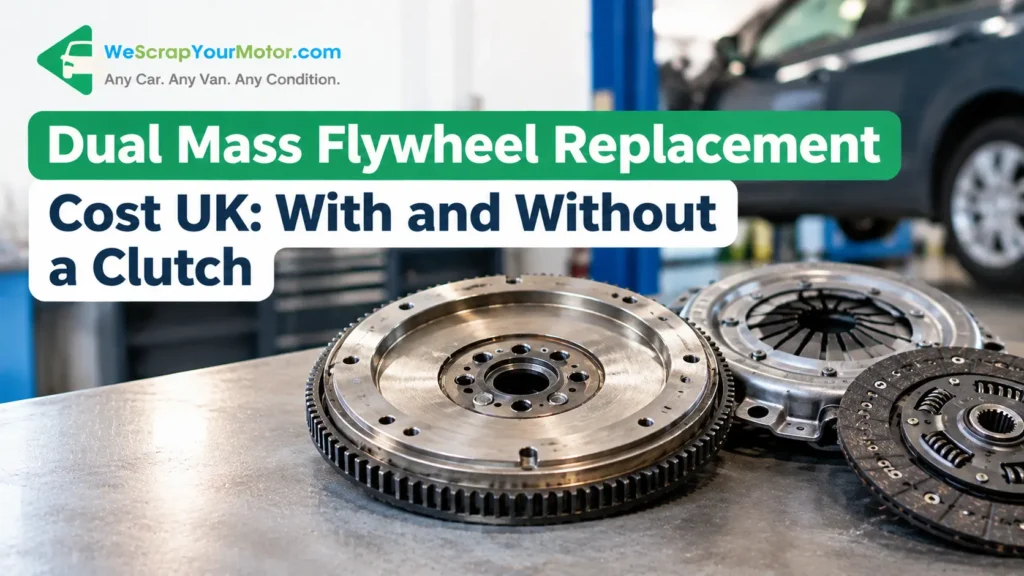
“The clutch needs replacing, and the flywheel might need doing too.”
That sentence can turn a manageable repair estimate into a much more difficult decision. You may wonder whether the garage is being thorough or adding an expensive part unnecessarily.
The dual mass flywheel replacement cost depends heavily on the vehicle, the parts required and whether the gearbox is already being removed for another job.
For context, one UK repairer publishes clutch-and-flywheel figures of approximately £780 to £1,250 for diesel hatchbacks, with larger vans and four-wheel-drive vehicles potentially costing substantially more. These are that repairer’s published examples, not a national fixed tariff.
Replacing the flywheel without the clutch may reduce the parts bill, but it does not remove most of the access work.
The right approach is to understand what has failed, what can reasonably be reused and how much additional work is involved while the transmission is accessible.
What Does a Dual Mass Flywheel Actually Do?
A dual mass flywheel, commonly shortened to DMF, helps manage the uneven rotational forces produced by an engine.
It sits between the engine and transmission system and uses a two-mass arrangement to reduce vibration reaching the drivetrain.
This is why it should not be viewed simply as an expensive metal disc. Its condition affects how smoothly the drivetrain operates.
ZF describes the DMF as a component that can be assessed using appropriate inspection methods and specialist tools. That matters because replacement should follow a proper condition assessment rather than an assumption based on vehicle age.
Not every car has one. Do not accept a quotation until the workshop has identified the actual transmission and flywheel arrangement.
A petrol or diesel label alone does not establish the specification.
Understanding that first point prevents you from comparing dual mass flywheel replacement cost figures for vehicles with fundamentally different systems.
How Much Does Replacement Cost?
There are three different prices people often confuse.
The first is the flywheel part itself. The second is the complete fitted price when the gearbox must be removed specifically for the repair. The third is the additional charge for fitting the flywheel during an already authorised clutch job.
Those prices should not be treated as interchangeable.
| Quotation Type | What It Usually Covers | Main Comparison Risk |
| Flywheel Part Only | the Component | Labour and Associated Items Are Excluded |
| Flywheel Replacement Alone | Access, Replacement and Reassembly | Existing Clutch May Be Reused |
| Clutch and Flywheel Together | Shared Access Plus Both Assemblies | Kit Contents May Differ |
| Flywheel Added During Clutch Work | Extra Part and Incremental Work | Full Access Labour Should Not Be Counted Twice |
A reasonable dual mass flywheel replacement cost quotation should identify which of these situations applies.
Ask for a vehicle-specific figure including VAT where applicable. Generic online averages cannot account for the exact part, drivetrain layout and condition of surrounding components.
Why Is Labour So Significant?
The flywheel is not normally an easily accessible external service part.
Access generally involves separating the engine and transmission, with the exact procedure depending on the vehicle.
That can require substantial workshop time before the technician reaches the component being replaced.
Once access has been gained, fitting the additional part may involve much less time than repeating the entire removal process later.
This is the central reason clutch and flywheel work is often considered together.
However, “the gearbox is already out” does not mean every additional component should automatically be renewed. Each recommendation still needs a reason.
When assessing dual mass flywheel replacement cost, ask the garage to separate access labour from extra work.
A clear quotation helps you see whether combining repairs provides a real saving.
It also makes an unexpected telephone call easier to assess if the workshop discovers a worn flywheel after removing the gearbox.
Must the Clutch Always Be Replaced Too?
Not automatically.
The answer depends on the clutch’s condition, age, history, contamination and compatibility with the repair.
If the clutch is heavily worn, replacing only the flywheel could leave you paying much of the same access labour again when the clutch fails.
If a suitable clutch was fitted recently and remains serviceable, reuse may be worth discussing.
Ask the workshop to explain the findings rather than rely on an absolute rule.
A photograph may help demonstrate obvious damage, but some assessments require measurements or manufacturer-specific criteria.
Your dual mass flywheel replacement cost should reflect the actual condition found.
It is also reasonable to ask whether reusing the clutch changes the workshop’s warranty terms. A business may distinguish between the new component it supplies and an existing component it agrees to reinstall.
That distinction should be explained before you decide.
Must the Flywheel Always Be Replaced During Clutch Work?
Again, not automatically.
A clutch replacement provides an opportunity to inspect the flywheel. It does not prove that the flywheel is defective.
ZF advises checking a DMF when a clutch is replaced because a worn or defective unit can undermine the new clutch and lead to repeated work. That supports inspection, not indiscriminate replacement of every flywheel.
Ask whether the flywheel passes the applicable checks and whether any limitations remain.
A workshop should not promise an exact remaining lifespan for a used component based only on an inspection. Equally, it should not present uncertainty as proof of failure.
The dual mass flywheel replacement cost is easiest to justify when the technician can explain a confirmed defect, unacceptable wear or a well-supported reason for preventive replacement.
If the recommendation is preventive, request that description clearly. It allows you to distinguish necessity from risk reduction.
Which Symptoms Make a Check Sensible?
Drivers may report rattling, vibration, judder or changes during starting and stopping.
Those observations can help a technician investigate, but they are not a remote diagnosis.
Other drivetrain, engine-running or mounting problems can produce symptoms that appear similar from inside the cabin.
Record when the problem occurs. Is the engine cold or warm? Is the car stationary or moving? Does the symptom happen during starting, idling, moving away or switching off?
You do not need to perform aggressive tests yourself. A clear description is more useful than repeatedly provoking the fault.
ZF’s technical guidance discusses checking other possible causes when investigating DMF-related noise.
Before agreeing to the dual mass flywheel replacement cost, ask what evidence connects your symptoms to the flywheel.
A diagnosis based solely on “these cars often need one” deserves further explanation.
Can You Continue Driving?
There is no responsible universal mileage allowance for a suspected failing flywheel.
The severity and cause of the symptoms need assessment.
If the vehicle develops severe vibration, significant abnormal noise, loss of drive or another condition affecting control, stop safely and arrange assistance.
For milder symptoms, ask the inspecting workshop whether the vehicle is suitable to drive before the booked repair.
Do not interpret a quiet period as proof that the problem has resolved itself.
Also avoid searching for a way to extract a guaranteed extra month from a component whose condition is unknown.
The dual mass flywheel replacement cost can become only part of the expense if continued use results in further damage or an inconvenient breakdown.
That does not mean every rattle requires immediate replacement. It means the driving decision should follow the actual diagnosis rather than a generic internet estimate.
What Should the Quote Include?
The quotation should name the flywheel and identify the clutch-related components included, if any.
A “clutch kit” can mean different packages. Ask whether the release bearing or concentric slave cylinder is included where applicable.
Also establish whether required fasteners, fluids and seals are covered.
The relevant parts depend on the vehicle and repair procedure. Do not expect every line item to apply to every car.
A concise booking checklist is useful:
- Confirm the exact parts and their manufacturer
- Ask whether VAT and required consumables are included
- Agree how unexpected findings will be approved
- Check the parts-and-labour warranty
- Confirm the completion estimate
For dual mass flywheel replacement cost comparisons, equal scope matters more than identical headline wording.
One quote may appear higher because it includes a hydraulic component that another garage has left out.
Ask why that component is recommended and what the extra charge achieves.
How Much Can Shared Labour Save?
Consider a hypothetical clutch quotation of £650.
During inspection, the garage recommends a flywheel costing £400, with £50 of additional agreed work. The combined total becomes £1,100.
Now imagine declining the flywheel and needing it replaced later. You could face the component price plus much of the access labour again.
The potential saving comes from avoiding repeated access, not from receiving the flywheel for free.
These figures are illustrative and should not be treated as a model-specific price.
Your dual mass flywheel replacement cost may be higher or lower, depending on the part and vehicle.
Ask the garage to show the difference between replacing it now and undertaking the same repair separately.
That comparison is more informative than a general statement that you “might as well do everything”.
You can then decide whether the condition and your ownership plans justify the additional expenditure.
Should You Fit a Cheaper Single Mass Conversion?
Do not treat a single mass conversion as an automatically equivalent budget substitute.
A conversion changes the way the drivetrain manages vibration. Suitability depends on the exact application and the engineered kit.
ZF has warned that replacing a DMF with an unsuitable single mass arrangement can reduce refinement and, in the worst cases, contribute to transmission damage. That warning is a reason to check application suitability carefully.
Ask who manufactures the proposed kit, which vehicle specification it covers and what changes the installer expects.
If the only explanation is “it is cheaper”, you do not have enough information.
A reduced dual mass flywheel replacement cost is not a useful saving if the alternative creates unacceptable vibration or weakens confidence in the repair.
For an everyday road car, retaining the correct specified arrangement is often the clearer comparison unless a qualified specialist can justify another solution.
Can a Used Flywheel Save Money?
A used component can look attractive when the car’s value is low, but its condition and history may be difficult to establish.
The access labour remains substantial regardless of whether the fitted part is new or used.
That means a poor component choice can expose you to repeating the expensive part of the job.
Ask whether the workshop will fit a used flywheel and what warranty, if any, applies to the component and installation.
Do not assume a used part is suitable because it came from a lower-mileage vehicle. Mileage is only one piece of information.
Similarly, avoid treating an unspecified refurbished unit as equivalent to a traceable new component.
The dual mass flywheel replacement cost should be considered over the period you intend to keep the vehicle.
Saving a smaller amount on an uncertain part may not be sensible when failure would require another major removal operation.
Is the Repair Worth It on a High-Mileage Car?
High mileage is a reason to assess condition, not an automatic instruction to scrap.
A regularly maintained car with sound bodywork and a healthy engine may still provide useful service after clutch and flywheel work.
The calculation changes if it also needs substantial corrosion repairs, emissions-system work or another expensive mechanical repair.
Ask for an assessment of known upcoming needs before approving the bill.
Our guide to scrapping a car with clutch failure can help when the transmission repair sits within a wider pattern of deterioration.
Avoid treating the original purchase price as the main reference. What matters now is the cost of keeping the vehicle compared with obtaining an acceptable alternative.
A familiar car with documented maintenance may remain preferable to another inexpensive used car with unknown problems.
The decision should reflect evidence about both options.
Use a Twelve-Month Comparison
Imagine an illustrative £1,150 clutch-and-flywheel repair.
If the car also needs £600 of known work soon, your foreseeable spending becomes £1,750 before normal running expenses.
Compare that with the net cost of another suitable vehicle, including purchase checks and immediate maintenance.
Do not add every imaginable future fault to the current car while assuming the replacement will be trouble-free. That produces a biased result.
Equally, do not ignore a confirmed major defect because you like the vehicle.
A valuation through Scrap My Car gives you a concrete alternative figure to include in the comparison.
For a car you intend to retain, the relevant benefit is usable transport. You do not need to recover the entire repair bill through an immediate resale-price increase.
However, if you plan to sell shortly, spending on a major repair deserves a separate sale-value calculation.
What if the Garage Finds More Damage?
Agree on the process before work starts.
Ask the workshop to contact you with a description, supporting evidence and a revised total before undertaking additional work.
You should know whether declining the extra work leaves the vehicle safely reassemblable and what charges will remain payable.
Sometimes the most sensible decision changes after access reveals the true condition. That is not automatically evidence of a poor original quotation, provided its limitations were explained.
Owners considering Scrap My Car in Salisbury should mention if the gearbox has already been removed.
A dismantled car may have different collection requirements, and the garage may need payment and release authorisation before the vehicle can leave.
Do not assume that selling the car makes the diagnostic labour disappear.
Include those committed costs when comparing the remaining options.
What Should Happen After Fitting?
Ask the workshop what checks were completed and whether it identified any remaining concerns.
Collect an invoice recording the supplied parts and warranty.
If the original symptom remains, report it promptly and describe the circumstances clearly. A new component does not prove that every source of vibration or noise has been addressed.
You should also ask whether there are any application-specific running-in instructions for the clutch assembly.
Follow the fitter’s documented guidance rather than adopting generic driving advice intended for a different component.
For everyday use, avoid habits that place unnecessary strain on the drivetrain, such as repeatedly demanding heavy acceleration in an unsuitable high gear.
However, do not accept driver blame as a substitute for investigation if a recently completed repair develops a problem.
Clear records protect both the owner and the workshop by showing what was agreed and completed.
Approve the Work Based on Condition and Shared Labour
A dual mass flywheel replacement cost makes sense when it reflects a confirmed need, appropriate parts and an honest allowance for the work involved.
The clutch and flywheel should be considered together because access overlaps. They should not be treated as inseparable components that must always be replaced regardless of condition.
Ask for the evidence, compare equivalent quotations and understand the warranty.
If the car remains sound, a properly scoped repair may be a worthwhile investment. If several major expenses are accumulating, compare the full ownership picture before committing.
The strongest decision is the one you can explain from the diagnosis and the numbers, rather than from pressure to choose the cheapest quote or replace every part.