
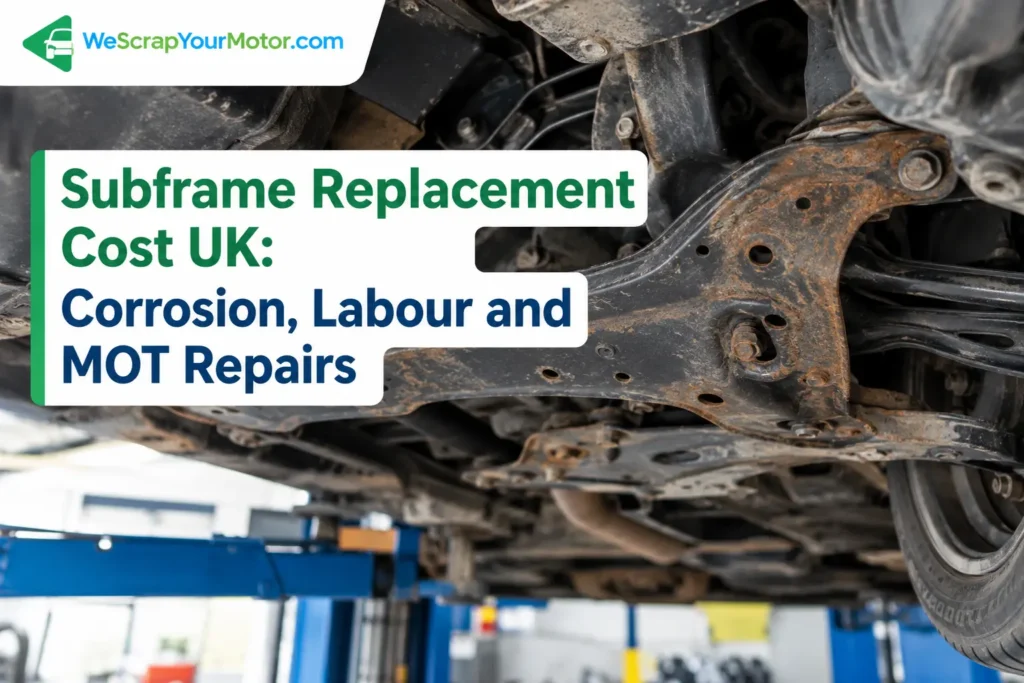
A subframe replacement cost is difficult to judge from an MOT failure notice alone. The same phrase can describe a relatively straightforward component replacement or a job complicated by corrosion around the vehicle’s mounting points.
The first question is therefore not “How cheaply can I buy a subframe?” It is “What has failed, and is the surrounding structure sound?”
A replacement component can address a defective subframe. It cannot automatically solve corrosion in the body structure to which that component attaches.
For budgeting, an uncomplicated job may run into several hundred pounds, while work involving costly parts, difficult removal or associated damage can exceed £1,000. These are broad planning descriptions, not a verified national average.
The sections below follow the decision from inspection to repair approval. They explain which findings change the bill and why some older cars remain worth repairing while others need a wider structural assessment first.
Inspection Stage: Identify the Actual Component
Before requesting a subframe replacement cost, establish exactly what the garage means by subframe.
Vehicles use different arrangements. A front carrier, rear suspension subframe and rear axle assembly are not interchangeable descriptions.
Ask the garage to identify the component on the vehicle or provide a photograph. Confirm whether the problem is corrosion, accident damage, a mounting fault or a worn replaceable bush.
This distinction affects both the repair and the parts search. Buying a rear axle because an online advert uses the word “subframe” could leave you with the wrong component.
Use the registration, VIN and appropriate part identification rather than relying on model name alone.
Also establish whether the recommendation is based on a current defect or a preventive assessment. A corroded but serviceable component and a structurally weakened one require different discussions.
Clear identification at this stage prevents confusion throughout the quotation process.
Inspection Stage: Separate Surface Rust From Lost Strength
The subframe replacement cost only becomes relevant once the inspection establishes that replacement is appropriate.
Brown surface staining does not tell you how much strength remains. Equally, a component that looks acceptable from one angle may have serious local deterioration elsewhere.
Ask the inspecting garage what it found and why the condition requires replacement. Photographs can help you understand the location, although they cannot replace a physical assessment.
Avoid judging the issue solely from the size of a visible rust patch. The significance depends on the component and the affected area.
The DVSA inspection manual notes that thin pressed-steel components, including some subframes, can develop serious local corrosion that requires close inspection.
An owner should not crawl beneath a vehicle supported only by its emergency jack to investigate. Have the assessment performed with suitable workshop access and equipment.
The goal is a reliable condition report, not simply a more dramatic photograph of the rust.
Inspection Stage: Check the Vehicle Around the Subframe
A subframe replacement cost can rise sharply when the surrounding mounting structure needs attention.
Ask whether the body attachment points have been assessed and whether removal might expose additional deterioration.
A sound replacement assembly needs sound attachment points. If the garage cannot yet confirm their condition, that uncertainty should appear in the estimate.
This is especially important when buying a low-value vehicle advertised as needing “just a subframe.” The phrase may accurately describe the problem, but it may also conceal an incomplete diagnosis.
Request evidence rather than assuming either the best or worst outcome.
The inspection should also identify associated components that may need transferring, replacing or further checking. Ask the garage to distinguish confirmed work from possible work.
That gives you an informed choice about proceeding to dismantling, with an agreed stopping point if the vehicle proves less sound than expected.
Pricing Stage: Build the Bill From Its Components
The subframe replacement cost is best understood as a collection of separate charges.
| Cost Element | Why It Matters |
| Replacement assembly | Price depends on specification, condition and availability |
| Removal and refitting | Access and corrosion affect the required work |
| Mountings and fasteners | Some items may need replacement during installation |
| Associated components | Condition may justify additional work |
| Geometry checks | Required checks depend on the repair and vehicle |
| Unexpected structural work | Must be assessed separately if discovered |
| Transport and retesting | Can increase the owner’s total expenditure |
Ask for the VAT position and identify any charges not included in the headline figure.
Do not add together every possible extra as though all cars need them. Instead, ask which items are confirmed for your vehicle and which remain provisional.
A transparent quote gives you a base price, explains the uncertainty and states when the garage needs further approval.
That is more useful than a reassuring low estimate with no information about what happens once dismantling begins.
Pricing Stage: Compare New And Used Parts
Part selection can make a substantial difference to the subframe replacement cost.
A new part may offer clearer condition and warranty information, although price and availability vary. A used assembly may be affordable, but its structural condition must be assessed carefully.
Age and mileage alone do not prove that a used component is sound. Ask about corrosion, previous repairs, damage and compatibility.
A freshly painted part deserves the same inspection as an unpainted one. Paint is not evidence of structural quality.
Online retail listings illustrate why parts-only figures vary. One supplier lists different support frames at prices ranging from approximately £140 to more than £430, depending on the product. Those listings do not establish the fitted cost for your car.
Have the garage approve a customer-supplied part before purchase. Also agree who is responsible for return costs and labour if the component is unsuitable.
A bargain that cannot be fitted correctly is not a saving.
Pricing Stage: Understand What Is Included with the Assembly
Two parts with different prices may not contain the same items.
One subframe could be supplied bare. Another might include bushes, brackets or other attached components. Used assemblies may include parts that still need inspection before reuse.
Ask the garage to list what is being transferred from your vehicle and what is being replaced.
Do not assume an attached suspension arm or bush is serviceable simply because it arrives with the replacement assembly.
Likewise, do not assume every transferred component needs renewing. Decisions should be based on condition, compatibility and the requirements of the job.
This detail helps explain differences between quotations that otherwise appear identical.
It also helps you assess the warranty. If a supplied assembly includes several components, establish which are covered and whether the warranty applies to the whole assembly or only the structural carrier.
Clear parts descriptions reduce disagreements after the car has been dismantled.
Labour Stage: Allow For Difficult Removal
The subframe replacement cost can change when corroded fittings resist removal or associated parts cannot be separated without damage.
A responsible garage should explain this possibility without treating it as permission for unlimited spending.
Agree whether the quoted labour is fixed or estimated. If estimated, ask for the hourly rate and an approval threshold.
For example, you might authorise the initial removal work but require photographs and a revised quotation before any additional structural repair.
The exact arrangement is for you and the garage to agree. What matters is having it documented.
Also ask about downtime. A job can pause because a replacement component or additional fitting is unavailable, even when the actual labour requirement is manageable.
If the vehicle is your only transport, include alternative travel in the decision. The cheapest workshop quotation may not produce the lowest total cost if availability causes a lengthy delay.
Repair Stage: Check Whether Welding Is Appropriate
Owners sometimes hope welding will avoid the full subframe replacement cost. Whether that is suitable depends on the component, damage and permitted repair method.
Do not assume every corroded subframe can be patched safely. Equally, a general internet statement cannot assess the exact component fitted to your car.
The DVSA manual says welded repairs to highly stressed components are not normally acceptable, subject to its stated qualifications. The correct assessment must consider the component’s design and applicable repair guidance.
Ask the workshop to explain why its proposed method is appropriate, particularly around load-bearing areas and mountings.
A promise that “it will get through the MOT” is not a substitute for a sound repair plan.
For a decision about keeping a heavily corroded vehicle, our guide to scrapping a car with rust damage provides broader ownership considerations.
The priority is restoring the necessary structural condition, not choosing whichever method uses the least material.
MOT Stage: Read the Failure Wording Precisely
An MOT report provides a useful starting point, but it does not calculate your subframe replacement cost.
Read the exact defect wording and ask the test station to show you the affected area where practical.
Do not confuse an advisory with a major or dangerous defect. The categories have different implications, and the current physical condition still matters.
The DVSA suspension manual provides the relevant inspection framework for Great Britain. Northern Ireland has a separate testing system, so owners there should confirm the applicable local requirements.
If the vehicle is considered unsafe, arrange recovery rather than assuming a journey to another garage is acceptable.
Also ask whether other failures remain. Completing the subframe work does not resolve unrelated tyre, brake or lighting defects.
A useful repair estimate should address the identified work clearly enough that you can understand what will remain before the vehicle is ready for retesting and use.
Budget Stage: Compare Two Illustrative Jobs
Consider how the subframe replacement cost might differ between two hypothetical cars.
The first has a damaged front assembly, sound body mounting points and readily available replacement parts. The job requires replacement, associated fittings and appropriate geometry checks.
The second has a corroded assembly, uncertain attachment-point condition and several seized associated components. Its final repair scope cannot be confirmed until more investigation is completed.
These are different projects even if both MOT reports mention a subframe.
To illustrate the budgeting process, imagine a quote containing £300 for a suitable component, £450 labour and £150 for fittings and final checks. The total would be £900.
Those figures are an example of arithmetic, not market prices for a particular model.
Ask your garage for the same separation using actual figures. Then establish which items are fixed and what could increase the bill. That is the number you can use to compare repair against replacement transport.
Ownership Stage: Decide Whether the Whole Car Justifies Repair
A subframe replacement cost should be judged against the vehicle’s overall condition and your transport needs.
A car with a sound engine, reliable transmission and otherwise healthy structure may remain useful after replacement of a defective assembly.
The calculation changes when corrosion extends across several areas or when other major mechanical repairs are imminent.
Do not assume a repair is pointless simply because it approaches the car’s market value. Replacing the vehicle may cost more, and the replacement may require work too.
However, do not ignore mounting uncertainty because you recently bought tyres or paid for servicing. Those costs have already occurred.
If you need a current disposal offer, use WeScrapYourMotor’s Scrap My Car to request a valuation based on the vehicle’s actual condition.
Tell the buyer about structural defects and whether the suspension remains assembled. Collection planning can be different for a vehicle that cannot safely roll or support normal loading.
Approval Stage: Set a Clear Stop Point
Before agreeing to the subframe replacement cost, decide what information would change your decision.
You might be comfortable with replacing the assembly but unwilling to fund extensive body repairs discovered during removal. Tell the garage that before work begins.
Ask it to pause if the attachment points are unsound or if the total exceeds the agreed amount.
Clarify what you would owe if you stop at that stage. Inspection, dismantling, reassembly and storage arrangements should not become surprises.
Also consider the practical position of the car. A partially dismantled vehicle may be harder to move, so establish whether it can be made suitable for collection if you decline further work.
This is not an argument against investigation. It is a way of keeping the investigation controlled.
A garage that explains the risks and approval stages clearly gives you a better basis for decision-making than one that promises certainty before it can see the full condition.
Handover Stage: Keep Evidence Of the Completed Job
After the repair, retain the invoice and any relevant photographs or measurements.
Ask the garage to confirm what was replaced, which associated items were renewed and what final checks were completed.
If the vehicle required an MOT retest, keep that result with the repair documents. It provides a record of the outcome, though it is not a lifetime guarantee against further corrosion.
Ask whether there are other areas to monitor during future servicing. A single repaired component does not establish the condition of every part underneath the vehicle.
If corrosion protection was included, request a description of what was applied and where. Protection should complement a sound repair rather than hide an unassessed surface.
Good documentation is useful when maintaining or selling the car. It helps the next inspector distinguish completed work from a vague claim that “the underside has been done.”
Questions About Corroded Subframes
Is a Rusty Subframe Always an MOT Failure?
No. The assessment concerns the actual condition and relevant inspection criteria. Surface appearance alone cannot determine the outcome.
Have the component assessed rather than assuming any rust means replacement or that the absence of a hole means it is sound.
Can I Supply a Second-Hand Subframe?
Possibly, but obtain the fitting garage’s agreement first. Confirm compatibility, condition and who bears the cost if the part cannot be used.
A parts warranty may not cover repeated fitting labour.
Does Replacement Include Suspension Arms?
Not automatically. The supplied assembly and agreed repair scope determine what is included.
Ask which existing components will be transferred and whether their condition has been checked.
Can a Car with a Failed Subframe Be Collected?
Collection may be possible, but the operator needs accurate information about the defect and whether the vehicle can roll safely.
If the car is in the area, Scrap My Car in Plymouth is a relevant place to enquire. Mention restricted access, detached components or a wheel that cannot move normally.
Will a Replacement Subframe Prevent Future Rust?
It addresses the replaced component’s condition at that time. It does not guarantee the rest of the vehicle will remain free from corrosion.
Continue appropriate inspections and maintenance.
Approve the Repair Only After the Structure Is Understood
The right subframe replacement cost is one that reflects a suitable component, sound attachment points and a clearly defined installation.
Before proceeding, confirm what has failed, what remains uncertain and when the garage will seek further authorisation.
An older car can remain worth repairing when the problem is localised and the rest of the vehicle is dependable. Widespread deterioration requires a broader decision.
A careful inspection and transparent quote help you avoid both unnecessary disposal and an expensive repair that leaves the underlying structural problem unresolved.