
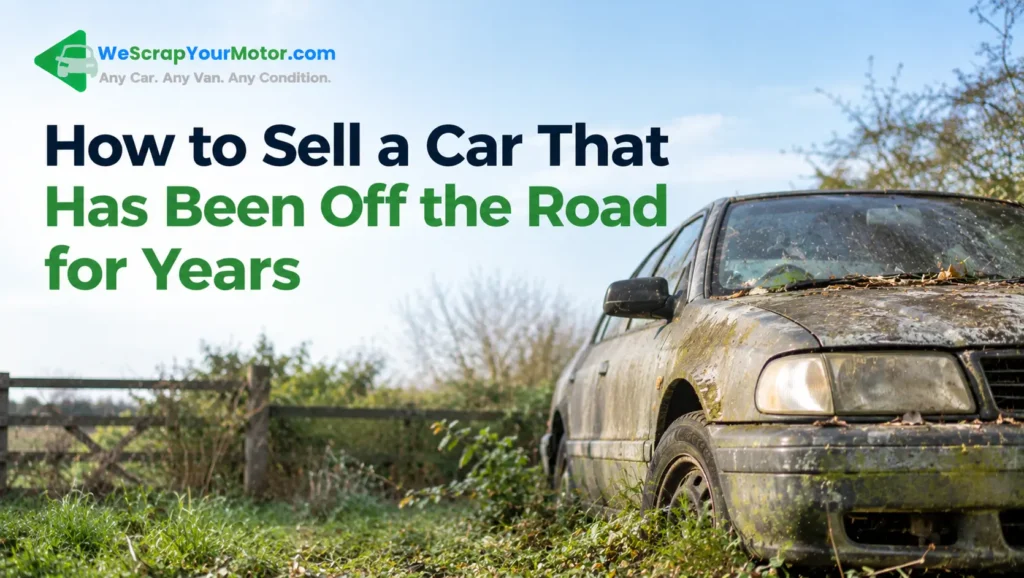
That old car sitting in your driveway might not have moved for three, five, or even ten years. Its tyres may be flat, the battery may be dead, and the MOT could have expired long ago. But does that mean nobody will buy it?
Not necessarily.
You can sell a car that has been off the road for years in the UK, even if it no longer starts or cannot be driven. Depending on its condition, it may still have value as a repair project, a source of reusable parts, or a vehicle for authorised scrapping.
The real challenge is deciding what the car is worth, checking its registration status, and arranging collection without creating unnecessary costs.
You might also need to deal with an old SORN declaration, missing documents, or a vehicle that has deteriorated during storage.
This guide walks through the process from the moment you decide to clear the space to the point when the buyer collects the car and the DVLA records are updated.
First, Find Out What Condition Your Car Is Really In
A car that has been standing unused is not necessarily beyond repair.
However, long-term storage can create problems that are not immediately visible.
The condition of the car when it was last driven may be very different from its condition today.
A vehicle that was mechanically reliable before storage might now have deteriorated tyres, seized brakes, electrical faults, or corrosion.
Before requesting a valuation, make a simple visual assessment.
You do not need to start taking the car apart or carry out a mechanical inspection yourself.
Look at its general condition from a safe position and record what you can see.
Inspect the Exterior
Check whether the body panels are complete and whether there are obvious signs of corrosion.
Pay attention to areas around the wheel arches, sills, doors, and lower bodywork.
A little surface rust is different from serious structural deterioration.
If the underside cannot be inspected safely, leave that assessment to a qualified professional.
Check the Tyres and Wheels
Tyres can lose pressure while a vehicle is parked.
Long periods of standing can also contribute to tyre deterioration and flat spots.
Record whether the tyres appear inflated and whether all wheels are fitted.
Avoid attempting to move a vehicle with visibly damaged tyres.
Look For Signs of Water Damage
Water may enter through damaged seals, open windows, blocked drainage areas, or deteriorated bodywork.
Inspect the interior for visible dampness, staining, or mould without disturbing anything hazardous.
Extensive moisture damage can affect seats, carpets, wiring, and electronic modules.
Record Missing Components
Check whether the vehicle still has its keys, number plates, wheels, battery, and other obvious components.
Do not remove parts merely to inspect their condition.
This first assessment helps buyers understand whether the car is likely to be repairable or more suitable for recycling.
Does a Car Lose Value While It Is Off the Road?
Often, yes, but not always at the same rate.
A stored vehicle’s value depends on age, make, model, condition, demand, and the reason it was taken off the road.
For example, an older classic car with desirable specifications may retain interest among enthusiasts.
A common family hatchback that has stood outside for several years may have limited repair value after significant deterioration.
Storage conditions also make a difference.
A dry garage may protect some components better than prolonged exposure to rain and changing temperatures.
However, a vehicle kept indoors can still develop mechanical and electrical problems.
| Storage Condition | Possible Effect on Value |
| Dry garage, complete vehicle | May help preserve its overall condition |
| Open driveway for several years | Greater exposure to weather and deterioration |
| Missing wheels or major parts | Reduced value and more difficult collection |
| Recently maintained before storage | Maintenance records may support buyer interest |
| Extensive visible corrosion | Repair costs may reduce salvage potential |
| Complete interior and body panels | May support reusable-parts value |
| Rare or desirable specification | May attract specialist buyers |
Time alone does not determine the price.
A buyer will want to understand the actual condition before making an offer.
Check Whether the Vehicle Is Still Registered With the DVLA
One of the first administrative tasks is checking what information DVLA holds.
Many owners remember taking a car off the road but cannot recall exactly when they completed the SORN declaration.
Others have moved house since the vehicle was last used.
The official DVLA vehicle information service allows you to check details using the registration number.
Depending on the record, you can check:
- Vehicle tax status
- SORN status
- MOT expiry information
- Date of first registration
- Last V5C issue date
- Fuel type and other vehicle details
This is particularly useful when you want to sell a car that has been off the road for a long time and have limited paperwork remaining.
What If the Vehicle Details Are Incorrect?
Do not ignore discrepancies.
If your address on the V5C is outdated, follow the relevant DVLA update procedure.
If the registration number, make, or other details do not match the vehicle, establish why before selling it.
An unexplained discrepancy can delay a legitimate transaction and may concern potential buyers.
Keep a record of your correspondence with DVLA when resolving an issue.
Can You Sell a Car That Is Declared SORN?
Yes.
A Statutory Off Road Notification does not prevent you from selling the vehicle.
SORN tell DVLA that the vehicle is being kept off the public road rather than used normally.
The vehicle must remain off the road while that declaration applies.
When the car is sold, the registered keeper must notify DVLA through the appropriate sale or transfer process.
A SORN does not transfer automatically to the new keeper.
The buyer must make their own arrangements for vehicle tax, insurance, and SORN as appropriate.
GOV.UK confirms that new keepers cannot transfer a previous owner’s SORN and must make their own declaration if they intend to keep the vehicle off the road.
Do You Need To Cancel SORN Before Selling?
You do not normally need to put a vehicle back on the road simply to sell it.
If it will be collected using appropriate transport, it can remain off the road until the transfer is completed.
Do not tax a long-unused car solely because you assume that taxation is necessary for collection.
The buyer’s intended use determines what arrangements they must make after acquiring it.
If the car is returning to normal road use, it must meet the applicable legal requirements.
Can You Sell an Off-Road Car Without a Valid MOT?
Yes.
An MOT certificate is not required for the act of selling a vehicle.
A vehicle that has been unused for several years may have no current MOT, and that is common among non-running cars.
However, the absence of an MOT affects how the vehicle can be moved and what the buyer may be willing to pay.
A buyer who plans to repair the car will need to assess its condition before driving it.
A buyer intending to dismantle or scrap it may instead arrange recovery directly.
Do not attempt to drive a long-stored vehicle simply because the engine starts.
Tyres, brakes, steering, and other essential components may have deteriorated during storage.
Even a vehicle with an MOT exemption, such as some qualifying historic vehicles, must remain roadworthy when used on public roads.
For most old vehicles being sold after years of storage, planned recovery is the sensible option.
What If You Cannot Find the V5C Logbook?
Missing paperwork is a common problem with long-stored vehicles.
The V5C may have been placed in a folder years ago, lost during a house move, or damaged.
A missing logbook does not automatically mean the vehicle cannot be sold.
However, it can make the process less straightforward.
Before arranging the collection, establish whether you are the registered keeper and what documentation the buyer requires.
Should You Apply For a Replacement V5C?
That depends on the circumstances and the intended transaction.
If you want to sell privately, having an up-to-date V5C can simplify the process.
If the vehicle will be scrapped, discuss the missing document with the authorised collection service and follow DVLA’s guidance.
The official process may still allow the keeper to make the necessary notification without the original logbook, but the appropriate method must be used.
Never claim to possess paperwork that you do not have.
What If the Car Was Registered at an Old Address?
Check whether your keeper records need updating.
An outdated address can cause difficulties when DVLA sends replacement documents or correspondence.
If you are uncertain about the process, contact DVLA directly before releasing the vehicle.
Where Can You Sell a Car That Has Been Sitting For Years?
The best buyer depends on the vehicle’s actual condition.
Not every stored car belongs in a scrapyard, but not every stored car is worth repairing either.
A Restoration Buyer
Enthusiasts sometimes look for older vehicles with desirable specifications.
They may be interested in models that are becoming difficult to find or that have strong restoration communities.
An original interior, matching components, or documented history may support interest.
However, restoration buyers are often selective.
They may inspect bodywork, corrosion, completeness, and the availability of replacement parts.
If the vehicle is a common model with extensive damage, this market may be limited.
A Mechanic or Repair-Project Buyer
A repair buyer may be interested when the reason for storage is straightforward.
For example, a car taken off the road after a clutch failure may still have an otherwise usable engine and body.
But a vehicle stored outdoors for eight years could need much more than a clutch.
Be clear about what is known and what has not been inspected.
Avoid describing the vehicle as needing only one repair unless there is current evidence to support that claim.
A Salvage Buyer
Salvage operators may assess the car for reusable components or repair potential.
This can be worthwhile when the engine, gearbox, body panels, or interior still have market value.
The buyer will consider recovery costs and the work required before components can be reused or sold.
An Authorised Scrap Car Service
If the car has deteriorated significantly, organised collection may be the simplest option.
WeScrapYourMotor’s Scrap My Car service accepts enquiries about non-running, damaged, and unwanted vehicles.
You can provide the registration, location, condition, and collection details to receive a vehicle-specific assessment.
This avoids making an unsafe vehicle roadworthy merely to move it.
Should You Try To Start a Car That Has Been Standing For Years?
It is generally better to arrange a professional assessment before attempting to restart a vehicle that has been unused for a long time.
Engine oil, coolant, fuel-system components, electrical equipment, and other systems may need inspection.
An old battery may be discharged or damaged.
The fuel system may also have deteriorated, depending on storage conditions.
Brakes and tyres can create safety concerns even when the engine appears to run.
Starting the engine does not demonstrate that the vehicle is safe to drive.
If you are selling the car for scrap or salvage, you may not need to restart it at all.
Tell buyers that its starting condition is unknown if you have not tested it.
That is more accurate than claiming that the car “should start with a new battery”.
A suitable buyer can account for the uncertainty when making an offer.
How Much Is a Car Worth After Several Years Off the Road?
The car’s value depends on what remains usable and the cost of recovering it.
Three categories are particularly helpful.
Repairable Vehicle Value
A car may retain repair value if its body is sound, major components are present, and faults can be corrected economically.
However, the cost of safely returning it to the road must be included.
Salvage and Parts Value
Some vehicles contain useful components even when they are not economically repairable as complete cars.
For example, an undamaged door, gearbox, interior assembly, or factory-fitted component may be of interest to a specialist.
Potential parts value does not mean a buyer will pay the full retail price of every part.
Dismantling, testing, storage, and selling involve costs.
Scrap Metal Value
When repair and parts recovery have limited economic value, the car may primarily be valued for recyclable materials.
Weight, metal market conditions, vehicle completeness, and collection requirements become important.
The following examples are illustrative rather than actual market quotations.
| Vehicle Example | Potentially Strongest Market |
| Complete classic car stored in a garage | Specialist restoration |
| Older hatchback with one known fault | Repair or salvage |
| Car with extensive rust and missing components | Scrap recycling |
| Popular model with a damaged engine but good bodywork | Salvage or parts |
| Severely deteriorated car with seized wheels | Scrap with specialist recovery |
Ask for an actual valuation before assuming the car is worthless.
The Seven-Day Preparation Plan For Selling a Stored Car
You do not need to repair or dismantle the vehicle before arranging a sale.
Instead, organise the information a buyer needs.
Day 1: Identify the Vehicle
Record its registration, make, model, approximate mileage, fuel type, and location.
If you cannot access the odometer safely, say that the mileage is unverified.
Day 2: Check the DVLA Record
Review the tax, MOT, and SORN information.
Find the V5C if available.
Make a note of any discrepancies that need resolving.
Day 3: Photograph the Condition
Take clear photographs from safe, accessible positions.
Show the overall vehicle, wheels, interior, visible damage, and access route.
Do not climb underneath the car or attempt to move it.
Day 4: Check What You Still Have
Look for keys, maintenance paperwork, service records, spare wheels, and other relevant items.
List anything missing.
Remove personal belongings from accessible areas.
Day 5: Compare Selling Options
Request quotations based on the condition you have documented.
You might ask a salvage buyer and a scrap collection service to assess the vehicle.
For a potentially valuable restoration project, a specialist opinion may also be appropriate.
Day 6: Review the Offers
Compare the actual amount payable, recovery arrangements, and paperwork.
Check whether the quotation assumes that the car rolls, steers, and has all its major components.
Day 7: Arrange Collection
Choose a suitable buyer, confirm the agreed price in writing, and organise the handover.
This seven-day sequence is an organisational example, not a promise of sale or collection within seven days.
How To Advertise a Car That Has Not Moved For Years
A useful advert should explain the storage history rather than pretending the car has recently been driven.
Include how long it has been off the road, where it has been kept, and whether anyone has recently inspected it.
For example:
2009 Ford Mondeo – Off Road Since 2020 – Spares or Repair
The car has been parked on a private driveway since 2020 and has not been used on public roads during that period.
Its current mechanical condition has not been professionally assessed. The battery is discharged, the MOT has expired, and the vehicle is not advertised as roadworthy.
Bodywork has age-related marks and visible corrosion around one wheel arch.
The vehicle is complete, with four wheels fitted. One key and the V5C are available.
Collection using suitable transport is required.
This description communicates useful information without claiming that repairs will be inexpensive.
The buyer can decide whether to investigate further.
How To Arrange Collection From a Driveway, Garage, or Garden
Collection planning becomes particularly important when you want to sell a car that has been off the road for years.
The vehicle may have been parked in the same position for so long that moving it requires specialist equipment.
Before booking, describe where it is located.
Driveway Collection
Explain whether the driveway is level, sloped, narrow, or shared.
A car parked close to a wall or another vehicle may be difficult to access.
Garage Collection
Provide information about the garage opening, available space, and any height restrictions.
If the vehicle is positioned close to the walls, recovery equipment may need additional clearance.
Garden or Private Land Collection
Soft or uneven ground can complicate recovery.
The operator needs to know whether the vehicle is on grass, gravel, paving, or another surface.
Do not attempt to pull the car across unsuitable ground yourself.
Locked Wheels or Seized Brakes
Long-standing vehicles can develop brake problems that prevent normal movement.
Tell the collection provider if the wheels appear locked.
A professional recovery operator can assess whether suitable specialist equipment and access are available.
If your car is stored in Kent, WeScrapYourMotor’s car scrapping service in Kent can assess the vehicle’s condition and discuss collection arrangements.
What If the Car Has No Keys?
A missing key can create additional uncertainty, particularly if the steering lock is engaged or the transmission cannot be placed into a suitable position.
However, missing keys do not automatically prevent a vehicle from being sold or scrapped.
Tell the buyer before booking.
The available recovery method will depend on the vehicle, parking position, and equipment.
Do not attempt to defeat the steering lock or force the vehicle to move.
If this applies to your vehicle, our guide on scrapping a car without keys explains the issues owners should consider.
A quotation that accounts for missing keys is more useful than one based on the assumption that the car can be driven onto a recovery truck.
What About Insurance on a Long-Stored Car?
A vehicle kept off the road under a valid SORN does not normally need the same road-use insurance arrangements as a vehicle being driven.
However, that does not mean it is protected against theft, fire, storm damage, or other losses.
Some owners maintain specialist laid-up or storage insurance.
The policy terms determine what is covered.
If the vehicle remains insured, contact the provider when arranging its sale or disposal.
Do not assume that insurance cover ends automatically at the moment the buyer agrees to purchase it.
Likewise, do not cancel insurance before you have confirmed that any necessary collection, storage, or ownership arrangements are covered.
The main objective is to avoid paying for unnecessary cover while ensuring you understand when responsibility for the vehicle changes.
Should You Repair the Car Before Selling?
Repairing a long-stored car may increase its selling price, but the improvement is not always enough to cover the cost.
A professional inspection may reveal problems that were not present when the vehicle was last used.
For example, a car originally parked because of a minor electrical fault might now require tyres, braking work, servicing, and other repairs.
Compare:
Expected Selling Price After Repair − Total Repair Cost − Recovery and Inspection Expenses
Then compare the result with a genuine offer for the vehicle in its current condition.
Consider a hypothetical situation.
A stored car might sell for £1,800 after repair.
The necessary work is estimated at £1,100, with an additional £200 for recovery and inspection.
That leaves a theoretical £500 before any unexpected costs.
If a salvage buyer offers £450 without requiring the repairs, the difference may not justify the time, uncertainty, and expense.
This example shows why the best choice cannot be determined from the repair estimate alone.
How To Complete the Sale and Notify DVLA
The handover process should match what is happening to the vehicle.
If you sell it to another individual, follow the normal DVLA change-of-keeper procedure.
If it is transferred to a motor trader, use the correct motor-trade notification.
If it is permanently scrapped at an Authorised Treatment Facility, follow the government process for end-of-life vehicles.
The registered keeper must ensure DVLA receives the appropriate notification.
GOV.UK explains that the keeper remains responsible for relevant tax or SORN obligations until the proper transfer or disposal notification is made.
GOV.UK
Keep a copy of the sale receipt, collection confirmation, and payment record.
For a vehicle that is completely scrapped, retain the Certificate of Destruction.
This paperwork is particularly important when the car has been registered in your name for many years.
Frequently Asked Questions About Selling a Long-Stored Car
Can I Sell a Car That Has Been Off the Road For Ten Years?
Yes. The length of time alone does not prevent a sale. Its current condition, ownership status, paperwork, and transport requirements determine how the transaction should proceed.
Is a Car Worth Anything After Five Years on a Driveway?
It can be. A complete vehicle may retain repair, salvage, parts, or recyclable metal value. The amount depends on condition, demand, and collection costs.
Do I Need To Renew the MOT Before Selling?
No. A valid MOT is not required simply to transfer ownership, although the vehicle must not be driven unlawfully.
Can I Sell a Car That Is Currently SORN?
Yes. Make the appropriate DVLA sale or transfer notification. A SORN does not transfer to the new keeper.
Can a Scrap Company Collect a Car With Flat Tyres?
Often, subject to recovery access and equipment. Tell the operator about the tyre condition before booking.
What If the Wheels Are Seized?
A suitable professional recovery operator may be able to arrange collection. The vehicle’s location and accessibility determine which methods are practical.
Is It Better To Advertise the Car Privately?
Private advertising may be worthwhile when a vehicle has meaningful repair or restoration potential. Scrapping may be simpler when the vehicle has deteriorated extensively.
Do I Need To Start the Engine Before Getting a Quote?
Not necessarily. Buyers can often assess a long-stored vehicle from its registration, description, photographs, and known condition. State clearly when the starting condition is unknown.
What Happens To the Car After Scrapping?
An authorised facility processes end-of-life vehicles, manages hazardous components, recovers suitable materials, and issues the relevant destruction record.
Turn Your Unused Vehicle Into Available Space and Value
If you want to sell a car that has been off the road for years, begin by gathering information rather than paying for repairs immediately.
Check its DVLA status, assess its visible condition, locate the paperwork, and obtain realistic offers.
A vehicle that has not moved for years may still contain valuable components or recyclable materials.
Most importantly, make sure the buyer understands its condition and can arrange suitable recovery.
You do not need to restore an unwanted car to driving condition simply to sell it for scrap or salvage.
A clear valuation and properly organised collection can help you remove the vehicle, recover its remaining value, and make use of the space it has occupied for years.