
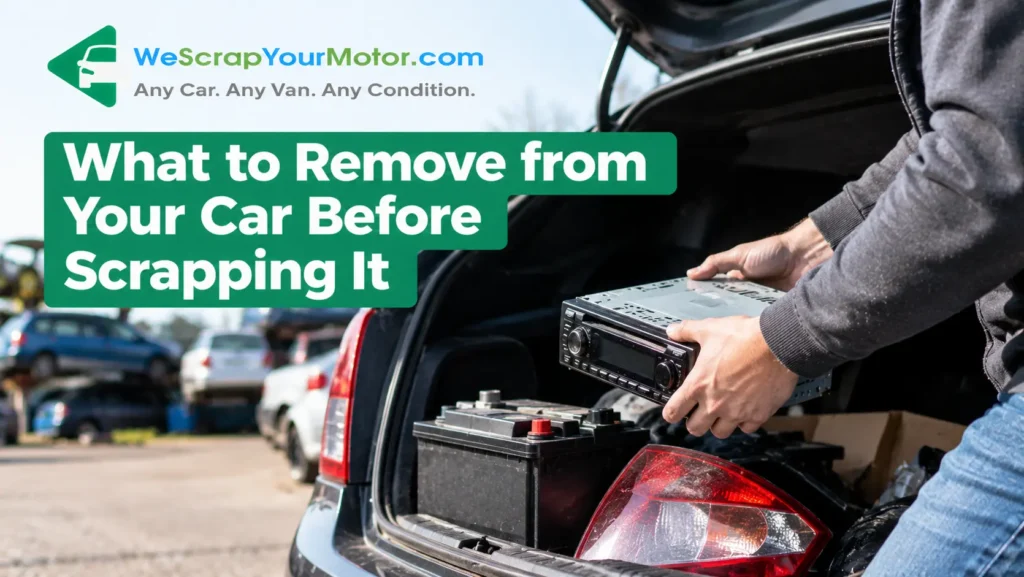
Before your old car is collected for scrapping, there are several things worth checking. Personal belongings, important documents, parking permits, and stored digital information can easily be forgotten.
But should you also remove the battery, catalytic converter, stereo, or number plates?
Not necessarily.
Understanding what to remove from the car before scrapping helps you protect your personal information, avoid losing valuable belongings, and prevent unexpected changes to the agreed scrap price.
The safest approach is to remove personal property and private information while leaving essential vehicle components in place unless you have agreed otherwise with the buyer.
This guide provides a practical UK checklist covering items to take out, things to leave alone, and the paperwork to complete before the collection team arrives.
Your Pre-Scrapping Checklist at a Glance
Before handing over your vehicle, use the following table.
| Item | Remove or Keep? | Reason |
| Personal belongings | Remove | Protects your property |
| Wallets, cash, and valuables | Remove | Prevents permanent loss |
| Personal documents | Remove | Protects confidential information |
| Parking permits | Remove | May contain personal or account details |
| Toll tags and electronic passes | Remove | Prevents continued account association |
| Child seats | Remove if yours | They are personal possessions |
| Dashcam and memory card | Remove if yours | May contain private recordings |
| Sat-nav personal data | Delete where possible | Protects saved addresses and journeys |
| Garage door remote | Remove | Protects access to your property |
| Personalised number plate rights | Arrange retention first | Physical plate removal is not enough |
| Vehicle battery | Normally leave fitted | Removing it may affect the quote and requires safe handling |
| Catalytic converter | Normally leave fitted | Missing components can reduce the offer |
| Engine and gearbox | Leave fitted | Essential components affect valuation |
| Wheels and tyres | Normally leave fitted | Needed for easier collection |
| Vehicle fluids | Leave for professional treatment | Improper removal can cause pollution |
This checklist applies to ordinary unwanted vehicles being sold for authorised scrapping.
If the buyer has agreed to purchase an incomplete vehicle, the exact preparation requirements may differ.
1. Remove All Personal Belongings From the Interior
The first thing to remove is anything that belongs to you rather than the vehicle.
It sounds obvious, but owners often overlook items stored in compartments they rarely use.
Start with the glovebox, door pockets, centre console, and areas beneath the seats.
Then check the boot, seatback pockets, and any storage spaces fitted to your particular model.
Common Items People Forget
- Sunglasses and prescription glasses
- Phone charging cables
- USB drives
- Earphones
- Spare keys
- Wallets and loose change
- Shopping bags
- Umbrellas
- Jackets and spare clothing
- Children’s toys
- Personal medication
- Receipts and letters
- Reusable shopping equipment
Check behind the sun visors and inside any overhead storage compartments.
Some cars have small drawers underneath the seats or concealed storage beneath the boot floor.
If the car is safe to access, inspect these areas before collection.
Do not enter a badly damaged or unstable vehicle simply to retrieve a low-value item. Ask the collection provider how to proceed safely.
2. Take Out Important Documents
An old car can become an accidental storage space for paperwork.
Owners sometimes leave insurance letters, service invoices, bank correspondence, or other documents inside the glovebox.
Before scrapping, remove anything that contains confidential information.
This includes:
- Insurance documents
- Breakdown cover paperwork
- Old MOT certificates
- Service receipts containing personal details
- Finance correspondence
- Bank letters
- Employment documents
- Address information
- Copies of identification
- Business paperwork
Some records may be useful to retain even after the vehicle has been scrapped.
For example, an invoice showing recent mechanical repairs may be relevant if you need to explain a past expense.
Keep documents you may require for your financial or personal records.
Dispose of unwanted confidential paperwork securely rather than leaving it in the car.
What About the V5C Logbook?
The V5C is different from ordinary paperwork.
It is needed for the vehicle’s registration and handover process.
GOV.UK advises owners scrapping a vehicle to give the V5C to the Authorised Treatment Facility while retaining the relevant yellow motor-trade section.
The registered keeper must also notify DVLA through the correct procedure.
Do not throw away the V5C or leave it loose inside the vehicle before completing the handover.
3. Remove Parking Permits and Toll Devices
Parking permits can remain attached to windscreens long after they have expired.
Before collection, check for residential parking permits, workplace parking passes, and private car park access stickers.
Some permits contain registration numbers, reference numbers, or information that connects the vehicle to your address or account.
If the permit belongs to an employer, building manager, or local authority, follow their return or cancellation procedure.
Also remove any electronic device linked to an account, such as a toll-payment tag.
Removing the physical device may not cancel the account automatically.
Contact the provider to remove the vehicle registration and close or update any payment arrangements.
Otherwise, the registration could remain associated with an account you no longer need.
This is especially important for vehicles previously used for work or regular journeys through toll-operated areas.
4. Remove Your Dashcam and Stored Recordings
A dashcam is easy to overlook because it often remains fitted permanently.
However, the device may contain recordings of your home, workplace, local roads, and regular journeys.
If the dashcam is your personal property, remove it before handing over the car, provided it can be detached safely.
Check whether it contains a removable memory card.
Some cameras also use connected apps or cloud storage.
Review the associated account and decide whether the device should remain registered.
Avoid leaving recordings behind merely because the camera itself has little resale value.
If the dashcam is hardwired or professionally installed, do not disturb wiring unnecessarily.
Ask a suitable professional to assess safe removal if required.
A damaged cable or disconnected vehicle system is not worth the risk of retrieving inexpensive equipment.
5. Delete Personal Information From the Infotainment System
Modern cars may store more personal information than owners realise.
Bluetooth systems, built-in navigation units, and connected vehicle apps can retain information long after the last journey.
This makes digital privacy an important part of what to remove from car before scrapping.
Depending on the model, the car may contain:
- Paired phone information
- Contact lists
- Recent calls
- Saved home and work addresses
- Navigation history
- Favourite destinations
- User profiles
- Connected account details
- Music service information
- Wi-Fi connections
How To Protect Your Data
If the vehicle’s electrical system works and it is safe to operate, consult the manufacturer’s handbook for the correct privacy or factory-reset procedure.
Remove saved devices and user profiles where possible.
Also check any manufacturer’s mobile app connected to the vehicle.
If the car is linked to an account, follow the provider’s process for removing or transferring it.
A factory reset may not cancel subscriptions, financing arrangements, or external online accounts.
If the vehicle does not power on, tell the buyer that personal data may remain stored and ask what secure data-removal options are available.
Do not connect a damaged electrical system or attempt unsafe repairs simply to reset the screen.
6. Remove Garage Door Remotes and Access Devices
Garage door remotes are among the most important personal items to check.
They may be stored in the centre console, clipped to a sun visor, or attached to the keyring.
A remote could allow access to your home, garage, or another private property.
Remove it before the vehicle leaves your possession.
Also check for:
- Electric gate remotes
- Workplace access fobs
- Parking barrier controls
- Building entry cards
- Storage unit keys
- Remote-controlled security devices
Some vehicles have built-in programmable garage door controls.
If your vehicle has one, consult the manufacturer’s instructions about clearing saved settings.
You may also wish to update the settings on the associated access system.
The aim is to prevent an unwanted vehicle from retaining an active connection to your property.
7. Take Out Child Seats and Personal Accessories
If you own a child seat fitted to the car, remove it before collection when safe to do so.
Child seats are personal equipment and are not normally part of the vehicle’s recyclable metal valuation.
The same applies to detachable accessories purchased separately.
Examples include:
- Detachable phone holders
- Portable navigation devices
- Personal seat cushions
- Removable storage organisers
- Child window shades
- Portable air purifiers
- Detachable roof-mounted accessories
However, not every accessory should automatically be removed.
For example, factory-fitted equipment, integrated electronics, and structural components may form part of the vehicle’s quoted condition.
Before removing an expensive accessory, confirm that it is not included in the buyer’s valuation.
If it is difficult to remove safely, discuss it with the collection provider.
8. Should You Remove the Number Plates Before Scrapping?
This depends on what you mean by removing them.
There is an important difference between taking off the physical number plates and retaining the legal right to use a personalised registration number.
If your car has an ordinary registration, you do not normally need to remove the plates before scrapping.
If it has a personalised registration that you want to keep, the DVLA retention process must be completed before the vehicle is scrapped or sold.
Simply unscrewing the plates does not retain the registration.
How To Keep a Personalised Registration
Apply through DVLA to take the private registration number off the vehicle.
You must meet the applicable eligibility rules.
For example, DVLA’s requirements include the vehicle being registered in the UK, being available for inspection if needed, and being able to move under its own power.
After a successful application, you should receive a V778 retention document and a replacement V5C.
You must have the V778 and new V5C before scrapping or selling the vehicle.
Otherwise, you risk losing the right to the registration.
If your car is badly damaged or has been standing unused for years, eligibility may be more complicated.
Contact DVLA before disposal rather than assuming retention is guaranteed.
9. Should You Remove the Car Battery?
Generally, leave the battery fitted unless a qualified professional or the buyer has arranged otherwise.
A battery can contain hazardous substances and requires appropriate handling and recycling.
Removing it may also change the vehicle’s quoted condition.
If the buyer expects a complete vehicle and discovers that the battery is missing, the final valuation could be affected.
A battery that is damaged, leaking, or otherwise unsafe needs professional assessment.
Do not attempt to dismantle it.
Hybrid and electric vehicles require particular care because they contain high-voltage systems.
Owners should not attempt to remove or disconnect traction batteries.
Tell the collection provider about any relevant damage, warning messages, or suspected battery problems.
Authorised facilities have procedures for handling hazardous vehicle components and waste.
10. Should You Remove the Catalytic Converter?
Usually not.
A catalytic converter may contain recoverable materials that contribute to a scrap or salvage valuation.
Removing it could reduce the amount a buyer is willing to pay for the complete car.
The component is also part of the vehicle’s exhaust system, and removal can create additional handling and environmental concerns.
If your car still has its original catalytic converter, explain that the vehicle is complete when requesting a quote.
If the converter has already been removed or stolen, disclose this information.
Do not attempt to inspect or remove the converter from underneath an unsafe vehicle.
If yours is missing, our guide on scrapping a car without a catalytic converter explains how the condition can affect valuation.
The most useful approach is to obtain a whole-vehicle quote before considering the removal of any valuable components.
11. Leave the Engine, Gearbox, and Other Essential Components
Owners sometimes assume that removing valuable parts before scrapping will always produce more money.
That is not necessarily true.
A buyer’s quotation may reflect the value of the vehicle as a complete unit.
Removing important components can reduce its value and make collection more difficult.
The parts most likely to affect the quotation include:
- Engine
- Gearbox
- Wheels
- Catalytic converter
- Battery
- Significant bodywork
- Major mechanical assemblies
GOV.UK explains that an Authorised Treatment Facility can charge a fee when essential components have been removed before scrapping.
It also sets out conditions for removing parts from vehicles before disposal, including environmental safeguards and requirements for vehicles bought specifically for dismantling.
If you want to retain a particular component for another vehicle you own, check the official rules and speak to the receiving facility first.
Do not dismantle the vehicle without understanding the legal, environmental, and commercial implications.
12. Do Not Drain Engine Oil, Coolant, or Other Fluids Yourself
Vehicle fluids are not personal belongings.
They are materials requiring appropriate environmental handling.
Engine oil, coolant, brake fluid, fuel, and other substances can cause pollution if released or disposed of incorrectly.
You do not need to drain the car yourself before ordinary authorised scrapping.
An Authorised Treatment Facility manages the relevant depollution process.
Improperly removing fluids can create leaks, contamination, and other hazards.
The Environment Agency explains that end-of-life vehicles require authorised depollution and appropriate waste controls.
If the vehicle already has a significant fluid leak, tell the collection provider before booking.
Do not attempt to conceal the leak or move the car in a way that could worsen the situation.
The facility and recovery operator can assess the appropriate handling arrangements.
13. What About Expensive Alloy Wheels or Aftermarket Equipment?
Some vehicles contain equipment that the owner purchased separately.
Examples include upgraded alloy wheels, detachable audio equipment, or aftermarket accessories.
Whether removing an item makes financial sense depends on its value and the effect on the complete-vehicle quotation.
For example, removing alloy wheels might allow you to sell them separately, but the car will still need suitable support and recovery arrangements.
The buyer may also reduce the original offer if the wheels were included in the quoted condition.
Similarly, removing integrated audio equipment could affect wiring or other components.
Before making a decision, ask:
- Is the accessory legally mine to keep?
- Does the buyer’s quote include it?
- Can it be removed safely?
- Will removal affect collection?
- Is the additional sale value worth the effort and cost?
For most ordinary scrap collections, removing personal possessions and leaving major fitted components in place is the simpler approach.
14. Check the Boot and Spare Wheel Compartment
The boot deserves a separate inspection because it often holds items that are not visible during a quick interior check.
Start with any loose property.
Then check accessible storage compartments, including beneath the boot floor.
Depending on the vehicle, you may find:
- Personal shopping items
- Tools you purchased separately
- Camping equipment
- Spare clothing
- Sports equipment
- Portable chargers
- Important paperwork
- Household supplies
- Old number plates
Some vehicles also have storage spaces behind side panels.
Do not remove fixed panels or disturb electrical equipment simply to search for belongings.
What about the spare wheel and vehicle toolkit?
These may form part of the car’s original equipment.
If the buyer expects them to be present, removing them could affect the agreed condition.
Check the quotation before retaining original vehicle accessories.
15. Remove Business Information and Commercial Equipment
If the vehicle was used for business, it may contain more information than a privately owned car.
Check for paperwork, devices, access passes, and commercial equipment.
For example, a former delivery vehicle might have stored customer addresses or business routes in its navigation system.
A company car could contain employee identification, parking passes, or access cards.
Some vehicles also have removable tracking devices or telematics equipment.
Before disposal, contact the relevant service provider about cancelling the account or arranging authorised removal.
If the vehicle belongs to a company, obtain permission from the person responsible for its disposal.
Check whether the business needs to retain records for accounting, insurance, or fleet management purposes.
Do not remove equipment owned by a leasing provider or another organisation without authorisation.
16. What Should You Leave With the Scrap Car?
Not everything needs to be taken away.
In an ordinary complete-vehicle collection, the buyer generally expects the car to remain substantially as described.
This may include:
- Original wheels and tyres
- Engine and gearbox
- Fitted exhaust components
- Battery
- Built-in electronics
- Factory-fitted interior components
- Fitted mechanical parts
The exact requirements depend on the quotation.
Some buyers accept incomplete vehicles, but they need accurate information before collection.
If you have already removed a component, disclose it clearly.
It is better to receive a realistic offer for an incomplete car than to accept a higher quotation based on inaccurate information.
17. Prepare the Right Documents For Collection
The vehicle handover is just as important as removing belongings.
Before the collection appointment, identify which documents the buyer requires.
For a normal scrap car transaction, this may include:
- V5C logbook, if available
- Appropriate identification
- Vehicle keys, if available
- Agreed collection quotation
- Relevant ownership or authority records
- Payment information
The DVLA notification must be completed through the appropriate process.
For a qualifying vehicle that is permanently scrapped at an ATF, keep the Certificate of Destruction when it is issued.
If the car is repaired and resold instead, the paperwork will differ.
The Certificate of Destruction is not a general receipt for every unwanted vehicle sale.
18. What Should You Do on Collection Day?
Collection day should involve confirmation rather than last-minute dismantling.
Before the recovery operator arrives, make a final check of accessible storage areas.
Confirm that personal belongings, removable electronic devices, and confidential documents have been taken out.
Then check that the vehicle’s condition still matches what you told the buyer.
If something has changed, explain it before the recovery begins.
For example, a previously inflated tyre may now be flat, or a car that could roll may have developed a wheel problem.
Let the recovery operator know rather than attempting to correct the problem yourself.
At handover:
- Confirm the buyer or recovery operator’s identity.
- Check the vehicle registration and agreed collection details.
- Confirm the final price and payment method.
- Complete the correct vehicle transfer paperwork.
- Keep the collection receipt and payment record.
- Notify DVLA as required.
- Retain the Certificate of Destruction when applicable.
If you need a valuation first, WeScrapYourMotor offers a Scrap My Car service for unwanted vehicles throughout the UK.
19. What Happens If You Forget Something Inside the Car?
Retrieving an item after collection may be difficult or impossible.
Once a vehicle has been transferred, the buyer may move it to a storage facility, dismantling site, or authorised treatment facility.
Personal property could be discarded or become inaccessible during processing.
If you discover that something important was left inside, contact the collection company immediately.
Provide the vehicle registration, collection date, and a clear description of the item.
Do not assume that the car will still be available for inspection.
The best protection is a thorough check before handover.
For urgent items such as keys, identification, or confidential documents, explain the issue to the collection provider and ask whether recovery is possible.
20. How To Arrange Scrapping After Preparing Your Car
Once you have removed your belongings and checked the documents, the next step is arranging an accurate valuation.
Provide the registration number, mileage where known, vehicle condition, and collection postcode.
Explain whether any major components are missing.
If the car is parked in a difficult location, describe the access restrictions.
The buyer can then assess the offer and recovery requirements.
For owners in Wiltshire, WeScrapYourMotor’s scrap car collection service in Salisbury provides a way to request an assessment and arrange suitable collection.
Before accepting a quotation, confirm which components are expected to remain with the car.
This reduces the risk of disagreements during the handover.
Frequently Asked Questions
Should I Remove My Number Plates Before Scrapping?
Ordinary plates do not normally need to be removed. If you want to retain a personalised registration, complete DVLA’s official retention procedure before the car is scrapped.
Can I Keep the Battery From My Scrap Car?
Removing a battery may affect the quote and requires appropriate safety and environmental handling. It is usually simpler to leave it fitted unless an authorised arrangement has been agreed.
Should I Take the Stereo Out Before Scrapping?
A removable personal stereo may be worth retaining, but check whether it is included in the valuation. Do not damage vehicle wiring or integrated equipment.
Can I Remove My Catalytic Converter Before Scrapping?
Removing it may reduce the vehicle’s scrap or salvage value. Obtain a whole-vehicle quotation before making decisions about components.
Do I Need To Empty the Fuel Tank?
You do not normally need to drain the fuel tank before authorised scrapping. Tell the collection provider about any leak or known fuel-system hazard.
Can I Keep My Car’s Spare Wheel?
Potentially, but check whether it forms part of the agreed vehicle condition. The buyer may expect the original spare wheel and toolkit to remain.
Should I Delete Bluetooth Connections?
Yes, where it is safe and possible. Remove stored personal information and disconnect relevant manufacturer accounts before handing over the vehicle.
What If My Car Does Not Switch On?
You may not be able to reset its electronic systems. Explain the situation to the buyer and ask about secure data handling. Do not attempt unsafe electrical repairs.
Can I Remove Parts To Sell Separately?
UK rules distinguish between retaining suitable parts for another vehicle you own and dismantling vehicles bought specifically for parts. Environmental requirements and collection conditions also apply.
Will Removing Parts Reduce the Scrap Price?
It can. The absence of major components may lower the offer or make collection more expensive.
Make Your Last Car Check Count
Knowing what to remove from the car before scrapping is about more than emptying the glovebox.
It helps protect your privacy, preserve important documents, prevent the loss of personal belongings, and avoid unexpected problems during collection.
Take out personal possessions, removable access devices, and confidential information. Clear stored digital details where possible and arrange personalised registration retention before disposal if eligible.
At the same time, leave essential mechanical components and vehicle fluids for appropriate professional handling.
With a clear checklist, an accurate quotation, and the correct DVLA paperwork, you can hand over your old car knowing that the important details have been addressed.