
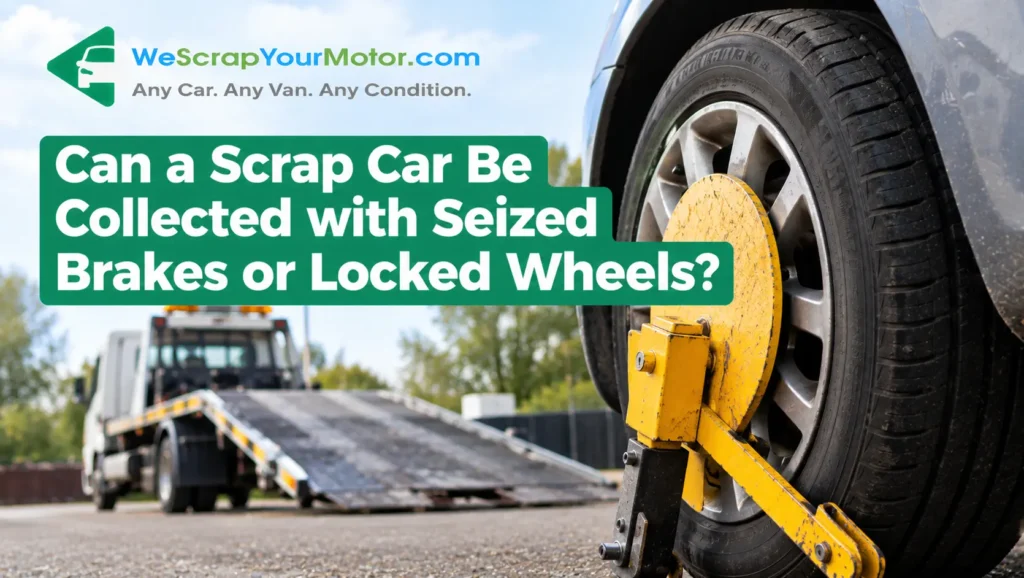
Yes, a scrap car with seized brakes or locked wheels can often be collected in the UK. However, the recovery operator must know about the problem before arriving so they can assess the vehicle’s position, access, and equipment requirements.
A car that cannot roll normally may require specialist recovery rather than straightforward loading.
This situation is common with vehicles that have been parked for months or years, especially those left outdoors or taken off the road after mechanical failure.
Sometimes the problem involves a seized parking brake. In other cases, one or more wheels will not rotate because of faults in the braking system or other mechanical components.
The good news is that a vehicle does not need to be driveable to retain scrap value.
If you want to scrap car with seized brakes, the most important steps are to describe the problem accurately, avoid unsafe attempts to move it, and arrange a recovery assessment.
Can a Scrap Company Collect a Car That Will Not Roll?
Often, yes.
Professional vehicle recovery businesses regularly encounter damaged cars, non-runners, accident-damaged vehicles, and cars that cannot move normally.
However, not every recovery vehicle or collection appointment is suitable for every situation.
A car that rolls freely can usually be handled more easily than one with locked wheels.
When the wheels are seized, the operator may need equipment designed to handle a vehicle without relying on normal wheel rotation.
Suitable equipment may include a recovery truck, professionally operated winching equipment, vehicle skates, or wheel-handling equipment.
The operator must determine which method is suitable for the vehicle and location.
Collection feasibility depends on:
- Vehicle weight and size
- Number of affected wheels
- Whether the steering works
- Position of the vehicle
- Ground surface and slope
- Available working space
- Access for a recovery truck
- Condition of the tyres and wheels
- Any additional mechanical or structural damage
A seized brake is therefore not automatically a reason to reject the vehicle.
It is a condition that needs to be included in the recovery plan.
Why Do Car Brakes Seize When a Vehicle Is Parked?
A braking system contains several components that can deteriorate or become difficult to operate.
When a vehicle remains stationary for a long time, corrosion, moisture, and mechanical wear may affect these components.
Corrosion on Brake Discs
Brake discs are exposed to moisture and can develop surface corrosion.
Light surface corrosion is common after a vehicle has stood unused.
However, more substantial deterioration may contribute to braking problems.
The extent of the problem cannot always be identified from a photograph.
Sticking Brake Calipers
A brake caliper contains components responsible for applying braking force.
Mechanical deterioration or corrosion may prevent parts of the system from moving as intended.
This can cause a brake to remain engaged or operate incorrectly.
Parking Brake Problems
A parking brake may remain applied because of a mechanical or electrical fault.
This is particularly relevant when a vehicle has been stored with the parking brake engaged for a long period.
Electronic parking brake systems can introduce additional complications when the vehicle’s battery is discharged or its electrical systems do not work.
Deteriorated Brake Components
Cables, mechanical linkages, and other braking components can deteriorate as a car ages.
A vehicle that has already failed its MOT for brake defects may be especially difficult to move.
Other Mechanical Problems
Not every locked wheel is caused by seized brakes.
Wheel bearings, transmission faults, accident damage, or other mechanical problems may also prevent movement.
For collection purposes, it is more useful to describe what happens than to guess the precise cause.
For example, “The rear wheels do not appear to rotate” is better than claiming that a caliper has seized without a professional diagnosis.
How Can You Tell Whether the Brakes Are Seized?
You may suspect seized brakes if the car will not roll despite being prepared for movement by a qualified professional.
Other indications can include a known history of braking problems or a vehicle that has remained stationary for an extended period.
However, the exact cause should not be assumed.
A car that does not move may have a different fault, including a locked transmission or another mechanical restriction.
For a vehicle already destined for scrapping, there is usually no need to commission extensive brake repairs solely to establish the precise fault.
Instead, record what you know.
Tell the collector whether:
- The vehicle has stood unused for a long period
- A garage previously diagnosed brake problems
- One or more wheels appear locked
- The parking brake is known to be faulty
- The vehicle has an electronic parking brake
- The steering is also restricted
- The tyres are flat or damaged
Do not attempt to force a wheel to rotate or move a stuck vehicle.
A professional can assess the recovery requirements without requiring you to diagnose the braking system.
What Equipment Might Be Used For Collection?
The correct equipment depends on the individual recovery situation.
A responsible operator will consider the vehicle’s weight, wheel condition, available space, and whether it can be safely loaded.
The following table explains common recovery approaches at a general level.
| Recovery Equipment | General Purpose | Important Limitation |
| Flatbed Recovery Truck | Transporting the vehicle on a loading platform | Requires sufficient access and loading space |
| Professional Winching Equipment | Assisting controlled vehicle recovery | Suitability depends on vehicle condition and recovery plan |
| Vehicle Skates | Supporting movement where wheel rotation is restricted | Requires suitable ground and professional assessment |
| Wheel Dollies | Supporting or repositioning affected wheels | Space, load capacity, and surface affect suitability |
| Specialist Recovery Vehicle | Handling difficult or damaged vehicles | Availability and access vary |
These are professional recovery methods, not instructions for owners to attempt themselves.
A car may require more than one type of equipment or a different collection arrangement.
For example, a vehicle parked in a narrow garage may present challenges that do not exist when the same car is parked on an open driveway.
The operator should assess these conditions before confirming the collection.
How the Collection Process Works
A scrap car with seized brakes usually requires more information at the quotation stage than a vehicle that rolls normally.
Here is how a properly organised collection may proceed.
Stage 1: Provide the Vehicle Details
Start with the registration number, make, model, fuel type, and approximate condition.
Explain whether the engine starts, whether the steering works, and whether the car has all its wheels.
If the vehicle has been declared SORN or has no MOT, disclose that information.
The buyer can use these details to assess its potential value.
Stage 2: Describe the Wheel Problem
Explain whether the front wheels, rear wheels, or all wheels appear affected.
If you do not know, say so.
Do not invent a diagnosis simply to complete a quotation form.
A description such as “Vehicle has been parked for four years and cannot be moved normally” may be sufficient to begin the assessment.
Stage 3: Share the Collection Location
Provide the postcode and explain the exact parking position.
Mention whether the car is on a driveway, road, private yard, garage, or another permitted location.
The operator may request photographs.
Stage 4: Confirm Recovery Requirements
The collection company assesses whether normal recovery is suitable or specialist equipment may be needed.
This is where access, ground conditions, and vehicle weight become important.
Stage 5: Agree the Quotation
Confirm the price and any conditions in writing.
If specialist recovery affects the amount payable, this should be explained before collection.
Stage 6: Complete the Handover
At collection, confirm the operator’s identity and follow the required transfer process.
For vehicles being permanently scrapped, ensure the appropriate authorised treatment and DVLA procedures are followed.
Does It Cost More To Scrap a Car with Seized Brakes?
It can, but an additional charge is not inevitable.
The effect depends on the vehicle, the recovery company’s equipment, and the collection location.
Some operators may include the required recovery in their quotation.
Others may adjust the price if specialist equipment or additional work is needed.
The important distinction is between a transparent quotation and an unexpected deduction.
Why Recovery Costs Can Be Higher
A vehicle with locked wheels may require additional equipment, planning, or recovery time.
It might also need a different vehicle or a more experienced recovery team.
The operator must consider these costs when valuing the job.
Does a Higher Recovery Cost Mean the Car Has No Scrap Value?
No.
The vehicle may still contain recoverable metal and reusable components.
For example, a complete family car with seized brakes may retain similar basic material value to another car of the same model.
However, the additional work involved in collection may affect the net amount offered.
How Can You Avoid Unexpected Charges?
Disclose the mobility problem before accepting the quote.
Ask whether the offer assumes that the vehicle rolls freely.
Also ask whether collection is included and what circumstances could change the final amount.
An accurate quotation is more useful than a higher headline figure that assumes normal vehicle movement.
Where Is the Car Parked? Why Location Matters
A vehicle’s location can make as much difference to collection as the mechanical fault itself.
Two identical cars with seized brakes may require very different recovery arrangements.
On a Level Driveway
An accessible driveway may provide suitable space for a recovery vehicle.
However, the operator still needs to know whether the driveway is narrow, shared, or blocked.
A vehicle positioned close to walls or other obstacles may be difficult to reach.
On a Sloping Driveway
A slope introduces additional recovery considerations.
The operator must evaluate the gradient, vehicle position, and available space.
Do not attempt to push or otherwise move a car with locked wheels on a slope.
Inside a Garage
Garage dimensions and access can restrict which recovery methods are possible.
Low ceilings, narrow doors, and limited space around the vehicle may affect the recovery plan.
The collection company needs accurate measurements or photographs where these can be obtained safely.
On Grass or Soft Ground
A car parked on grass, soil, or another soft surface may be difficult to recover.
Weather conditions can change the ground’s suitability.
Tell the operator about the surface and any history of the vehicle sinking into the ground.
In an Underground Car Park
Height restrictions can prevent a standard recovery truck from entering.
Access ramps and confined spaces may also complicate removal.
The operator should assess the available options before making a firm booking.
If you need to scrap car with seized brakes from an unusual location, photographs showing the surrounding space can help the collection team understand the problem.
Can You Scrap a Car with Both Seized Brakes and Flat Tyres?
Often, yes, subject to suitable recovery arrangements.
A car with flat tyres may already require additional handling.
When one or more wheels also cannot rotate, the recovery plan becomes more complicated.
The vehicle’s condition and the surrounding space determine whether specialist equipment can be used.
For example, a car with four flat tyres parked in an open yard may be easier to assess than one positioned tightly inside a small garage.
Do not try to move the car simply to make it appear accessible.
Tell the collection provider about both problems.
A clear description helps ensure the correct recovery arrangements are considered.
The same principle applies if a vehicle has damaged wheels, missing keys, or a locked steering system.
Each condition should be disclosed before the quotation is confirmed.
Can a Car with an Electronic Parking Brake Be Scrapped?
Yes.
An electronic parking brake does not automatically prevent a vehicle from being collected and scrapped.
However, a failed battery or electronic fault may prevent the brake from operating normally.
Different manufacturers use different systems.
Some vehicles have model-specific service procedures that should be performed only by suitably qualified professionals.
For a scrap vehicle, it is not necessary for the owner to attempt to overcome an electronic parking brake fault before requesting a collection.
Tell the operator the make, model, and whether the electrical system is functional.
If the vehicle is a hybrid or electric model, also disclose the powertrain type and any known battery or electrical damage.
This allows the collection provider to consider appropriate recovery and handling requirements.
What If the Steering Is Also Locked?
Locked steering can make vehicle recovery more difficult because normal directional control may not be available.
The operator needs to know whether the keys are present and whether the steering responds.
If the car has no working key or suffers an electronic steering fault, explain this before booking.
Do not attempt to defeat a steering lock or force the steering mechanism.
Recovery companies may need to assess a different method or equipment depending on the vehicle’s position.
A combination of locked wheels and locked steering is more complicated than a vehicle with only a flat battery.
However, it does not necessarily mean collection is impossible.
An accurate description gives the operator the best opportunity to determine whether a safe recovery route is available.
Do You Need To Repair Seized Brakes Before Scrapping?
Usually not.
If the vehicle is being permanently scrapped, repairing the brakes solely to make it easier to collect may be unnecessary.
The cost of diagnosis, parts, and labour could exceed any improvement in the scrap offer.
However, this does not mean the vehicle can be moved without regard to safety.
The recovery operator should assess how it can be transported.
Consider an illustrative example.
A car is worth £300 as scrap in its existing condition.
A garage estimates £350 for necessary brake repairs.
Even if repaired brakes made the car easier to collect, spending £350 might not produce a comparable increase in its value.
A specialist recovery quotation could therefore be more economical.
This is only an example. Actual costs depend on the vehicle, location, and fault.
If the car might be repaired and kept in use rather than scrapped, a professional mechanical assessment may be appropriate.
How Much Is a Scrap Car with Seized Brakes Worth?
Seized brakes do not determine the vehicle’s entire value.
The main valuation factors are still its make, model, weight, condition, completeness, and potential recoverable materials.
The buyer may also consider the demand for reusable components.
A complete vehicle with seized brakes may have considerable recycling value even though it cannot move normally.
However, difficult recovery can reduce the net offer.
Vehicle Weight
Recoverable metal contributes to the basic scrap value.
Larger vehicles often contain more material, although weight is only one factor.
Make and Model
Some models have stronger demand for replacement components.
That may affect the amount a buyer can offer beyond the vehicle’s metal value.
Missing Parts
A vehicle missing its engine, gearbox, wheels, or catalytic converter may be worth less than a comparable complete car.
General Condition
Accident damage, corrosion, fire exposure, and mechanical faults can influence recovery and processing.
Collection Access
Distance, restricted space, uneven ground, and additional recovery requirements may affect the net valuation.
To obtain a realistic offer, provide the registration and an honest description rather than relying on a generic scrap price estimate.
Will WeScrapYourMotor Collect a Vehicle with Locked Wheels?
WeScrapYourMotor accepts enquiries for damaged, non-running, and mechanically faulty vehicles.
The company also asks customers to explain whether a vehicle starts, rolls, steers, and brakes, along with any access restrictions.
A scrap car with seized brakes can therefore be submitted for assessment.
However, collection suitability must be confirmed for the actual vehicle and location.
The available recovery arrangements depend on the problem, access, and equipment.
You can begin with the Scrap My Car service and provide the relevant vehicle information.
When requesting a quotation, mention the locked wheels immediately.
This helps the team assess the recovery requirements before confirming the offer.
What Information Should You Give the Collection Company?
A complete description makes it easier to arrange suitable recovery.
Use this checklist.
| Information | What To Explain |
| Vehicle Registration | Exact registration number |
| Make and Model | Vehicle identification |
| Collection Postcode | Where the vehicle is located |
| Starting Condition | Starts, does not start, or unknown |
| Brake Condition | Suspected seized brakes or known diagnosis |
| Wheel Mobility | Which wheels appear locked, if known |
| Steering | Working, locked, or unknown |
| Keys | Available or missing |
| Tyres | Inflated, flat, or damaged |
| Parking Surface | Concrete, tarmac, gravel, grass, or other |
| Access | Gates, slopes, restricted width, or height limits |
| Missing Components | Any significant parts removed |
You do not need to know every technical detail.
If something has not been tested, state that it is unknown.
The aim is to help the operator assess the collection accurately rather than make assumptions.
Can Seized-Brake Cars Be Collected From Kent?
Collection may be possible when the vehicle and location are suitable for the available recovery arrangements.
WeScrapYourMotor provides a scrap car collection service in Kent for unwanted, damaged, and non-running vehicles.
If your car has seized brakes or locked wheels, include that information when requesting the quote.
Also describe whether it is parked on a driveway, inside a garage, or in another location.
The team can then assess the vehicle’s condition and discuss the appropriate collection arrangements.
Do not assume that every postcode or parking position can be handled with the same equipment.
Can the Agreed Scrap Car Price Change on Collection Day?
A quotation may depend on the accuracy of the vehicle information supplied.
For example, a buyer might issue an initial offer assuming that the car is complete and rolls freely.
If the collection team discovers that several wheels are seized and the vehicle is in a restricted location, the original assumptions may no longer be accurate.
This is why disclosure matters.
Before accepting an offer, ask the buyer to explain:
- Whether the price includes collection
- Whether locked wheels have been considered
- Whether specialist recovery is included
- Which conditions could affect the quotation
- When payment will be made
- What happens if recovery is not possible
If you want to understand these issues in greater detail, read our guide on whether a scrap car quote can change on collection day.
A written agreement based on accurate information reduces the chance of disagreement.
What Happens After the Vehicle Has Been Collected?
Once an end-of-life vehicle has been collected, it must be handled through an appropriate authorised treatment route.
At an Authorised Treatment Facility, relevant hazardous components and substances are managed under the applicable environmental requirements.
Suitable components and materials can then be recovered for reuse or recycling.
For a qualifying car that is completely scrapped, the facility should issue a Certificate of Destruction within seven days.
The registered keeper must also ensure that DVLA is properly notified.
GOV.UK states that an ATF can either completely scrap an eligible vehicle or decide to repair and sell it. A Certificate of Destruction applies when the qualifying vehicle is completely scrapped.
Keep the collection receipt, payment confirmation, and relevant DVLA documentation.
These records help establish what happened to the vehicle after it left your possession.
Frequently Asked Questions About Seized-Brake Scrap Cars
Can You Scrap a Car If the Brakes Are Seized?
Yes, in many cases. A professional recovery company may be able to collect it using suitable equipment, subject to vehicle condition and access.
Can a Scrap Car Be Collected If All Four Wheels Are Locked?
Potentially. However, the recovery arrangements may be more complex. Tell the operator that all four wheels appear locked before accepting the booking.
Will Seized Brakes Reduce My Scrap Car Price?
They may affect the net offer if additional recovery work is required. The vehicle can still retain recycling or salvage value.
Can a Recovery Truck Collect a Car That Does Not Move?
Often, subject to equipment, access, and the operator’s assessment. A vehicle does not necessarily need to be driveable for recovery.
Do I Need To Release the Handbrake Before Collection?
Do not attempt unsafe work on a vehicle with suspected brake problems. Explain the condition and let the recovery operator assess the appropriate procedure.
Will a Flat Battery Prevent Collection?
Not necessarily. Many non-running cars can be recovered. However, the battery condition may matter if electronic systems control the brakes or steering.
Can You Scrap a Car with Seized Brakes and No MOT?
Yes. An MOT is not required simply for authorised scrapping. The vehicle should be transported lawfully rather than driven while unroadworthy.
What If the Car Is Stuck Inside a Garage?
Collection depends on the available space and suitable recovery methods. Provide photographs and details of the garage entrance before booking.
Can a Scrap Car Be Collected From a Sloping Driveway?
Possibly, but the slope requires professional assessment. Do not attempt to move or push the vehicle yourself.
Does a Car with Seized Brakes Still Have Scrap Value?
Yes. Its value may come from recyclable materials and usable components, although recovery costs can affect the amount offered.
Arrange a Collection That Matches Your Vehicle’s Condition
A scrap car with seized brakes does not have to remain permanently stuck on your driveway or in your garage.
Professional recovery may be possible even when the wheels cannot rotate normally.
The most important part of the process is providing accurate information before booking.
Tell the collection company which wheels are affected, whether the steering works, and where the vehicle is parked.
Do not spend money repairing the brakes solely for scrap collection without first comparing the costs.
With an appropriate assessment, a clear quotation, and suitable professional recovery, you may still be able to sell your vehicle for scrap or salvage and recover its remaining value.