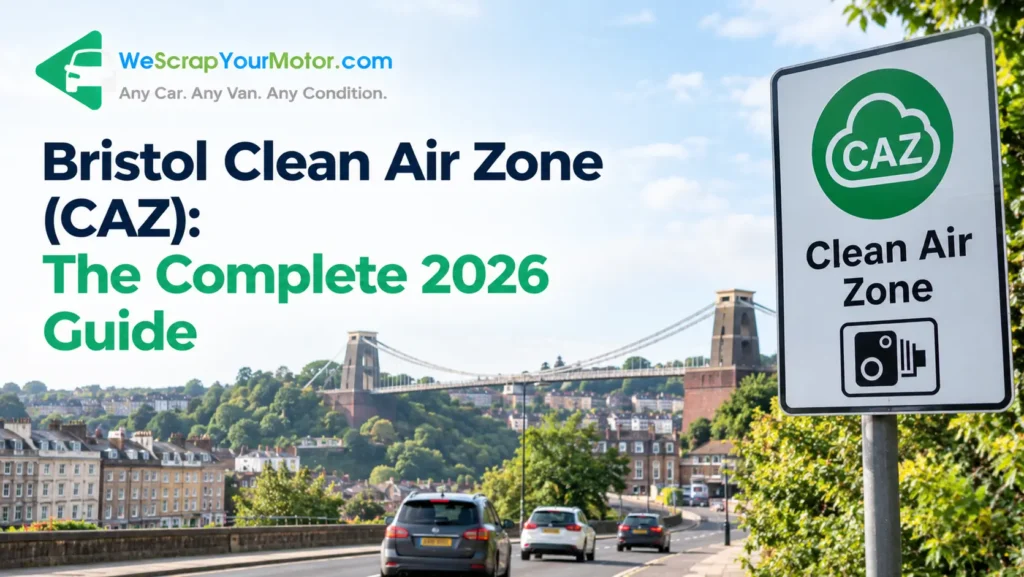
The Bristol Clean Air Zone (CAZ) charges drivers of certain higher-emission vehicles for travelling within a defined part of the city.
In 2026, the standard daily charge is £9 for affected cars, taxis and light vans, while non-compliant buses, coaches and heavy goods vehicles generally pay £100.
Petrol cars usually need to meet Euro 4 emissions standards, while diesel cars need Euro 6 to avoid the daily fee.
The zone operates 24 hours a day, seven days a week, including bank holidays.
If your vehicle is compliant, you do not need to pay the CAZ charge.
However, the city’s road layout means that visitors unfamiliar with Bristol should check their route carefully, especially when travelling near the city centre and roads approaching the waterfront.
This guide explains the rules for 2026, the official payment process, financial assistance and practical ways to avoid unnecessary charges.
Bristol Clean Air Zone at a Glance
| Question | Answer |
| When Did the Zone Start? | 28 November 2022 |
| What Type of Zone Is It? | Class D Clean Air Zone |
| Daily Charge for Non-Compliant Cars | £9 |
| Daily Charge for Non-Compliant HGVs | £100 |
| Petrol Car Standard | Euro 4 |
| Diesel Car Standard | Euro 6 |
| Operating Hours | 24 hours daily |
| Weekend Charges | Yes |
| Official Vehicle Checker | GOV.UK Clean Air Zone service |
| Advance Payment | Up to six days before travel |
| Payment After Travel | Up to six days afterwards |
These details are based on Bristol City Council’s published rules and current charging information.
Why Bristol Introduced a Clean Air Zone
Bristol introduced its Clean Air Zone to reduce harmful levels of pollution from road traffic.
The scheme aims to encourage cleaner transport and improve air quality, particularly in areas experiencing higher concentrations of vehicle-related emissions.
Unlike a complete vehicle ban, Bristol’s arrangement allows many non-compliant vehicles to enter the zone after paying the applicable daily charge.
The charging system creates an additional running cost for higher-emission vehicles, particularly those making frequent journeys.
The Bristol Clean Air Zone is a Class D scheme.
That means ordinary private cars can be charged, alongside taxis, vans and heavier commercial vehicles.
Not every English Clean Air Zone includes private cars, so it is important to check the rules for the city you are visiting.
Bristol’s council has also published information about financial assistance, travel alternatives and exemptions designed to support eligible motorists.
Where Does the Bristol Clean Air Zone Start and End?
The Bristol Clean Air Zone covers a defined central area rather than the whole city.
Its boundaries include central Bristol and parts of the main road network around the city centre.
Drivers should pay particular attention to routes involving the central waterfront, the A4 corridor and roads around Cumberland Basin.
The exact roads included can be checked on the official Bristol City Council map.
City-Centre Destinations
If you are travelling towards central Bristol destinations, check whether your route enters the CAZ.
Popular destinations that may involve driving through the charging area include:
- Bristol Temple Meads and surrounding roads
- Cabot Circus and central shopping areas
- The Harbourside
- Broadmead and the city centre
- Central business districts
- Parts of the route towards Hotwells
- Roads around Cumberland Basin
These locations are travel-planning references, not a statement that every road or car park serving them is inside the zone.
A route can cross a charging boundary even when the final destination lies outside it.
Is the Whole of Bristol Covered?
No.
Many residential neighbourhoods and roads outside the designated boundary are not part of the charging area.
However, a driver travelling between two areas outside the zone may still pass through it.
That is why checking only your home postcode and destination postcode may not be enough.
Review the roads between those locations.
How to Identify the Boundary
Clean Air Zone signs are positioned on relevant approaches.
They display a green cloud symbol containing the letter D.
Additional signs may indicate that charges apply.
Always follow current road signs and check the council’s map rather than relying on outdated screenshots or informal route advice.
Road layouts and temporary restrictions can change.
Which Cars Pay the Bristol Clean Air Zone Charge?
A vehicle’s fuel type and emissions classification are central to determining whether it must pay.
Petrol Vehicles
Petrol cars generally avoid the charge when they meet Euro 4 or a higher emissions standard.
Many petrol cars registered from around 2006 onwards qualify.
However, registration age is only a guide.
A petrol vehicle manufactured earlier may still meet the relevant standard.
Diesel Vehicles
Diesel cars generally need Euro 6 emissions compliance.
Many diesel vehicles registered from late 2015 onwards meet the requirement.
If your diesel was first registered around the transition period, verify its individual status.
Two cars registered in the same year may have different engines and emissions classifications.
Hybrid Vehicles
Hybrid cars are not automatically exempt simply because they use some electric power.
The combustion engine must meet the applicable standard.
Electric Vehicles
Fully electric cars meet the relevant emissions requirements.
They are not charged under the ordinary Bristol CAZ emissions rules.
Motorcycles
Motorcycles are not charged under Bristol’s current Clean Air Zone arrangement.
This differs from London’s ULEZ, which has emissions requirements covering motorcycles.
How Much Does It Cost to Drive in Bristol?
The Bristol Clean Air Zone uses different charges for lighter and heavier vehicles.
| Vehicle Category | Charge per Day |
| Private Petrol Car | £9 |
| Private Diesel Car | £9 |
| Taxi | £9 |
| Light Goods Vehicle Under 3.5 Tonnes | £9 |
| Heavy Goods Vehicle Over 3.5 Tonnes | £100 |
| Bus | £100 |
| Coach | £100 |
These fees apply when the relevant vehicle is non-compliant and no exemption applies.
If your car meets the required standard, the CAZ fee is £0.
The charge is assessed by charging day rather than distance travelled.
A short journey through the zone can therefore create the same daily fee as several journeys within that day.
Does the £9 Charge Cover Multiple Journeys?
Yes.
You normally pay one CAZ charge for each applicable charging day.
For example, you could drive into central Bristol for a morning appointment, leave and return later.
If both journeys occur on the same charging day, the normal charge remains £9.
However, the charging day runs from midnight to midnight.
Example: A Late-Night Journey
Suppose you enter the zone at 10:45 pm on Saturday.
You leave at 12:15 am on Sunday.
Your journey crosses two charging days.
If your vehicle is chargeable, you would need to pay £18 in total.
This can surprise drivers collecting passengers after an evening event or returning from an airport transfer.
The same principle applies to overnight delivery work.
What If You Stay in Bristol for Several Days?
You do not automatically pay for every day you are staying inside the zone.
If the car remains parked and is not driven on a particular day, a fresh daily CAZ charge is not normally due for that day.
For example, you might arrive on Friday, leave your car parked on Saturday and drive home on Sunday.
The relevant charging days would normally be Friday and Sunday.
Parking fees are separate and may still apply.
How to Check Whether Your Vehicle Must Pay
The easiest way to confirm your vehicle’s status is to use the official government checker.
The Bristol Clean Air Zone works through the national Clean Air Zone service.
Five-Step Vehicle Check
- Open the official GOV.UK Clean Air Zone service.
- Enter your registration number.
- Review the vehicle information.
- Check whether a daily charge applies in Bristol.
- Confirm any exemption or required payment.
If the result appears incorrect, check your vehicle documents and emissions classification.
Contact the appropriate authority for guidance about correcting the record.
Do not assume that a valid MOT means your car is CAZ compliant.
An MOT and a Clean Air Zone check examine different legal requirements.
A vehicle can pass its MOT while failing the emissions standard required for charge-free entry.
How to Pay the Bristol Clean Air Zone Charge
You can pay through the official GOV.UK Clean Air Zone payment service.
The standard payment window allows payment up to six days before travelling, on the day of travel or during the six days after the journey.
You will need the vehicle registration number and an accepted payment method.
Before Your Journey
Check the vehicle’s compliance status.
If you know the exact charging day, you can make the applicable payment in advance.
Keep the payment confirmation for your records.
On the Day
You can pay on the day you drive within the zone.
Ensure the correct registration and charging date have been entered.
A small mistake in the registration number may prevent the payment from being matched to the correct vehicle.
After Your Journey
If you forgot to pay beforehand, you still have the permitted six-day payment window.
Do not wait for a reminder from the council.
Drivers are responsible for ensuring that the required payment is made.
Beware of Unofficial Payment Websites
Some third-party websites may advertise themselves as convenient CAZ payment services.
They can charge additional fees or create confusion.
Using the official government service is the simplest way to avoid unnecessary intermediary charges.
Bristol Clean Air Zone Fines and Penalties
If your vehicle is chargeable and you fail to pay within the permitted period, you may receive a Penalty Charge Notice.
Bristol’s standard CAZ PCN is £120, reduced to £60 if paid within the applicable 14-day discount period.
The outstanding daily CAZ charge is payable in addition to the penalty.
For an ordinary car, that can mean:
| Situation | Illustrative Amount |
| Daily CAZ Charge Paid on Time | £9 |
| PCN Paid Within Discount Period | £60 plus £9 |
| PCN Paid at Standard Rate | £120 plus £9 |
These figures exclude any further enforcement costs that could arise from missing later legal deadlines.
Bristol City Council explains the PCN payment and appeals process on its official website.
What Should You Do If You Receive a Fine?
Start by checking the details printed on the notice.
Look for the vehicle registration, contravention date, amount and appeal deadline.
If you believe you paid or were exempt, gather the relevant evidence.
Use the council’s formal appeal procedure.
Do not assume an email enquiry automatically pauses the legal payment or appeal deadline.
Follow the instructions stated on the PCN.
What Happens If Roadworks Force You into the Zone?
This is an important situation that many general CAZ guides overlook.
Bristol City Council publishes specific guidance for drivers diverted into the Clean Air Zone because of road closures or roadworks.
Where a driver follows the official signed diversion route, the council says the charge does not apply.
If an affected driver has already paid, a refund application may be available.
If a PCN has been issued, the driver may be able to appeal.
However, this protection depends on following the designated diversion.
Choosing a different route through the charging area may not qualify.
What to Do During an Unexpected Diversion
- Follow the official diversion signs.
- Note the date and approximate time.
- Record the location if it is safe to do so.
- Keep any available information about the road closure.
- Check the council’s guidance if a charge or PCN appears.
Do not stop unsafely to photograph road signs.
If a charge is disputed, use the proper council process instead of assuming that the diversion will automatically be recognised in every case.
Bristol Clean Air Zone Exemptions in 2026
Bristol has national and local exemption arrangements for certain vehicles and circumstances.
Eligibility varies.
For that reason, drivers should not assume they qualify solely because they are residents, have a medical appointment or hold a Blue Badge.
Disabled Vehicle Exemptions
Some vehicles linked to qualifying disabled tax classes or other recognised arrangements may be exempt.
The applicable vehicle classification and registration details are important.
Blue Badge Holders
Bristol publishes specific guidance for Blue Badge holders.
Check that guidance before entering the zone rather than assuming the badge itself makes every vehicle exempt.
Hospital-Related Exemptions
Bristol has published arrangements covering some qualifying patients and visitors to the Bristol Royal Infirmary complex.
These exemptions are not automatically available for every hospital journey.
The relevant eligibility requirements and application process must be checked.
Specialist Vehicles
Certain specialist vehicles may qualify for exemption under the council’s rules.
An application or supporting evidence may be required.
Financial Assistance Exemptions
Some temporary arrangements may apply to vehicles progressing through approved financial assistance, retrofit or replacement processes.
Check the current conditions before relying on an exemption.
Bristol City Council lists the available exemption categories on its official CAZ website.
Bristol Clean Air Zone Financial Support in 2026
Bristol has an official financial assistance programme intended to help eligible residents and businesses replace or adapt non-compliant vehicles.
This is especially relevant for drivers who use the zone regularly.
The council’s published support includes a maximum of £1,500 for qualifying cars, although the amount and form of assistance depend on the programme’s terms.
Support may include grants, loan-interest contributions or a combination of assistance.
The council states that applications are subject to available funding and that registering interest does not guarantee approval.
Who May Receive Priority?
Published criteria include consideration of:
- Bristol residents meeting income requirements
- Qualifying Blue Badge holders and carers
- Registered keepers meeting ownership requirements
- Eligible small businesses
- Self-employed drivers
- Businesses operating qualifying vehicles
Certain individual applicants may be prioritised when their income is below £35,000 and they meet the other conditions.
The vehicle’s ownership history and V5C information may also be important.
Do Not Sell Your Vehicle Before Approval
This is particularly important.
The council advises applicants seeking financial support not to sell their existing vehicle and privately buy a replacement before completing the required assistance process.
Retrospective applications may not qualify.
If you are considering replacing your car with support from the Bristol Clean Air Zone programme, contact the council and confirm the correct process first.
When Is Replacing Your Car More Economical Than Paying £9?
Regular CAZ charges can build up over time.
However, replacing a vehicle is not automatically the cheapest option.
Consider your travel habits.
| Monthly Chargeable Days | Monthly CAZ Cost | Annual CAZ Cost |
| 2 | £18 | £216 |
| 5 | £45 | £540 |
| 10 | £90 | £1,080 |
| 15 | £135 | £1,620 |
| 20 | £180 | £2,160 |
These calculations assume the same monthly pattern throughout the year.
For someone visiting central Bristol only twice monthly, the annual charge could be relatively modest.
For a driver entering 20 days per month, the annual amount becomes much more significant.
A business vehicle could also face higher charges depending on its category.
Compare More Than the Daily Fee
Before buying a replacement, consider:
- Current vehicle market value
- Replacement purchase price
- Insurance premium
- Vehicle tax
- Fuel costs
- Servicing
- Expected repairs
- Finance interest
- Depreciation
A newer car may meet the emissions standards but still cost more to own overall.
The correct decision depends on the full comparison.
Should You Sell or Scrap Your Non-Compliant Car?
If your car is roadworthy, selling privately may provide more money than scrapping it.
However, its emissions classification could affect demand among local buyers.
If the vehicle has significant mechanical problems, the situation may be different.
For example, imagine a diesel car that has failed its MOT because of expensive corrosion repairs.
It is also non-compliant with Bristol’s CAZ.
Repairing it may not make financial sense if the cost is close to or higher than its realistic sale value.
A scrap or salvage quote can provide another option.
With Scrap My Car, you can request a vehicle-specific valuation rather than assuming your car is worthless because it is old or non-compliant.
WeScrapYourMotor accepts enquiries for unwanted cars, MOT failures, damaged vehicles and non-runners.
What If the Car Still Has Valuable Parts?
A vehicle with mechanical or body damage may retain salvage value.
Its engine, gearbox, panels and other reusable components can influence the offer.
That is why an accurate description of the car matters.
If you are considering selling a damaged vehicle rather than disposing of it permanently, our guide explains how to sell a car for spares or repair in the UK.
Practical Advice for First-Time Visitors to Bristol
A short visit can still create a charge if your car enters the zone.
Consider these practical travel situations.
Visiting Bristol for Shopping
If you plan to park near a central shopping destination, check the route and car park address.
Some parking locations may be outside the charging boundary while others require travelling through it.
Do not assume that parking outside the zone always means your route avoids it.
Travelling to Temple Meads
Check the exact station approach and intended drop-off point.
Driving towards the station may involve central roads subject to the CAZ.
If your car is non-compliant, compare the cost of driving with other available travel options.
Visiting the Harbourside
The central waterfront is a popular destination, but surrounding roads can involve the charging area.
Check the council’s map before choosing a parking location.
Walking from suitable parking outside the zone may be an option, depending on accessibility and travel needs.
Staying Overnight
Check which days you will actually drive.
A vehicle parked for a complete day does not incur a fresh CAZ charge solely because it remains in Bristol.
Driving shortly after midnight may create an additional charging day.
Travelling for a Hospital Appointment
Check whether your journey enters the zone and whether any official hospital-related exemption applies.
Do not assume all hospital visits are exempt.
Contact the appropriate service if you need clarification.
How Bristol Businesses Can Reduce CAZ Costs
Businesses operating delivery vans, taxis and commercial vehicles may face regular charges.
The financial impact depends on vehicle type and frequency of travel.
A practical starting point is to list every vehicle used for Bristol journeys.
Check its emissions status individually.
Then review which vehicles enter the zone most frequently.
Prioritise High-Cost Vehicles
For example, replacing a non-compliant van used every working day may deliver greater savings than replacing an older car used only occasionally.
For heavier vehicles, the £100 daily charge can make the calculation particularly important.
Consider Approved Retrofit Options
Some commercial vehicles may qualify for approved emissions-retrofit solutions.
Check official approval and scheme recognition before spending money.
Review Available Support
Bristol publishes financial assistance information for eligible businesses.
The maximum support varies by vehicle category.
Do not assume an advertised amount is automatically available.
Improve Journey Planning
Combining deliveries and reviewing routes may reduce the number of chargeable days.
However, businesses should not compromise road safety or legal driving requirements to avoid fees.
Common Questions About Bristol Clean Air Zone
Is Bristol Clean Air Zone Still Operating in 2026?
Yes. The zone has operated since 28 November 2022 and continues to apply charges to qualifying non-compliant vehicles.
How Much Is Bristol’s Clean Air Zone for a Diesel Car?
A non-compliant diesel car generally pays £9 per charging day unless an exemption applies.
Are Petrol Cars Charged in Bristol?
Petrol cars that do not meet Euro 4 emissions standards may be charged. Petrol vehicles meeting Euro 4 or higher generally avoid the fee.
Are Motorbikes Included in Bristol Clean Air Zone?
No. Motorcycles are not charged under Bristol’s current CAZ arrangement.
Do I Have to Pay on a Sunday?
Yes. The zone operates every day, including Sundays and public holidays.
Can I Pay After Driving into Bristol?
Yes. The ordinary payment window extends up to six days after the relevant charging day.
Can I Drive Through Bristol Without Paying?
Yes, if your vehicle is compliant or you remain outside the charging boundary. Certain exemptions may also apply.
How Can I Avoid a Bristol Clean Air Zone Fine?
Check your vehicle, review your route and pay any required daily charge within the permitted payment window.
Does a Blue Badge Automatically Exempt My Car?
Not necessarily. Check Bristol City Council’s specific Blue Badge and vehicle-exemption requirements.
Is the Bristol Clean Air Zone the Same as London’s ULEZ?
No. They are separate schemes with different boundaries, charges and some different vehicle rules.
Make Your Next Bristol Journey Easier
The Bristol Clean Air Zone is easier to manage when you know three things: your vehicle’s emissions status, the roads you will use and the correct payment deadline.
For occasional visitors, checking the map before travelling may prevent unexpected charges.
For residents and businesses, calculating annual CAZ costs can help determine whether keeping, replacing or selling an older vehicle makes financial sense.
If an ageing car has also become unreliable or uneconomical to repair, compare its possible resale value with a scrap quotation before spending more on repairs.
WeScrapYourMotor also provides regional services, including scrap-car valuations and collection in Kent for motorists arranging disposal in the South East.
Check before you drive, keep a record of payment and make vehicle-replacement decisions using your real annual costs.