
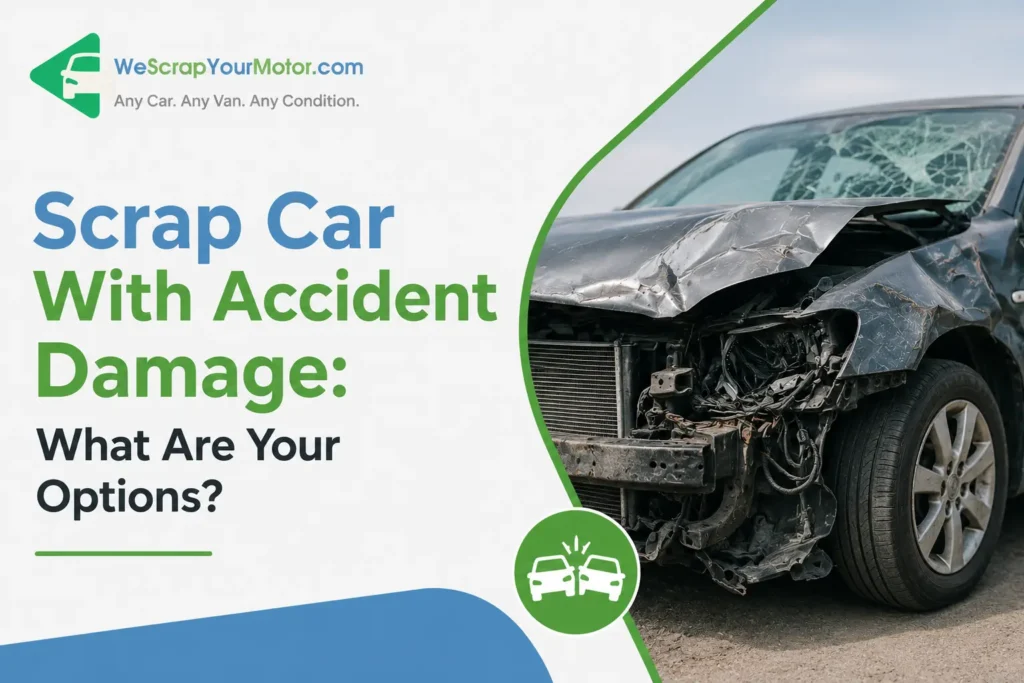
Yes, you can scrap a car with accident damage in the UK. Whether your vehicle has minor cosmetic dents or severe structural damage, authorised scrap car companies can legally purchase and recycle it. If the cost of repairs is higher than the car’s value or the vehicle has been declared a write-off, scrapping it is often the most practical and cost-effective option.
What Counts as Accident Damage?
Accident damage refers to any damage a vehicle suffers during a collision, regardless of whether it involves another vehicle, a wall, roadside furniture, or even wildlife.
The damage can range from small cosmetic scratches to severe structural problems that make the vehicle unsafe to drive.
Common examples include:
- Cracked or broken bumpers
- Damaged doors
- Bent bonnet
- Broken headlights
- Smashed windscreen
- Suspension damage
- Chassis or frame damage
- Airbag deployment
- Wheel alignment issues
- Engine bay damage
Some vehicles may appear to have only minor visible damage, but hidden mechanical or structural problems can significantly increase repair costs.
For this reason, it’s often worth having the vehicle professionally inspected before deciding whether to repair or scrap it.
Can You Scrap a Car With Accident Damage?
Absolutely.
UK Authorised Treatment Facilities (ATFs) accept vehicles in almost any condition, including cars that have been involved in serious road traffic accidents.
It doesn’t matter if the vehicle:
- Won’t start
- Cannot be driven
- Has severe body damage
- Has deployed airbags
- Has suspension damage
- Has engine damage following the collision
- Has failed its MOT because of the accident
Even heavily damaged vehicles still contain valuable recyclable materials and reusable components.
These include:
- Steel
- Aluminium
- Copper
- Catalytic converter
- Engine parts
- Alloy wheels
- Starter motor
- Alternator
- Battery
- Electronic control modules
Because of this, your vehicle may still have value even if repairing it no longer makes financial sense.
If you’re unfamiliar with the process, our guide on How to Scrap a Car in the UK explains everything from obtaining a quote to completing the paperwork.
Should You Repair or Scrap an Accident-Damaged Car?
There isn’t a one-size-fits-all answer.
The right decision depends on several factors, including:
- The severity of the damage
- Repair costs
- Current market value
- Vehicle age
- Mileage
- Mechanical condition before the accident
- Insurance status
For example, replacing a damaged bumper on a three-year-old vehicle may be worthwhile.
However, repairing extensive structural damage on a fifteen-year-old vehicle usually isn’t.
The key is comparing the total repair cost with the vehicle’s current value.
Repair May Be Worth Considering If
Repairing the vehicle could be the better option when:
- The damage is mostly cosmetic.
- The vehicle has relatively low mileage.
- It has been regularly serviced.
- The engine and gearbox remain in excellent condition.
- The repair costs are well below the vehicle’s market value.
- The car has not suffered structural damage.
In these situations, repairing the vehicle could allow you to continue driving it safely or achieve a better resale price later.
Scrapping May Be the Better Option If
Scrapping often becomes the smarter financial decision when:
- The repair costs exceed the vehicle’s value.
- The chassis has been damaged.
- Multiple airbags have deployed.
- Several mechanical systems require repair.
- The vehicle has high mileage.
- It already had existing mechanical faults before the accident.
- The insurance company has declared it a total loss.
If your vehicle already has major mechanical issues alongside accident damage, repairing everything can quickly become uneconomical.
Our guide on Should I Repair or Scrap My Car? can help you compare your options.
Common Types of Accident Damage
Not all accidents cause the same level of damage.
Understanding what has actually been affected helps determine whether repairing or scrapping is the better choice.
Cosmetic Damage
This is the least serious type of accident damage.
Examples include:
- Small dents
- Scratches
- Paint scuffs
- Minor bumper damage
- Broken mirrors
These repairs are often relatively affordable and don’t usually affect the vehicle’s structural integrity.
Body Panel Damage
More significant collisions can damage:
- Doors
- Wings
- Bonnet
- Boot lid
- Roof panels
Although individual panels can often be replaced, labour and paint costs may become expensive, particularly on modern vehicles.
Suspension Damage
Even a low-speed collision with a kerb can damage:
- Suspension arms
- Shock absorbers
- Springs
- Steering components
- Wheel hubs
Signs include:
- Uneven tyre wear
- Vehicle pulling to one side
- Poor handling
- Steering wheel no longer centred
Suspension repairs should never be ignored, as they directly affect the vehicle’s safety.
Structural Damage
Structural or chassis damage is among the most serious forms of accident damage.
The vehicle’s frame is designed to absorb crash forces and protect occupants.
If the chassis becomes bent or twisted, repairs can be extremely expensive and may not restore the vehicle to its original strength.
Many insurers declare vehicles with severe structural damage as write-offs because repair costs often exceed their value.
Engine Damage
Front-end collisions can also damage:
- Radiator
- Cooling system
- Timing components
- Engine mounts
- Belts
- Oil sump
In severe cases, the engine itself may suffer internal damage after impact.
If your vehicle now has engine problems as well, our guide on Should I Scrap a Car With Engine Failure? may also help.
How Much Does Accident Damage Cost to Repair?
Repair costs vary considerably depending on the type of damage and the vehicle involved.
Below are typical UK repair cost estimates.
| Repair | Typical UK Cost |
| Front bumper replacement | £350–£900 |
| Door replacement | £500–£1,500 |
| Bonnet replacement | £500–£1,200 |
| Headlight replacement | £250–£1,200 |
| Suspension repair | £400–£2,000 |
| Chassis straightening | £1,500–£5,000+ |
| Airbag replacement | £1,000–£3,000+ |
Modern vehicles often include advanced safety systems such as cameras, parking sensors, radar units, and adaptive cruise control. If these components are damaged, repair costs can increase significantly because they usually require specialist calibration after installation.
For older vehicles, it’s not uncommon for the total repair bill to exceed the car’s market value.
What Is an Insurance Write-Off?
After inspecting an accident-damaged vehicle, an insurance company may decide that repairing it is no longer economically viable.
When this happens, the vehicle is classified as a write-off, also known as a total loss.
This doesn’t always mean the car is beyond repair. Instead, it means the insurer believes repairing it would cost more than the vehicle is worth, or that it cannot be safely returned to the road.
Many owners choose to scrap a written-off vehicle rather than invest in costly repairs, especially if the damage is extensive or the car is older.
When Scrapping Makes More Financial Sense
Repairing an accident-damaged car isn’t always the most economical choice.
In many situations, scrapping the vehicle can save you from investing thousands of pounds into a car that may continue to lose value or require further repairs.
Here are some of the most common situations where scrapping becomes the better option.
1. The Repair Costs Exceed the Vehicle’s Value
This is one of the biggest reasons people choose to scrap an accident-damaged car.
For example:
- Current vehicle value: £2,800
- Estimated repair costs: £3,600
Even after spending more than the car is worth, its resale value is unlikely to increase enough to recover your investment.
2. The Vehicle Has Multiple Existing Problems
Sometimes accidents aren’t the only issue.
Your vehicle may already have:
- High mileage
- Clutch problems
- Gearbox wear
- Engine faults
- Rust
- MOT advisories
If several expensive repairs are needed at the same time, scrapping often becomes the more sensible long-term decision.
If your vehicle has also developed gearbox issues, our guide on Scrap Car With Gearbox Problems explains when repairing may no longer be worthwhile.
3. Safety Is No Longer Guaranteed
Modern vehicles are engineered with carefully designed crumple zones and reinforced structures to protect occupants during a collision.
If these structural areas have been severely damaged, repairing the car may not fully restore its original crash protection.
In these situations, replacing the vehicle is often the safer choice.
4. The Car Has Already Failed Its MOT
If the accident has caused your vehicle to fail its MOT and there are additional mechanical issues that also need attention, repair costs can quickly escalate.
Our guide on Scrap a Car That Failed MOT explains when scrapping may be a more practical alternative.
Does Accident Damage Always Mean a Car Should Be Scrapped?
Not necessarily.
Many vehicles involved in minor accidents can be repaired safely and continue providing years of reliable service.
The decision ultimately comes down to balancing three key factors:
- The cost of repairs
- The vehicle’s current market value
- Its overall mechanical and structural condition
Obtaining a professional repair estimate and comparing it with your car’s potential scrap value is often the best way to make an informed decision.
Does Accident Damage Reduce Scrap Value?
Yes, accident damage can affect how much your vehicle is worth, but not always as much as people expect.
Many owners assume that a badly damaged car has little or no value. In reality, scrap vehicles are purchased for much more than their appearance. Licensed scrap car companies also consider the recyclable materials and reusable components the vehicle still contains.
Several factors influence the final price, including:
- Vehicle make and model
- Age of the vehicle
- Kerb weight
- Current scrap metal prices
- Overall condition
- Damage severity
- Demand for reusable parts
- Catalytic converter
- Alloy wheels
- Collection location
For example, a car with heavy front-end accident damage may still contain a valuable engine, gearbox, catalytic converter, and other components that can be recycled or reused where appropriate.
On the other hand, if the accident has damaged multiple major components or caused extensive fire damage, the vehicle’s value may be lower because fewer parts can be recovered.
How Is the Scrap Value Calculated?
Every scrap vehicle is different, so there isn’t a fixed price for an accident-damaged car.
When preparing a quote, buyers typically assess several factors rather than focusing on one issue alone.
Vehicle Weight
Heavier vehicles generally contain more recyclable metal, which can increase their scrap value.
Large SUVs, vans, and 4x4s often weigh more than smaller hatchbacks, meaning they may be worth more for recycling.
Current Scrap Metal Prices
The value of steel, aluminium, copper, and other metals changes throughout the year based on market conditions.
As a result, two identical vehicles may receive different offers if they’re scrapped at different times.
Make and Model
Some vehicles have components that are in greater demand than others.
Even if a car has been involved in an accident, reusable parts such as mirrors, alloy wheels, engines, or electronic modules may still have value.
Extent of the Damage
Minor accident damage usually has less impact on scrap value than severe structural damage or fire damage.
Vehicles that are largely complete and haven’t been stripped of parts generally receive stronger offers than incomplete cars.
Collection Distance
If the vehicle is located a long way from the buyer, transport costs may also be considered when preparing a quote.
Can You Scrap an Insurance Write-Off?
Yes.
Many insurance write-offs can still be legally scrapped.
Once an insurer declares a vehicle a total loss, some owners decide not to repair it because the repair costs are too high or the vehicle has suffered significant structural damage.
Licensed scrap car companies regularly purchase insurance write-offs, whether they are:
- Non-running
- Heavily damaged
- Missing body panels
- Unsafe to drive
- Beyond economical repair
Before accepting an offer, ensure you’re dealing with an Authorised Treatment Facility (ATF) so your vehicle is recycled legally and responsibly.
Can a Non-Running Accident-Damaged Car Be Collected?
Yes.
If the accident has left your vehicle unsafe or impossible to drive, you don’t need to arrange a tow yourself.
Most reputable UK scrap car companies provide free collection using specialist recovery vehicles capable of transporting:
- Cars with suspension damage
- Vehicles that won’t start
- Cars with steering damage
- Vehicles with deployed airbags
- Cars with seized engines after an accident
- Vehicles with wheel damage
- Cars that have suffered significant body damage
When requesting a quote, simply explain the vehicle’s condition so the appropriate recovery vehicle can be arranged.
What Documents Do You Need to Scrap an Accident-Damaged Car?
The paperwork is generally straightforward.
Having the following information ready can help make the process smoother:
- Vehicle registration number
- V5C logbook (if available)
- Proof of ownership
- Photo identification if requested
If your V5C was lost during the accident or you no longer have it, don’t panic.
Many licensed scrap companies can still process the vehicle after carrying out additional ownership checks.
You can learn more in our guide on Can I Scrap a Car Without a V5?
What Happens After an Accident-Damaged Car Is Scrapped?
Once your vehicle arrives at an Authorised Treatment Facility, it goes through a regulated recycling process designed to maximise material recovery while protecting the environment.
Although individual facilities may follow slightly different procedures, the main stages are generally the same.
Vehicle Inspection
The vehicle’s identity and ownership details are checked before processing begins.
Depollution
All hazardous materials are safely removed, including:
- Fuel
- Engine oil
- Brake fluid
- Coolant
- Air conditioning gases
- Battery
This prevents harmful substances from entering the environment.
Recovery of Reusable Components
If certain parts remain undamaged and meet legal requirements, they may be removed before recycling.
Examples include:
- Alloy wheels
- Starter motor
- Alternator
- Doors
- Mirrors
- Engine components
- Electronic control units
Metal Recycling
The remaining shell is crushed, shredded, and separated into recyclable materials such as:
- Steel
- Aluminium
- Copper
These materials are then used to manufacture new products, reducing the need for raw material extraction.
Certificate of Destruction
Where applicable, the Authorised Treatment Facility will issue a Certificate of Destruction (CoD) and notify the relevant authorities that the vehicle has been permanently recycled.
To learn more about the process, read What Happens After You Scrap Your Car?
Tips for Getting the Best Price for an Accident-Damaged Car
Even if your vehicle has been involved in a serious collision, there are several ways to maximise its value.
Compare Multiple Quotes
Offers can vary between buyers, so obtaining more than one quote is always worthwhile.
Describe the Damage Accurately
Providing clear information about the vehicle’s condition helps ensure you receive an accurate quotation and avoids delays on collection day.
Keep the Vehicle Complete
Removing valuable components before selling can reduce the overall offer.
Where possible, leave the vehicle intact.
Remove Personal Belongings
Before collection, check:
- Glove box
- Centre console
- Boot
- Door pockets
- Under the seats
Many people are surprised by how many personal items are left inside a vehicle.
Choose a Licensed Scrap Company
Always deal with an Authorised Treatment Facility or a reputable company working with licensed recycling partners.
This ensures your vehicle is disposed of legally and gives you confidence that the necessary paperwork will be handled correctly.
Common Mistakes to Avoid
Repairing Without Comparing Costs
Some owners authorise repairs immediately after an accident without checking whether the vehicle is still worth fixing.
Comparing repair costs with the current market value can prevent unnecessary spending.
Accepting the First Offer
Not all scrap companies offer the same price.
Taking a little extra time to compare quotations may result in a better return.
Forgetting to Remove Personal Items
It’s surprisingly common for documents, tools, sunglasses, and other valuables to be left inside a vehicle before collection.
Always carry out one final check.
Delaying Your Decision
If the vehicle is already beyond economical repair, leaving it unused for months won’t increase its value.
Making a timely decision can help you avoid additional storage or recovery costs.
Using an Unlicensed Buyer
Selling to an unlicensed operator could create problems later if the vehicle isn’t disposed of correctly.
Always choose a licensed company that follows UK regulations.
Frequently Asked Questions
Can I scrap a car after a road traffic accident?
Yes. Licensed scrap companies buy vehicles with minor and major accident damage, including cars that are no longer roadworthy.
Will accident damage stop my car from being scrapped?
No. Even heavily damaged vehicles can usually be recycled by an Authorised Treatment Facility.
Can I scrap a car that won’t start after an accident?
Yes. Most companies provide collections for non-running vehicles.
Is it worth repairing an accident-damaged car?
It depends on the repair costs, the vehicle’s value, and the extent of the damage. If repairs exceed the car’s market value, scrapping is often the better financial decision.
Can I scrap an insurance write-off?
Yes. Many insurance write-offs are legally scrapped every year in the UK.
Does accident damage reduce my scrap price?
It can, but the reduction depends on the severity of the damage and the remaining recyclable materials and reusable parts.
Can I scrap a car without an MOT after an accident?
Yes. A valid MOT certificate is not required when scrapping a vehicle.
Learn more in our guide on Can I Scrap a Car With No MOT?
How long does the scrapping process take?
Many vehicles can be collected within one or two days, depending on your location and the buyer’s availability.
For more details, see How Long Does It Take to Scrap a Car in the UK?
What if my accident-damaged car also has mechanical problems?
Many vehicles have more than one issue. Whether it’s engine failure, gearbox problems, or a failed MOT, licensed scrap companies usually accept vehicles in any condition.
Is Scrapping an Accident-Damaged Car the Right Choice?
The right decision depends on your vehicle’s condition, repair costs, and long-term value.
If the damage is minor and the repair costs are reasonable, fixing the vehicle may be worthwhile. However, when repairs become uneconomical, the car has suffered structural damage, or it has already been declared a write-off, scrapping is often the more practical and financially sensible option.
Before making your decision, compare the estimated repair costs with both your vehicle’s current market value and its potential scrap value. Looking at the full picture can help you avoid investing in repairs that you’ll never recover.
At We Scrap Your Motor, we buy accident-damaged cars in all conditions, including non-running vehicles, insurance write-offs, and cars with significant body or mechanical damage. If you’re unsure whether to repair or scrap your vehicle, requesting a no-obligation quote is a simple way to understand its value and decide on your next step.