
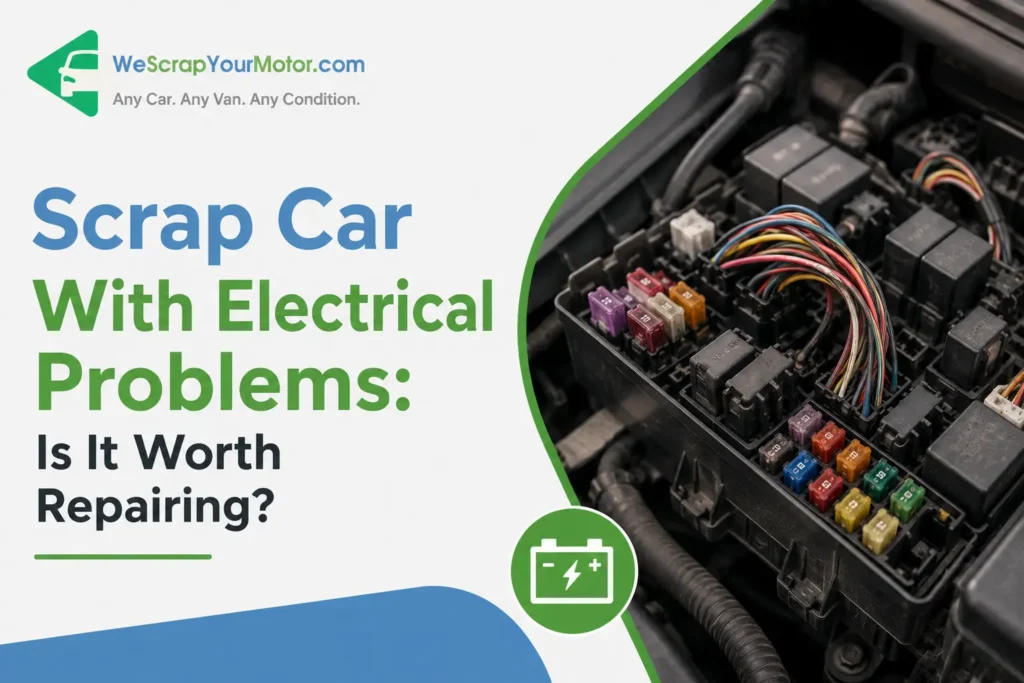
Yes, you can scrap a car with electrical problems in the UK. Whether your vehicle has a faulty wiring loom, ECU issues, repeated battery drain, or electrical faults that prevent it from starting, licensed scrap car companies will still buy it. If diagnosing and repairing the fault costs more than the vehicle is worth, scrapping the car is often the smarter financial decision.
Common Signs of Electrical Problems
Electrical faults can be frustrating because they don’t always have an obvious cause.
Unlike a worn clutch or visible rust, electrical problems often appear without warning and may disappear just as quickly, making them difficult to diagnose.
Some of the most common warning signs include:
- The engine won’t start
- Dashboard warning lights flashing randomly
- Battery repeatedly going flat
- Headlights flickering
- Electric windows not working
- Central locking failure
- Infotainment system constantly restarting
- Power steering warning light
- Burning smell from wiring
- Blown fuses occurring repeatedly
One fault doesn’t always mean your vehicle has a serious problem.
However, if several electrical systems begin failing at the same time, it’s often a sign of a deeper issue that requires professional diagnosis.
Why Modern Cars Develop Electrical Faults
Today’s vehicles contain far more electronic systems than cars built twenty years ago.
A typical modern vehicle may include dozens of control modules responsible for:
- Engine management
- Transmission control
- ABS
- Airbags
- Climate control
- Parking sensors
- Cameras
- Navigation
- Keyless entry
- Electronic handbrake
These systems communicate with one another through complex wiring networks.
If one important module fails, it can sometimes trigger warning lights and faults across several unrelated systems, making diagnosis much more complicated.
This is one reason electrical repairs often cost more than drivers expect.
Can You Scrap a Car With Electrical Problems?
Absolutely.
Electrical faults do not prevent a vehicle from being legally scrapped in the UK.
Whether your car:
- Doesn’t start
- Won’t unlock electronically
- Has a failed ECU
- Suffers from wiring damage
- Has electrical fire damage
- Keeps draining the battery
licensed scrap companies will normally still purchase it.
Even if the vehicle cannot be driven, it still contains valuable recyclable materials and reusable components.
These include:
- Steel
- Aluminium
- Copper wiring
- Catalytic converter
- Alloy wheels
- Engine
- Gearbox
- Suspension components
- Starter motor
- Alternator
If the vehicle cannot be driven safely, most companies also provide free collection.
If you’ve never scrapped a vehicle before, our guide on How to Scrap a Car in the UK explains each step of the process.
The Most Common Electrical Faults
Electrical problems vary from simple battery issues to complex faults hidden deep within the vehicle’s wiring.
Below are some of the issues most commonly seen in UK vehicles.
Battery That Keeps Going Flat
A battery reaching the end of its lifespan is normal.
However, if a new battery also continues losing charge, another fault may be causing excessive power drain.
Possible causes include:
- Faulty alternator
- Parasitic battery drain
- Wiring short circuit
- Faulty control module
- Interior lights remaining on
- Defective alarm system
Alternator Failure
The alternator charges the battery while the engine is running.
When it fails, the battery eventually runs out of power, causing:
- Warning lights
- Dim headlights
- Loss of electrical functions
- Engine stalling
Although alternators can usually be replaced, older vehicles may not justify the repair cost if other faults also exist.
Starter Motor Problems
A faulty starter motor often causes:
- Clicking noises
- Slow engine cranking
- Failure to start
Since similar symptoms can also result from battery or wiring problems, proper diagnosis is important before replacing parts.
ECU Failure
The Engine Control Unit (ECU) acts as the vehicle’s central computer.
It controls essential systems including:
- Fuel injection
- Ignition timing
- Emissions
- Engine sensors
A failed ECU can prevent the vehicle from starting altogether.
Replacement often requires specialist programming, increasing repair costs significantly.
Wiring Loom Damage
The wiring loom connects almost every electrical component within the vehicle.
Damage can occur because of:
- Previous accident repairs
- Rodents chewing wiring
- Water ingress
- Corrosion
- Electrical overload
Locating damaged wiring can take many hours because technicians often need to inspect large sections of the harness manually.
Faulty Sensors
Modern vehicles rely on dozens of sensors.
Common failures include:
- Crankshaft sensor
- Camshaft sensor
- ABS sensor
- Oxygen sensor
- Wheel speed sensor
- Mass airflow sensor
Although many sensors are inexpensive, identifying which one has failed isn’t always straightforward.
Why Electrical Repairs Can Be Expensive
Many drivers are surprised when they’re charged several hundred pounds before any parts have even been replaced.
The reason is simple.
Finding an electrical fault often takes longer than repairing it.
Unlike replacing worn brake pads or tyres, electrical diagnosis usually involves:
- Computer diagnostics
- Live data analysis
- Wiring continuity tests
- Voltage testing
- Component inspection
- Software updates
Technicians may spend several hours tracing the source of one intermittent fault.
This labour often becomes the biggest part of the repair bill.
Average Electrical Repair Costs in the UK
The exact cost depends on the fault, vehicle make, and labour rates.
Typical estimates include:
| Electrical Repair | Typical UK Cost |
| Battery replacement | £100–£250 |
| Alternator replacement | £350–£700 |
| Starter motor replacement | £250–£600 |
| ECU replacement and programming | £700–£2,000+ |
| Wiring loom repair | £300–£2,500+ |
| Diagnostic testing | £80–£180 per hour |
Complex electrical faults can quickly become uneconomical, particularly on older vehicles worth only a few thousand pounds.
Should You Keep Repairing Electrical Problems?
Not always.
Many electrical faults can be repaired successfully.
However, there comes a point where continuing to spend money no longer makes financial sense.
Ask yourself:
- Has the same fault returned several times?
- Have you already replaced multiple electrical components?
- Is the diagnosis still uncertain?
- Does the repair estimate exceed the vehicle’s value?
- Are other major repairs likely in the near future?
If the answer to several of these questions is yes, it may be time to consider scrapping the vehicle instead.
Our guide on Should I Repair or Scrap My Car? can help you compare both options before making a final decision.
When Electrical Problems Usually Mean It’s Time to Scrap
Although every situation is different, there are several circumstances where scrapping often becomes the more practical choice.
Multiple Control Modules Have Failed
If several electronic control units require replacement, repair costs can escalate into thousands of pounds.
Water Has Damaged the Wiring
Vehicles that have suffered flooding or severe water ingress often develop widespread electrical problems.
Moisture can corrode connectors and wiring long after the initial incident, making repairs unpredictable.
The Vehicle Has Other Expensive Faults
Electrical issues rarely occur in isolation on older vehicles.
You may also be facing:
- Engine problems
- Gearbox wear
- Rust damage
- Suspension repairs
- MOT failures
When multiple costly repairs are required, scrapping often provides better financial value than continuing to invest in an ageing vehicle.
If your car has already developed engine problems, our guide on Should I Scrap a Car With Engine Failure? may also help.
Does an Electrical Fault Reduce Your Scrap Car Value?
It can, but usually not as much as many vehicle owners expect.
When a car is being sold privately, serious electrical problems often reduce its value because buyers know they can be difficult and expensive to diagnose. However, scrap car companies assess vehicles differently.
Rather than focusing solely on whether the car starts or whether all of its electrical systems work correctly, they also consider the recyclable materials and reusable components that still have value.
A vehicle with electrical problems may still contain:
- A serviceable engine
- Gearbox
- Alloy wheels
- Catalytic converter
- Body panels
- Suspension components
- Steel, aluminium, and copper
For this reason, even a car that won’t start because of an electrical fault can still receive a competitive scrap quote.
What Determines the Value of a Car With Electrical Problems?
Every vehicle is assessed individually, but several factors usually influence the final offer.
Vehicle Make and Model
Some makes and models have higher demand for used parts than others, which can positively affect the vehicle’s value.
Overall Condition
A vehicle with electrical problems but a clean body, good tyres, and a healthy engine may be worth more than one with additional mechanical or accident damage.
Current Scrap Metal Prices
The value of recycled steel, aluminium, and copper changes throughout the year, which means scrap prices also fluctuate.
Age and Mileage
Newer vehicles or those with lower mileage may still contain more valuable reusable parts.
Location
Collection costs can vary depending on where the vehicle is located, particularly in remote areas.
To learn more about how quotations are calculated, read our guide on How Much Is My Scrap Car Worth?
Can a Car That Won’t Start Still Be Scrapped?
Yes.
One of the most common misconceptions is that a vehicle must be running before it can be scrapped.
In reality, licensed scrap companies regularly purchase vehicles that:
- Won’t start
- Have flat batteries
- Have ECU failures
- Have wiring faults
- Have alternator problems
- Have starter motor issues
If your vehicle can’t be driven safely, collection is usually carried out using a recovery truck or vehicle transporter.
This means you don’t need to arrange separate towing before selling your car.
What Documents Will You Need?
Scrapping a car with electrical problems involves the same paperwork as scrapping any other vehicle.
If available, keep the following ready:
- Vehicle registration number
- V5C logbook
- Proof of ownership
- Photo identification if requested
If you no longer have your V5C, many Authorised Treatment Facilities can still complete the transaction after confirming ownership.
For more information, read What Documents Do I Need to Scrap My Car?
What Happens After an Electrical Faulty Car Is Scrapped?
Once collected, your vehicle is transported to an Authorised Treatment Facility (ATF), where it enters a regulated recycling process.
Initial Inspection
The vehicle’s registration details and ownership documents are checked before processing begins.
Safe Removal of Hazardous Materials
Before recycling, technicians remove environmentally harmful substances, including:
- Engine oil
- Fuel
- Brake fluid
- Coolant
- Air conditioning gases
- Battery
This process helps prevent pollution and ensures the vehicle is recycled responsibly.
Recovery of Reusable Components
If suitable, certain parts may be removed for reuse, including:
- Engine
- Gearbox
- Alloy wheels
- Alternator
- Starter motor
- Body panels
- Mirrors
Metal Recycling
After reusable components have been removed, the remaining shell is crushed and processed so metals such as steel, aluminium, and copper can be recycled.
Certificate of Destruction
Where applicable, the Authorised Treatment Facility will issue a Certificate of Destruction (CoD) to confirm that the vehicle has been permanently recycled.
To understand the full recycling process, see What Happens After You Scrap Your Car?
Practical Ways to Get the Best Scrap Price
Even if your vehicle has significant electrical problems, there are several simple steps you can take before accepting an offer.
Compare Quotes
Prices vary between companies, so it’s worth obtaining more than one quotation.
Explain the Fault Clearly
Let the buyer know whether the vehicle starts, whether it can be driven, and which electrical systems are affected.
Providing accurate information usually results in a more reliable quotation.
Don’t Remove Valuable Parts
Removing components such as the battery, catalytic converter, or alloy wheels may reduce the value of your vehicle.
Where possible, leave the vehicle complete.
Check Inside the Vehicle
Before collection, remove any personal belongings from:
- Glove box
- Centre console
- Boot
- Door pockets
- Under the seats
Use a Licensed Scrap Company
Choosing an Authorised Treatment Facility or a reputable scrap company helps ensure your vehicle is recycled legally and that all necessary paperwork is completed correctly.
Mistakes That Can Cost You Money
Replacing Parts Without Proper Diagnosis
Many owners replace batteries, alternators, or starters hoping to solve the problem, only to discover the fault lies elsewhere.
A professional diagnosis before buying expensive parts can prevent unnecessary spending.
Ignoring Early Warning Signs
Flickering lights, warning messages, or repeated battery problems often indicate an electrical issue that may worsen over time.
Addressing problems early may prevent additional damage.
Spending More Than the Car Is Worth
Electrical faults can become expensive because diagnosis alone often involves several hours of labour.
Before approving repairs, compare the estimate with your vehicle’s current market value.
Accepting the First Offer
Different buyers may value the same vehicle differently.
Comparing several quotations could help you secure a better price.
Choosing an Unlicensed Buyer
Always sell your vehicle to a licensed company that follows UK recycling regulations.
Frequently Asked Questions
Can I scrap a car with ECU problems?
Yes. Vehicles with failed ECUs are commonly accepted by licensed scrap companies.
Can I scrap a car that won’t start because of electrical faults?
Yes. Most scrap companies buy non-running vehicles and provide collection.
Are electrical problems expensive to repair?
They can be. While some faults are relatively inexpensive, diagnosing complex electrical issues or replacing components such as an ECU or wiring loom can cost thousands of pounds.
Will a faulty battery stop my car from being scrapped?
No. A flat or faulty battery does not prevent a vehicle from being scrapped.
Can water damage cause electrical faults?
Yes. Water entering wiring, connectors, or electronic control units can cause widespread electrical problems that may develop immediately or over time.
Can I scrap a car without a valid MOT?
Yes. A current MOT certificate isn’t required when scrapping your vehicle.
Read more in Can I Scrap a Car With No MOT?
How long does it take to scrap a non-running car?
Many companies can arrange a collection within one or two working days, depending on your location.
Our guide on How Long Does It Take to Scrap a Car in the UK? explains what to expect.
What if my car has electrical and mechanical problems?
Many vehicles develop multiple faults as they age. Licensed scrap companies regularly purchase cars with electrical issues alongside engine, gearbox, clutch, or suspension problems.
Will electrical faults continue getting worse?
In many cases, yes. Loose wiring, failing modules, or damaged connectors can lead to additional faults if left unresolved.
Knowing When to Stop Spending on Repairs
Electrical problems are among the most challenging vehicle faults because the visible symptoms don’t always reveal the underlying cause. A simple issue such as a loose connection may be inexpensive to fix, while a damaged wiring loom or failed control module can require extensive labour and specialist equipment to diagnose.
If your vehicle is otherwise in good condition and the repair costs are reasonable, fixing the fault may still be worthwhile. However, if you’ve already spent money replacing multiple electrical components, the diagnosis remains uncertain, or the estimated repair costs exceed your car’s value, continuing to invest may no longer make financial sense.
At We Scrap Your Motor, we buy vehicles with all types of electrical faults, including non-starting cars, ECU failures, wiring problems, and battery drain issues. Whether your vehicle can still be driven or requires recovery, requesting a no-obligation quote can help you understand its remaining value and make an informed decision.