
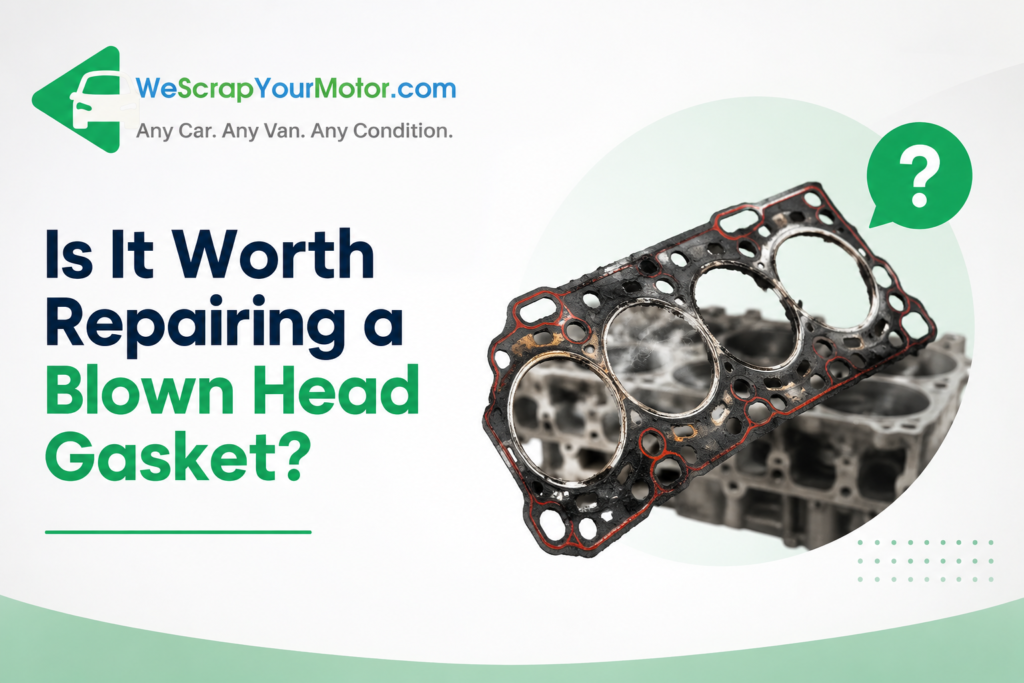
If you’re asking is it worth repairing a blown head gasket, you’re probably facing one of the most expensive engine repairs a car can need. While replacing a head gasket can restore a vehicle to good working condition, the repair isn’t always financially worthwhile. The right decision depends on your car’s value, repair costs, age, mileage, and overall condition. In this guide, we’ll explain when repairing a blown head gasket makes sense and when scrapping the vehicle could save you money.
At a Glance
| Question | Answer |
| Average UK repair cost | £700–£2,500 |
| Can you drive with a blown head gasket? | Not recommended |
| Is it always worth repairing? | No |
| Best option for newer vehicles | Usually repair |
| Best option for older low-value cars | Often scrap |
| Main deciding factor | Compare repair cost with vehicle value |
Quick Answer
A blown head gasket is worth repairing if the repair cost is reasonable compared with your car’s current market value and the rest of the vehicle is in good condition. However, if the repair bill approaches or exceeds the vehicle’s value, or the engine has suffered additional damage from overheating, scrapping the car is often the more economical choice.
What Is a Blown Head Gasket?
The head gasket is a seal that sits between the engine block and the cylinder head.
Although it’s a relatively thin component, it performs several important jobs at once.
It keeps:
- Engine oil where it belongs
- Coolant flowing through separate channels
- Combustion pressure sealed inside each cylinder
When the gasket fails, these systems can mix together.
For example:
- Coolant may leak into the engine oil.
- Oil may enter the cooling system.
- Compression can escape from the cylinders.
- The engine may overheat within minutes.
Because the head gasket protects several critical engine systems, ignoring the problem can quickly lead to severe engine damage.
What Causes a Head Gasket to Blow?
A head gasket rarely fails without a reason.
In most cases, another problem causes excessive heat or pressure inside the engine.
The most common causes include:
Engine Overheating
This is the leading cause of head gasket failure.
When the engine becomes too hot, the cylinder head expands more than the engine block. This movement places enormous stress on the gasket until it eventually fails.
Cooling System Problems
Faults such as:
- Coolant leaks
- Failed water pumps
- Blocked radiators
- Broken cooling fans
- Stuck thermostats
can all cause temperatures to rise high enough to damage the gasket.
High Mileage
Like any engine component, head gaskets wear over time.
Vehicles with high mileage are generally more likely to experience gasket failure, particularly if maintenance has been neglected.
Engine Detonation
Incorrect ignition timing or abnormal combustion can create excessive cylinder pressure.
Over time, this extra pressure can weaken the gasket and eventually cause it to fail.
Poor Previous Repairs
An incorrectly installed cylinder head, reused bolts, or poor-quality replacement parts can all shorten the life of a new head gasket.
Signs Your Head Gasket Has Blown
Recognising the symptoms early can prevent much more expensive engine damage.
1. White Smoke From the Exhaust
One of the clearest warning signs is thick white smoke.
This usually means coolant is entering the combustion chamber and burning with the fuel.
A small amount of condensation on cold mornings is normal.
Continuous white smoke after the engine has warmed up is not.
2. Engine Overheating
If the temperature gauge regularly moves into the red zone, stop driving as soon as it is safe.
Continuing to drive an overheating engine can warp the cylinder head or even destroy the engine completely.
3. Milky Engine Oil
Check the oil filler cap.
If you notice a creamy, mayonnaise-like substance, coolant may be mixing with the engine oil.
This reduces the oil’s ability to lubricate moving parts and can quickly lead to serious engine wear.
4. Coolant Keeps Disappearing
If you’re topping up the coolant frequently but can’t find an external leak, the coolant may be leaking internally through the damaged head gasket.
5. Loss of Engine Power
A damaged gasket can reduce cylinder compression.
Common symptoms include:
- Poor acceleration
- Rough idling
- Engine misfires
- Reduced fuel economy
These problems often become progressively worse if the fault isn’t repaired.
Can You Drive With a Blown Head Gasket?
Technically, yes but it isn’t advisable.
Some vehicles continue to run for a short time after the gasket fails, which leads many owners to believe it’s safe to keep driving.
Unfortunately, every mile driven with a blown head gasket increases the risk of much more expensive damage.
You could end up with:
- A warped cylinder head
- Cracked engine block
- Damaged pistons
- Failed catalytic converter
- Complete engine failure
Expert Insight
Many drivers don’t end up paying for a head gasket replacement, they end up paying for a complete engine rebuild because they continued driving after the first warning signs appeared.
If you suspect your head gasket has failed, have the vehicle inspected as soon as possible instead of continuing to drive it.
How Much Does It Cost to Repair a Blown Head Gasket in the UK?
The gasket itself is relatively inexpensive.
The majority of the cost comes from labour because mechanics must dismantle a large part of the engine to reach it.
| Repair Item | Typical UK Cost |
| Head gasket replacement | £700–£2,500 |
| Cylinder head skimming | £120–£350 |
| Water pump (if replaced) | £150–£350 |
| Timing belt replacement (if recommended) | £250–£600 |
| Engine oil and coolant | £80–£200 |
| Labour | £400–£1,200 |
The final price depends on the make and model of your vehicle, engine size, and whether any additional damage is discovered during the repair.
When Is It Worth Repairing a Blown Head Gasket?
Repairing the head gasket can be a sensible investment if the vehicle still has plenty of useful life left.
In general, the repair is more likely to be worthwhile when:
- The vehicle has a high market value.
- The engine hasn’t suffered severe overheating damage.
- This is the first major mechanical problem.
- The car has been regularly serviced.
- The repair cost is well below the vehicle’s current value.
- You plan to keep the vehicle for several more years.
For example, spending £1,400 on a car worth £12,000 is usually a far better financial decision than replacing the vehicle altogether.
When Is It Better to Scrap Your Car?
Unfortunately, not every blown head gasket is worth repairing.
Sometimes the repair bill is only the beginning. Once the engine is dismantled, a mechanic may also discover a warped cylinder head, cracked engine block, damaged pistons, or worn timing components. These additional faults can increase the final cost significantly.
In many cases, scrapping the vehicle becomes the more practical option if:
- The repair costs are close to or higher than the vehicle’s market value.
- The engine has suffered severe overheating damage.
- The car already has very high mileage.
- It has multiple expensive mechanical problems.
- It has failed its MOT and also needs major repairs.
- Rust or structural corrosion has reduced its overall value.
- The vehicle has become unreliable and requires frequent garage visits.
Expert Verdict
A useful guideline is to compare the total repair estimate with the current market value of your car.
- Repair if the total cost is comfortably below the vehicle’s value and the car is otherwise in good condition.
- Consider scrapping if the repair bill reaches around 60–70% or more of the vehicle’s value, especially if further repairs are likely in the near future.
This isn’t a strict rule, but it’s a practical way to evaluate whether investing more money in the vehicle makes financial sense.
Repair or Scrap? Real Examples
Looking at real-world situations often makes the decision much clearer.
| Vehicle | Market Value | Repair Estimate | Recommended Option |
| 2022 BMW 320d | £18,000 | £1,500 | Repair |
| 2019 Ford Focus | £8,500 | £1,300 | Repair |
| 2014 Nissan Qashqai | £3,800 | £2,200 | Depends on condition |
| 2010 Ford Fiesta | £1,400 | £1,800 | Scrap |
| 2008 Vauxhall Corsa | £800 | £1,600 | Scrap |
These examples are estimates only, but they illustrate why the same repair isn’t the right decision for every vehicle.
Common Mistakes to Avoid
Many drivers spend far more money than necessary simply because they make decisions too quickly.
Ignoring the Early Warning Signs
Continuing to drive an overheating vehicle is one of the biggest mistakes.
The sooner the fault is diagnosed, the greater the chance of avoiding additional engine damage.
Using Temporary Sealants
Some products claim to permanently repair a blown head gasket.
While they may reduce a small leak for a short period, they rarely solve the underlying problem and can sometimes create blockages within the cooling system.
Temporary sealants should never be viewed as a long-term repair.
Approving Repairs Without Comparing the Car’s Value
Before authorising expensive work, find out:
- The vehicle’s current market value.
- The estimated repair cost.
- The likely resale value after repairs.
Making this comparison often changes the decision.
Forgetting About Future Repairs
A successful head gasket repair doesn’t reset the age of your vehicle.
If the clutch, gearbox, suspension, turbocharger, or other major components are already showing signs of wear, more expensive repairs could soon follow.
Always think beyond the current repair bill.
A Simple Decision Checklist
Answer the following questions before deciding.
| Question | Yes | No |
| Is the repair less than 50% of the car’s value? | ☐ | ☐ |
| Has the engine avoided severe overheating damage? | ☐ | ☐ |
| Is the rest of the vehicle in good condition? | ☐ | ☐ |
| Has the car been reliable until now? | ☐ | ☐ |
| Do you plan to keep the vehicle for several more years? | ☐ | ☐ |
If you answered “Yes” to most questions, repairing the vehicle may be worthwhile.
If you answered “No” to several, scrapping the vehicle could be the more economical decision.
Frequently Asked Questions
Can a blown head gasket be repaired?
Yes. In many cases, the head gasket can be replaced successfully. However, the overall cost depends on whether additional engine damage has occurred.
Is it worth fixing a blown head gasket on an old car?
It depends on the vehicle’s value, mileage, and condition. Older cars with low market values are often not worth repairing if the repair bill is very high.
How long does a head gasket repair take?
Most repairs take between one and three days, depending on the vehicle and whether additional parts need replacing.
Can I drive my car with a blown head gasket?
It’s strongly discouraged. Continuing to drive can cause much more serious engine damage and significantly increase repair costs.
Does a blown head gasket mean I need a new engine?
Not necessarily.
If the problem is identified early, replacing the head gasket may be all that’s required. However, prolonged overheating can damage the engine beyond repair.
Can I sell or scrap a car with a blown head gasket?
Yes. Many scrap car buyers purchase vehicles with engine damage, including blown head gaskets. The vehicle’s value will depend on its age, condition, and the demand for reusable parts.
Final Thoughts on Is It Worth Repairing a Blown Head Gasket?
A blown head gasket is one of the most expensive repairs a car owner can face, but it doesn’t always mean the end of the vehicle. For newer cars with good market value and no additional engine damage, repairing the gasket can be a sensible investment.
However, if the repair costs approach or exceed the car’s value, or the vehicle already suffers from multiple mechanical issues, continuing to spend money on repairs may not be the most practical choice. Comparing repair costs with the vehicle’s current value and thinking about future maintenance, will help you make a decision that is both financially and mechanically sound.