
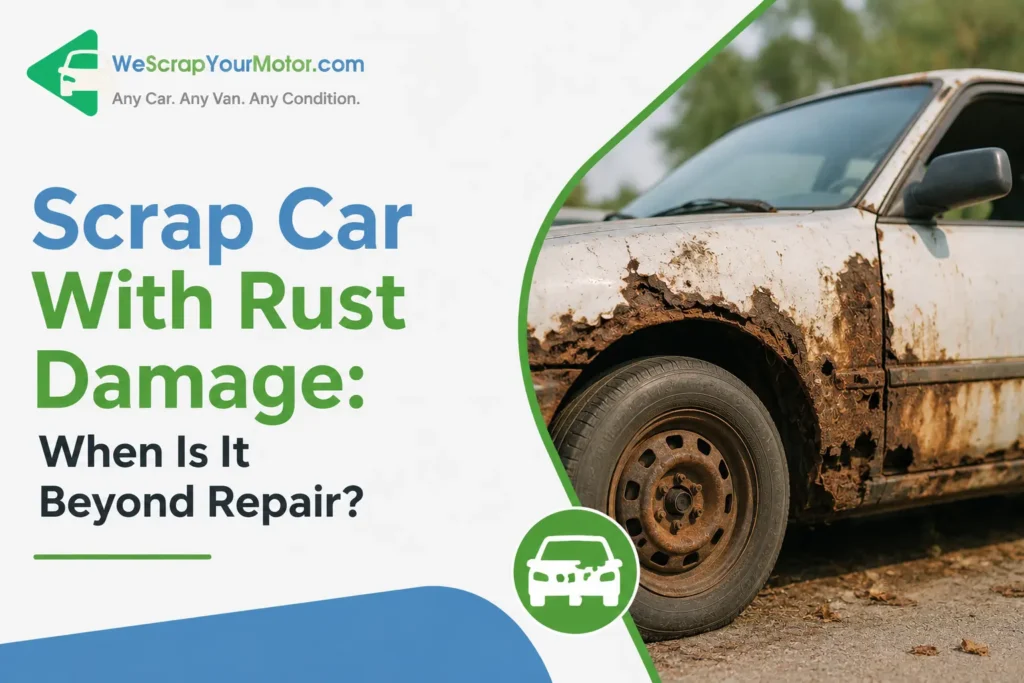
Yes, you can scrap a car with rust damage in the UK. While small patches of surface rust can often be repaired, extensive corrosion affecting the chassis, suspension, or other structural components can make a vehicle unsafe to drive and expensive to fix. If repair costs exceed your car’s value, scrapping it is usually the more practical solution.
Why Does Rust Develop on Cars?
Rust is one of the most common reasons older vehicles lose value and eventually reach the end of their lifespan.
It forms when steel is exposed to oxygen and moisture over time. Once the protective paint or coating is damaged, water can reach the metal underneath and begin a process known as corrosion.
In the UK, rust develops more quickly because vehicles are regularly exposed to:
- Rain
- Snow
- Road salt during winter
- Coastal air
- Standing water
- Mud and dirt trapped underneath the vehicle
Although modern cars include better corrosion protection than older models, no vehicle is completely immune. As a car ages, small chips in the paintwork, worn underseal, and everyday wear can all allow rust to spread.
Without early treatment, what starts as a small patch of corrosion can eventually weaken important structural components.
Not All Rust Is the Same
One of the biggest misconceptions is that every rusty car should be scrapped.
In reality, rust falls into different categories, and some types are far more serious than others.
Understanding the difference can help you decide whether repairing your vehicle is worthwhile.
Surface Rust
Surface rust only affects the outer layer of the metal.
You’ll often notice it as:
- Small orange or brown patches
- Bubbling paint
- Minor corrosion around stone chips
- Rust beginning around scratches
At this stage, the metal underneath usually remains strong.
If treated early, surface rust can often be removed by sanding the affected area, applying rust treatment, and repainting the panel.
Scale Rust
If surface rust is ignored, it gradually penetrates deeper into the metal.
This stage is known as scale rust.
Signs include:
- Flaking metal
- Rough, uneven surfaces
- Paint lifting away from the body
- Larger areas of visible corrosion
Repairing scale rust is generally more expensive because damaged metal often needs cutting out and replacing.
Structural Rust
Structural rust is the most serious form of corrosion.
Instead of affecting cosmetic panels, it weakens parts of the vehicle responsible for safety and strength.
Examples include:
- Chassis rails
- Suspension mounting points
- Sills
- Floor pans
- Subframes
- Crossmembers
Once these components become heavily corroded, the vehicle may no longer provide adequate protection during a collision.
In many cases, repairing structural rust requires extensive welding, fabrication, and repainting, making it one of the most expensive body repairs.
How Rust Affects Your Vehicle
Rust is more than just a cosmetic issue.
As corrosion spreads, it can reduce your vehicle’s safety, reliability, and resale value.
Some of the most common problems include:
Reduced Structural Strength
The chassis acts as the backbone of your vehicle.
When corrosion weakens structural sections, they may no longer absorb impact forces as intended during an accident.
This can increase safety risks for both occupants and other road users.
Suspension Problems
Rust can weaken suspension mounting points and supporting brackets.
If left untreated, this may lead to:
- Poor handling
- Unstable steering
- Increased tyre wear
- Suspension movement under load
These issues can make driving less predictable, especially at higher speeds.
Brake System Corrosion
Certain brake components are also vulnerable to rust, including:
- Brake pipes
- Brake discs
- Brake backing plates
Severe corrosion may eventually affect braking performance, making prompt repairs essential.
Water Leaks
Rust holes in the floor or body panels allow water to enter the cabin.
This often causes:
- Damp carpets
- Condensation
- Electrical faults
- Mould growth
- Unpleasant odours
Moisture trapped inside the vehicle can also accelerate corrosion from the inside out.
Falling Resale Value
Even if your car still drives well, visible rust often reduces buyer confidence.
Potential purchasers may worry about hidden structural damage or expensive repairs, resulting in lower offers or difficulty selling the vehicle privately.
Can a Rusty Car Fail Its MOT?
Yes.
Rust is one of the most common reasons older vehicles fail an MOT in the UK.
However, not every rusty car automatically fails.
During an MOT inspection, the tester assesses whether corrosion affects the vehicle’s safety.
Minor cosmetic rust usually isn’t enough to fail the test.
Structural corrosion is a different matter.
Your vehicle may fail if rust has significantly weakened areas such as:
- Suspension mounting points
- Seat belt anchorages
- Chassis members
- Steering components
- Brake mounting areas
- Sills close to prescribed structural points
These components play an important role in keeping the vehicle safe on the road.
If corrosion has reduced their strength, repairs are normally required before the vehicle can pass another MOT.
If your vehicle has already failed because of corrosion, our guide on Scrap a Car That Failed MOT explains when scrapping may be the better option.
Can You Scrap a Car With Rust Damage?
Absolutely.
Licensed scrap car companies regularly purchase vehicles with severe rust and corrosion.
In fact, rust is one of the most common reasons people choose to scrap older vehicles.
Even if corrosion has made the vehicle uneconomical to repair, it still contains valuable recyclable materials.
These include:
- Steel
- Aluminium
- Copper
- Catalytic converter
- Alloy wheels
- Engine components
- Gearbox
- Electrical modules
If the vehicle can no longer be driven safely because of rust, many companies also provide free collection.
If you’re scrapping a vehicle for the first time, our guide on How to Scrap a Car in the UK explains the process from start to finish.
Is Rust Worth Repairing?
That depends on where the rust is, how extensive it has become, and what the vehicle is worth today.
There isn’t a single answer that applies to every situation.
For example, repairing a small rusty wheel arch on a relatively new vehicle may be a sensible investment.
However, repairing extensive corrosion throughout the chassis of an older vehicle can quickly become more expensive than the car itself.
Rather than focusing only on the visible rust, it’s important to consider the overall condition of the vehicle.
Ask yourself:
- How old is the car?
- What is its current market value?
- Has it already needed several expensive repairs?
- Has it recently failed its MOT?
- Is the rust limited to one area or spreading throughout the vehicle?
- Are there other mechanical faults developing at the same time?
Looking at the complete picture often leads to a better financial decision than focusing on the rust alone.
Warning Signs That Rust Is Becoming a Serious Problem
Rust often develops slowly, which means many drivers don’t realise how severe it has become until the damage is extensive.
Some warning signs include:
- Paint bubbling in multiple places
- Rust holes appearing underneath the vehicle
- Flaking metal around suspension components
- Soft areas when pressing on body panels
- Water entering the cabin
- MOT advisories mentioning corrosion
- Visible rust around seat belt mounting points
- Excessive corrosion underneath the car
If several of these signs are present, arranging a professional inspection is advisable before deciding whether repairs are worthwhile.
When Rust Repairs Stop Making Financial Sense
Many vehicle owners continue paying for rust repairs because the corrosion appears manageable at first.
However, rust rarely stays in one place.
Once corrosion reaches structural components, repair costs can increase rapidly due to the amount of labour involved.
Scrapping often becomes the better option when:
The Vehicle Needs Extensive Welding
Structural welding requires skilled labour and can take many hours to complete.
As more corrosion is uncovered, costs often increase beyond the original estimate.
Corrosion Exists in Multiple Areas
Repairing one rusty section may not solve the problem if corrosion has already spread throughout the vehicle.
When multiple structural sections require attention, the repair bill can escalate quickly.
The Car Already Has Other Mechanical Problems
Rust is often only one part of a much larger repair bill.
Older vehicles may also require:
- Clutch replacement
- Suspension repairs
- Engine work
- Gearbox repairs
- Brake system repairs
When several major faults occur together, replacing or scrapping the vehicle may be the more economical choice.
If your vehicle also has engine issues, our guide on Should I Scrap a Car With Engine Failure? may help you compare your options.
How Much Does Rust Repair Cost in the UK?
The cost of repairing rust depends on three main factors:
- How far the corrosion has spread
- Which parts of the vehicle are affected
- The amount of labour required
A small rust patch on a wheel arch is far less expensive to repair than corrosion affecting the chassis or suspension mounting points.
Below are typical repair costs in the UK.
| Rust Repair | Typical UK Cost |
| Small surface rust repair | £100–£300 |
| Wheel arch rust repair | £250–£700 |
| Door or wing rust repair | £300–£900 |
| Welding small structural sections | £300–£800 |
| Extensive chassis welding | £1,000–£3,500+ |
| Complete sill replacement | £600–£1,500 |
These are only estimates. If the technician discovers additional hidden corrosion after removing damaged metal, the final bill can increase considerably.
For older vehicles with low market values, investing thousands of pounds in rust repairs is rarely economical.
Does Rust Reduce a Car’s Scrap Value?
Not always.
Many people assume that severe rust makes a scrap car worthless, but that’s not how scrap vehicles are valued.
Licensed scrap companies consider the vehicle as a whole rather than focusing on one fault.
When preparing a quotation, they typically assess:
- Vehicle make and model
- Overall weight
- Current scrap metal prices
- Age
- Condition of reusable components
- Demand for parts
- Collection distance
Although severe corrosion may reduce the value of some reusable parts, the vehicle still contains recyclable metals such as steel, aluminium, and copper.
This means even heavily rusted cars usually retain some value.
If you’d like to understand how quotations are calculated, our guide on How Much Is My Scrap Car Worth? explains the main factors that influence pricing.
Which Vehicles Are Most Likely to Develop Rust?
Rust can affect almost any vehicle, but certain conditions make corrosion more likely.
These include:
Older Vehicles
As protective coatings wear away over time, older vehicles naturally become more vulnerable to corrosion.
Cars Driven in Coastal Areas
Salt carried in sea air accelerates corrosion, particularly on exposed metal underneath the vehicle.
Vehicles Used During Winter
Road salt helps improve driving conditions during icy weather, but it also speeds up the rusting process if it’s left on the vehicle for long periods.
Cars Stored Outdoors
Vehicles parked outside throughout the year experience constant exposure to moisture, changing temperatures, and rainfall, all of which contribute to corrosion.
Poorly Repaired Accident Damage
If damaged panels aren’t repaired correctly or protective coatings aren’t restored, rust can begin developing surprisingly quickly.
Can You Prevent Rust From Spreading?
While existing corrosion can’t always be reversed, regular maintenance can slow its progression.
Helpful preventative measures include:
- Washing road salt from the underside during winter
- Repairing paint chips promptly
- Keeping drain holes clear
- Applying rust protection or underseal
- Cleaning wheel arches regularly
- Parking in a dry, well-ventilated area where possible
These steps are particularly useful for newer vehicles, where preventing corrosion early can significantly extend their lifespan.
Can a Rust-Damaged Car Be Collected?
Yes.
If corrosion has made your vehicle unsafe or unroadworthy, most reputable UK scrap car companies can arrange collection using specialist recovery vehicles.
This applies even if the vehicle:
- Cannot pass an MOT
- Has structural corrosion
- Is unsafe to drive
- Has seized brakes caused by rust
- Has suspension corrosion
- Has been sitting unused for months
When requesting a quote, explain the vehicle’s condition so the collection team can prepare the appropriate recovery equipment.
What Documents Will You Need?
The paperwork required is generally the same regardless of why you’re scrapping your vehicle.
If possible, have the following available:
- Vehicle registration number
- V5C logbook
- Proof of ownership
- Photo identification if requested
Don’t worry if you’ve lost your V5C.
Many licensed scrap companies can still process your vehicle after carrying out the necessary ownership checks.
You may also find What Documents Do I Need to Scrap My Car? helpful before arranging the collection.
What Happens After a Rust-Damaged Car Is Scrapped?
Once your vehicle arrives at an Authorised Treatment Facility (ATF), it enters a carefully managed recycling process.
Inspection
The vehicle’s identity and ownership details are checked before processing begins.
Depollution
Hazardous materials are safely removed, including:
- Engine oil
- Fuel
- Coolant
- Brake fluid
- Air conditioning gases
- Battery
Removing these substances helps protect the environment during recycling.
Removal of Reusable Parts
Where suitable, undamaged components may be removed before the remaining vehicle is recycled.
These could include:
- Alloy wheels
- Engine components
- Alternator
- Starter motor
- Mirrors
- Electronic modules
Metal Recycling
The remaining vehicle shell is crushed and processed so valuable metals can be separated and reused in future manufacturing.
This reduces waste and helps conserve natural resources.
Certificate of Destruction
Where applicable, the Authorised Treatment Facility will issue a Certificate of Destruction (CoD) and notify the relevant authorities that the vehicle has been permanently recycled.
To understand the complete process, read our guide on What Happens After You Scrap Your Car?
Tips for Getting the Best Price for a Rust-Damaged Car
Even if corrosion has affected your vehicle, there are several ways to maximise its value.
Compare More Than One Quote
Different buyers may offer different prices, so comparing quotations is worthwhile.
Describe the Vehicle Honestly
Accurate information helps ensure the quotation reflects the vehicle’s actual condition.
Leave the Vehicle Complete
Removing valuable parts before collection can reduce the amount you’re offered.
Check for Personal Belongings
Before the vehicle is collected, inspect:
- Boot
- Glove box
- Centre console
- Door pockets
- Under the seats
This simple check helps avoid leaving valuable items behind.
Choose a Licensed Buyer
Working with a reputable company or Authorised Treatment Facility ensures your vehicle is disposed of legally and responsibly.
Common Mistakes to Avoid
Ignoring Rust for Too Long
Small patches of corrosion are usually much cheaper to repair than widespread structural rust.
Delaying repairs often allows the damage to spread.
Repairing a Car Worth Less Than the Repairs
It’s easy to focus on fixing the immediate problem without considering the vehicle’s overall value.
If repairs exceed what the car is worth, scrapping may be the more sensible financial decision.
Accepting the First Offer
Comparing several quotations could help you secure a better price.
Forgetting MOT Advisories
Many MOT advisories highlight corrosion before it becomes a failure.
Ignoring these warnings often results in larger repair bills later.
Choosing an Unlicensed Scrap Operator
Always ensure your vehicle is recycled through a licensed company that complies with UK regulations.
Frequently Asked Questions
Can I legally scrap a rusty car?
Yes. Licensed scrap companies accept vehicles with rust, including those with severe structural corrosion.
Will rust automatically fail an MOT?
No. Surface rust usually isn’t enough to fail an MOT. However, corrosion affecting structural or safety-related components may result in a failure.
Can a rusted car still be worth money?
Yes. Even heavily corroded vehicles contain recyclable metals and reusable components that retain value.
Is welding always cheaper than scrapping?
Not necessarily. Extensive structural welding can cost more than the vehicle is worth, especially on older cars.
Can I scrap a car with rust and no MOT?
Yes. You don’t need a valid MOT certificate to scrap a vehicle.
Read our guide on Can I Scrap a Car With No MOT?
Will rust continue spreading if I leave the car parked?
Yes. Moisture and oxygen can continue to corrode exposed metal even if the vehicle isn’t being driven.
Can a scrap company collect a rusted vehicle that won’t move?
Yes. Most reputable companies provide collections for non-running vehicles.
How long does it take to scrap a rusty car?
Collection can often be arranged within one or two days, depending on your location and the buyer’s availability.
You can learn more in How Long Does It Take to Scrap a Car in the UK?
Is surface rust a reason to scrap a car?
Usually not. Surface rust is often repairable if treated early. The decision to scrap becomes more likely when corrosion affects structural components or repair costs outweigh the vehicle’s value.
Making the Right Decision
Rust is a normal part of a vehicle’s ageing process, but not every rusty car needs to be scrapped. Minor surface corrosion can often be repaired, helping to extend the life of your vehicle. The real challenge begins when rust reaches structural areas, weakens safety-critical components, or leads to repair bills that are difficult to justify.
Before deciding, consider the overall condition of your car rather than focusing on the rust alone. Compare the estimated repair costs with your vehicle’s current market value, take any upcoming MOT repairs into account, and think about whether other mechanical issues are likely to arise in the near future.
At We Scrap Your Motor, we purchase vehicles with all levels of rust damage, from light corrosion to extensive structural deterioration. Whether your car has failed its MOT because of rust or repairs are no longer economical, requesting a no-obligation quote can help you make an informed decision and understand the remaining value of your vehicle.