
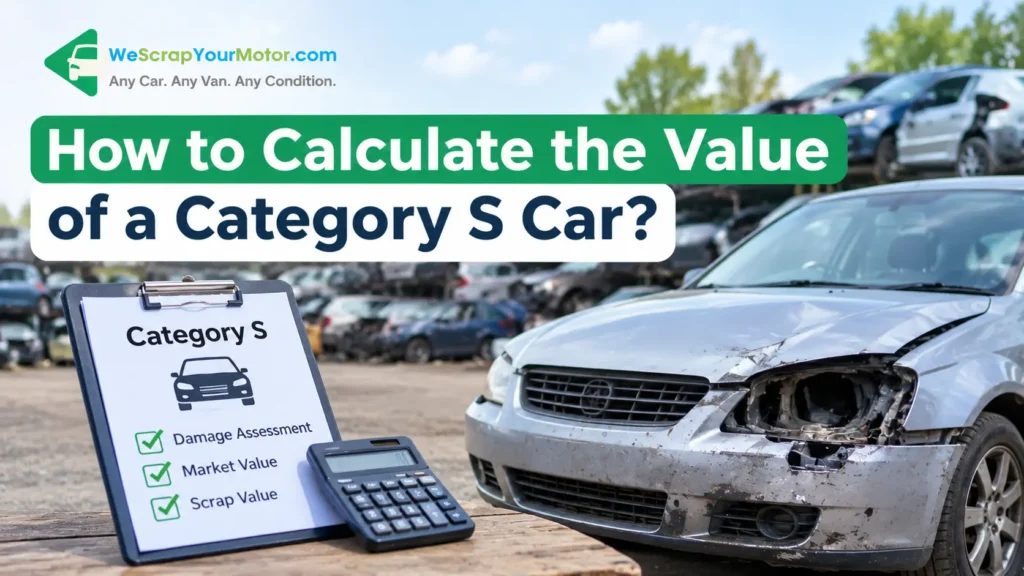
Your insurer has declared your vehicle a Category S write-off, but what does that actually mean for its value? Is it worth repairing, selling as damaged salvage, or scrapping altogether?
A Category S car has suffered structural damage but is considered repairable. Its value depends on the extent of that damage, the cost of restoring it safely, its previous market value, and what buyers are prepared to pay for a vehicle with a recorded insurance history.
The biggest mistake is calculating its worth using only the price of an equivalent undamaged car. A repaired write-off and an accident-free example do not necessarily command the same resale price.
To estimate its value accurately, you must consider three figures: its pre-accident market value, its current salvage value, and its potential resale value after professional repairs.
This guide explains how to calculate those figures, understand the costs involved, compare your options, and decide which route makes financial sense in the UK.
What Is a Category S Car In the UK?
Category S is an insurance salvage classification given to a vehicle that has experienced structural damage but can potentially be repaired.
The letter S stands for structural.
Structural damage involves parts of the vehicle’s supporting framework rather than simply removable exterior panels.
Depending on the vehicle’s construction, structural components may include:
- Chassis rails and structural crossmembers
- Structural pillars surrounding the passenger compartment
- Parts of the floor structure
- Structural sills
- Certain suspension mounting areas
- Other load-bearing sections identified by the manufacturer
Damage to these components may affect crash protection, alignment, or the vehicle’s ability to withstand future impacts.
However, the Category S classification does not automatically mean that the vehicle is beyond repair.
According to GOV.UK’s insurance write-off guidance, Category S vehicles can return to the road after being repaired to a roadworthy condition.
Does Category S Mean Severe Damage?
Not necessarily.
A vehicle can receive a Category S classification even when the damage appears relatively localised. Conversely, a car that looks reasonably presentable from the outside could have significant structural problems.
For example, a collision may deform a structural mounting point beneath an otherwise undamaged-looking panel.
The deciding factor is not how dramatic the accident looked.
It is whether the damage affected the vehicle’s structure and whether appropriate repairs can restore it safely.
A Category S car should therefore be assessed using the actual damage report and repair requirements, not photographs alone.
How Much Is a Category S Car Worth?
There is no fixed UK valuation percentage for every structurally damaged write-off.
A Category S car can have three different values, depending on its condition and the intended buyer.
| Valuation Type | What It Represents |
| Pre-accident value | What the vehicle was reasonably worth before the damage |
| Damaged salvage value | What a buyer offers for the unrepaired vehicle |
| Repaired resale value | What buyers may pay after safe, documented repairs |
These figures should be calculated separately.
An insurer’s settlement may reflect the vehicle’s pre-accident market value, subject to policy terms. A salvage buyer, meanwhile, is interested in what can be recovered from the damaged vehicle after allowing for costs and risk.
A private buyer considering a repaired vehicle may concentrate on its safety, history, condition, warranty implications, and resale prospects.
That is why two buyers can offer very different amounts for the same vehicle.
Does a Category S Car Lose 20% To 40% Of Its Value?
You may see websites suggesting that repaired write-offs always sell for a particular percentage less than accident-free vehicles.
Treat such figures cautiously.
There is no universal official discount that applies to every Category S car.
An older, low-value hatchback with extensive repairs may face a different market from a newer premium model with clear repair documentation.
Actual discounts depend on comparable sales, buyer confidence, repair quality, and current demand.
Use observed market prices rather than applying an arbitrary percentage.
A Practical Formula For Calculating Category S Car Value
The most useful calculation is the expected financial return after repair.
Estimated Net Resale Return = Expected Repaired Selling Price − Repair Costs − Additional Expenses − Risk Allowance
Compare that result against an actual offer for the damaged vehicle.
The calculation involves five steps.
Step 1: Establish the Pre-Accident Market Value
Start by estimating what the vehicle would have sold for immediately before the accident.
Look for comparable cars with similar:
- Make and model
- Registration year
- Engine and transmission
- Mileage
- Specification and trim
- Service history
- General condition
- Previous ownership and accident history
- MOT status
For example, a 2018 Ford Focus with 65,000 miles should not automatically be valued against a 2018 example with 110,000 miles.
Mileage, maintenance, and specification can create substantial price differences.
Check several comparable advertisements, but remember that asking prices are not necessarily completed sale prices.
Professional valuations from recognised UK automotive valuation providers can also provide useful context.
A fair starting point uses multiple sources rather than the highest advertisement you find.
Step 2: Obtain an Itemised Structural Repair Estimate
A professional assessment should identify the damage and specify how it would be repaired.
A Category S car may require more than ordinary panel replacement.
The estimate could involve:
- Structural measurement and assessment
- Manufacturer-approved repair methods
- Replacement structural components
- Approved joining and bonding procedures
- Suspension geometry checks
- Airbag and restraint-system inspection
- Wheel alignment
- Electrical diagnostics
- Painting and finishing
- Final safety checks
A quotation that simply says “accident repair” without detailing the work is not enough for a reliable financial decision.
Ask whether the estimate includes VAT, parts, labour, and necessary safety-system work.
Also ask whether the garage can identify hidden damage after dismantling.
A low initial quotation becomes less attractive if it excludes essential operations.
Step 3: Include Hidden Repair Expenses
Collision damage can extend beyond what is immediately visible.
For example, removing a damaged front panel might reveal broken supports, wiring damage, or problems with components behind it.
A realistic financial calculation should allow for this uncertainty.
Possible additional expenses include:
- Further mechanical inspections
- Diagnostic scans
- Recovery charges
- Storage fees
- Replacement sensors
- Additional paintwork
- Calibration of driver-assistance systems
- Replacement brackets or fixings
- Unanticipated labour
Do not treat a contingency allowance as a fixed industry rule.
The appropriate amount depends on the damage, inspection findings, and how complete the garage’s estimate is.
When the repairer cannot reasonably establish the full damage, the uncertainty itself should influence your decision.
Step 4: Estimate the Repaired Resale Value
A properly repaired Category S car may be marketable, but buyers often want evidence of the work.
Search for examples of repaired write-offs with similar specifications where possible.
Consider whether the seller can provide:
- Original damage photographs
- Repair invoices
- Parts documentation
- Structural measurement reports
- Evidence of appropriate repairs
- Inspection or assessment records
- Current MOT information
These documents do not guarantee a particular resale price, but they help a buyer evaluate the vehicle.
A Category S classification remains part of the vehicle’s history.
Repainting the bodywork or obtaining a fresh MOT does not erase that history.
Remember that an MOT checks defined minimum standards at the time of testing. It is not a comprehensive structural repair certification.
Step 5: Compare the Result With a Salvage Offer
Once you know the likely financial return after repairs, request a quotation for selling the vehicle in its current condition.
A salvage buyer might value the vehicle because it has:
- A usable engine
- An undamaged gearbox
- Valuable interior components
- Reusable electronic modules
- Demand for model-specific parts
- Repair potential
- Recoverable materials
The buyer must also allow for recovery, labour, storage, testing, sales costs, and commercial risk.
The price offered will therefore differ from the theoretical retail value of all individual parts.
Always compare the net amount you would actually receive, including any collection costs.
Category S Car Valuation Example: Repair Or Sell?
Consider a hypothetical accident-damaged family car.
All figures below are illustrative calculations, not current UK market quotations.
| Item | Example Amount |
| Pre-accident market value | £7,500 |
| Expected repaired resale price | £5,900 |
| Professional repair estimate | £3,100 |
| Additional repair allowance | £600 |
| Inspection and other expenses | £200 |
| Estimated net resale return | £2,000 |
| Damaged salvage offer | £2,200 |
| Scrap quotation | £330 |
In this example, the salvage offer provides £200 more than the estimated return from repairing and selling.
The difference may appear small, but the repair route also involves time, uncertainty, and the possibility of further expenses.
Selling the damaged vehicle could therefore be more financially sensible.
Now imagine the same vehicle needed only £1,600 in properly assessed repairs, with no significant additional damage.
The estimated repaired return could become much more attractive.
This illustrates an important principle: the best option depends on the numbers for the individual car, not the insurance category alone.
What If You Plan To Keep Driving the Car?
The calculation changes when you intend to keep the repaired vehicle.
You are no longer relying entirely on the resale price.
You should consider the value of reliable future use, the cost of replacing the vehicle, and the likelihood of additional repairs.
For instance, a safely repairable car that suits your needs may be worth keeping if replacement would cost significantly more.
However, never justify inadequate structural repairs simply because replacing the car would be expensive.
Safety must remain the first requirement.
How Does Category S Affect Insurance Value?
A recorded write-off can affect how insurance companies assess a vehicle.
Insurers may consider the previous damage, repair documentation, current condition, vehicle market, and their underwriting rules.
Some insurers may request additional information before offering cover.
Others may apply different terms or valuations.
It is sensible to speak to potential insurers before committing to expensive repairs.
Ask the insurer:
- Will you insure this repaired Category S vehicle?
- Do you require evidence of the repairs?
- Are any inspections necessary?
- How will its value be assessed after another accident?
- Are there policy conditions relating to previous damage?
Do not assume that an existing insurance policy will automatically continue unchanged after a total-loss settlement.
Does a Previous Write-Off Reduce Future Claims?
It may affect the vehicle’s assessed market value.
For example, if a repaired Category S vehicle has a lower market value than an equivalent accident-free model, that difference may matter in a subsequent claim.
The insurer’s actual assessment depends on the vehicle and policy.
This is another reason to avoid spending close to the full accident-free market value on repairs.
Is It Worth Buying a Category S Car?
A repaired structural write-off can appear attractive because its asking price may be below that of similar accident-free vehicles.
However, a lower purchase price is not automatically a bargain.
Imagine two similar vehicles:
- Vehicle A is accident-free and advertised for £8,000.
- Vehicle B is a repaired structural write-off advertised for £6,100.
The £1,900 difference may seem worthwhile.
But the correct question is whether Vehicle B has been repaired safely and whether its recorded history justifies the price.
A sensible buyer should obtain a suitable independent inspection and examine the repair evidence.
Structural Repairs Deserve More Attention Than Cosmetic Repairs
A newly painted bumper tells you very little about the quality of a structural repair.
Look for evidence that the repairer followed appropriate methods for the damaged structural components.
Consider whether the vehicle drives straight, whether the tyre wear is even, and whether safety-related warning lights operate correctly.
These are useful observations, but they are not substitutes for professional inspection.
A qualified repair specialist may need to check alignment, structural measurements, or safety systems that cannot be assessed during a casual viewing.
Request the Original Damage Details
Ask the seller for photographs taken before the repair.
Compare the photographs with the repair invoices.
If a photograph shows serious damage to one corner of the vehicle but the invoices mention only cosmetic work, request an explanation.
Missing paperwork is not conclusive proof of poor repairs, but it makes the vehicle harder to evaluate.
For a buyer, that additional uncertainty has financial value.
Check the Insurance Write-Off History
A standard MOT history check does not establish whether a vehicle has previously been written off.
Use an appropriate vehicle-history service to check recorded insurance damage, outstanding finance, and other relevant information.
Confirm that the registration and vehicle identification number match the documents.
If the seller’s explanation conflicts with recorded history, investigate before paying.
Can You Remove the Category S Status After Repairs?
No. Completing repairs does not simply remove a recorded Category S history.
The vehicle may be returned to roadworthy condition and used again, but the salvage classification remains relevant to its recorded history.
The DVLA has specific arrangements for Category S vehicles.
If the original owner retains the car following an insurance settlement, GOV.UK explains that the owner must send the complete V5C to the insurer and apply for a free duplicate using form V62.
The category is recorded on the replacement document.
A buyer should not interpret a fresh V5C as evidence that previous structural damage has disappeared.
Do You Need a Special Category S Inspection?
There is no general rule requiring every repaired Category S car to pass a separate national vehicle identity check before returning to the road.
However, it must be roadworthy and comply with applicable legal requirements.
A valid MOT may be necessary depending on the vehicle’s age and circumstances.
Because an MOT is not a comprehensive accident-repair assessment, obtaining a suitable professional post-repair inspection is strongly advisable.
Retain the evidence for future buyers and insurers.
What Affects the Scrap Value Of a Category S Car?
If repairs are uneconomical, the vehicle may still have meaningful scrap or salvage value.
The amount depends on more than the extent of the accident damage.
Vehicle Weight and Recyclable Materials
The vehicle’s weight influences its basic recycling value.
Larger vehicles often contain more recoverable material, although weight alone does not determine the final quotation.
Market demand for ferrous and non-ferrous metals also changes over time.
Consequently, old online scrap price estimates may not reflect current offers.
Condition Of the Engine and Gearbox
Undamaged mechanical components may create additional salvage value.
For example, a vehicle with substantial rear-end damage might still have usable front mechanical components.
A badly damaged vehicle with a destroyed engine and gearbox may be less attractive to a parts-focused buyer.
However, suitability for reuse must be properly assessed.
Missing Parts and Previous Dismantling
A complete vehicle may attract a different offer from one missing major components.
Removing the catalytic converter, engine, wheels, or battery can affect both the potential value and the recovery process.
Never assume that selling a component separately will increase the total return.
Dismantling, transport, and disposal costs can cancel out the apparent benefit.
Location and Collection Access
A vehicle parked on an accessible driveway may be easier to collect than one trapped in a restricted underground car park.
The collector may need special recovery arrangements when steering, brakes, or wheels are damaged.
Explain the condition accurately when requesting a quotation.
If you’re located in Berkshire, our Scrap My Car in Reading service can provide a vehicle-specific quotation and arrange collection subject to the booking details.
Category S Car Vs Category N Car: Which Holds More Value?
Category S and Category N describe different types of recorded damage.
| Feature | Category S | Category N |
| Recorded damage | Structural | Non-structural |
| Potentially repairable | Yes | Yes |
| Road use after suitable repair | Permitted when roadworthy | Permitted when roadworthy |
| Safety inspection recommended | Strongly | Strongly |
| Resale value | Depends on market and repairs | Depends on market and repairs |
| Scrap value | Based on vehicle and condition | Based on vehicle and condition |
It would be misleading to assume that every Category N vehicle is automatically safer or more valuable than every Category S car.
Non-structural damage can still involve expensive or safety-critical components.
Similarly, a properly repaired structural write-off can have greater value than a non-structural write-off with severe mechanical or electrical damage.
The insurance classification describes the type of damage, not a guaranteed resale discount.
Should You Repair, Sell Or Scrap Your Category S Car?
A useful decision process has three stages.
First, confirm the vehicle can be repaired safely using appropriate methods.
Second, calculate the full expected repair cost and compare it with a realistic repaired market value.
Third, obtain a current damaged-vehicle quotation and compare the amount you would receive without carrying out repairs.
Repairing may make sense when the structural work is professionally assessed, affordable, and supported by a worthwhile expected value.
Selling as salvage may be preferable when the vehicle has substantial repair potential but the owner does not want the expense or uncertainty.
Scrapping becomes more attractive when structural damage is extensive, components are badly damaged, or the repair costs are disproportionate to the vehicle’s realistic value.
For a broader explanation of damaged vehicle disposal, read our guide to scrapping an insurance write-off.
Who Owns the Vehicle After an Insurance Settlement?
This is particularly important.
If your insurer has paid a total-loss settlement and taken ownership of the salvage, you cannot independently sell the car.
If you want to retain a Category S car, discuss the arrangement with the insurer.
The insurer may pay the claim and sell the damaged vehicle back to you, normally adjusting the settlement to reflect the retained salvage.
Get that arrangement confirmed in writing.
Do not add the entire insurance settlement to the value of salvage you no longer own when comparing your choices.
How To Get a Fair Quote For a Category S Car
An accurate quotation starts with accurate vehicle information.
Provide the registration number, make, model, mileage, insurance category, damage details, and location.
If possible, include photographs of the damaged areas.
Explain whether the vehicle starts, rolls, steers, or has missing components.
A quotation based on inaccurate information can create problems at collection.
When comparing buyers, ask whether the price includes recovery and whether deductions may apply.
You should also establish where the vehicle will be taken and whether it is being purchased for lawful salvage or permanent recycling.
For cars that have reached the end of their useful life, WeScrapYourMotor offers a Scrap My Car UK quotation service for damaged and unwanted vehicles.
If your vehicle is being completely scrapped, GOV.UK requires it to go through an authorised treatment facility. The facility should issue a Certificate of Destruction within seven days for an eligible car.
GOV.UK
Keep the documentation showing the transfer, payment, and final disposal.
Frequently Asked Questions About Category S Car Value
How Much Value Does a Category S Car Lose?
There is no fixed percentage. Its value depends on damage history, repair quality, supporting documents, demand, and comparable vehicles. Use genuine market evidence rather than assuming a universal discount.
Can I Sell a Category S Car Without Repairing It?
Yes, provided you legally own the vehicle and the transaction follows applicable requirements. Disclose the recorded write-off and damage accurately. A specialist buyer may assess it for repair, salvage, or recycling.
Can a Category S Car Pass an MOT?
Yes, if it meets the applicable MOT requirements. However, passing an MOT does not independently certify that all previous structural repairs were completed to the appropriate standard.
Is a Category S Car Worth More Than Scrap?
It can be. A damaged vehicle with valuable components or realistic repair potential may receive a salvage offer above its basic material value. The result depends on current buyer demand and recovery costs.
Does Mileage Matter When Valuing a Category S Car?
Yes. Mileage affects the pre-accident market value, potential repaired selling price, and demand for reusable mechanical parts. It should be considered alongside service history and condition.
Can I Insure a Repaired Category S Car?
Potentially, yes. Insurer acceptance, premiums, evidence requirements, and policy terms vary. Obtain confirmation before committing to significant repair expenditure.
Will a Category S Car Always Be Difficult To Sell?
Not necessarily. Documented repairs, reasonable pricing, and transparent history can help. However, some buyers may prefer an equivalent accident-free vehicle, which can reduce demand.
What Happens If Repair Costs Exceed the Car’s Value?
You should compare the total expense with the realistic financial benefit of repairs. A salvage or scrap quotation may provide a more sensible alternative, particularly when hidden damage remains uncertain.
Make the Most Of Your Category S Car’s Remaining Value
A Category S car is not automatically worthless, and it is not automatically worth repairing.
The right decision comes from understanding its pre-accident value, obtaining a professional repair estimate, assessing its realistic repaired resale price, and comparing that figure with current salvage offers.
Avoid spending thousands of pounds on repairs simply because the car was once valuable.
Equally, do not accept the first scrap quotation without checking whether its condition and reusable components justify a stronger offer.
If repairs are safe and economically sensible, keeping or selling the repaired vehicle may be worthwhile. If the numbers do not work, a transparent salvage or authorised scrapping route can protect you from unnecessary expenditure.
The best valuation is not the highest theoretical price. It is the amount you can realistically recover after accounting for costs, safety, and risk.