
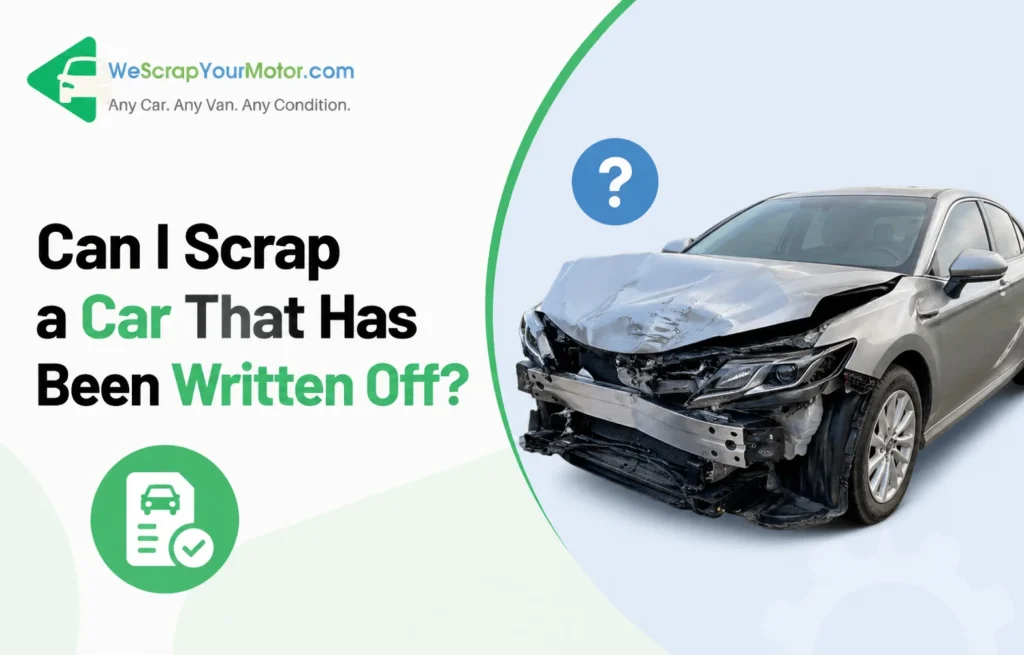
Yes, a written-off car can be scrapped, but the correct route depends on its insurance category and who owns the salvage after settlement. Category A vehicles must be crushed completely. Category B body shells must be crushed, although some parts may be salvaged. Category S and N cars may be repaired, but you can still choose lawful disposal if scrapping is the better option.
The phrase scrap written off car covers several very different situations. A car may look badly damaged but be classified as repairable, or it may look complete while its category legally prevents it returning to the road. The insurer’s category and settlement terms are more important than a visual guess.
What does “written off” mean?
An insurance write-off occurs when an insurer decides to pay the vehicle’s current value instead of funding repairs. That decision may be based on safety, repair cost, parts availability, expected delays or the relationship between the repair bill and the car’s pre-accident value.
A write-off is not automatically the same as physical destruction. GOV.UK recognises four categories:
Category A: complete destruction
The car cannot be repaired and the entire vehicle must be crushed. No components should return to use. The insurer will usually control disposal through an appropriate authorised route.
Category B: shell must be crushed
The car cannot return to the road. Its body shell must be crushed, although suitable parts may be recovered. Dismantling should be handled by an authorised operator, not treated as an ordinary private repair project.
Category S: repairable structural damage
The vehicle has suffered structural damage but may be repaired. It can be used again only after repair to a roadworthy condition. DVLA records the category on the V5C.
Category N: repairable non-structural damage
The damage is classed as non-structural, but that does not mean minor or automatically safe. Steering, suspension, brakes, electrical systems and other safety-related components can still be affected. The car may return to use only when repaired to a roadworthy condition.
Who owns the car after the insurer pays?
This question must be answered before you seek an independent scrap quote. In the usual total-loss process, the insurer pays the agreed settlement and takes ownership or control of the salvage. GOV.UK describes writing off and scrapping the vehicle as equivalent to selling it to the insurance company.
If the insurer has taken the car, you cannot sell it again. Doing so could create an ownership dispute and duplicate collection arrangements. Ask for written confirmation of:
- the category;
- the settlement amount;
- whether the insurer owns the salvage;
- whether collection has already been booked;
- whether any policy excess or finance balance affects the payment;
- which documents the insurer needs;
- who will notify DVLA and what you must do yourself.
If you want to keep a Category S or N vehicle, discuss owner-retained salvage before accepting the final settlement. The insurer may pay the claim and sell the vehicle back to you, normally deducting the salvage value. Only after that arrangement is confirmed should you decide whether to repair, sell or scrap it.
The category decision tree
Use this practical route:
- Category A: Do not plan repairs or parts recovery. Follow the insurer’s destruction process.
- Category B: The shell cannot return to the road. Confirm authorised dismantling and destruction with the insurer.
- Category S: Decide whether a professionally assessed repair is safe and economically sensible. If not, arrange authorised scrapping once ownership is clear.
- Category N: Compare repair cost, hidden-damage risk, future value and insurance availability. Scrap it if repair is not worthwhile and you own the salvage.
For a lawful quote and collection conversation, use We Scrap Your Motor only after you can show that you are entitled to dispose of the vehicle.
Paperwork for insurer-controlled and owner-retained cars
The paperwork changes according to who keeps the vehicle. This is where many owners make mistakes because they assume the insurer has completed every DVLA step.
Route A: the insurer takes and scraps the vehicle
GOV.UK says you must tell DVLA if the vehicle has been written off and scrapped by your insurance company. The notification is treated like selling the vehicle to the insurer. For the online service you will need the insurer’s name and postcode, the vehicle registration, and the 11-digit reference from the yellow motor-trade section of the V5C.
The normal sequence is:
- Remove a personalised registration first if you want to keep it.
- Give the main V5C to the insurer when requested.
- Keep the yellow “sell, transfer or part-exchange your vehicle to the motor trade” section until you have used its reference.
- Tell DVLA that the vehicle has been written off.
- Save the email or letter confirming you are no longer the keeper.
- Check that any full remaining months of vehicle tax are refunded.
If the insurer asks for the entire V5C, GOV.UK allows a postal alternative: write to DVLA with the insurer’s details and the date you gave it the vehicle. Do not stay silent because the insurer collected the car. GOV.UK states that a failure to notify can lead to a fine of up to £1,000.
Route B: you retain a Category S or N vehicle
Owner retention means the vehicle remains your responsibility after the settlement and salvage agreement. Ask the insurer for a written invoice, settlement letter or other evidence showing that the vehicle has been sold back to you.
For a Category S vehicle, GOV.UK says the full V5C goes to the insurer and you apply for a free duplicate using form V62. DVLA records the write-off category on the replacement log book. For Category N, you can keep the V5C.
If you then decide to scrap the vehicle, follow the ordinary end-of-life route: use an authorised treatment facility, provide accurate vehicle details, tell DVLA about transfer to the motor trade or dismantler, and retain the final evidence. Do not describe the car as merely “accident damaged” while hiding the recorded category. The category affects handling, value and potential reuse.
If collection is required in Essex, the planned Scrap My Car in Colchester can support the local journey.
What if the car is still at a garage or recovery compound?
Find out who authorised storage and who is paying. Charges can build while ownership and collection are being discussed. Get written answers from the insurer or claims handler before arranging a second transporter.
Give the collector exact access information, including whether wheels turn, airbags have deployed, keys are available, glass is loose or the vehicle is blocked in. The aim is not to dramatise the condition but to make recovery safe and correctly equipped.
Do not drive a damaged car because it starts or moves. A Category S or N label is not a certificate of roadworthiness. If it is not insured, taxed, MOT-compliant where required and safe, use professional recovery.
Private number plates on a write-off
The private registration should be handled before the insurer disposes of the car. GOV.UK places plate removal first in its write-off steps. Tell the claims handler as soon as the total-loss discussion begins and ask them to delay disposal until the retention process is complete.
The normal DVLA retention rules still apply, including vehicle eligibility. Severe damage can make the situation more difficult because the car must normally be able to move under its own power. Contact DVLA rather than assuming the plate can be recovered after destruction.
Outstanding finance and the settlement
A written-off car can still be subject to hire purchase, personal contract purchase or another finance agreement. The finance provider may have a legal interest in the vehicle and may be paid first from the insurance settlement. If the payout is below the settlement figure, a shortfall can remain unless other cover applies.
Do not independently scrap owner-retained salvage until the insurer and finance provider confirm in writing that you may dispose of it. A scrap quote does not override the finance agreement.
How a write-off affects scrap value
The category has only one pricing factor. A lawful buyer may consider vehicle weight, make, model, age, complete or missing components, battery type, catalytic converter, location, access and current material markets. Damage may reduce reusable parts value, while a complete heavy vehicle may still have meaningful material value.
Category A and B restrictions limit what can be reused. Category S and N salvage may attract repair or parts interest, but the owner should compare that route with certain disposal, storage charges and the time needed to manage a sale. Never accept a higher price from an operator who suggests hiding the category or avoiding the correct paperwork.
Safe disposal and a clean record
Once ownership is clear and scrapping is the chosen outcome, use an authorised treatment facility. GOV.UK says end-of-life vehicles must be scrapped at an ATF. The facility is equipped to depollute the vehicle and handle regulated waste.
For a completely scrapped eligible car, the ATF should issue a Certificate of Destruction within seven days. Keep it with the insurer’s settlement, salvage invoice if applicable, DVLA confirmation, collection receipt and payment evidence. These documents answer different questions: category and settlement come from the insurer; keeper status comes from DVLA; destruction comes from the ATF.
For a broader explanation of the disposal route, link readers to How to Scrap a Car in the UK.
Handover checklist for an owner-retained write-off
Before collection, confirm:
- the insurer has released or sold the salvage to you;
- any finance interest has been resolved;
- a private registration has been retained if required;
- the V5C position is correct for Category S or N;
- the collector knows the category and damage condition;
- the destination is an authorised treatment facility;
- payment will use a lawful method;
- you know who will make the DVLA notification;
- you will receive a Certificate of Destruction if the car is destroyed;
- personal belongings and data have been removed from the vehicle.
Personal data can remain in paired phones, address books, navigation history, garage-door controls and app accounts. Delete what you can safely access, remove parking permits and take the registration document and finance papers out of the car.
Warning signs during disposal
Stop and verify the operator if anyone:
- asks you to hide the write-off category;
- cannot explain the vehicle’s authorised destination;
- offers cash for a scrapped vehicle in England or Wales;
- refuses to provide collection or payment evidence;
- says DVLA does not need to know;
- wants the car before you have resolved a private number;
- asks you to sign a document with blank buyer or vehicle details;
- treats a Category A or B vehicle as roadworthy stock.
A fast collection is useful only when the legal and ownership record is correct.
Frequently asked questions
Can I scrap a Category S car?
Yes. Category S cars can be repaired, but they may also be scrapped if repair is unsafe or uneconomic. Make sure you own the salvage and use an authorised treatment facility.
Can I scrap a Category N car?
Yes. Category N means the recorded damage is non-structural, not that the car must be repaired. You can choose lawful disposal once ownership and insurer paperwork are settled.
Can I buy back a Category A or B car from my insurer?
Category A vehicles must be crushed entirely. Category B shells must be crushed, although appropriate parts may be salvaged through the proper route. These are not normal owner-retention repair categories.
Does the insurer tell DVLA for me?
Do not assume so. GOV.UK says the keeper must tell DVLA when the insurer has written off and scrapped the vehicle. Save the DVLA confirmation.
What happens to my vehicle tax?
After DVLA receives the correct notification, tax is cancelled and any full remaining months are normally refunded. A Direct Debit is cancelled automatically.
Can I drive a Category S or N car to the scrapyard?
Only if it is roadworthy and you meet every legal requirement, including insurance, tax and MOT where applicable. Recovery is the safer route for damaged or uncertain vehicles.
Will I receive a Certificate of Destruction?
If an eligible car is completely scrapped at an ATF, the certificate should normally be issued within seven days. If the vehicle is repaired and sold instead, a Certificate of Destruction is not issued.
Can I keep my personal number plate?
Potentially, but apply to remove it before the insurer disposes of the vehicle. Severe damage can affect normal retention eligibility, so contact DVLA early.
Final Thought
You can scrap a written-off car, but category and ownership decide the route. Let the insurer control Category A or B disposal. For an owner-retained Category S or N car, confirm the salvage transfer and any finance position before arranging an ATF collection. In every case, protect a private registration first, notify DVLA correctly and keep evidence of the final outcome.