
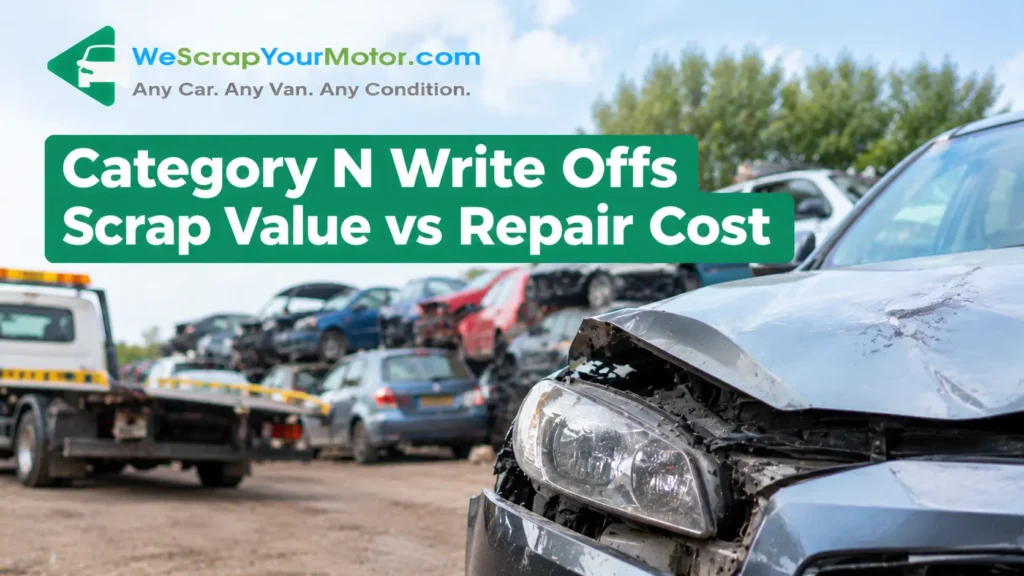
Your insurance company has declared your car a Category N write-off. It still looks repairable, the engine might run perfectly, and the damage may not even seem serious. So why has the insurer decided not to repair it?
More importantly, should you spend your own money getting it fixed?
Understanding Category N write-offs scrap value is essential when deciding whether to repair a damaged vehicle, sell it as salvage, or arrange permanent recycling.
A Category N classification means the recorded damage is non-structural and the vehicle is potentially repairable. However, non-structural does not mean inexpensive, harmless, or automatically safe to drive.
Modern vehicles contain sophisticated electrical systems, sensors, and safety equipment. Damage to these components can result in repair estimates that make a seemingly minor accident uneconomical.
This guide examines the actual financial considerations, common repair scenarios, hidden expenses, insurance implications, and practical selling options for UK drivers.
What Does Category N Mean On a Car?
Category N stands for non-structural damage.
It replaced the older Category D classification under the revised UK salvage categorisation system introduced in 2017.
The classification indicates that the vehicle is considered repairable and has not suffered damage classed as structural under the applicable salvage assessment.
It does not tell you exactly how expensive the repairs will be.
For example, non-structural damage may involve:
- Bumpers and exterior panels
- Headlights and lighting assemblies
- Electrical wiring and control modules
- Parking sensors and cameras
- Interior trim
- Certain suspension components
- Airbags and related safety equipment
- Other damaged non-structural assemblies
The precise classification depends on the nature of the damage and the professional assessment.
The UK government’s write-off classification guidance confirms that Category N vehicles can return to use when repaired to a roadworthy condition.
Why Would an Insurer Write Off a Repairable Car?
Insurance companies make financial decisions based on more than whether a damaged vehicle can physically be fixed.
They may consider repair labour, parts, vehicle value, recovery, storage, and other claim-related costs.
A repair that appears affordable to an owner may be uneconomical for an insurer operating under different commercial conditions.
For example, replacing a damaged bumper on a modern car may require more than purchasing a replacement panel.
The work could include paint matching, new sensors, replacement brackets, and recalibration of driver-assistance features.
These costs can increase the overall estimate substantially.
A relatively low-value vehicle is particularly vulnerable to being written off because a large repair bill represents a high proportion of its market value.
How Much Is a Category N Write-Off Worth For Scrap?
There is no fixed scrap value for every Category N vehicle in the UK.
The amount depends on the vehicle itself, its remaining components, current material values, and the buyer’s intended use.
A complete, relatively recent vehicle with non-structural damage may interest salvage buyers because it retains repair potential.
An older vehicle with extensive electrical problems may have limited demand beyond recycling.
Several important factors influence the quotation.
Make, Model and Market Demand
A popular model with widely used replacement components may attract stronger salvage interest.
Demand for engines, gearboxes, body panels, and electrical components can increase the buyer’s willingness to pay.
However, popular does not always mean valuable.
A plentiful supply of used components can also limit prices.
Specialist and premium vehicles may contain expensive individual components, but testing, compatibility, and warranty requirements can make those components costly to recover.
Age and Mileage
A car with lower mileage may have more attractive reusable mechanical parts.
Age can affect both the repair potential and the demand for replacement components.
A newer vehicle might retain enough market value to justify extensive repairs.
An older car with several unrelated faults may offer less potential return, even if the original accident damage is relatively limited.
Vehicle Completeness
A complete vehicle contains more potentially recoverable components than one that has already been partly dismantled.
Missing major parts can reduce the total offer.
They can also complicate vehicle recovery.
For example, a vehicle without wheels may require specialist loading arrangements.
Be clear about missing parts when requesting a valuation.
Current Scrap Metal Prices
Recyclable materials create a baseline value even when repair is not worthwhile.
Changes in steel and non-ferrous metal markets influence the amount recycling businesses can recover.
This explains why an old quotation may no longer be accurate.
The most useful figure is a current offer based on the car’s registration, condition, and collection location.
Category N Repair Costs: What Makes Them Expensive?
The phrase non-structural damage can create a misleading impression that repairs will always be straightforward.
In reality, the cost depends on the components affected.
Consider the following scenarios.
Scenario 1: Damaged Bumper and Parking Sensors
A low-speed collision may damage a bumper, grille, parking sensors, and mounting brackets.
The vehicle’s main structure might remain unaffected.
However, the repairer still needs to establish whether nearby components were damaged.
Modern bumpers can contain technology that must be fitted and checked correctly.
The repair may include removing and replacing parts, painting, electrical diagnostics, and recalibration where required.
An apparently small repair can become costly when several components need replacement.
Before committing to repairs, ask for a quotation that identifies all necessary work.
Scenario 2: Airbags and Interior Safety Equipment
Airbag deployment can involve several components.
Depending on the vehicle and the accident, the repair may require replacement or inspection of airbags, seatbelt pretensioners, sensors, electronic modules, and interior trim.
Do not assume that replacing a deployed airbag is the complete repair.
Safety systems should be assessed and restored using appropriate manufacturer procedures by suitably qualified professionals.
A car that starts and drives may still have unresolved restraint-system problems.
The ability to drive is not proof of roadworthiness.
Scenario 3: Electrical and Control Module Damage
Electrical faults can be especially difficult to price before diagnosis.
A wiring problem may involve a damaged connector or a larger section of the wiring harness.
A damaged electronic module might require replacement, programming, or additional components.
Water exposure may create further uncertainty because problems can develop after the initial inspection.
These situations increase financial risk.
Before repairing, ask the garage to identify the actual fault rather than replacing components based on guesswork.
Scenario 4: Suspension and Steering Problems
Some suspension damage may fall within a non-structural assessment.
However, steering and suspension are safety-critical systems.
A damaged control arm, wheel, steering component, or mounting assembly may require careful inspection of related parts.
A bent suspension component can also cause abnormal tyre wear and handling problems.
The repair quotation should account for any necessary alignment and additional checks.
Do not drive a vehicle with suspected unsafe steering or suspension simply because its write-off category is N.
Category N Scrap Value Vs Repair Cost: a Worked Example
Imagine a 2016 hatchback involved in a collision that damaged its front bumper, lighting, and electrical components.
The insurer has categorised it as a non-structural write-off.
You are considering whether to retain and repair it.
The following figures are hypothetical and are provided to illustrate the calculation.
| Financial Item | Example Cost Or Value |
| Comparable roadworthy market value | £4,200 |
| Replacement parts | £900 |
| Labour and paintwork | £850 |
| Electrical diagnostics and repairs | £450 |
| Additional allowance | £300 |
| Total estimated repair expenditure | £2,500 |
| Expected value after repair | £3,400 |
| Damaged salvage offer | £1,150 |
| Scrap-only offer | £280 |
If the owner repairs the car and immediately sells it for £3,400, the estimated remaining amount after repair expenditure is £900.
That compares with £1,150 from the damaged salvage offer.
In this scenario, selling the unrepaired vehicle could provide a better financial return.
But suppose an accurate inspection reduces the estimated repair expenditure to £1,200.
The repaired resale calculation would then leave £2,200 before other selling expenses.
Repairing could become more attractive.
This example demonstrates why the estimated repair bill matters more than the Category N label alone.
The Insurance Settlement Must Be Considered Separately
There is another important complication.
If the insurer has declared a total loss, the owner may receive an insurance settlement and the insurer may take ownership of the damaged vehicle.
If the owner wants to keep the vehicle, the insurer may offer an owner-retention arrangement.
The retained salvage has a value, which will normally affect the settlement.
Therefore, the decision should be based on the actual settlement options.
Do not assume that you will receive the entire insurance payout and independently keep the vehicle at no cost.
Ask the insurer for written figures showing the settlement, excess, salvage retention amount, and any deductions.
When Is Repairing a Category N Car Worthwhile?
Repairing may be reasonable when several favourable conditions exist.
The first is that the vehicle can be restored safely.
The second is that a qualified repairer has identified the necessary work and provided a dependable quotation.
The third is that the repair expenditure is proportionate to the vehicle’s realistic value or the cost of obtaining another suitable vehicle.
Other favourable signs include:
- Limited and clearly documented damage
- No significant unresolved electrical faults
- Readily available replacement parts
- Good maintenance history
- Reasonable mileage
- No serious unrelated mechanical problems
- Access to a qualified repair specialist
- Acceptable insurance terms after repair
The economics also depend on whether you intend to keep the car or sell it.
If you plan to keep it for several years, compare the cost of repair with the expense of replacing it.
A safe, dependable repair may provide useful remaining service life.
However, the fact that a repair is cheaper than buying another car does not guarantee that it is the right choice.
Expected reliability and future maintenance still matter.
When Should You Consider Scrapping a Category N Car?
Scrapping may be a better option when the total financial commitment is difficult to justify.
This often occurs when the vehicle already has significant age-related problems.
For instance, a car may have accident damage requiring expensive electrical repairs while also needing major servicing, tyres, or suspension work.
Individually, each issue may appear manageable.
Together, they may exceed the realistic benefit of keeping the vehicle.
Watch for these warning signs:
- The repair estimate approaches the realistic repaired value
- Several expensive systems require attention
- Additional faults remain undiagnosed
- Parts are difficult to obtain
- Storage and recovery costs are increasing
- Insurance arrangements are impractical
- The vehicle has a poor maintenance history
- The owner no longer needs the vehicle
One expensive repair does not automatically make a car worthless.
The relevant question is what you will spend in total and what you will receive in return.
Do Not Ignore Costs That Have Already Been Incurred
A common mistake is continuing to spend money because previous repairs were expensive.
Imagine an older car has already received £1,500 of maintenance.
Following an accident, it now needs another £2,000 of repairs.
The previous spending cannot be recovered simply by spending more.
Instead, consider the current vehicle condition and the future cost of each available choice.
This helps prevent an emotional decision from becoming a larger financial loss.
Should You Sell a Category N Write-Off For Salvage Instead?
Selling for salvage and scrapping are not always identical.
A salvage buyer may purchase a repairable vehicle or recover suitable reusable components.
Scrapping means the vehicle is permanently treated as an end-of-life vehicle through an authorised treatment facility.
For a relatively recent Category N write-off, salvage can sometimes provide a stronger offer.
The vehicle may retain significant repair potential even if the original insurer decided the claim was uneconomical.
For example, a repair business may have access to suitable parts or repair arrangements that differ from the insurer’s estimated costs.
However, never assume that every damaged car can be repaired economically.
A salvage buyer must still consider safety, acquisition costs, labour, and the risk of discovering additional damage.
For a broader comparison of disposal methods, read our Scrap Vs Salvage Car guide.
Why a High Salvage Offer May Not Be the Best Deal
A higher quotation can become less attractive if the buyer introduces unexpected deductions.
Ask whether the price includes collection.
Confirm whether it is guaranteed against the information supplied.
Check when payment will be made.
Make sure the buyer understands that the vehicle is a recorded write-off.
If the car is not being sold for repair but is being scrapped, verify the authorised disposal arrangements.
Always assess the whole transaction rather than just the advertised amount.
How To Calculate Your Break-Even Repair Cost
Before approving repairs, calculate the maximum amount you can spend without making the repair-and-sale option financially worse than selling the damaged vehicle.
Use this calculation:
Break-Even Repair Budget = Expected Repaired Selling Price − Current Damaged Salvage Offer − Selling Expenses
For example:
- Expected repaired selling price: £4,500
- Current salvage quotation: £1,400
- Expected selling expenses: £200
Your break-even repair budget would be £2,900.
If the repair bill is higher than £2,900, repairing purely to resell is unlikely to outperform the immediate salvage offer.
If the estimate is close to that figure, the financial advantage may disappear if unexpected problems arise.
A prudent owner should leave room for uncertainty rather than spending the entire break-even amount.
For a vehicle you plan to keep, adjust the analysis to include replacement cost and expected future use instead of focusing only on immediate resale.
Can a Category N Car Be Driven Again?
Yes, but only after it is roadworthy and meets the applicable legal requirements.
A Category N classification is not permission to drive a damaged car.
The vehicle may still have dangerous faults.
Before returning it to the road, ensure that all necessary safety-related repairs have been completed.
You may also need a valid MOT, insurance, and vehicle tax, depending on the circumstances.
An MOT alone is not a guarantee that every accident-related defect has been identified.
For significant damage, obtain a suitable professional assessment before driving.
The vehicle should not be used on public roads if it is unsafe.
Can You Insure a Category N Car?
Insurance may be available, but acceptance and terms vary between providers.
Some companies may ask for information about the previous damage.
Others may require evidence of repairs or apply different underwriting conditions.
Before repairing or purchasing a previously written-off car, contact prospective insurers.
Make sure you accurately disclose its history when asked.
Also ask how the insurer would calculate the vehicle’s market value if another total-loss claim occurred.
A low purchase price may look attractive, but unsuitable insurance terms can change the overall financial decision.
Will the Write-Off Affect Resale Value?
Potentially.
Future buyers may be cautious about recorded insurance damage.
Some will request repair invoices, photographs, or independent inspection reports.
Others may choose an accident-free alternative.
Therefore, use a realistic resale estimate when deciding whether to repair.
Do not calculate your expected return from the highest advertised price of an equivalent undamaged car.
How To Obtain a Category N Scrap Car Quote In the UK
Start by gathering the vehicle’s basic information.
You will normally need the registration number, make, model, mileage, location, and a description of its condition.
Explain the recorded insurance category.
Provide accurate details about the damage, especially if the car has electrical problems, deployed airbags, missing components, or difficulties moving.
Photographs can help a buyer understand the condition more accurately.
If the vehicle is still held by an insurer or recovery company, establish who owns it and whether you are authorised to sell it.
If finance remains outstanding, resolve the finance provider’s interest before arranging independent disposal.
What Happens If the Vehicle Cannot Be Driven?
A non-running Category N vehicle may still be collected using professional recovery equipment.
You do not need to repair the car merely to move it to a buyer or authorised recycling facility.
However, tell the collection provider whether the wheels turn, steering operates, keys are available, and the vehicle is accessible.
This information helps prevent collection problems.
For drivers in Devon, our Scrap My Car in Plymouth service offers quotations for damaged, non-running, and unwanted vehicles, with collection arrangements confirmed before booking.
What Happens To the V5C and DVLA Record?
The correct paperwork depends on the vehicle’s ownership and disposal route.
If the insurance company has written off and taken the car, follow the official DVLA notification process.
If you retain a Category N vehicle, GOV.UK says you can keep the V5C.
If you subsequently sell or scrap it, the appropriate transfer or scrapping notification must be completed.
The keeper must not simply assume the insurer or collector has completed every required notification.
Failing to tell DVLA about a written-off vehicle when required can result in a fine of up to £1,000.
What If Your Car Is Permanently Scrapped?
The vehicle must be taken to an authorised treatment facility.
For an eligible car that is completely scrapped, the facility should issue a Certificate of Destruction within seven days.
Keep that document because it provides evidence that the vehicle has entered the permanent destruction process.
For scrapped vehicles in England and Wales, payment must be made by bank transfer or cheque rather than cash.
Make sure the buyer explains the process before you hand over the vehicle.
Five Mistakes That Reduce the Return From a Category N Car
Accepting the First Repair Estimate
One estimate may not identify every issue.
For substantial work, compare suitably qualified repairers and ask for itemised quotations.
Different estimates should be compared based on the work included rather than their totals alone.
Hiding the Insurance Classification
A damaged vehicle’s recorded category is relevant to potential buyers.
Providing incomplete or misleading information can cause disputes and invalidate quotations.
Transparency supports a smoother transaction.
Overestimating the Repaired Selling Price
An accident-free vehicle’s asking price may not represent the achievable price for a repaired write-off.
Look for realistic market evidence.
Include the recorded damage history in your valuation.
Ignoring Storage Charges
A damaged vehicle held in a commercial storage or recovery facility may incur charges.
Clarify who is responsible for those costs and when they begin.
Delay can reduce the amount ultimately recovered.
Paying For Repairs Before Confirming Ownership
If the insurer has settled the claim and taken the salvage, the vehicle may no longer belong to you.
Confirm the retention arrangement before authorising repairs or arranging a separate sale.
Frequently Asked Questions About Category N Write-Offs
Is a Category N Car Worth Scrapping?
It depends on repair costs and salvage value. A vehicle with manageable damage and a useful market value may be worth repairing. One with extensive electrical faults, high mileage, and several other problems may be more economical to scrap.
Is Category N Better Than Category S?
Category N indicates non-structural damage, while Category S indicates structural damage. Neither classification guarantees a cheap repair or a particular market value.
Can I Sell a Category N Car Without an MOT?
Potentially, yes. You can sell a damaged vehicle that is not roadworthy, provided you follow the applicable ownership and legal requirements and describe its condition accurately. It should be transported rather than driven if unsafe or otherwise not legally permitted on the road.
Does a Category N Write-Off Have Scrap Value?
Yes. It may contain valuable recyclable materials and reusable components. The amount depends on the specific vehicle, condition, market demand, and recovery costs.
Should I Buy Back My Category N Car From the Insurer?
Only after reviewing the settlement adjustment, repair estimate, vehicle condition, insurance options, and likely future value. An owner-retention offer is not automatically a bargain.
Can a Category N Car Pass Its Next MOT?
Yes, once it meets the applicable testing standards. However, passing an MOT does not replace a suitable assessment of accident repairs.
What If the Repair Garage Finds More Damage?
Ask for an updated written estimate before approving additional work. Recalculate the overall financial benefit. If costs have increased substantially, selling as salvage may become more practical.
Can I Scrap a Category N Car That Still Runs?
Yes, provided you own it and follow the correct disposal process. A running engine does not mean repairing the vehicle is economically worthwhile.
Choose the Option That Protects Your Money
Category N damage is not always minor, and a repairable car is not always worth repairing.
The best decision comes from comparing a dependable repair estimate, realistic market value, current salvage offers, and the potential expense of additional problems.
Before spending money, confirm the damage, establish ownership, and consider the vehicle’s likely reliability after repair.
If the figures support a safe, professional repair, keeping the car may provide good value.
If the repair cost is disproportionate to its remaining worth, selling or scrapping can be the more practical solution.
For a vehicle-specific assessment, Scrap My Car UK offers a straightforward way to obtain a quotation for an unwanted or damaged car.
A Category N classification tells you the type of damage. A proper financial comparison tells you what to do next.