
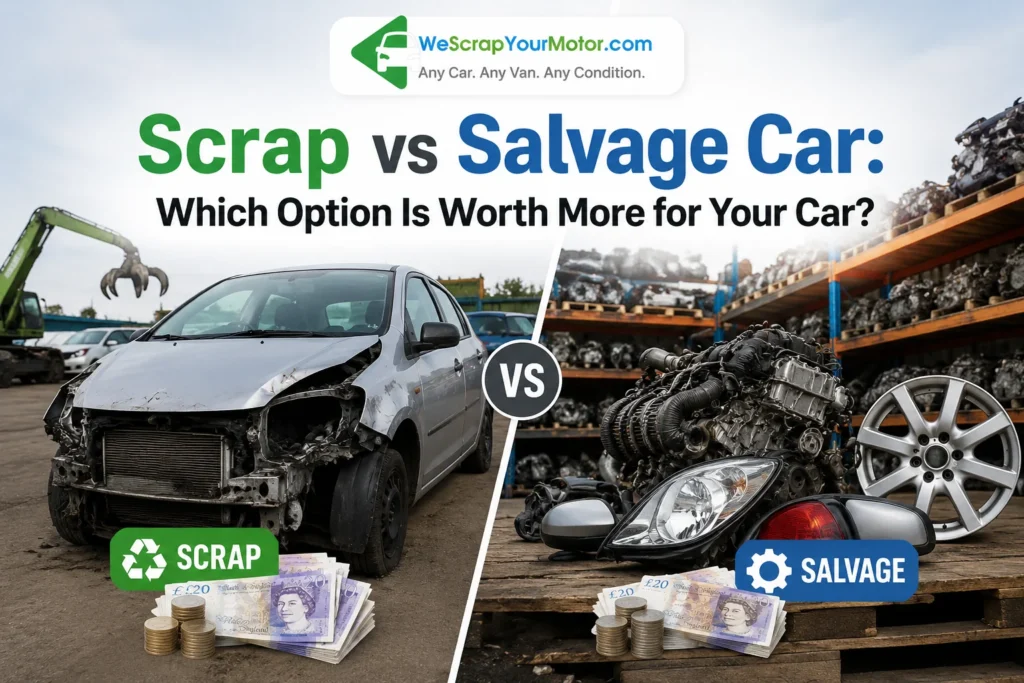
A damaged, non-running, or unwanted vehicle is not automatically worth only its weight in metal. Some cars have repairable faults or reusable components that make them more valuable as salvage.
The right scrap vs salvage car decision depends on what remains usable, the cost of recovery and repair, the vehicle’s write-off category, current parts demand, and whether it can lawfully return to the road.
Scrapping normally means permanent end-of-life treatment through an authorised treatment facility. Salvage means the whole vehicle or suitable components retain value for repair, resale, or reuse.
This guide provides a practical method for comparing the two routes without relying on guesses or unrealistic online price ranges.
Scrap Vs Salvage Car
A salvage offer can be higher when a vehicle has valuable reusable parts, a repairable fault, a desirable specification, or a realistic route back to the road.
Scrapping may be the better route when the vehicle has severe damage, little parts demand, missing major components, extensive corrosion, or a legal category that requires destruction.
In a scrap vs salvage car comparison, ask for both the proposed value and the intended vehicle route. A higher headline offer is only useful when its terms, collection conditions, and payment are reliable.
We Scrap Your Motor can assess the registration, condition, mileage, location, missing parts, and recovery needs before a route is agreed.
What Is A Scrap Car?
A scrap car is generally a vehicle that has reached the end of its useful life and will be treated as waste.
It must be sent through an authorised treatment facility, where hazardous fluids and components can be removed safely before dismantling, recycling, and destruction.
The Environment Agency explains that an end-of-life vehicle must be depolluted by an authorised treatment facility and issued with a Certificate of Destruction where the certificate rules apply.
Scrap value may come from:
- Steel and other metals
- Catalytic-converter materials
- Alloy wheels
- Batteries
- Recyclable components
- Limited reusable parts
- Vehicle weight
Once a qualifying vehicle is completely destroyed, it cannot return to the road.
What Is A Salvage Car?
A salvage car is a damaged, faulty, or unwanted vehicle that still has economic value beyond straightforward metal recycling.
The vehicle may be:
- Repaired and returned to the road
- Dismantled for reusable parts
- Sold to a specialist repairer
- Used as a donor vehicle
- Reconditioned for resale
- Exported where legally permitted
- Assessed for parts and recycling value together
A salvage vehicle is not automatically safe or roadworthy. It may require significant inspection and professional repair.
The term also does not guarantee a higher offer. If parts demand is weak or recovery costs are high, its salvage value may still be close to its basic scrap value.
Scrap Vs Salvage Car Differences
| Factor | Scrap Route | Salvage Route |
| Main Purpose | Permanent disposal and recycling | Repair, resale, or parts recovery |
| Vehicle Future | Normally destroyed | May return to use if legally repairable |
| Primary Value | Metal, weight, and recyclable material | Whole vehicle, components, and repair potential |
| Treatment Location | Authorised treatment facility | Licensed buyer, repairer, dismantler, or salvage operator |
| Certificate Of Destruction | Normally issued for eligible destroyed vehicles | Not issued if the vehicle is repaired and resold |
| Best For | End-of-life or non-repairable vehicles | Repairable or parts-rich vehicles |
| Price Potential | More predictable | Can be higher but varies more |
| Inspection Detail | Completeness and metal value | Damage, repair cost, specification, and parts demand |
This table provides a starting point. A reliable scrap vs salvage car decision requires vehicle-specific evidence.
How Insurance Write-Off Categories Affect The Choice
Insurance write-off categories are important when comparing scrap and salvage.
Category A
A Category A vehicle is scrap only. The entire vehicle must be destroyed, and its components should not re-enter the second-hand parts market.
There is no realistic scrap vs salvage car choice here. The vehicle follows the destruction route.
Category B
A Category B vehicle cannot return to the road. Its body shell must be destroyed, although certain usable parts may be recovered.
The shell has scrap value, while approved components may contribute salvage value.
Category S
Category S indicates repairable structural damage. The vehicle may return to the road after suitable professional repair, but the costs, safety requirements, reduced resale value, and insurance position must be considered.
Category N
Category N indicates non-structural damage. This does not mean the damage is minor. Steering, braking, electrical, or other safety-related systems can still be affected.
Official consumer guidance distinguishes Categories A and B as vehicles that cannot or should not be repaired, while Categories S and N can represent constructive losses that may be repaired.
Which Option Usually Pays More?
Salvage can pay more because the buyer may recover value from usable components or repair and resell the vehicle.
However, this is not guaranteed. The expected salvage return must be reduced by:
- Collection cost
- Storage
- Inspection
- Depollution
- Dismantling
- Parts testing
- Repair labour
- Replacement components
- Transport
- Advertising
- Warranty risk
- Unsold stock
- Reduced resale value
A buyer will not normally offer the entire projected retail value of the parts. Its offer must account for the time, work, and commercial risk involved in recovering that value.
Scrap may pay more when the vehicle is complete, heavy, easy to collect, and has little practical repair or parts potential.
Seven Factors That Determine The Better Route
Vehicle Age
A newer vehicle may justify repair even after substantial damage because its roadworthy market value remains high.
An older car with several faults may not support the same repair investment.
Make And Model
Popular vehicles can have stronger demand for engines, gearboxes, doors, lights, electronic modules, and interior parts.
Rare does not always mean valuable. A rare model may have few potential buyers.
Mechanical Condition
A car with a failed clutch but a healthy engine and clean body may retain useful salvage value.
A vehicle with simultaneous engine, gearbox, electrical, and corrosion problems may be better suited to scrapping.
Accident Damage
Localised bolt-on panel damage may be easier to repair than damage affecting the shell, chassis, airbags, or multiple systems.
Do not attempt to assess structural safety from photographs alone.
Vehicle Completeness
Missing wheels, catalytic converters, batteries, engines, gearboxes, or electronic units can lower both scrap and salvage offers.
Collection Requirements
A car that rolls, steers, and brakes is generally easier to recover than one with seized wheels, locked steering, or difficult access.
Current Market Demand
Metal prices affect scrap value, while demand for the model and its components affects salvage value.
The winning scrap vs salvage car option can therefore change as markets move.
A Practical Valuation Formula
Use two separate estimates.
Estimated Scrap Return
Recyclable Vehicle Value + Recoverable Components − Collection And Processing Costs
Estimated Salvage Return
Whole-Vehicle Or Parts Potential − Repair, Recovery, Storage, Labour, Sales, And Risk Costs
The buyer’s offer will be below the maximum theoretical value because the buyer must perform and fund the work.
Ask each buyer to explain whether the quotation is based mainly on:
- Weight
- Reusable parts
- Repair potential
- Insurance category
- Export potential
- Complete-vehicle demand
This makes the scrap vs salvage car comparison more meaningful than simply choosing the highest number on a quote form.
Scenario One: A Non-Running Family Hatchback
Consider an eight-year-old family hatchback with a failed starter motor, sound bodywork, a clean interior, and a recent MOT history.
Its metal value provides a baseline. However, the minor mechanical fault and usable components may support a salvage offer above scrap value.
Before accepting either route, the owner should compare:
- Confirmed repair cost
- Roadworthy market value
- Salvage offer
- Scrap offer
- Collection cost
- Time required to sell privately
In this example, salvage may win because the vehicle has a realistic repair route.
Scenario Two: A Heavily Corroded Older Vehicle
Now consider a 19-year-old car with serious structural corrosion, an expired MOT, engine problems, worn tyres, and little demand for parts.
Although individual pieces might still be reusable, the labour and storage required to remove and sell them may outweigh their value.
The stronger scrap vs salvage car decision may be permanent scrapping through an authorised facility.
The owner gains a clear disposal route and should receive the appropriate destruction record.
Scenario Three: An Accident-Damaged Premium Vehicle
A premium vehicle with front-end accident damage may contain valuable lights, wheels, interior components, electronics, engine parts, and body panels.
Its salvage value could exceed its metal value, but the answer depends on:
- Write-off category
- Structural condition
- Parts damaged in the collision
- Model-specific demand
- Repair cost
- Vehicle history
- Storage and recovery needs
A specialist salvage assessment may therefore be more appropriate than a weight-only quote.
When Scrapping Is Usually The Stronger Choice
Scrapping may be more suitable when:
- The vehicle is Category A
- A Category B shell must be destroyed
- Structural corrosion is extensive
- Repair costs exceed realistic roadworthy value
- Multiple major systems have failed
- The car has been stripped of valuable components
- Parts demand is very limited
- Flood or fire exposure has affected many systems
- Ownership or history makes resale impractical
- Safe storage is becoming difficult
If the car has several expensive faults, read Should I Repair Or Scrap My Car before paying for another repair.
When Salvage Is Usually Worth Exploring
Request a salvage assessment when:
- The vehicle is relatively new
- Damage is localised
- The engine or gearbox remains usable
- The model has strong parts demand
- It has valuable factory equipment
- It is Category S or N and professionally repairable
- Repair costs are below its adjusted market value
- The vehicle is complete
- The mileage is attractive for its age
- The buyer specialises in that make or model
Salvage is especially worth exploring when a generic scrap calculator only asks for registration and postcode. A more detailed buyer may recognise value that an automated weight-based estimate misses.
How To Compare Two Offers Properly
Do not compare headline numbers alone.
For each quote, record:
| Question | Offer One | Offer Two |
| Is The Vehicle Being Scrapped Or Salvaged? | ||
| Is Collection Included? | ||
| Is The Quote Fixed Or Provisional? | ||
| What Details Could Change It? | ||
| When Will Payment Be Made? | ||
| What Paperwork Will Be Issued? | ||
| Which Facility Will Receive The Car? | ||
| How Long Is The Quote Valid? |
A £600 offer with unexplained deductions may be weaker than a reliable £550 written offer with included collection and clear payment terms.
What Paperwork Should Each Route Produce?
For a car being permanently scrapped, keep:
- Written quote
- Collection receipt
- Payment record
- DVLA notification
- Certificate of Destruction where applicable
- Identity of the authorised treatment facility
For a salvage sale, keep:
- Written purchase agreement
- Buyer or motor-trader details
- Payment record
- DVLA transfer notification
- Description of the vehicle’s condition
- Confirmation of the intended route
GOV.UK explains that a Certificate of Destruction is not issued when an authorised facility repairs and sells the vehicle instead of completely scrapping it.
The paperwork should match the actual scrap vs salvage car route.
Can I Decide The Vehicle’s Final Route?
You can tell the buyer what you want, but the accepted agreement must make the intended route clear.
If you require permanent destruction, ask for confirmation that the vehicle will enter an authorised treatment facility and that a Certificate of Destruction will be issued where eligible.
If you are open to salvage, understand that the car or its components may be repaired and resold.
Do not assume “scrap-car collection” always means immediate destruction. GOV.UK recognises that an authorised facility can decide to destroy a vehicle or repair and sell it.
How To Improve Your Offer Without Misleading The Buyer
Provide complete information:
- Registration number
- Mileage
- Model and trim
- Engine size and fuel type
- MOT status
- Service history
- Warning lights
- Mechanical faults
- Accident damage
- Write-off category
- Missing components
- Keys and V5C availability
- Clear photographs
- Collection access
Accurate information helps the buyer identify salvage potential and reduces the chance of a price change during collection.
For collections in the area, Scrap My Car In Kent can assess non-runners, accident-damaged vehicles, MOT failures, and end-of-life cars using the details supplied.
Frequently Asked Questions
Is A Salvage Car The Same As A Scrap Car?
No. A scrap car is intended for end-of-life treatment and destruction. A salvage car may be repaired, resold, or used for recoverable components.
Does A Non-Running Car Have Salvage Value?
Yes. A non-running car may have a repairable fault or valuable components. Its condition must be assessed individually.
Can A Category S Car Return To The Road?
A Category S vehicle can potentially return to the road after proper repair, but it must be roadworthy, safe, insured, and handled in accordance with applicable requirements.
Can A Category B Car Be Repaired?
Its body shell must be destroyed and cannot return to the road. Certain usable components may be recovered through the appropriate route.
Will A Salvage Buyer Always Pay More?
No. The scrap vs salvage car result depends on model demand, condition, recovery costs, parts value, and repair potential.
Do I Get A Certificate Of Destruction For Salvage?
Not when the vehicle is repaired and resold instead of being destroyed. Confirm which handover documents will apply.
Should I Remove Valuable Parts Before Getting Quotes?
Removing components can reduce the whole-vehicle offer and increase collection difficulty. Obtain complete-car quotes before taking anything off.
Can I Reject Both Offers?
Yes, provided you have not entered a binding arrangement that imposes lawful cancellation terms. Review the written conditions before booking.
Compare Both Routes Before Your Car Loses More Value
The best scrap vs salvage car choice is the route that produces the strongest reliable net return while matching the vehicle’s legal condition and realistic future.
Obtain detailed quotes, disclose every major fault, compare included collection and payment terms, and ask what will happen to the vehicle. If useful parts or repair potential remain, salvage may produce more. If the car has reached the end of its practical life, authorised scrapping can provide a clearer and safer solution.