
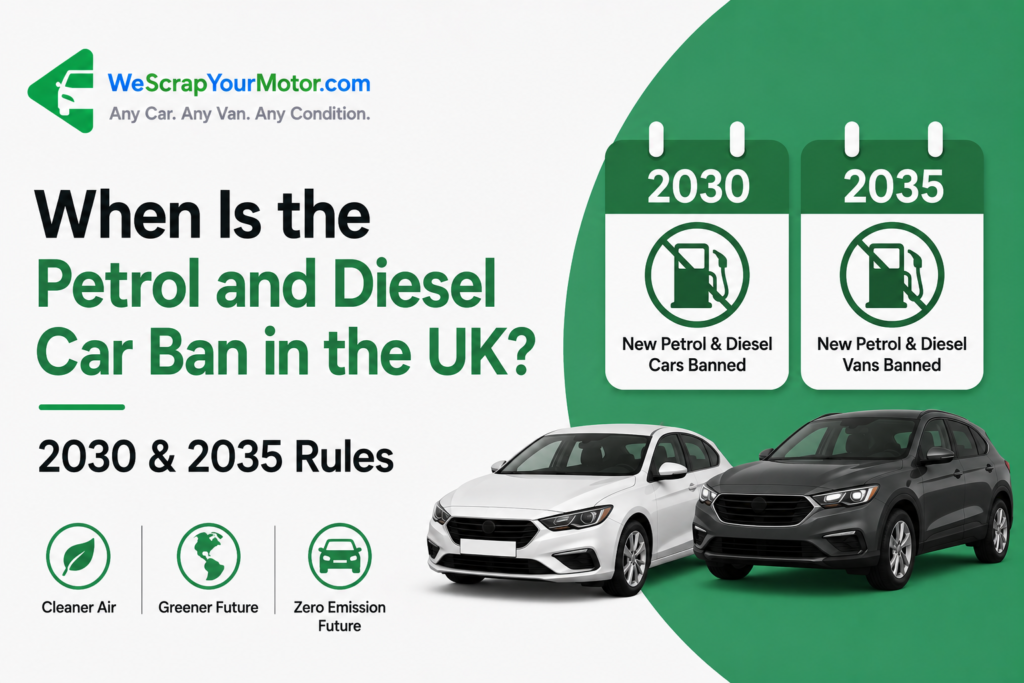
The UK’s transition toward cleaner transportation is accelerating, and one of the biggest topics among motorists is the petrol and diesel car ban. Whether you own an ageing diesel vehicle, drive a petrol family car, or are considering scrapping your vehicle, understanding the upcoming changes is essential.
Many people believe that petrol and diesel cars will become illegal after 2030. However, the reality is very different. The government’s plans focus on ending the sale of new petrol and diesel vehicles while allowing existing vehicles to remain on the road for many years.
This guide explains exactly what the petrol and diesel car ban means, when it starts, which vehicles are affected, how it may impact vehicle values, and whether scrapping your vehicle before the ban could be a smart financial decision.
Quick Answer: What Is the UK Petrol and Diesel Car Ban?
The UK government plans to stop the sale of most new petrol and diesel cars from 2030 as part of its strategy to reduce carbon emissions and achieve net-zero targets.
Here are the key facts:
- Existing petrol and diesel cars can still be driven after 2030.
- Used petrol and diesel vehicles can still be bought and sold.
- Most hybrid vehicles can continue to be sold until 2035.
- The ban applies primarily to new vehicle sales.
- Drivers will not be forced to scrap their existing vehicles.
Understanding these points helps clear up many of the myths surrounding the petrol and diesel car ban.
When Is the Petrol and Diesel Car Ban in the UK?
The UK government has introduced a phased approach to vehicle electrification.
2030: End of Most New Petrol and Diesel Vehicle Sales
From 2030, the sale of most new petrol and diesel cars and vans will be prohibited.
Manufacturers and dealerships will no longer be able to sell new vehicles powered solely by internal combustion engines.
2035: Hybrid Vehicle Restrictions
Many hybrid vehicles that still produce emissions will be phased out by 2035.
After this date, almost all newly sold vehicles will need to be zero-emission vehicles.
Petrol and Diesel Car Ban Timeline
| Year | What Happens |
| 2026 | Current transition period |
| 2030 | Most new petrol and diesel vehicle sales end |
| 2035 | Most hybrid vehicle sales end |
| After 2035 | New vehicles must be zero-emission |
The petrol and diesel car ban therefore affects future vehicle sales rather than vehicles that are already on the road.
Why Is the UK Banning Petrol and Diesel Cars?
The government has several reasons for introducing the ban.
1. Reducing Carbon Emissions
Road transport contributes significantly to the UK’s greenhouse gas emissions. Electric vehicles produce no tailpipe emissions, making them an important part of reducing the country’s environmental impact.
2. Improving Air Quality
Vehicle emissions contribute to air pollution, especially in urban areas. Reducing reliance on petrol and diesel engines can improve air quality and public health.
3. Achieving Net-Zero Goals
The UK has committed to reaching net-zero carbon emissions by 2050. The petrol and diesel car ban is one of the major policies supporting this target.
4. Encouraging Electric Vehicle Adoption
By setting firm deadlines, the government encourages manufacturers, businesses, and consumers to invest in electric vehicle technology and charging infrastructure.
Can You Still Drive Petrol and Diesel Cars After 2030?
Yes.
This is the question most UK motorists ask.
The answer is straightforward: owning and driving a petrol or diesel vehicle will remain legal after 2030.
You can still:
- Drive your vehicle.
- Renew your MOT.
- Buy insurance.
- Purchase used petrol or diesel cars.
- Sell your vehicle privately.
The petrol and diesel car ban only applies to the sale of new vehicles.
If you plan to keep your petrol or diesel vehicle beyond 2030, it is worth reviewing your insurance coverage to ensure you remain adequately protected. Understanding what is comprehensive car insurance can help you compare policy options and decide whether your current level of cover is suitable for your vehicle and driving needs.
Can I Drive a Petrol Car After 2030?
Yes. Existing petrol vehicles can continue to be used normally.
Can I Drive a Diesel Car After 2030?
Yes. Existing diesel vehicles will remain legal, although some cities may introduce additional emissions-related restrictions.
Which Vehicles Will Be Affected?
Vehicles That Will Be Affected
The following vehicles are expected to face restrictions:
- New petrol cars
- New diesel cars
- Some hybrid vehicles
- Certain commercial vehicles
Vehicles That Will Not Be Immediately Affected
These vehicles can continue operating:
- Existing petrol cars
- Existing diesel cars
- Used petrol vehicles
- Used diesel vehicles
- Classic and historic vehicles
For most motorists, the petrol and diesel car ban will not require immediate action.
Petrol and Diesel Cars in the UK: Key Statistics
The UK’s vehicle market remains heavily dependent on petrol and diesel vehicles.
Key trends include:
- Millions of petrol and diesel vehicles remain registered across the UK.
- Electric vehicle registrations continue increasing annually.
- Public charging infrastructure is expanding rapidly.
- More manufacturers now prioritise EV production.
- Demand for low-emission vehicles continues growing.
These trends suggest that while traditional vehicles will remain common for years, the market is gradually shifting toward electric mobility.
Can You Still Buy and Sell Used Petrol and Diesel Cars?
Absolutely.
The second-hand vehicle market will continue to operate long after 2030.
Used Petrol Cars
Petrol vehicles remain attractive because of:
- Lower purchase costs
- Familiar maintenance requirements
- Widespread fuel availability
- Lower upfront investment compared with EVs
Used Diesel Cars
Diesel vehicles continue to appeal to:
- Long-distance drivers
- Commercial users
- Towing vehicle owners
- Rural motorists
The impact of the petrol and diesel car ban on used vehicle values will depend on market demand, regulations, and fuel prices.
Will Petrol and Diesel Cars Lose Value?
Many owners worry that the ban will dramatically reduce the value of their vehicles.
The reality is more complex.
Factors That Affect Vehicle Value
Vehicle values are influenced by:
- Age
- Mileage
- Condition
- MOT status
- Service history
- Fuel type
- Local demand
Will Diesel Vehicles Be Hit Harder?
Potentially.
Diesel vehicles may face stronger downward pressure because:
- Some cities charge emissions-related fees.
- Businesses increasingly adopt cleaner fleets.
- Environmental regulations may become stricter.
However, diesel vehicles still offer advantages for certain drivers, helping maintain demand.
What About Petrol Cars?
Petrol vehicles may retain stronger value because they generally face fewer restrictions than older diesel models.
The petrol and diesel car ban is unlikely to cause an immediate collapse in used vehicle values.
Should You Scrap Your Vehicle Before 2030?
This depends on your vehicle’s condition.
Consider Scrapping If:
- Repair costs exceed vehicle value.
- The vehicle frequently fails MOT tests.
- The engine requires major repairs.
- The car has severe corrosion.
- Insurance costs continue increasing.
- Fuel economy is poor.
Consider Keeping If:
- The vehicle remains reliable.
- Maintenance costs are manageable.
- You do not need a replacement soon.
- The vehicle still has strong resale value.
For many motorists, the petrol and diesel car ban provides a good opportunity to assess whether continuing to repair an ageing vehicle makes financial sense.
How the Ban Could Affect Scrap Car Values
One of the most valuable components in many older vehicles is the catalytic converter. Since scrap values can be influenced by precious metals contained within these parts, it is worth understanding how much are catalytic converters worth before deciding whether to sell or scrap your vehicle.
Owners planning to scrap their vehicles often ask whether they should do it now or wait.
Factors Affecting Scrap Prices
Scrap vehicle values depend on:
- Vehicle weight
- Steel and metal prices
- Catalytic converter value
- Demand for spare parts
- Vehicle condition
Will Scrap Prices Increase?
Possibly.
Growing demand for recycled materials could support prices. However, if large numbers of vehicles enter the scrap market simultaneously, prices may fluctuate.
Best Time to Scrap a Vehicle
You should consider scrapping when:
- Repairs become uneconomical.
- The vehicle is unsafe.
- MOT failures are becoming frequent.
- Resale value has dropped significantly.
If you’re considering scrapping, our scrap my car service can provide a quick valuation and collection service.
Are There Any UK Vehicle Scrappage Schemes?
The UK has previously introduced scrappage schemes designed to encourage drivers to move to cleaner vehicles.
1. Government Scrappage Schemes
Past schemes have offered financial incentives for replacing older vehicles.
Availability depends on current government policy.
2. Local Authority Schemes
Some councils have provided support for residents affected by:
- Clean Air Zones
- Low Emission Zones
- Air quality improvement initiatives
3. Manufacturer Incentives
Many vehicle manufacturers offer trade-in bonuses for customers switching to electric vehicles.
When considering the petrol and diesel car ban, it is worth checking whether any local or manufacturer incentives are available.
1. Alternatives to Scrapping Your Vehicle
Scrapping is not the only option.
2. Sell Privately
A private sale may generate a higher return if the vehicle remains roadworthy.
3. Part Exchange
Dealerships often accept older vehicles as part payment for newer models.
4. Export
Some vehicles continue to have value in overseas markets.
5. Continue Driving
Since existing vehicles remain legal, many owners may simply keep their cars for several more years.
How to Scrap Your Vehicle Responsibly in the UK
If you decide scrapping is the right choice, follow the proper legal process.
Use an Authorised Treatment Facility (ATF)
Only authorised facilities can legally dismantle and recycle vehicles.
Gather Your Documents
You may need:
- V5C logbook
- Proof of identification
- Vehicle information
Notify the DVLA
Once ownership is transferred, ensure the DVLA is informed.
Choose a Trusted Scrap Vehicle Company
Look for a service that offers:
- Free collection
- Competitive prices
- Fast payments
- Environmentally responsible recycling
If your vehicle has reached the end of its life, our scrap car collection service can help you dispose of it legally and efficiently.
Why Trust This Guide?
This guide has been prepared specifically for UK motorists seeking information about the petrol and diesel car ban, vehicle disposal options, and scrappage decisions.
It has been written using publicly available government guidance, industry trends, and vehicle recycling best practices relevant to UK drivers in 2026.
Frequently Asked Questions
Will petrol cars be illegal after 2030?
No. Existing petrol vehicles will remain legal to drive, buy, and sell after 2030.
Will diesel cars be illegal after 2030?
No. Existing diesel vehicles can continue operating after 2030.
What does the petrol car ban in the UK 2030 actually mean?
It means manufacturers can no longer sell most new petrol and diesel vehicles after 2030.
Can I still buy a used diesel car after 2030?
Yes. The second-hand market will continue operating.
Should I scrap my diesel car now?
If repair costs are high and the vehicle’s value is low, scrapping may be worth considering.
Will there be a UK scrappage scheme in 2026?
Scrappage schemes depend on government and local authority policies. Availability can vary by location.
What happens to used petrol cars after the ban?
Used petrol cars can still be bought, sold, and driven.
Will petrol cars lose value after 2030?
Values may gradually change due to market demand, but an immediate collapse is unlikely.
Can I still insure my petrol car after 2030?
Yes. Insurance providers are expected to continue covering existing vehicles.
Is it worth selling my car for scrap?
If repairs exceed the vehicle’s value or it is becoming unreliable, scrapping may be the most cost-effective solution.
Final Thoughts
The UK’s transition to cleaner transportation is a long-term process rather than an overnight change. While the petrol and diesel car ban will stop the sale of most new petrol and diesel vehicles from 2030, existing vehicles can continue to be driven, bought, and sold for many years afterward.
For motorists with older vehicles, the coming years provide an opportunity to evaluate repair costs, resale value, fuel expenses, and future plans. Some drivers may choose to keep their vehicles, while others may decide that scrapping an ageing car offers the best financial outcome.
Whether you plan to continue driving your vehicle or explore disposal options, understanding the petrol and diesel car ban will help you make informed decisions and prepare for the future of motoring in the UK.