
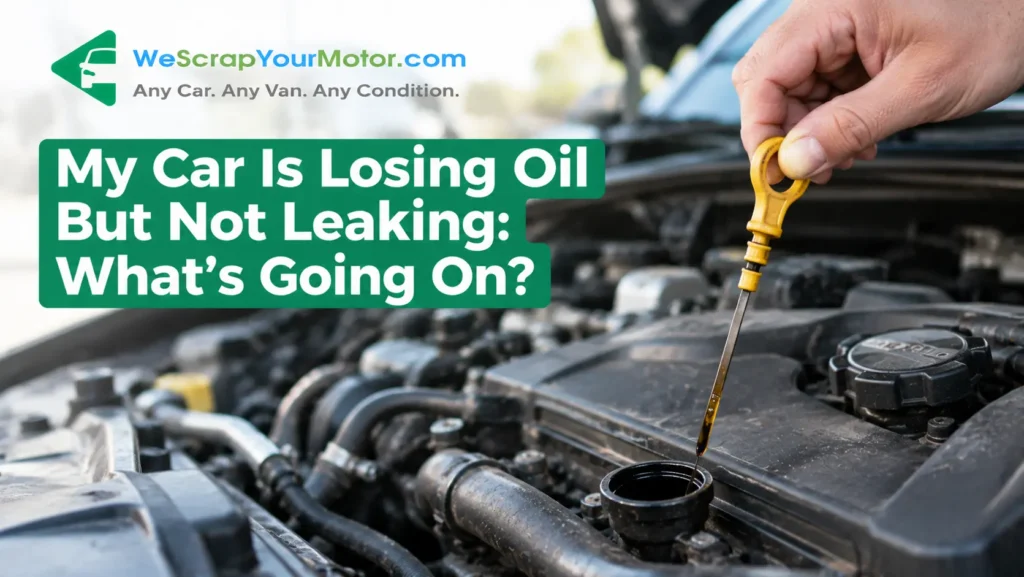
You’ve checked your driveway. There are no oily patches beneath the car, no obvious drips around the engine and no signs of a major leak.
Yet every time you check the dipstick, the oil level seems lower.
Perhaps you topped it up recently, only to find another low-oil warning appearing a few weeks later.
Where is the oil going?
A car burning oil but not leaking may have worn piston rings, failing valve stem seals, a faulty crankcase ventilation system or a turbocharger-related problem. However, oil can also escape through hidden external leaks without leaving a visible puddle.
Some engines consume a small amount of oil during normal operation. Excessive or increasing consumption, though, deserves attention.
The important thing is to establish how much oil is disappearing, where it is going and whether the problem is becoming worse.
This guide explains the most likely causes of unexplained oil loss, the symptoms that distinguish them, how a garage investigates oil consumption and what UK drivers might pay for repairs.
Why Is My Car Losing Oil When There Is No Leak?
If the engine oil level is falling without an obvious external leak, there are several possible explanations.
Oil may be:
- Entering the combustion chambers and burning with the fuel
- Passing through worn valve stem seals
- Escaping past piston rings
- Entering the intake through a crankcase ventilation fault
- Passing through a faulty turbocharger
- Leaking from a hidden area of the engine
- Collecting on an undertray
- Escaping only when the engine is running
It is also possible that inconsistent oil-level checks are making consumption appear worse than it actually is.
For example, measuring oil on uneven ground or immediately after switching off the engine can produce different readings.
That is why checking the level consistently is the best starting point.
Where Can Engine Oil Go Without Leaving a Puddle?
Engine oil circulates through internal passages to lubricate moving components.
It helps reduce friction, manage heat and protect parts from wear.
In a healthy engine, systems such as piston rings, seals and crankcase ventilation help control where the oil travels.
When these components deteriorate, oil may enter areas where it should not.
If oil reaches the combustion chamber, it can burn during engine operation.
Some oil may also enter the intake or exhaust system because of turbocharger or ventilation problems.
Alternatively, oil may escape externally while driving and spread across the underside of the vehicle.
This can happen without creating a visible puddle where the car is parked.
Therefore, a dry driveway does not prove that the engine is free from leaks.
Seven Common Causes of a Car Burning Oil but Not Leaking
The likely cause depends on the engine’s age, design, maintenance history and symptoms.
1. Worn Piston Rings
Piston rings sit around the pistons inside the engine cylinders.
They help maintain compression and control the oil film on the cylinder walls.
As the engine operates, the pistons move rapidly up and down.
The rings help prevent excessive quantities of oil from entering the combustion chambers.
Over time, wear or damage can reduce their effectiveness.
When oil passes the rings, it may burn along with the fuel.
Possible symptoms include:
- Increasing oil consumption
- Blue or blue-grey exhaust smoke
- Reduced engine compression
- Poor engine performance
- Increased crankcase pressure
- Oil-related deposits within the engine
However, some engines consume oil through worn piston rings without producing obvious visible smoke.
Modern exhaust treatment systems may also reduce how noticeable the emissions appear.
Piston ring repairs can be expensive because they often involve substantial engine dismantling.
A garage should confirm the problem before recommending major work.
2. Damaged Valve Stem Seals
Valve stem seals help control the amount of oil travelling along the valve stems.
As these seals age, they may harden, deteriorate or lose effectiveness.
Oil can then enter the combustion chamber through the valve guides.
One possible symptom is a brief puff of blue-grey smoke after starting the engine.
Smoke may also appear after particular operating conditions, such as prolonged idling followed by acceleration.
However, these patterns are clues rather than definitive tests.
A car burning oil but not leaking externally may have worn valve stem seals even when its general performance seems normal.
Replacing the seals can sometimes be less expensive than rebuilding the entire engine.
The repair cost depends heavily on engine design and accessibility.
Some engines require extensive dismantling to reach the seals.
3. A Faulty PCV Valve or Crankcase Ventilation System
The positive crankcase ventilation system, commonly called PCV, helps manage gases that enter the engine crankcase.
It directs these gases back into the intake system in a controlled manner.
A defective PCV valve, breather hose or oil separator can interfere with this process.
Depending on the design and fault, excessive oil mist may be carried into the intake.
That oil can eventually reach the combustion chambers and burn.
Possible symptoms include:
- Increased oil consumption
- Uneven idling
- Engine management warnings
- Unusual crankcase pressure
- Oil contamination within intake components
A PCV problem can sometimes be relatively affordable to repair compared with serious internal engine wear.
However, the system varies significantly between manufacturers.
On some engines, the relevant components are integrated into larger assemblies.
A technician should confirm whether the ventilation system is responsible before replacing parts.
4. Turbocharger Oil Problems
Turbochargers operate at high speeds and require lubrication.
Oil flows through the turbocharger to protect its internal components.
If a seal, bearing or related oil-return system develops a problem, oil may enter the intake or exhaust path.
Depending on where it travels, the oil may eventually burn and create visible exhaust smoke.
Other warning signs can include unusual turbocharger noises, reduced performance or oil contamination in the intake system.
But the presence of oil around turbocharger pipework does not automatically prove that the turbocharger has failed.
Some oil mist may be present in certain intake systems during normal operation.
The amount of oil, the condition of the turbocharger and related engine systems all matter.
A qualified mechanic should distinguish a genuine turbocharger fault from a crankcase ventilation issue or another source of oil consumption.
5. Worn Cylinder Walls
The cylinder walls form the surfaces against which the piston rings operate.
Over time, excessive wear or physical damage may prevent the rings from maintaining an effective seal.
Oil can then pass into the combustion chamber.
This may occur alongside:
- Reduced compression
- Increased oil consumption
- Excessive crankcase gases
- Poor performance
- Abnormal engine noise
Cylinder wear is usually a more serious concern than a minor external leak.
Repair may require specialist engine machining, rebuilding or replacement.
However, the diagnosis must be supported by appropriate testing.
A mechanic should not conclude that the cylinders are worn simply because the engine needs frequent oil top-ups.
6. Hidden External Oil Leaks
Sometimes the oil is leaking, even though you cannot see it.
This is particularly common when a vehicle has an engine undertray.
Oil can collect on the tray instead of dripping directly onto the road.
Other leaks may occur only while the engine is operating.
Airflow can spread escaping oil across nearby surfaces.
Potential hidden leak locations include:
- Rocker cover gasket
- Oil filter housing
- Sump gasket
- Timing cover
- Crankshaft seals
- Oil cooler connections
- Turbocharger oil lines
Small leaks may also contact hot engine or exhaust components and burn off.
A burning-oil smell can therefore indicate an external leak rather than internal oil consumption.
If hidden leakage is suspected, our guide to Engine Oil Leak Repair Cost UK: When Does Repair Become Too Expensive? explains how to evaluate the repair bill.
A professional inspection can identify leaks that are not visible during an ordinary driveway check.
7. Incorrect Oil Specification or an Existing Engine Condition
Engines are designed to operate with particular oil specifications.
Using an unsuitable oil may affect engine protection and consumption.
However, switching oil grades is not a reliable cure for worn mechanical components.
Always follow the manufacturer’s requirements.
Oil consumption can also change with engine age, operating conditions and maintenance history.
For example, frequent high-load driving may produce different consumption patterns from gentle local journeys.
A recent service can sometimes complicate the picture if the oil level was not recorded accurately.
Before assuming major damage, confirm that the engine contains the correct oil and that the level has been measured consistently.
Is It Normal for a Car to Burn Some Oil?
A certain amount of oil consumption can occur during normal engine operation.
However, there is no single universal oil-consumption rate that applies to every vehicle.
Manufacturers may specify different acceptable limits depending on engine design and operating conditions.
The most reliable reference is the vehicle manufacturer’s guidance.
A small amount of consumption over a long distance is different from an engine that suddenly requires frequent top-ups.
Pay particular attention to changes.
If the car previously maintained a stable oil level between services but now needs regular additional oil, something may have changed.
For a car burning oil but not leaking, a measured increase in consumption is more useful evidence than simply assuming the engine is old.
How to Measure Your Car’s Oil Consumption
Keeping a basic record can help you distinguish normal consumption from a developing fault.
You do not need specialist tools to document oil levels.
Start With a Consistent Oil-Level Check
Park the vehicle on level ground.
Switch the engine off and follow the handbook’s recommended procedure for checking the oil.
Many vehicles use a physical dipstick.
Others have an electronic oil-level display.
For a dipstick-equipped vehicle, check the reading according to the manufacturer’s instructions.
Avoid touching hot engine components.
Do not assume the distance between minimum and maximum marks represents the same quantity on every vehicle.
Record the Details
Write down the date, mileage, oil-level reading and quantity of oil added.
For example:
| Date | Mileage | Oil Added | Observation |
| 1 October | 82,000 miles | None | Level checked |
| 8 October | 82,250 miles | None | Level slightly lower |
| 15 October | 82,500 miles | 250 ml | Level restored |
| 22 October | 82,750 miles | 250 ml | Further top-up recorded |
This is an illustrative example, not a recommended or normal consumption rate.
If the car requires 500 ml over 750 miles, that is approximately 0.67 litres per 1,000 miles.
The significance of that figure depends on the engine and manufacturer’s limits.
The purpose of the log is to give a mechanic reliable evidence.
Avoid Overfilling the Engine
More oil is not always better.
Overfilling can cause engine problems.
Only use the manufacturer’s specified oil and follow the correct checking and filling procedure.
If you are unsure how much oil to add, ask a qualified mechanic.
Do not continue topping up an engine without investigating rapid or increasing oil loss.
Signs That Your Engine Is Burning Oil Internally
Oil consumption does not always produce obvious symptoms.
Nevertheless, certain signs can help identify an internal problem.
| Symptom | Possible Explanation |
| Blue-grey exhaust smoke | Oil entering combustion |
| Smoke after starting | Possible valve stem seal problem |
| Smoke during acceleration | Possible internal wear or turbocharger issue |
| Frequent top-ups | Increased oil consumption or hidden leak |
| Rough engine idle | Combustion or ventilation problem |
| Misfiring | Possible oil contamination or another engine fault |
| Reduced power | Engine wear or related mechanical problem |
| Burning-oil smell | Oil contacting hot external components |
| No visible smoke | Does not rule out oil consumption |
These clues should not be treated as proof of a specific fault.
For example, blue smoke can result from several different causes.
Likewise, rough idling can be unrelated to oil consumption.
A garage may need to perform further testing to identify the problem accurately.
Can a Car Burn Oil Without Producing Blue Smoke?
Yes.
A car burning oil but not leaking does not necessarily produce visible exhaust smoke.
The amount of oil consumed, engine conditions and exhaust system can influence whether smoke is noticeable.
Small quantities of oil may burn without creating an obvious blue cloud.
Smoke may also appear only during specific operating conditions.
For example, a vehicle might produce a brief puff after starting but show little visible smoke during normal driving.
Some drivers only discover abnormal consumption through repeated dipstick readings.
That is why a dry driveway and clean-looking exhaust cannot completely rule out internal oil loss.
How a Mechanic Diagnoses Unexplained Oil Consumption
A proper investigation should establish whether the oil is escaping externally or being consumed internally.
The garage may begin by reviewing the oil-consumption record.
It will also consider the engine’s age, mileage, service history and manufacturer specifications.
External Leak Inspection
The mechanic checks the engine and surrounding components for evidence of escaping oil.
An undertray may need to be removed professionally.
The technician may inspect gaskets, oil lines, seals and the oil filter housing.
This helps distinguish hidden leaks from internal consumption.
Crankcase Ventilation Inspection
The ventilation system may be checked for abnormal operation.
Faulty breathers or oil separators can influence how oil travels through the intake system.
The exact procedure depends on the engine.
Compression Testing
A compression test assesses cylinder sealing performance.
It can help identify certain internal mechanical problems.
However, an engine may consume oil even when compression readings are not obviously poor.
Compression testing should therefore be interpreted alongside other evidence.
Cylinder Leak-Down Testing
A leak-down test can help identify where cylinder sealing is being lost.
This may help distinguish internal wear or valve-related problems.
It is a specialist diagnostic procedure rather than a simple oil-level check.
Turbocharger Inspection
On a turbocharged vehicle, the mechanic may examine the turbocharger and related intake components.
The aim is to determine whether abnormal oil movement is associated with the turbocharger or another engine system.
Additional Engine Inspection
If the evidence points towards internal wear, more advanced inspection may be necessary.
The mechanic should explain the reason for each test and the likely cost before proceeding.
An experienced technician will try to narrow down the fault before recommending extensive engine dismantling.
How Much Does It Cost to Fix a Car Burning Oil in the UK?
The repair cost varies enormously because unexplained oil loss has several possible causes.
The table below provides broad UK budgeting estimates.
| Possible Work | Indicative UK Cost |
| Basic diagnostic check | £30–£180 |
| Minor breather hose repair | £60–£180 |
| PCV or ventilation component replacement | £80–£300+ |
| Rocker cover gasket repair | £120–£350 |
| Oil filter housing leak repair | £150–£500+ |
| Valve stem seal replacement | £400–£1,500+ |
| Turbocharger replacement | £600–£2,000+ |
| Major piston ring or internal engine repair | £1,500–£4,000+ |
| Complete engine replacement | Highly vehicle-specific |
These are illustrative estimates, not published national averages for every repair.
The price can vary significantly according to the vehicle, workshop labour rates and repair complexity.
A simple PCV fault may be relatively affordable.
Piston ring replacement can require extensive engine work.
In some cases, replacing an engine may be more practical than rebuilding badly worn internal components.
Before authorising substantial repairs, request an itemised quotation.
Ask whether it includes diagnosis, parts, labour, VAT, fluids and any additional testing.
Can You Drive a Car That Is Burning Oil?
It depends on the cause, severity and current oil level.
However, unexplained excessive oil consumption should not be ignored.
Engine oil is essential for protecting internal moving parts.
Insufficient lubrication can cause overheating, accelerated wear and major engine damage.
If the vehicle displays a red oil pressure warning, safely stop and switch off the engine immediately.
Do not assume adding oil will resolve an oil-pressure fault.
A vehicle can have an apparently adequate oil level while still experiencing dangerous oil-pressure problems.
Arrange recovery or professional advice if the engine is making abnormal mechanical noises, has severe smoke or shows signs of inadequate lubrication.
If the issue is mild and has already been professionally assessed, follow the garage’s advice and the manufacturer’s maintenance recommendations.
Do not continue using the car indefinitely simply by adding more oil.
What Happens If You Ignore Excessive Oil Consumption?
The consequences depend on the underlying fault.
A relatively minor ventilation problem may deteriorate or contribute to additional engine issues.
Worn piston rings may continue to allow oil into the combustion chambers.
Excessive oil consumption can contribute to deposits, misfires and damage to certain emissions-related components.
The most serious risk is allowing the engine oil level or pressure to become insufficient.
Major internal wear can then develop.
An initially manageable fault may become a much more expensive repair.
This does not mean every engine with modest oil consumption is about to fail.
It means that unexpected or worsening consumption deserves investigation.
Can an Oil Change Stop My Car Burning Oil?
An oil change may improve lubrication and address certain maintenance-related concerns.
However, it will not normally repair worn piston rings, damaged valve stem seals or a defective turbocharger.
Using the correct oil specification is important, but changing viscosity without manufacturer guidance may create additional problems.
Be cautious about products that promise to stop excessive oil consumption without identifying the fault.
Some additives may not be appropriate for particular engines or emissions systems.
A mechanical failure requires a mechanical solution.
If the engine is consuming oil because of worn components, a fresh oil change alone is unlikely to remove the cause.
Is It Worth Fixing an Engine That Burns Oil?
The answer depends on the diagnosis and the condition of the vehicle.
Consider the difference between a minor ventilation fault and extensive internal wear.
Example One: Affordable Ventilation Repair
A petrol hatchback is worth approximately £3,000 in good condition.
A mechanic confirms that a faulty crankcase ventilation component is contributing to increased oil consumption.
The complete repair costs £180.
Provided there are no other major problems, fixing the fault is likely to make financial sense.
Example Two: Major Internal Engine Wear
An older car is worth approximately £1,500 when roadworthy.
The garage confirms substantial internal wear and estimates £2,500 for repair.
The vehicle also has upcoming suspension and MOT expenditure.
In this situation, major engine rebuilding may not be financially practical.
Example Three: Valuable Car With an Isolated Fault
A well-maintained vehicle is worth approximately £7,000.
The engine requires £1,200 of confirmed repairs.
If the rest of the vehicle is reliable and the repair has a suitable warranty, restoring the engine may still be the better option.
These figures are examples rather than actual valuations.
A decision should consider expected repair reliability, future maintenance and the cost of replacing the car.
When Should You Consider Scrapping a Car With Excessive Oil Consumption?
Oil consumption alone does not automatically make a vehicle suitable for scrapping.
Many causes can be repaired.
However, an older car may no longer be economical to restore when excessive oil consumption is linked to extensive internal engine damage.
Important considerations include:
- The engine requires a complete rebuild
- Repair costs exceed the car’s realistic value
- The vehicle has repeatedly failed major mechanical inspections
- Significant gearbox problems are also present
- The car has serious structural corrosion
- Replacement engine costs are unaffordable
- Reliable repairs cannot be achieved economically
For a vehicle with extensive confirmed damage, Scrap My Car in the UK provides an alternative to further investment.
Owners in Wiltshire can also explore Scrap My Car in Salisbury when comparing responsible disposal options.
Before arranging scrapping, obtain a realistic assessment of the vehicle’s remaining value.
Some damaged cars may still have value to repairers or salvage buyers.
A verified engine diagnosis helps you make that decision with greater confidence.
Frequently Asked Questions
Why Is My Engine Oil Disappearing Without a Leak?
Oil may be entering the combustion chambers through worn rings or seals.
A PCV or turbocharger problem may also allow excessive oil to enter the intake.
Alternatively, an external leak may be hidden from view.
Is a Car Burning Oil but Not Leaking a Serious Problem?
It can be.
A minor ventilation fault may be straightforward to repair.
Severe piston ring or cylinder wear can require expensive work.
The amount of consumption and its cause determine the seriousness.
How Much Oil Consumption Is Normal?
There is no universal figure.
Different manufacturers specify different acceptable consumption rates.
Check the vehicle handbook and seek professional advice if oil usage increases unexpectedly.
Can Worn Piston Rings Cause Oil Consumption?
Yes.
Worn or damaged rings may allow oil to enter the combustion chamber.
The fault may also affect compression and engine performance.
Can a Faulty PCV Valve Cause Oil Burning?
Yes.
On some engines, a defective crankcase ventilation system can allow excessive oil mist to enter the intake.
The exact symptoms depend on the system design.
Why Is My Car Losing Oil but Not Smoking?
Oil can be consumed internally without creating obvious visible smoke.
Alternatively, a concealed external leak may be responsible.
Consistent oil-level measurements and professional inspection can help identify the cause.
Can Bad Valve Stem Seals Cause Oil Loss?
Yes.
Damaged valve stem seals can allow engine oil into the combustion chambers.
A brief puff of blue-grey smoke after starting may be one clue, although it is not definitive.
Does High Mileage Cause Oil Burning?
Higher mileage can be associated with wear that contributes to oil consumption.
However, mileage alone does not determine engine condition.
Service history, engine design and previous operating conditions also matter.
Can a Turbocharger Cause Engine Oil Loss?
Yes.
A faulty turbocharger or related oil system may allow oil into the intake or exhaust.
The turbocharger should be inspected before replacement is recommended.
Will Thicker Oil Stop an Engine Burning Oil?
Not necessarily.
Changing oil viscosity does not repair worn mechanical parts.
Use the oil specification approved by the manufacturer unless a qualified professional advises otherwise for your vehicle.
Can a Car Pass Its MOT While Burning Oil?
Potentially, depending on the condition of the vehicle and whether it meets the applicable test requirements.
However, abnormal emissions or related faults may cause failure.
An MOT pass does not guarantee that an engine is mechanically healthy.
How Can I Tell If Oil Loss Is Getting Worse?
Record the quantity of oil added and the distance travelled.
An increasing consumption rate may indicate a developing problem.
Use consistent measuring conditions and compare the results with the manufacturer’s guidance.
Find Out Where the Oil Is Going Before Replacing Major Engine Parts
A car burning oil but not leaking is not necessarily approaching the end of its life.
The cause might be a relatively inexpensive crankcase ventilation fault, an ageing seal or an external leak that is simply difficult to see.
However, excessive consumption can also indicate serious internal engine wear.
The most useful starting point is a reliable oil-consumption record.
From there, a qualified mechanic can inspect the relevant systems and determine whether the oil is escaping externally or entering the engine’s combustion process.
Do not assume a dry driveway means there is no leak, and do not assume every engine that consumes oil needs rebuilding.
If the problem is repairable at a reasonable cost, fixing it may extend the vehicle’s useful life.
If substantial internal damage is confirmed, compare the complete repair bill with the vehicle’s condition and realistic market value.
A measured diagnosis gives you a stronger basis for deciding whether to repair, sell or scrap the car.