
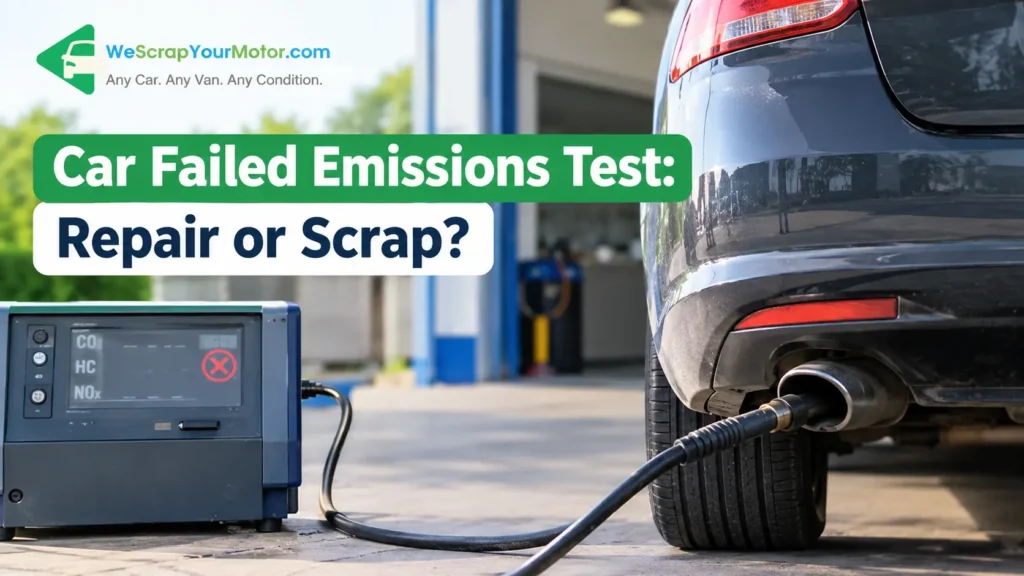
Your car was running normally yesterday. No strange noises, no obvious engine trouble, and perhaps not even a warning light on the dashboard. Then the MOT result arrives, and you discover that your car failed its emissions test.
Now the garage is talking about catalytic converters, diesel particulate filters, oxygen sensors or expensive engine repairs. Suddenly, an ordinary MOT appointment could leave you facing a bill worth hundreds or even thousands of pounds.
But here’s something worth knowing. A car’s failed emissions test result does not automatically mean the engine is damaged or the vehicle should be scrapped.
Some emissions failures are caused by relatively minor faults, while others indicate serious problems with combustion, exhaust treatment or engine condition. The challenge is distinguishing between them before you spend money.
Quick Answer: If your car fails its MOT emissions test, get the actual test readings and a proper diagnosis before authorising repairs. Repairing is generally worth considering when the fault is isolated, the cost is reasonable, and the rest of the car remains dependable. Scrapping may make more financial sense when expensive emissions repairs coincide with significant mechanical problems, serious MOT defects or a vehicle value too low to justify further investment.
This guide explains what your MOT results mean, how much different emissions repairs can cost in the UK, whether you can legally drive after a failure, and how to choose between repairing, selling or scrapping an older vehicle.
What Does It Mean When Your Car Fails an Emissions Test?
An MOT emissions failure means the vehicle has not satisfied one or more applicable environmental requirements during its inspection.
The MOT is designed to assess specified road safety and environmental standards. It does not perform a complete mechanical inspection or guarantee that the engine is healthy.
The Driver and Vehicle Standards Agency (DVSA) sets out separate exhaust emissions procedures for petrol and diesel vehicles.
Petrol vehicles may undergo checks involving carbon monoxide, hydrocarbons and lambda readings, depending on which test is applicable.
Diesel vehicles are generally subject to smoke-opacity testing where required, along with relevant checks of emissions-control equipment. Some hybrid vehicles are exempt from the diesel opacity measurement, although applicable equipment and warning-light checks still matter.
The standards depend on factors including the vehicle’s age, fuel type and applicable manufacturer limits.
According to the DVSA’s MOT inspection manual, emissions results outside applicable limits can constitute a major defect. Missing, obviously modified or defective emissions-control equipment can also result in failure.
A car failed emissions test result therefore identifies a compliance problem, not necessarily the component responsible.
For example, excessive petrol emissions could originate from an incorrect fuel mixture, a misfire, an exhaust leak or a poorly functioning catalytic converter.
Similarly, excessive diesel smoke might relate to fuel injection, engine condition, air supply or exhaust after-treatment.
The next step is to identify the actual cause rather than replacing expensive components based on assumptions.
What To Do Immediately After Failing an MOT Emissions Test
The first decision isn’t whether to repair or scrap your car. It’s how to understand what actually failed.
Ask the MOT testing centre for the failure notice and the applicable emissions printout.
The DVSA requires the test centre to provide a copy of the result printout when a vehicle fails the relevant measured emissions test. These records can help a repair garage investigate the problem.
Read the failure description carefully.
A failed lambda reading is not the same as excessive diesel smoke. Likewise, a malfunction indicator lamp failure doesn’t automatically mean the catalytic converter needs replacing.
If the garage recommends major work, ask what evidence supports its diagnosis.
A reputable repairer should explain whether the recommendation is based on actual measurements, diagnostic tests or an initial suspicion that still requires investigation.
Avoid agreeing to a costly replacement simply because somebody says the emissions are too high.
A car’s failed emissions test result can involve several possible causes, and choosing the wrong repair may leave the vehicle unable to pass its retest.
If you’re not satisfied with the explanation, obtaining a second professional opinion may be sensible, particularly when the proposed work is expensive.
Understanding Your MOT Emissions Test Results
The numbers on an emissions printout can seem confusing, especially when the car appears to drive normally.
However, you don’t need to become a mechanic to understand what the main readings represent.
For petrol vehicles, the relevant measurements can provide clues about combustion and exhaust treatment.
| MOT Reading | What It Measures | What an Unusual Result May Suggest |
| Carbon Monoxide (CO) | Carbon monoxide present in the exhaust | Fuel mixture, combustion or catalytic converter concerns |
| Hydrocarbons (HC) | Unburnt hydrocarbons in exhaust gases | Misfires, incomplete combustion or related faults |
| Lambda | Relationship between the actual and ideal air-fuel mixture | Fuel-control problems or possible exhaust sampling issues |
| Diesel Smoke Opacity | How much the exhaust reduces light transmission | Excessive particulate emissions or combustion-related problems |
| Engine Malfunction Indicator | Whether an applicable warning-light system indicates a fault | A recorded or active engine-management issue |
These are diagnostic clues rather than guaranteed fault identifications.
For example, a high hydrocarbon reading doesn’t prove that the spark plugs are defective. Several engine faults can produce incomplete combustion.
Likewise, an abnormal lambda result does not automatically prove that the lambda sensor itself has failed.
The DVSA’s basic petrol emissions test includes limits of 0.2% CO, 200 ppm HC and lambda between 0.97 and 1.03 at fast idle, but these are not universal limits for every vehicle or every emissions procedure. The tester must apply the appropriate vehicle-specific or default requirements using the official testing process.
If your car failed emissions test checks because one reading exceeded its limit, ask the garage to explain that specific result.
This can help distinguish a relatively small correction from a repair involving a major component.
Why Petrol Cars Fail Their MOT Emissions Test
Petrol engines depend on a carefully controlled mixture of fuel and air.
The engine-management system monitors combustion and adjusts fuel delivery to maintain suitable operating conditions.
Exhaust-treatment equipment then helps reduce harmful emissions before they leave the tailpipe.
When something in this process stops working properly, emissions may increase even when the vehicle seems reasonably normal to drive.
Faulty Oxygen or Lambda Sensors
An oxygen sensor monitors oxygen levels in the exhaust and provides information used by the engine-management system.
If a sensor produces incorrect information, fuel delivery or emissions monitoring may be affected.
The driver might notice increased fuel consumption, an engine warning light or irregular performance.
However, an oxygen-sensor fault code does not automatically mean that the sensor itself needs replacing.
Wiring problems, exhaust leaks and other engine faults can contribute to abnormal readings.
A mechanic should investigate the cause before recommending a new component.
Catalytic Converter Problems
The catalytic converter helps reduce harmful exhaust pollutants through chemical reactions.
Over time, it can deteriorate or become damaged, particularly when underlying engine faults expose it to unsuitable operating conditions.
For example, persistent engine misfires can cause unburnt fuel to enter the exhaust system and damage the converter.
Replacing an expensive catalytic converter without correcting the original problem could leave the new component vulnerable.
A car failed emissions test diagnosis involving the catalytic converter should therefore include checks for related engine faults.
Engine Misfires and Incomplete Combustion
A misfire occurs when combustion does not take place correctly in one or more cylinders.
Possible causes include ignition problems, fuel delivery faults and other engine issues.
Misfires can increase unburnt hydrocarbons and contribute to poor emissions readings.
A vehicle with a severe misfire should be professionally assessed promptly rather than driven repeatedly in the hope that the problem disappears.
Exhaust Leaks and Fuel-Control Problems
An exhaust leak can affect some emissions measurements, depending on its location.
Faults affecting fuel delivery or air measurement can also contribute to incorrect combustion conditions.
This is why emissions diagnosis should examine the broader engine-management system instead of focusing exclusively on the catalytic converter.
Why Diesel Cars Fail Their MOT Emissions Test
Diesel emissions failures require a different approach from petrol failures.
Diesel engines can produce particulate matter, commonly called soot, during combustion.
Depending on the vehicle’s age and specification, equipment such as a diesel particulate filter helps control the release of these particles.
If your car failed emissions test requirements because of excessive smoke, the cause could involve fuel delivery, insufficient air, emissions-control equipment or underlying engine problems.
The challenge is identifying which part of the system is responsible.
Blocked Diesel Particulate Filter
A diesel particulate filter (DPF) captures soot from exhaust gases.
Many DPF systems periodically remove accumulated soot through a process called regeneration.
However, a filter may become restricted when regeneration does not occur properly or when another fault causes excessive soot production.
RAC explains that a persistent warning can indicate a problem requiring inspection, and that some blocked filters may be suitable for professional cleaning rather than immediate replacement.
An obstructed DPF does not automatically mean the entire filter must be replaced.
The garage should establish whether the filter is temporarily restricted, physically damaged or affected by another fault.
Exhaust Gas Recirculation Valve Problems
The exhaust gas recirculation system, commonly known as EGR, helps control combustion conditions and certain emissions.
A faulty EGR valve can contribute to performance issues and engine-management problems.
Symptoms can overlap with turbocharger faults, intake problems and other mechanical issues.
Specialist diagnosis is important before buying parts.
Fuel Injector Faults
Fuel injectors control how fuel enters the engine.
A defective injector can contribute to incorrect combustion, poor performance and excessive smoke.
The problem may involve one injector or a broader fuel-system issue.
The repair cost depends on what is actually defective.
Turbocharger and Air Intake Problems
Diesel engines require an appropriate supply of air for efficient combustion.
Problems involving air intake components, boost control or turbocharger operation can contribute to abnormal smoke emissions.
But reduced power or black smoke does not, by itself, prove that the turbocharger needs replacing.
The mechanic should establish the underlying fault through appropriate tests.
A car failed emissions test result on a diesel vehicle deserves a proper mechanical assessment before expensive DPF, injector or turbocharger work is authorised.
Petrol vs Diesel Emissions Failures: What Is Different?
Although both types of vehicle must meet applicable environmental requirements, the reasons for failure can differ significantly.
| Comparison | Petrol Vehicles | Diesel Vehicles |
| Main Measured Concern | Relevant exhaust gas readings | Smoke opacity where applicable |
| Possible Combustion Problem | Misfires or incorrect fuel mixture | Fuel delivery or air supply problems |
| Common Emissions Equipment | Catalytic converter and lambda sensors | DPF, EGR and other after-treatment components |
| Diagnostic Approach | Gas readings, fault codes and engine checks | Smoke result, fault codes and mechanical checks |
| Potential Financial Risk | Expensive converter or engine repairs | Expensive DPF, injection or engine repairs |
The purpose of this comparison is not to suggest that one fuel type always costs more to repair.
A petrol vehicle with a defective oxygen sensor may have a relatively affordable repair.
A diesel vehicle with an isolated sensor problem could be similarly economical to fix.
Conversely, either engine type may develop extensive mechanical damage.
The actual cause matters far more than whether petrol or diesel is used.
How Much Does It Cost To Fix a Car That Failed Its Emissions Test?
One of the biggest difficulties for owners is estimating the repair bill before the fault has been diagnosed.
An MOT emissions failure is not a single mechanical defect. It is a test outcome that can result from different problems.
A minor electrical fault could require relatively little work, while replacing major exhaust-treatment equipment could cost considerably more.
When researching car failed emissions test repair expenses, it’s important to distinguish published price averages from vehicle-specific garage quotations.
The following UK figures come from RAC guidance and the repair marketplace data cited by RAC.
| Repair Type | Published UK Cost Information |
| Catalytic converter replacement | Approximately £300 to over £1,000 |
| Average catalytic converter replacement | £509.20, June 2026 data |
| DPF forced regeneration | Approximately £100–£250 |
| Specialist DPF cleaning | Approximately £200–£500 |
| Complete DPF replacement | Approximately £800 to over £4,000, depending on vehicle |
The catalytic converter average is based on WhoCanFixMyCar data reported by RAC. The DPF ranges reflect RAC’s September 2026 guidance. These are not quotations for your particular vehicle, and costs can vary substantially by make, model, parts and labour.
Other repairs, including oxygen sensors, EGR components, fuel injectors and exhaust leaks, require individual quotations.
A garage may also charge for diagnosis, recovery or associated repair work.
Before approving repairs, request a written breakdown showing what needs replacing, why the component is considered defective and whether the estimate includes VAT.
The final car failed emissions test repair cost should be based on confirmed problems, not the most expensive possible explanation.
Can You Fix an Emissions Failure Without Replacing Expensive Parts?
Sometimes, yes.
Suppose your petrol vehicle fails because the engine is running with an incorrect fuel mixture. If the root cause is a defective sensor or damaged connection, repairing that fault may restore correct operation without replacing the catalytic converter.
Likewise, a diesel with a DPF warning does not automatically require a new filter.
Depending on the vehicle and fault, professional cleaning or repair of an underlying problem may restore proper function.
However, there is no universal inexpensive solution.
You may encounter advice suggesting that every emissions failure can be resolved by adding a fuel treatment or driving at higher engine speeds.
That claim is misleading.
If a major component is damaged, a sensor is defective or the engine has a serious mechanical problem, those methods will not provide a proper repair.
Some vehicle maintenance products are suitable for specific applications, but they should not be treated as substitutes for professional diagnosis.
Also remember that temporarily clearing a warning light doesn’t necessarily correct the underlying fault.
For a car failed emissions test situation, the aim is to restore the emissions system’s correct operation so the vehicle meets the applicable standard.
Can a Blocked DPF Be Cleaned Instead of Replaced?
A blocked DPF is one of the most financially significant emissions problems faced by owners of older diesel vehicles.
However, not every DPF warning means the filter has reached the end of its useful life.
A DPF may become restricted when soot accumulates because normal regeneration has not occurred successfully.
In some circumstances, a professional may determine that a suitable cleaning or regeneration procedure can restore functionality.
RAC’s September 2026 guide quotes approximately £100–£250 for forced regeneration and £200–£500 for specialist cleaning, depending on the work required.
These options are not appropriate for every vehicle.
A damaged filter, significant contamination or unresolved engine problem can require more extensive repair.
The underlying cause must also be investigated.
For example, if a defective sensor prevents normal filter management, cleaning the DPF without correcting the sensor problem may lead to recurring faults.
Removing or disabling required emissions equipment is not a legitimate alternative.
The DVSA’s MOT inspection manual identifies missing, obviously modified or defective manufacturer-fitted emissions-control equipment as a major defect. It also includes checks for evidence of DPF tampering.
If your car failed emissions test checks because of a DPF-related problem, ask the garage whether the filter is blocked, damaged or being affected by another fault.
That distinction could significantly change the recommended repair.
Can You Drive After Failing an MOT Emissions Test?
The legal position depends on the MOT result, whether your previous certificate is still valid, the nature of the defects and whether the vehicle remains roadworthy.
A failed MOT does not give you unrestricted permission to continue driving.
If the vehicle has a dangerous defect, it must not be driven until the defect has been repaired.
A major defect also requires prompt attention. If the previous MOT remains valid and the vehicle is roadworthy, driving may be permitted in certain circumstances, but you must not assume this applies automatically.
Where the MOT has expired, driving is generally restricted to permitted journeys such as travelling to necessary repairs or a pre-arranged MOT appointment. The vehicle must still satisfy the minimum standards of roadworthiness.
GOV.UK and the AA explain these conditions in their guidance on MOT failures and repairs.
If a car’s failed emissions test result is accompanied by other serious defects, the vehicle may need recovery rather than being driven away.
For example, an emissions failure combined with dangerous braking or structural defects should not be treated as a minor inconvenience.
Ask the MOT testing centre to explain the recorded defect classification.
If you are uncertain whether the vehicle can be moved legally and safely, arrange appropriate transportation.
How Much Does an MOT Emissions Retest Cost?
You may not always need to pay for another complete MOT.
The amount depends on where the vehicle is repaired and when it returns for testing.
GOV.UK explains that if a vehicle is left at the original testing centre for repairs and receives an eligible partial retest within 10 working days, there is no additional retest fee.
If the vehicle is taken elsewhere for repairs and returned to the same centre within 10 working days, a partial retest may be available, but the garage can charge a fee.
Where the applicable conditions are not met, another full MOT and full test fee may be required.
Before arranging repairs, ask the testing centre what retest conditions apply.
This is particularly important if you intend to obtain quotations from several garages.
The cheapest repair quote may not provide the lowest overall expense if it requires vehicle recovery, additional diagnostic charges or a full retest.
When comparing the cost of fixing a car’s failed emissions test result, include the total cost of returning the vehicle to a valid, roadworthy condition.
Should You Repair Or Scrap Your Car After an Emissions Failure?
The decision becomes easier when you consider the car’s actual condition rather than its age alone.
A 15-year-old vehicle with a healthy engine, sound bodywork and an isolated sensor fault may still be economical to repair.
By contrast, a younger car with expensive emissions-system problems, repeated breakdowns and significant outstanding MOT work could become a financial burden.
Start by establishing what the vehicle would realistically be worth if repaired.
Then calculate the full amount needed to return it to a roadworthy and dependable condition.
Finally, compare that expense with the value of selling or scrapping the car in its current state.
A car failed emissions test result is one factor in that assessment, but it should not outweigh every other consideration.
If the vehicle has been reliable, the repair is affordable and you intend to keep it for several years, fixing the fault may provide good value.
If the garage has identified extensive mechanical deterioration or several costly repairs, scrapping may be worth considering.
It is also important to recognise that buying a replacement car involves its own costs and uncertainties.
The aim is to choose the most economical realistic option, not automatically the one involving the smallest immediate payment.
Repair Or Scrap: Two Realistic Financial Scenarios
Consider two hypothetical vehicles that have failed their MOT emissions checks.
Both owners have received professional diagnoses, but their financial situations are very different.
Scenario A: A Petrol Hatchback with One Confirmed Fault
| Financial Factor | Illustrative Amount |
| Vehicle value when roadworthy | £2,800 |
| Confirmed emissions-related repair | £190 |
| Additional necessary work | £0 |
| Total immediate repair bill | £190 |
Scenario B: An Older Diesel with Multiple Problems
| Financial Factor | Illustrative Amount |
| Vehicle value when roadworthy | £1,300 |
| Emissions-system repair quote | £900 |
| Other essential MOT repairs | £500 |
| Total immediate repair bill | £1,400 |
These amounts are fictional examples created to illustrate the decision. They are not actual customer quotations or UK market averages.
In Scenario A, spending £190 to restore a car worth £2,800 may be sensible, assuming the vehicle is otherwise mechanically sound.
In Scenario B, the owner faces £1,400 of repairs for a vehicle worth approximately £1,300 when roadworthy.
Repairing the second vehicle may still have practical value if the owner needs transport and cannot easily replace it, but the financial argument is much weaker.
The car failed emissions test diagnosis is important in both situations.
However, the difference lies in the total repair bill compared with the likely benefit of keeping the vehicle.
Before deciding, consider what you expect the car to cost over the next twelve months, not just what it will cost to pass its MOT.
When Is an Emissions Repair Financially Worthwhile?
Repairing your car is more attractive when the fault has been clearly identified and the proposed work is likely to provide a lasting solution.
Suppose your vehicle has a good service history and has not experienced repeated mechanical breakdowns.
If the garage confirms a relatively inexpensive exhaust leak or sensor fault, paying for the repair could allow you to continue using a familiar car.
Another positive sign is an MOT failure notice that contains no other major repair requirements.
A car with healthy tyres, reliable brakes and sound structural condition may be worth maintaining.
It is also worth considering recent maintenance expenditure.
If you have already replaced expensive wear items or completed necessary servicing, those repairs may improve the vehicle’s expected future usefulness.
However, previous expenditure alone is not a reason to continue investing indefinitely.
The car failed emissions test repair must still offer reasonable value when compared with the car’s current condition and realistic future costs.
Ask yourself whether you would choose to buy the same vehicle today for its current value plus the proposed repairs.
That question can help remove some of the emotional pressure from the decision.
When Does Scrapping Become the Better Option?
Scrapping may become financially sensible when the vehicle needs extensive repairs and has limited remaining value.
For example, an older diesel may require substantial emissions-system work while also having a worn clutch, serious corrosion or major suspension defects.
The owner might spend a large amount correcting emissions without resolving the other problems.
Recurring faults create another concern.
If expensive repairs have repeatedly failed to resolve an underlying problem, further work can become difficult to justify.
A vehicle with serious engine wear or significant mechanical damage may also be uneconomical to return to dependable use.
In these circumstances, requesting a scrap or salvage quote provides a useful alternative.
You can explore a vehicle-specific quotation through WeScrapYourMotor’s Scrap My Car service.
The website accepts enquiries for MOT-failed, damaged and non-running vehicles, with quotations based on vehicle details.
A car failed emissions test result does not remove the value of recyclable metals or potentially reusable components.
The amount offered will depend on the individual vehicle, its condition and the relevant collection arrangements.
Can You Sell a Car That Failed Its Emissions Test?
Yes. A failed emissions test does not automatically prevent you from selling your vehicle.
However, the failure and any known mechanical defects should be disclosed accurately.
Private buyers may be concerned about the cost of repairing emissions-related problems, especially if the fault has not been properly diagnosed.
A potential buyer may also require recovery if the vehicle cannot legally or safely be driven.
Selling privately could still be worthwhile when the vehicle has significant repair or resale potential.
However, finding a buyer willing to accept an MOT-failed vehicle can take time.
If your car failed emissions test requirements and the proposed repair is uneconomical, obtaining quotations from appropriate scrap or salvage buyers can provide another option.
The value of a scrap car is not determined solely by whether it starts or passes its MOT.
Vehicle weight, completeness, condition, recoverable components and collection requirements can influence the price.
A newer car with a relatively minor emissions issue might have salvage potential beyond its recyclable metal value.
An older car with severe engine damage may be assessed primarily for recycling.
Before accepting an offer, establish whether the buyer intends to scrap the vehicle permanently or potentially repair and resell it.
Can You Scrap a Car That Has Failed Its MOT?
Yes. A vehicle does not need to pass another MOT before it can be assessed for scrapping.
A car failed emissions test result does not make the vehicle ineligible for collection or authorised recycling.
Vehicles with defective catalytic converters, DPF problems, engine faults or other emissions-related issues may still have value.
However, collection arrangements depend on the vehicle’s condition.
A car that starts and rolls freely may be easier to recover than one with seized brakes, missing wheels or significant accident damage.
If the car is parked at a repair garage, confirm that the premises will allow collection and that any outstanding charges have been resolved.
Give the collecting company accurate information about its condition.
If the vehicle is unsafe or cannot legally be driven, appropriate recovery should be arranged rather than attempting to take it to the scrapyard yourself.
Scrap Car Collection in Kent After an Emissions Failure
If your car has failed its MOT in Kent, you may prefer collection rather than paying for transportation to a scrap facility.
This is particularly useful when the vehicle is unsafe, has an expired MOT or is no longer running.
WeScrapYourMotor provides local quotation and collection enquiries through its Scrap My Car in Kent service.
When requesting a valuation, provide the vehicle registration, collection postcode and details of the emissions failure.
Explain whether the car starts, whether it can move under its own power and whether there are any additional mechanical problems.
If the vehicle is parked at an MOT centre or garage, confirm the collection address and access arrangements.
The company’s website advertises free vehicle collection, but you should still confirm the final quotation and applicable conditions for your specific vehicle.
A confirmed offer helps you compare the cost of repairs against selling the car in its existing condition.
What Happens When You Scrap a Car After an MOT Failure?
Once you decide that repairing the vehicle is no longer worthwhile, the next step is arranging a suitable legal disposal.
In the UK, a car that is being permanently scrapped must be handled through an Authorised Treatment Facility (ATF).
The facility is responsible for the relevant treatment and depollution requirements before further material recovery or recycling.
You should provide the V5C log book when available and follow the appropriate DVLA notification procedure.
If an eligible vehicle is completely scrapped, the ATF must issue a Certificate of Destruction within seven days.
GOV.UK also explains that payment for vehicles being scrapped in England and Wales must be made by bank transfer or cheque rather than physical cash.
If the ATF instead purchases the vehicle for repair and resale, a Certificate of Destruction is not issued, and different transaction arrangements may apply.
Keep relevant payment confirmation and vehicle handover records.
A car’s failed emissions test result doesn’t change these legal responsibilities.
The vehicle’s mechanical condition affects its value and collection arrangements, but proper ownership notification and authorised disposal remain important.
Can You Challenge an MOT Emissions Failure?
If you believe the emissions failure is incorrect, you can discuss the result with the testing centre.
A disagreement about the result does not necessarily mean the garage has made a mistake, but you are entitled to seek clarification.
Ask the tester to explain which requirement the vehicle failed and how the result was obtained.
Check whether the correct vehicle information and applicable test procedure were used.
If you believe the test result is wrong, GOV.UK provides a formal appeal route through the DVSA.
For a failed MOT, the appeal must normally be submitted within 14 working days. You should discuss the result with the test centre first and avoid having repairs carried out until the appeal process has finished.
An appeal may be appropriate if there is a genuine reason to question the result.
However, appealing is not a substitute for repairing a vehicle that has a confirmed emissions defect.
If the car failed emissions test outcome is supported by valid measurements and the correct testing procedure, focus on identifying the cause and comparing your financial options.
How To Avoid Expensive Repairs After an Emissions Failure
The most effective way to avoid unnecessary spending is to separate diagnosis from repair.
A garage may identify several possible causes when first examining the vehicle.
That does not mean every suspected component should be replaced.
Ask which tests have been completed and what evidence supports the recommended work.
For example, if the garage recommends replacing a catalytic converter, ask whether it has assessed relevant fuel-control, combustion and exhaust issues.
If a DPF replacement is proposed, ask whether the filter itself is damaged and whether the underlying problem has been identified.
You should also request an itemised quotation that clearly identifies parts, labour and any additional charges.
If the cost is substantial, a second professional opinion may be worthwhile.
Consider the vehicle’s complete MOT result before making a decision.
An emissions repair costing £400 might be sensible on a reliable vehicle.
The same repair could be difficult to justify when the car also requires extensive structural work and major engine repairs.
For a broader comparison, read our guide to repairing or scrapping a car after an MOT failure.
The key is making a decision based on reliable information rather than assumptions about the most expensive possible fault.
Frequently Asked Questions About Failed Emissions Tests
Can a Car Pass an MOT After Failing Emissions?
Yes. A car can pass a subsequent MOT or applicable retest once the relevant faults have been corrected and it meets the applicable emissions requirements.
The necessary repairs depend on the original cause of the failure.
Does an Emissions Failure Mean the Engine Is Damaged?
No. Some emissions failures result from faulty sensors, exhaust leaks or other relatively isolated problems.
However, serious engine faults can also cause excessive emissions, so diagnosis is important.
Can a Car Fail Emissions Without an Engine Warning Light?
Yes. A vehicle may produce emissions above the applicable limits even when the dashboard warning light is not illuminated.
The actual exhaust measurements and other inspection results determine whether the vehicle meets the relevant requirements.
Is It Expensive To Fix a Failed Emissions Test?
It depends on the fault.
Some repairs may involve relatively inexpensive components, while major catalytic converter, DPF or engine repairs can cost hundreds or thousands of pounds.
Obtain a vehicle-specific quotation before deciding.
Can I Drive My Car After an Emissions Failure?
That depends on the vehicle’s MOT status, the defect classification and its roadworthiness.
Dangerous defects must be repaired before the vehicle is driven. If an MOT has expired, only limited permitted journeys may apply, and the vehicle must remain roadworthy.
Will a New Catalytic Converter Guarantee an MOT Pass?
No. If the underlying problem involves incorrect combustion, a sensor fault, an exhaust leak or another component, simply replacing the converter may not resolve the failure.
Can a Diesel Car Pass an MOT with a Blocked DPF?
It depends on the condition of the system and whether the vehicle meets all applicable requirements.
A blocked or damaged filter may contribute to a failure. Professional diagnosis should establish whether cleaning, repair or replacement is appropriate.
Should I Scrap an Old Car Over an Emissions Failure?
Not automatically.
An isolated, affordable fault may justify repair. Scrapping becomes worth considering when expensive emissions problems are combined with other major defects or repeated repair costs.
Does an Emissions Failure Reduce Scrap Value?
It can affect a buyer’s assessment when it indicates damaged mechanical components or limited salvage potential.
However, an emissions failure does not remove the recyclable material value contained in the vehicle.
Find Out Whether Your Car Is Worth Repairing
An emissions failure can turn a routine MOT into an expensive decision, but the result alone should not determine your car’s future.
Find out exactly which requirement the vehicle failed and whether the problem can be repaired economically.
If the fault is relatively minor and the rest of the car remains dependable, repairing it may be sensible.
If emissions problems are accompanied by extensive engine damage, repeated MOT failures or major outstanding repairs, scrapping may be the more practical option.
Before spending another large amount, compare the complete repair quotation with the value of the vehicle in its current condition.
If your car failed emissions test requirements and keeping it is no longer financially sensible, WeScrapYourMotor can help you explore the vehicle’s value and suitable collection arrangements.
A realistic scrap quotation gives you another option before committing to further repairs.