
If you’re buying a car, comparing insurance quotes, or deciding whether to keep an older vehicle, understanding car insurance groups can save you hundreds of pounds every year.
Many UK drivers focus on the purchase price of a vehicle but overlook insurance costs. A car that seems affordable to buy can sometimes be expensive to insure simply because it belongs to a higher insurance group.
Insurance providers use car insurance groups to assess risk and calculate premiums. These groups help insurers estimate how likely a vehicle is to be involved in a claim and how much it might cost to repair or replace.
Whether you’re a first-time driver, a family motorist, or someone considering scrapping an ageing vehicle, understanding car insurance groups can help you make smarter financial decisions.
In this guide, we’ll explain how insurance groups work in the UK, what factors determine a vehicle’s rating, and how insurance groups can affect your premium.
What Are Car Insurance Groups? (Quick Answer)
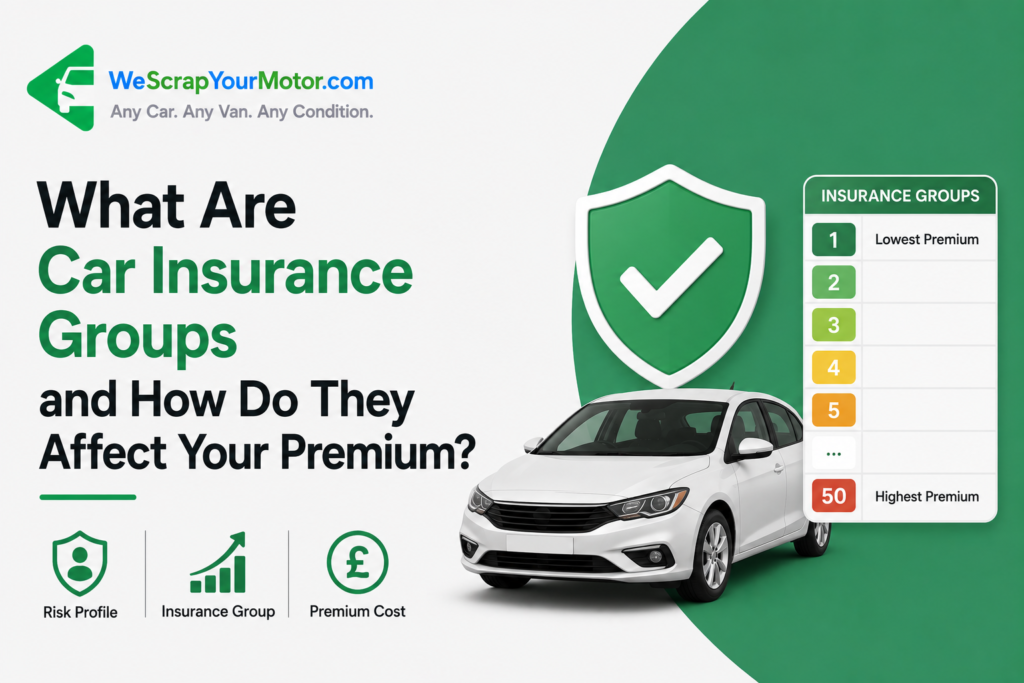
Car insurance groups are a UK vehicle rating system that places cars into groups ranging from 1 to 50. Vehicles in Group 1 are generally the cheapest to insure, while vehicles in Group 50 are usually the most expensive. Insurance companies use these ratings, along with factors such as age, driving history, and location, to calculate insurance premiums.
This system helps insurers assess risk consistently across thousands of vehicle models sold in the UK.
What Are Car Insurance Groups?
Car insurance groups are categories used by UK insurance companies to determine how much risk is associated with insuring a specific vehicle.
Every car sold in the UK is assigned an insurance group between 1 and 50. The lower the number, the lower the perceived insurance risk.
For example:
- Group 1 vehicles are typically small, affordable, and inexpensive to repair.
- Group 50 vehicles are often luxury, sports, or high-performance models that cost more to repair or replace.
The purpose of car insurance groups is to create a standardized way for insurers to compare vehicles and calculate insurance costs.
Without insurance groups, insurers would need to assess every vehicle individually, making the pricing process far more complicated.
Why Were Car Insurance Groups Created?
The UK insurance industry introduced vehicle group ratings to make insurance pricing more accurate and fair.
Instead of relying solely on the driver’s profile, insurers also evaluate the characteristics of the vehicle itself.
The system allows insurers to:
- Estimate repair costs.
- Assess theft risk.
- Evaluate vehicle performance.
- Compare safety features.
- Calculate likely claim costs.
As a result, drivers with similar backgrounds may still pay different premiums depending on which vehicle they own.
How Do Car Insurance Groups Work in the UK?
The UK insurance industry uses a sophisticated rating system developed through collaboration between insurers and automotive research specialists.
When a new vehicle enters the market, experts assess multiple risk factors before assigning an insurance group.
The vehicle is then placed into one of fifty insurance categories.
Generally speaking:
- Lower groups mean lower insurance costs.
- Higher groups mean higher insurance costs.
However, insurance groups are only one factor that insurers consider when calculating premiums.
Who Decides Vehicle Insurance Groups?
Many drivers assume insurance companies create the groups themselves.
In reality, several organizations contribute to the rating process.
Thatcham Research
Thatcham Research is one of the most influential organizations involved in vehicle risk assessment in the UK.
Founded by the insurance industry, Thatcham conducts testing on:
- Vehicle safety
- Repairability
- Security systems
- Crash performance
Their findings play a major role in determining insurance group ratings.
The Group Rating Panel
The Group Rating Panel consists of insurance industry experts who review vehicle data and assign appropriate insurance groups.
UK Insurance Companies
Insurers also contribute statistical data regarding:
- Claims frequency
- Repair costs
- Theft rates
- Accident severity
Together, these organizations help maintain the UK’s insurance group system.
Why Do Insurance Groups Range From 1 to 50?
The 1–50 scale allows insurers to classify vehicles based on risk levels.
Here’s a simple breakdown:
| Insurance Group | Risk Level | Typical Insurance Cost |
| 1–10 | Very Low | Cheapest |
| 11–20 | Low | Affordable |
| 21–30 | Moderate | Average |
| 31–40 | High | Expensive |
| 41–50 | Very High | Most Expensive |
While a Group 1 vehicle is not guaranteed to have the cheapest insurance quote, it generally provides a lower starting point for insurers when calculating premiums.
Likewise, vehicles in Groups 41–50 often attract significantly higher premiums because they present greater financial risk.
What Makes a Group 1 Car Different From a Group 50 Car?
The differences between lower and higher insurance groups often come down to cost and risk.
Typical Characteristics of Group 1 Vehicles
Vehicles in Group 1 usually have:
- Smaller engines
- Lower market values
- Lower repair costs
- Better affordability
- Reduced theft risk
Examples often include city cars and entry-level hatchbacks.
Typical Characteristics of Group 50 Vehicles
Vehicles in Group 50 often feature:
- High-performance engines
- Luxury components
- Expensive replacement parts
- Advanced technology
- Higher repair costs
Examples commonly include sports cars, luxury SUVs, and premium performance vehicles.
Why Understanding Insurance Groups Matters Before Buying a Car
Many motorists only check insurance prices after they’ve chosen a vehicle.
This can be an expensive mistake.
Two cars with similar purchase prices may belong to completely different insurance groups.
For example:
- One hatchback might sit in Group 8.
- Another similar-looking model might sit in Group 22.
The difference in annual insurance costs can be substantial.
Checking insurance groups before purchasing a vehicle helps you:
- Avoid unexpected insurance costs.
- Compare ownership expenses accurately.
- Choose a vehicle that fits your budget.
- Reduce long-term motoring costs.
This is especially important for:
- Young drivers
- First-time buyers
- Families
- Budget-conscious motorists
Insurance Groups Are Important, But So Is Your Level of Cover
Your vehicle’s insurance group affects premiums, but your policy type also plays a major role.
Before comparing quotes, many drivers first want to understand what is comprehensive car insurance and how it differs from third-party or third-party fire and theft policies.
Comprehensive cover often provides the highest level of protection, but the exact benefits vary between insurers.
Understanding both your insurance group and your level of cover can help you choose the most cost-effective policy.
What Factors Determine Car Insurance Groups?
Now that you understand how car insurance groups work, the next step is understanding what actually determines a vehicle’s insurance rating.
Insurance groups are not assigned randomly. Before a vehicle is placed into one of the UK’s 50 insurance groups, experts carefully assess numerous factors that influence risk and potential claim costs.
The more expensive a vehicle is likely to be for insurers, the higher its insurance group is likely to be.
Let’s examine the key factors that affect car insurance groups.
1. Vehicle Value
One of the first things insurers consider is the vehicle’s market value.
Simply put, expensive vehicles cost more to replace.
If a vehicle is stolen or declared a total loss after an accident, insurers may need to pay a significantly larger settlement.
For example:
| Vehicle Type | Approximate Risk to Insurer |
| Budget City Car | Low |
| Family Hatchback | Moderate |
| Luxury SUV | High |
| Sports Car | Very High |
Generally speaking, higher-value vehicles tend to fall into higher insurance groups.
2. Repair Costs
Repair costs play a major role in determining car insurance groups.
Insurers evaluate:
- Replacement part costs
- Labour charges
- Repair complexity
- Availability of specialist technicians
Modern vehicles often include sophisticated technology such as:
- Radar sensors
- Cameras
- Adaptive cruise control
- Parking assistance systems
While these features improve safety, they can also make repairs more expensive.
Even a minor accident may result in costly repairs if advanced systems require recalibration.
3. Vehicle Performance and Engine Size
Another important factor is vehicle performance.
Insurers generally view faster vehicles as carrying a greater risk of expensive claims.
When assessing a vehicle, experts examine:
- Engine capacity
- Horsepower
- Top speed
- Acceleration
For example:
| Vehicle Category | Typical Insurance Group Range |
| Small City Cars | 1–10 |
| Family Cars | 10–25 |
| Executive Cars | 20–40 |
| Performance Cars | 35–50 |
High-performance vehicles are statistically more likely to be involved in high-value claims, which is why they often occupy higher insurance groups.
4. Vehicle Security Features
Security features can positively influence car insurance groups.
Vehicles equipped with strong anti-theft technology may receive more favorable ratings.
Common security features include:
- Immobilisers
- Alarm systems
- Tracking devices
- Keyless entry protection
- Secure locking systems
Insurers prefer vehicles that are difficult to steal because they present lower financial risk.
5. Theft Rates and Recovery Statistics
Certain vehicles are targeted more frequently by thieves.
As part of the rating process, experts analyze:
- Theft frequency
- Vehicle recovery rates
- Organized crime trends
- Security vulnerabilities
A vehicle that is frequently stolen may receive a higher insurance group even if it isn’t particularly expensive.
This is why two similarly priced vehicles can sometimes have very different insurance ratings.
6. Vehicle Safety Ratings
Safety is another major factor used to calculate car insurance groups.
Safer vehicles often result in:
- Fewer injuries
- Less severe accidents
- Lower claim costs
Features that may improve insurance ratings include:
- Autonomous emergency braking
- Lane-keeping assistance
- Blind spot monitoring
- Stability control
- Collision avoidance systems
Vehicles with excellent safety records are often viewed more favorably by insurers.
7. Parts Availability
Many drivers overlook the importance of replacement parts.
Insurers consider:
- Parts availability
- Supply chain reliability
- Manufacturer support
- Repair turnaround times
A vehicle with rare or imported parts can be significantly more expensive to repair after an accident.
As a result, these vehicles may be assigned higher insurance groups.
How Insurers Calculate Your Premium
Although car insurance groups are important, they are only one piece of the puzzle.
Insurance providers use multiple factors when calculating premiums.
Understanding these factors can help explain why two drivers with the same vehicle may receive different quotes.
Your Age
Age is one of the biggest influences on insurance premiums.
Statistically, younger drivers are more likely to be involved in accidents.
As a result:
- Drivers aged 17–24 often pay the highest premiums.
- Experienced drivers generally receive lower rates.
- Premiums may increase again for older drivers depending on circumstances.
This is why young motorists often choose vehicles from lower car insurance groups.
Your Driving History
Insurers review your driving record carefully.
Factors include:
- Previous accidents
- Claims history
- Motoring convictions
- Penalty points
A clean driving history can significantly reduce premiums.
Your Postcode
Where you live matters.
Insurers analyze local statistics such as:
- Accident frequency
- Vehicle theft rates
- Vandalism levels
- Fraud claims
Drivers living in high-risk areas may pay more regardless of their vehicle’s insurance group.
Annual Mileage
The more time you spend on the road, the greater your exposure to risk.
Drivers with lower annual mileage often benefit from reduced premiums.
Typical mileage categories include:
- Under 5,000 miles
- 5,000–10,000 miles
- 10,000–15,000 miles
- Over 15,000 miles
Occupation
Certain professions are statistically associated with different levels of insurance risk.
Insurers may consider:
- Job type
- Driving frequency
- Work-related vehicle usage
This can influence premium calculations alongside car insurance groups.
Vehicle Usage
How you use your vehicle also affects pricing.
Examples include:
- Social use only
- Commuting
- Business use
- Commercial use
Business users typically pay higher premiums due to increased road exposure.
Why Young Drivers Should Pay Special Attention to Insurance Groups
Young drivers often face the highest insurance costs in the UK.
For new motorists, choosing the wrong vehicle can dramatically increase premiums.
A vehicle in Group 5 could cost substantially less to insure than a similar-looking vehicle in Group 25.
Popular low-group vehicles for young drivers include:
- Hyundai i10
- Kia Picanto
- Toyota Aygo
- Volkswagen Up
- Skoda Citigo
These vehicles are often among the cheapest cars to insure in the UK.
Examples of Popular UK Cars and Their Insurance Groups
The exact insurance group depends on the model year, trim level, and engine size, but the examples below provide a useful guide.
| Vehicle | Typical Insurance Group |
| Hyundai i10 | 1–5 |
| Kia Picanto | 1–8 |
| Toyota Aygo | 1–7 |
| Ford Fiesta | 3–20 |
| Vauxhall Corsa | 2–18 |
| Volkswagen Golf | 10–30 |
| Nissan Qashqai | 11–25 |
| BMW 3 Series | 20–40 |
| Audi S5 | 35–45 |
| Porsche 911 | 45–50 |
Before purchasing any vehicle, always verify its exact insurance group using a reliable insurance group checker.
Can You Drive Another Vehicle Under Your Insurance Policy?
A common question many motorists ask is can i drive any car with comprehensive insurance.
In the past, some comprehensive insurance policies included a “Driving Other Cars” (DOC) benefit. However, many insurers have reduced or removed this feature.
Whether you’re covered depends on:
- Your insurer
- Your policy wording
- Your age
- The vehicle owner
Never assume you’re insured to drive another car without checking your policy first.
Driving without proper cover can result in serious penalties.
How to Check a Vehicle’s Insurance Group Before Buying
One of the smartest things you can do before purchasing a vehicle is check its insurance group.
Many drivers spend hours comparing fuel economy, reliability, and purchase prices but overlook insurance costs. Unfortunately, that can lead to a costly surprise after receiving insurance quotes.
Checking car insurance groups before buying helps you estimate the true cost of ownership.
Use an Insurance Group Checker
Several insurance providers and comparison websites offer free insurance group checker tools.
You’ll typically need:
- Vehicle registration number
- Vehicle make and model
- Year of manufacture
- Engine size
These tools can quickly tell you which insurance group a vehicle belongs to and help you compare different models.
Compare Similar Models
Two versions of the same vehicle may have very different insurance groups.
For example:
| Vehicle Model | Insurance Group |
| Ford Fiesta 1.0 | 5–10 |
| Ford Fiesta ST | 25–35 |
| Volkswagen Golf 1.0 | 10–15 |
| Volkswagen Golf GTI | 26–38 |
Even minor differences in engine size and performance can have a significant impact on insurance costs.
Can Vehicle Modifications Affect Insurance Groups?
Yes.
Vehicle modifications can increase insurance premiums and sometimes affect how insurers view risk.
Even modifications that seem minor can influence insurance costs.
Common Modifications That Increase Insurance Costs
Examples include:
- Alloy wheels
- Performance exhaust systems
- Engine remapping
- Lowered suspension
- Body kits
- Tinted windows
- Upgraded sound systems
Insurers often see modifications as increasing the likelihood of claims or theft.
Why Modified Vehicles Cost More to Insure
Modified vehicles may:
- Be more expensive to repair
- Require specialist parts
- Be more attractive to thieves
- Encourage higher-risk driving
As a result, insurance companies may charge higher premiums.
Always inform your insurer about modifications, as failing to do so could invalidate your policy.
What Is the Cheapest Insurance Group in the UK?
Insurance Group 1 is generally considered the cheapest group.
Vehicles in Group 1 are usually:
- Small
- Affordable
- Easy to repair
- Low-powered
- Less likely to be stolen
These characteristics make them attractive to insurers.
Popular Insurance Group 1 Cars
Examples often include:
- Hyundai i10
- Kia Picanto
- Toyota Aygo
- Volkswagen Up
- Skoda Citigo
For many young drivers, choosing one of these vehicles can significantly reduce insurance costs.
What Is the Most Expensive Insurance Group?
Group 50 is the highest insurance group available in the UK.
Vehicles in this category often include:
- High-performance sports cars
- Luxury vehicles
- Premium SUVs
- Exotic supercars
Examples may include:
- Porsche 911 Turbo
- Audi R8
- Lamborghini Huracán
- Ferrari Roma
These vehicles typically cost more to repair, replace, and insure.
How to Lower Your Insurance Premium Regardless of Insurance Group
Even if your vehicle belongs to a higher insurance group, there are ways to reduce costs.
1. Increase Your Voluntary Excess
A higher excess means you’ll contribute more toward any future claim.
Because you’re accepting more risk, insurers often reduce premiums.
However, ensure the excess remains affordable if you need to make a claim.
2. Improve Vehicle Security
Installing additional security measures can sometimes lower premiums.
Examples include:
- Steering wheel locks
- Thatcham-approved alarms
- Tracking systems
- Immobilisers
These features may reduce the risk of theft.
3. Limit Annual Mileage
Drivers who spend less time on the road generally present lower risk.
If your annual mileage is low, inform your insurer.
4. Build a No-Claims Bonus
One of the most effective ways to lower premiums is maintaining a clean driving record.
Years without claims can lead to substantial discounts.
5. Compare Quotes Every Year
Insurance providers regularly change pricing models.
Comparing quotes at renewal time can often save money.
Why Insurance Costs Matter When Deciding Whether to Keep or Scrap a Car
Many motorists focus solely on repair costs when evaluating an ageing vehicle.
However, insurance costs should also be considered.
Sometimes a vehicle may still run well but become increasingly expensive to own.
Factors that may indicate it’s time to move on include:
- Rising insurance premiums
- Frequent repairs
- Repeated MOT failures
- Declining vehicle value
- Expensive maintenance
When these costs begin to exceed the vehicle’s worth, replacing or scrapping the car may be the more economical option.
When Does Scrapping a Car Make Financial Sense?
For some drivers, continuing to insure and maintain an older vehicle simply isn’t cost-effective.
Your Insurance Costs Exceed the Vehicle’s Value
Imagine paying £800–£1,000 per year to insure a vehicle worth only £1,500.
Over time, those costs can outweigh the value of keeping the car.
The Vehicle Requires Constant Repairs
Older vehicles often develop issues such as:
- Suspension problems
- Brake wear
- Electrical faults
- Corrosion
- Engine issues
When repair bills become frequent, it may be time to consider replacement.
You’re Planning to Upgrade
Many motorists choose to replace older vehicles with models in lower insurance groups.
This can reduce:
- Insurance premiums
- Maintenance expenses
- Fuel costs
If you’re upgrading your vehicle, selling or scrapping the old one can help offset the cost of replacement.
What Happens to Your Insurance When You Scrap a Car?
A common question drivers ask after scrapping a vehicle is whether their insurance policy can be cancelled.
If you’re disposing of a vehicle, it’s important to understand can you cancel car insurance at any time and whether cancellation fees or refunds may apply.
The answer depends on:
- Your insurer
- Your policy terms
- Whether you’ve paid monthly or annually
Always contact your insurer as soon as your vehicle is sold, scrapped, or transferred.
Additional Cover Options Worth Considering
Many drivers focus only on the basic level of cover.
However, insurers often offer optional extras that may provide valuable protection.
One popular add-on is legal cover car insurance.
Legal cover may help with:
- Recovering uninsured losses
- Legal expenses after an accident
- Compensation claims
- Personal injury support
While legal cover won’t affect your insurance group, it may provide additional peace of mind.
People Also Ask: Car Insurance Groups FAQs
What Are Car Insurance Groups?
Car insurance groups are ratings from 1 to 50 used by UK insurers to estimate the risk and cost of insuring a vehicle.
What Is the Cheapest Car Insurance Group?
Group 1 is generally the cheapest insurance group because vehicles in this category tend to be inexpensive, safe, and affordable to repair.
What Is Insurance Group 50?
Insurance Group 50 is the highest insurance group and typically includes luxury and high-performance vehicles that are expensive to repair or replace.
Do Insurance Groups Affect Monthly Payments?
Yes.
Higher insurance groups generally result in higher monthly and annual premiums.
Can Insurance Groups Change?
Insurance group ratings can occasionally be reviewed if new information becomes available, although major changes are relatively rare.
Are Electric Cars Expensive to Insure?
Some electric vehicles fall into higher insurance groups because battery replacement and specialist repairs can be costly.
However, insurance costs vary significantly between models.
Do Insurance Groups Matter for Young Drivers?
Absolutely.
Choosing a vehicle in a lower insurance group can often reduce insurance costs dramatically for younger motorists.
Can Two Versions of the Same Car Have Different Insurance Groups?
Yes.
Different trim levels, engine sizes, and performance specifications can place vehicles into different insurance groups.
How Can I Find My Car’s Insurance Group?
You can use an insurance group checker, consult your insurer, or review manufacturer specifications.
Is a Lower Insurance Group Always Better?
Not necessarily.
A lower insurance group usually means cheaper insurance, but factors such as reliability, fuel economy, maintenance costs, and suitability for your needs should also be considered.
Final Thoughts: Understanding Car Insurance Groups Can Save You Money
Understanding car insurance groups is one of the simplest ways to make smarter vehicle-buying decisions.
Because car insurance groups directly influence insurance premiums, knowing how the system works can help you avoid expensive mistakes and reduce your overall motoring costs.
Before purchasing a vehicle, always:
- Check its insurance group.
- Compare insurance quotes.
- Review ownership costs.
- Consider repair and maintenance expenses.
For drivers with ageing vehicles, rising insurance premiums can sometimes make replacement a more sensible option than continued ownership.
If your vehicle is becoming uneconomical to keep on the road, We Scrap Your Motor can help you dispose of it legally and responsibly while receiving a competitive quote.
By understanding car insurance groups, comparing your options carefully, and evaluating the true cost of ownership, you’ll be in a much stronger position to save money and make informed decisions about your vehicle.