
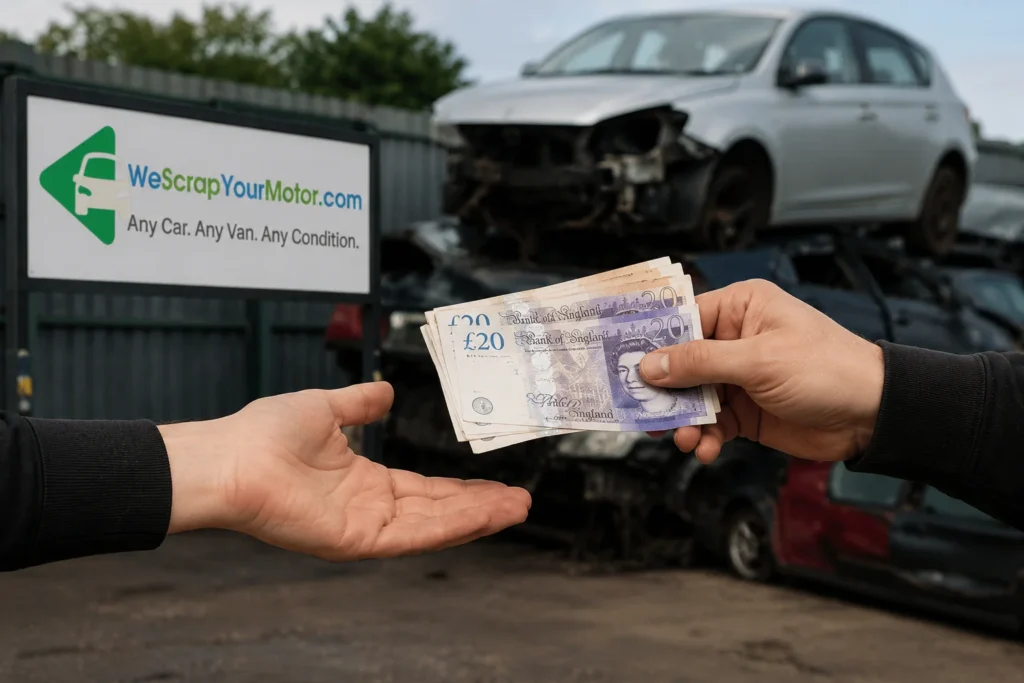
If you have an unwanted, damaged, or non-running vehicle, you may be searching for cash for scrap a car and expecting a buyer to hand you notes when collecting it. That may once have been common, but the rules governing scrap-vehicle payments have changed.
In England and Wales, a licensed scrap metal dealer must not pay physical cash for a vehicle that is being purchased as scrap. Payment should instead be made through an approved, traceable method, such as an electronic bank transfer or a non-transferable cheque.
This does not mean your old car has no cash value. It simply means that the money cannot lawfully be handed to you as banknotes or coins when the vehicle is being scrapped.
This guide explains how scrap-car payments work, which payment methods are permitted, when a vehicle may be treated as salvage instead of scrap, what information a buyer can request, and how to avoid payment scams.
Get Cash for Scrap a Car
You can receive money for an unwanted vehicle, but you cannot normally receive physical cash for scrap a car in England or Wales.
GOV.UK states that when a vehicle is completely scrapped, payment must be made by bank transfer or cheque. Physical cash payments are illegal. However, if an authorised facility decides to repair and resell the vehicle rather than destroy it, different payment options may be available because the transaction is for a reusable vehicle rather than scrap metal.
For customers using We Scrap Your Motor, the safest approach is to request a written quote, confirm the payment method, disclose the vehicle’s condition accurately, and keep evidence of the payment and handover.
What Does Cash For A Scrap Car Mean?
People use the phrase cash for scrap a car in two different ways.
Sometimes, “cash” simply means money received for the vehicle. In this sense, a bank transfer is still a cash payment from the seller’s financial point of view.
However, the law uses “cash” more specifically to mean physical banknotes and coins. This physical payment method is prohibited when a scrap metal dealer buys a vehicle as scrap in England or Wales.
The distinction matters because an advertisement may promise “cash for cars” while the business actually pays through bank transfer. That wording is not necessarily saying that notes will be handed over. Before accepting a quote, ask the buyer to explain:
- Whether the vehicle is being purchased for scrapping or salvage
- Whether payment will be made by bank transfer or cheque
- When the payment will reach your account
- Whether the quoted amount can change after inspection
- Whether collection is included
- What documents or identification you must provide
A professional buyer should answer these questions clearly before collection day.
Is Cash For Scrap A Car Illegal?
Physical cash for scrap a car is illegal when a vehicle is purchased as scrap by a dealer in England or Wales.
Section 12 of the Scrap Metal Dealers Act 2013 prohibits scrap metal dealers from purchasing scrap metal using cash. The permitted methods identified in the official guidance are a non-transferable cheque or an electronic transfer of funds.
Electronic methods can include:
- Bank transfer
- BACS payment
- Faster Payments
- Direct credit
- Credit transfer
- Other traceable electronic transfers
The purpose is to create a record connecting the payer, the recipient, the payment amount, and the transaction. This makes it harder for stolen vehicles or metal to move through anonymous cash transactions.
Scottish legislation also introduced restrictions on cash payments for scrap metal. Because specific licensing and waste rules differ across the UK, owners outside England and Wales should confirm the current requirements with their local licensed operator.
For a car being collected in Kent, our Scrap My Car In Kent service can explain the proposed payment method and collection terms before the booking is confirmed.
Why Were Physical Cash Payments Banned?
The restrictions were introduced to improve traceability in the scrap-metal industry.
Before traceable payments became mandatory, stolen metal could be sold anonymously, and it was harder for enforcement authorities to connect a payment with a particular seller or item. A recorded transaction gives licensed dealers and authorities a clearer audit trail.
The rule also offers practical protection to legitimate vehicle owners. If payment is sent electronically, you can retain a record showing:
- The sender’s name or account
- The amount paid
- The payment reference
- The date of payment
- The account that received it
This evidence can be useful if there is later a disagreement about whether you were paid.
A buyer offering physical cash for scrap a car may be ignoring licensing, identity-verification, payment, or record-keeping requirements. That should be treated as a warning sign rather than an extra benefit.
What Is The Difference Between Scrap And Salvage?
The legal payment position can depend on what will happen to the vehicle.
A scrap car is an end-of-life vehicle intended for depollution, dismantling, recycling, and destruction through an authorised treatment facility. An eligible car, light van, or three-wheeled vehicle that is completely destroyed should normally receive a Certificate of Destruction.
A salvage vehicle may still have a realistic route back into use. It might be repaired and resold, or its reusable components may have value beyond its basic metal content.
GOV.UK explains that an authorised treatment facility may decide either to completely scrap a vehicle or to repair and sell it. If it is repaired and sold, the seller will not receive a Certificate of Destruction, and payment can be made through other methods, including cash.
Do not assume that calling a vehicle “salvage” automatically makes a physical cash payment lawful. Its true condition, the buyer’s business activity, the agreed purpose, and the eventual treatment of the vehicle all matter.
Ask the buyer to confirm the transaction type in writing.
Which Scrap-Car Payment Methods Are Legal?
The safest payment arrangements create a clear and permanent record.
| Payment Method | Normally Accepted For Scrap In England And Wales? | What To Check |
| Bank Transfer | Yes | Confirm the account name, amount, and payment timing |
| Faster Payment | Yes | Keep the payment reference and bank record |
| BACS Transfer | Yes | Ask how many working days it may take |
| Non-Transferable Cheque | Yes | Confirm the payee name and clearing time |
| Physical Notes And Coins | No | Do not accept this for a vehicle sold as scrap |
| Goods Or Services Instead Of Payment | No | Payment in kind can also breach the rules |
| Untraceable Voucher | Usually Unsuitable | Ask the dealer to identify the legal payment basis |
Bank transfer is usually the most convenient option because the transaction can be recorded quickly. A cheque is also possible, but you may need to wait for it to clear before treating the payment as complete.
The exact timing should be stated before the vehicle leaves your possession.
When Should The Scrap-Car Payment Arrive?
There is no single payment time that applies to every buyer. Some electronic transfers appear quickly, while others may be processed after the vehicle details, ownership information, or collection record have been verified.
Before accepting a cash for scrap a car quote, ask the buyer:
- Is payment made before, during, or after collection?
- Is the payment released automatically?
- Could a weekend or bank holiday cause a delay?
- What reference will appear on my bank statement?
- Who should I contact if the payment does not arrive?
- Can I receive written confirmation that payment has been initiated?
Do not rely on a collector showing you an unverified screenshot. Check your own banking app or account record where practical.
If the agreed process involves payment after inspection, make sure you understand what will be inspected and which disclosed differences could change the price.
Why Does The Buyer Need My Identification?
Licensed scrap metal dealers in England and Wales must verify the full name and address of the person supplying scrap metal. They must also maintain transaction records.
A buyer may therefore request approved identification before accepting the vehicle. Depending on its verification procedure, this could involve photo identification and separate proof of address.
Identity checks are not an excuse to collect unnecessary information. Ask how your documents will be stored and used, especially if you are uploading them online.
The following details may also be requested:
- Vehicle registration
- Make and model
- Mileage
- V5C information
- Collection postcode
- Vehicle condition
- Missing components
- Name of the registered keeper
- Bank details needed for payment
Make sure you are dealing with the genuine company before sending documents or banking information. Check the website address, telephone number, company details, and collection confirmation.
Can Someone Else Receive The Payment?
This depends on the buyer’s verification process and whether the payment can be connected clearly to the lawful owner or seller.
If the vehicle is registered in your name but you want payment sent to another person, tell the buyer before booking. The dealer may require additional ownership evidence, written authority, or identification for both people.
Do not wait until the collection vehicle arrives to disclose that the bank account belongs to someone else. A mismatch may delay payment or prevent the collection from proceeding.
If you are dealing with:
- A company vehicle
- A deceased owner’s vehicle
- A vehicle registered to a family member
- A financed vehicle
- A car bought but not yet registered in your name
explain the situation during the quote process. Each scenario may require different documents.
How Is The Amount You Receive Calculated?
The ban on physical cash for scrap a car does not determine how much the vehicle is worth. It only affects the payment method.
Your quote may depend on:
- Make and model
- Vehicle age
- Kerb weight
- Engine and gearbox
- Catalytic converter
- Alloy wheels
- Reusable components
- Accident damage
- Fire or flood damage
- Missing parts
- Whether it starts, steers, rolls, and brakes
- Collection location
- Recovery access
- Current metal and parts demand
A complete vehicle will often be easier to value and collect than one missing its wheels, catalytic converter, engine, or gearbox. Removing major components can reduce the amount offered.
For a fuller explanation, read our guide to Scrap Car Prices Per Ton In The UK.
Can The Buyer Deduct Collection Costs?
A buyer should explain collection charges or deductions before you accept the booking.
Many complete vehicles can be collected without a separate fee, but specialist recovery may affect the quote. Examples include a car that:
- Has no wheels
- Has locked steering
- Has seized brakes
- Is in an underground car park
- Is parked on soft or unsafe ground
- Cannot be reached by a recovery vehicle
- Requires lifting equipment
- Is far outside the buyer’s normal collection area
Give the buyer accurate information and useful photographs before accepting the offer. If the recovery conditions match what you disclosed, an unexpected collection deduction deserves an explanation.
A strong written quote should state whether collection is included and list any circumstances that may change the amount.
What Happens If A Collector Offers Physical Cash?
Do not accept an offer of physical cash for scrap a car when the vehicle is being sold as scrap in England or Wales.
Ask for:
- The business’s full trading name
- Its scrap metal dealer licence information
- The destination authorised treatment facility
- A written quote
- A lawful payment method
- A collection receipt
If the collector refuses to provide basic business information or insists that “everyone pays cash,” cancel the arrangement.
Other warning signs include:
- Pressure to hand over the vehicle immediately
- No identity checks
- No receipt
- No explanation of the vehicle’s destination
- A payment offered through someone else’s personal account
- A large reduction without inspecting the claimed problem
- Requests for online banking passwords or security codes
A legitimate buyer needs your account details to send a transfer. It does not need your PIN, card security code, online banking password, or one-time login code.
What Records Should You Keep?
Keep a complete record of the sale even after you receive payment.
Your file should contain:
- The original quote
- The collection confirmation
- Photographs supplied to the buyer
- Messages describing the vehicle
- Identification of the buyer
- The collection receipt
- The payment record
- DVLA notification confirmation
- The Certificate of Destruction, where applicable
The Certificate of Destruction is particularly important when the vehicle has been permanently scrapped. GOV.UK says an authorised treatment facility should issue it within seven days for eligible vehicles that are completely destroyed.
You must still make sure DVLA is notified correctly. Do not assume the payment transaction alone ends your responsibilities as the registered keeper.
How To Receive Payment Safely
Use this process when comparing cash for scrap a car offers:
- Request the quote in writing.
- Confirm whether the vehicle is being bought as scrap or salvage.
- Describe all faults and missing components.
- Send current photographs.
- Confirm whether the collection is included.
- Ask which authorised facility will receive an end-of-life vehicle.
- Confirm the permitted payment method.
- Ask when the payment should arrive.
- Prepare your identification and ownership records.
- Check the payment amount and receipt.
- Notify DVLA using the correct process.
- Keep every transaction document.
This process gives both parties a clear record and reduces the chance of a collection-day disagreement.
Frequently Asked Questions
Can A Scrapyard Pay Me In Notes And Coins?
No, not when a scrap metal dealer buys the vehicle as scrap in England or Wales. The legal cash for scrap a car alternatives are generally an electronic transfer or non-transferable cheque.
Is Bank Transfer Safe For A Scrap Car?
Bank transfer is a traceable and widely used payment method. Confirm the payer, amount, timing, and reference in advance. Never share your banking password, PIN, or security code.
Can I Be Paid Before Collection?
That depends on the buyer’s payment procedure. Some buyers verify the vehicle during collection before releasing payment. Ask for the timing in writing.
Can I Get Cash If The Car Will Be Repaired?
GOV.UK distinguishes a vehicle that is completely scrapped from one that an authorised facility repairs and sells. Other payment methods may be possible for a genuine resale transaction, but the vehicle’s route should be confirmed honestly.
Do I Need A V5C To Receive Payment?
A missing V5C does not always prevent a lawful transaction, but the buyer will need suitable ownership and identity evidence. Tell the buyer before booking.
Why Has The Buyer Asked For My Bank Details?
The buyer needs suitable account information to send a traceable electronic payment. It should never request passwords, card PINs, or security codes.
Can The Quote Be Reduced Before Payment?
A quote may be revised if the vehicle differs materially from the description, but the buyer should identify the reason and obtain your agreement. You do not have to accept an unexplained reduction.
Is A Cheque A Legal Scrap-Car Payment?
Yes, a properly issued non-transferable cheque can be used. Ask how long it may take to clear and make sure it is payable to the correct person.
Choose A Lawful, Traceable Payment For Your Scrap Car
Searching for cash for scrap a car should lead you to a genuine vehicle valuation, not an illegal bundle of notes on the driveway.
Use a licensed buyer, provide accurate vehicle details, request written terms, and confirm a traceable payment method before collection. Keep your payment record, handover receipt, DVLA confirmation, and Certificate of Destruction where one is issued.
A clear transaction protects your money, your vehicle records, and your responsibilities as the registered keeper.