
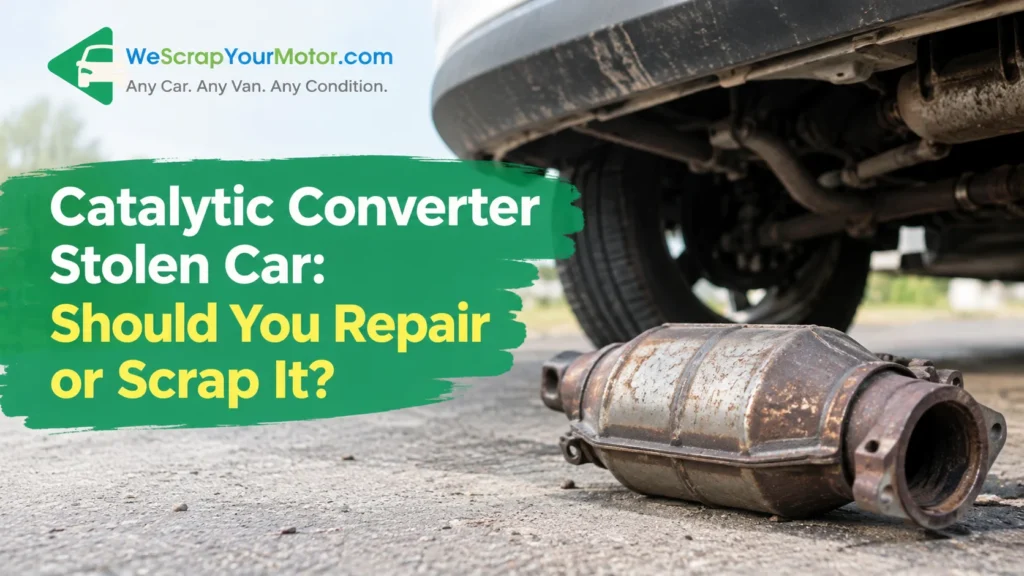
You start your car and hear a roar that was not there yesterday. The exhaust suddenly sounds much louder, and something underneath the vehicle may have been cut away. After discovering the theft, the next worry is usually money. Will replacing the missing part make financial sense, or has an already ageing car become too expensive to keep?
If you searched for “catalytic converter stolen car”, start with this answer: the theft alone does not mean your car should be scrapped. First, establish the full damage, check your insurance position, and compare a complete repair quote with the vehicle’s condition and realistic value.
A healthy car with a damaged exhaust may still be worth repairing. An older vehicle needing a converter, welding, tyres and other major work may justify a different decision.
The important comparison is the cost of getting dependable transport again, not simply the price of the stolen component.
Your First Decision Is Safety, Not Scrapping
Do not repeatedly start the engine to investigate the noise. A cut exhaust can leave hot gases escaping underneath the vehicle, while hanging components or damaged wiring may create additional problems. Arrange professional inspection or recovery rather than assuming the car is safe because it still starts.
Never crawl underneath a vehicle supported only by its emergency jack. You do not need to photograph the underside yourself to begin reporting the incident or requesting help.
The Metropolitan Police advises calling 999 if the theft is happening now and warns against approaching suspects. If the incident has already happened, report it through the appropriate police reporting route. Record any useful details you can obtain safely.
For a catalytic converter stolen car situation, the sensible order is to secure the vehicle, report the theft, contact your insurer and arrange an inspection. Deciding its final destination comes afterwards.
Keep photographs of visible damage, the crime reference number and any recovery paperwork together. These records make conversations with the garage and insurer clearer.
What Has Actually Been Stolen?
The catalytic converter is part of the exhaust system. Its job is to help reduce harmful exhaust emissions. It contains valuable materials, which is one reason thieves target it.
However, a loud exhaust does not prove that the converter has been stolen. A broken pipe, failed joint or damaged silencer can also change the sound dramatically. A garage should confirm what is missing before anyone orders parts.
Even when theft is obvious, the missing converter may only be one item on the repair list. The removal can damage adjoining exhaust sections, mounting points or nearby sensors.
That distinction matters when researching catalytic converter stolen car costs. A price for replacing a worn converter is not automatically a price for repairing theft damage.
Ask the garage to describe the affected parts in writing. “Exhaust repair” is too vague for a decision involving several hundred pounds or more. You need to know which components are missing, which can be retained and what must be replaced to return the car to proper working condition.
How Much Could the Repair Cost?
There is no dependable single price for every affected vehicle.
ClickMechanic’s catalytic converter price guide lists an average replacement cost of £310 and a range of £175 to £900. It also explains that theft can cause additional damage, increasing the overall bill. Treat those figures as that provider’s published guide, not a guaranteed price or a comprehensive UK market average.
Your quotation may differ substantially because the correct converter, adjoining exhaust assembly and labour requirements depend on the exact vehicle.
A catalytic converter stolen car repair quote should separate the main costs.
| Cost Element | What You Need To Check |
| Replacement converter | Correct specification for the vehicle |
| Exhaust sections | Whether cutting damaged adjoining pipes |
| Sensors and wiring | Whether these survived the theft |
| Fitting materials | Clamps, seals, brackets and related items |
| Labour | Inspection, removal, installation and testing |
| Additional charges | Recovery, VAT where applicable and storage |
A headline parts price is not enough. Ask for the total payable amount and an explanation of anything that could change after inspection.
If the garage cannot yet provide a fixed figure, agree the next diagnostic step and its cost before authorising further work.
Why Two Quotes Can Look Very Different
Two garages may not be quoting for the same repair, even when both descriptions say “replace catalytic converter”.
One may include an original-equipment component and a complete exhaust section. Another may propose an appropriate aftermarket replacement while retaining undamaged parts. Labour rates, access difficulties and supplier availability can also differ.
The lower figure deserves consideration, but only after you understand the specification. Ask whether the proposed part is suitable and compliant for your exact registration, engine and emissions requirements.
Do not accept a quotation for removing emissions equipment or fitting a plain pipe as though it were equivalent to restoring the original system.
When comparing catalytic converter stolen car quotations, request the part description, warranty, total fitted price and confirmation that damaged sensors or wiring have been assessed.
Also ask who handles a problem if the replacement fails. A parts warranty alone may leave uncertainty about removal, refitting or diagnostic labour.
A useful quotation makes the repair scope understandable. You should not need specialist knowledge to discover whether two prices cover different jobs.
Will the Car Fail Its MOT?
A current MOT certificate does not mean a newly damaged car remains roadworthy.
For Great Britain, the official MOT inspection manual identifies missing, obviously modified or defective emissions-control equipment as a major defect within the applicable inspection requirements. It includes specific rules based on vehicle age and emissions-test applicability. Northern Ireland uses its own inspection guidance.
For most modern cars originally equipped with a catalytic converter, leaving it missing is not a sensible route back to normal road use.
This is why the catalytic converter stolen car decision must include a proper repair specification. Quietening the exhaust alone does not necessarily restore emissions compliance.
Ask the repairer to explain how the completed work will address the damaged exhaust, any warning lights and the relevant emissions requirements.
If your MOT is due soon, request a separate assessment of other likely work. You do not want to spend heavily on the exhaust and immediately discover a much larger bill for unrelated deterioration.
Check Insurance Before Paying for Repairs
Contact your insurer before authorising substantial work or selling the vehicle. Cover, excesses, approved repair arrangements and settlement procedures depend on your policy.
Ask whether the theft is covered, which excess applies and whether the insurer needs photographs or an assessment before work begins. Confirm whether recovery, storage or replacement transport is included rather than assuming these are automatic benefits.
A catalytic converter stolen car insurance claim can change the financial comparison significantly. Your immediate personal expense might be the policy excess rather than the entire repair invoice. Conversely, a modest repair may be close enough to the excess that you want to understand the alternatives.
Do not assume that deciding against a claim removes any obligation to notify the insurer. Check the policy’s reporting requirements.
You should also ask how a claim could affect your no-claims discount and future policy pricing. Nobody can promise the exact renewal effect in advance.
If the insurer proposes a total-loss settlement, understand the amount, deductions and what happens to ownership before agreeing. Do not arrange a separate sale or collection while the insurer’s rights over the vehicle remain unresolved.
Written confirmation is especially valuable when several organisations are involved.
When Repairing Makes Financial Sense
Repair is easier to justify when the theft is an isolated event affecting an otherwise useful car.
Perhaps the engine runs well, the gearbox behaves normally and the vehicle has a known service history. If the body is sound and there are no substantial outstanding repairs, restoring the exhaust may give you a practical car for considerably less than replacing it.
Your knowledge of the vehicle also has value. Buying another inexpensive used car can introduce faults you have not yet discovered.
The strongest catalytic converter stolen car repair decision considers the next period of ownership. How long do you expect to keep the vehicle? What maintenance is already due? Can the garage provide a clear scope and a meaningful warranty?
Avoid treating age alone as a verdict. A well-maintained older car can remain useful, while a younger vehicle with several unresolved faults may be a poor place to spend money.
Equally, do not repair solely because you recently bought tyres or paid for a service. That money has already been spent. It matters only insofar as it improves the car’s present condition and reduces upcoming costs.
When Scrapping Deserves Serious Consideration
Scrapping becomes more reasonable when the theft adds to a wider pattern of expensive problems.
A replacement converter might be manageable on its own. Add serious corrosion, a slipping clutch, an unreliable gearbox or persistent overheating, and the total commitment can look very different.
The catalytic converter stolen car question is therefore partly about the rest of the vehicle. Ask what you would own after completing the exhaust repair. Would it be dependable transport, or simply a car waiting for another major appointment?
You do not need to assume the worst about every advisory. Separate confirmed urgent repairs from routine maintenance and uncertain future possibilities.
It can help to request three figures: the exhaust repair total, any other essential work and an offer for the car in its current condition.
If you want to understand how the missing component affects disposal rather than repair, read our guide to scrapping a car without a catalytic converter.
That is a different question from whether the theft makes the whole vehicle uneconomical to restore.
Compare the Options Using the Same Numbers
A simple comparison can prevent an emotional decision.
For selling after repair, calculate the likely sale proceeds after deducting the repair bill, transport and selling costs. Compare that result with an actual offer for the car as it stands.
For keeping the car, compare the total cost of returning it to dependable use with the realistic cost of obtaining a suitable replacement.
A catalytic converter stolen car comparison should not mix a dealer’s retail asking price with an immediate trade offer. Those figures describe different transactions.
Use conservative values and explain your assumptions. An advertised price does not prove that a buyer will pay that amount for your vehicle.
Also include timing. If the correct component will take several weeks to arrive, temporary transport may become a meaningful expense. If you can manage without the car, that delay may matter much less.
The best choice can differ between two owners with identical vehicles because their transport needs and available budgets differ.
Two Worked Examples
The following figures are hypothetical illustrations, not quotations or customer case studies.
Imagine a car that could realistically sell for £3,200 after repair. The complete theft repair is £650, with £100 of associated transport expenses. An as-is buyer offers £1,300.
Repairing and then selling would leave £2,450 before any additional selling costs. That is £1,150 above the immediate offer. If the diagnosis is sound and the sale estimate realistic, repair deserves consideration.
Now imagine another vehicle worth £1,250 in working condition. Its theft repair is £900, and confirmed essential work adds £450. An as-is offer is £300.
Spending £1,350 to restore a £1,250 vehicle creates a much weaker resale case. Keeping it could still be considered if replacement transport is especially costly, but there is little room for unexpected expense.
These examples show why a catalytic converter stolen car decision cannot be made from the converter price alone. The repair scope, vehicle condition and alternative offer all affect the result.
Will the Missing Converter Reduce the Offer?
It can. A buyer values the vehicle in its actual condition, and a missing component may affect either repair economics or recoverable parts value.
However, there is no honest universal deduction that applies to every car. The original converter specification, remaining components and intended use of the vehicle can all influence the offer.
Describe the damage before accepting a price. Provide the registration, location, whether the vehicle starts and any details from the garage’s inspection.
For a catalytic converter stolen car valuation, ask whether the quoted amount already accounts for the missing part. This reduces the chance of disagreement when the vehicle is collected.
You can request a comparison through Scrap My Car UK. Use the offer as one part of your decision, alongside the written repair estimate.
Do not buy and fit a replacement converter purely to improve a scrap offer unless the buyer’s confirmed increase exceeds your complete expenditure. In many cases, that would add cost without producing an equivalent return.
Arrange Collection Around the Vehicle’s Condition
Tell the collector about cut pipes, loose exhaust sections and any restrictions on moving the car.
Also explain whether it rolls, steers and can be reached by a recovery vehicle. A car parked on an accessible driveway presents a different collection problem from one inside a restricted-height car park.
If you are based locally, the Scrap My Car in Kent is the appropriate starting point for discussing collections in that area.
Before booking, confirm the agreed amount, any collection conditions and the receiving business’s details. Make sure the vehicle is yours to sell and that no insurance settlement or finance arrangement prevents the transaction.
If the vehicle is being scrapped, GOV.UK requires the authorised treatment facility route. For an eligible car that is destroyed, the facility should issue a Certificate of Destruction within seven days. A vehicle repaired and resold does not receive that certificate.
Keep your transaction records and complete the applicable DVLA notification.
Reduce the Risk If You Keep the Car
Repairing the damage does not address where the vehicle will be parked afterwards.
Ask the garage about a suitable protective device for your particular model and whether it affects servicing access or the warranty. Consider better lighting, secure parking and identification marking where appropriate.
The Metropolitan Police recommends measures including marking catalytic converters and using protective security devices. Such measures are deterrents, not guarantees against another theft.
A repeat catalytic converter stolen car incident could change an otherwise sensible ownership decision, especially if the vehicle must remain in the same exposed location.
However, avoid making the decision entirely from fear. Obtain a realistic security quotation, understand the available parking choices and include those costs in your budget.
If your insurer has security requirements, clarify them before installing equipment. Retain receipts and photographs of any professionally fitted protection.
The aim is to decide whether you can keep the car affordably and with an acceptable level of disruption.
Questions Drivers Ask After Converter Theft
Does the Theft Mean the Engine Is Damaged?
Not automatically. The missing converter is an exhaust-system problem, but a garage must assess any associated damage and warning lights. Avoid assuming either that the engine is ruined or that the entire vehicle is unaffected.
Can I Sell the Car Before Replacing the Converter?
Potentially, provided you are entitled to sell it and disclose the condition accurately. Resolve insurance ownership and finance issues first. A buyer may offer to purchase it for repair, salvage or scrap, so confirm which transaction is proposed.
Should I Accept the First Repair Quote?
You do not have to, particularly when the repair is substantial. A second written quotation can help, provided both garages are pricing the same specification. Include recovery or inspection charges when comparing them.
Is Scrapping Always the Cheapest Choice?
No. Scrapping avoids the repair bill but also leaves you needing another way to travel. The cheapest immediate action may not produce the lowest overall transport cost.
Decide After You Have a Repair Quote and an As-Is Offer
A catalytic converter stolen car search should lead to a clear comparison, not pressure to dispose of a repairable vehicle.
Get the damage confirmed. Establish the insurance position. Then compare the full repair total with the car’s remaining condition, a realistic replacement budget and an actual offer in its current state.
Choose repair when it restores a useful vehicle at a reasonable overall cost. Consider selling or scrapping when the expense is disproportionate, other serious faults remain or the ownership disruption no longer works for you.
The right decision protects your budget while giving you a practical route back to dependable transport.