
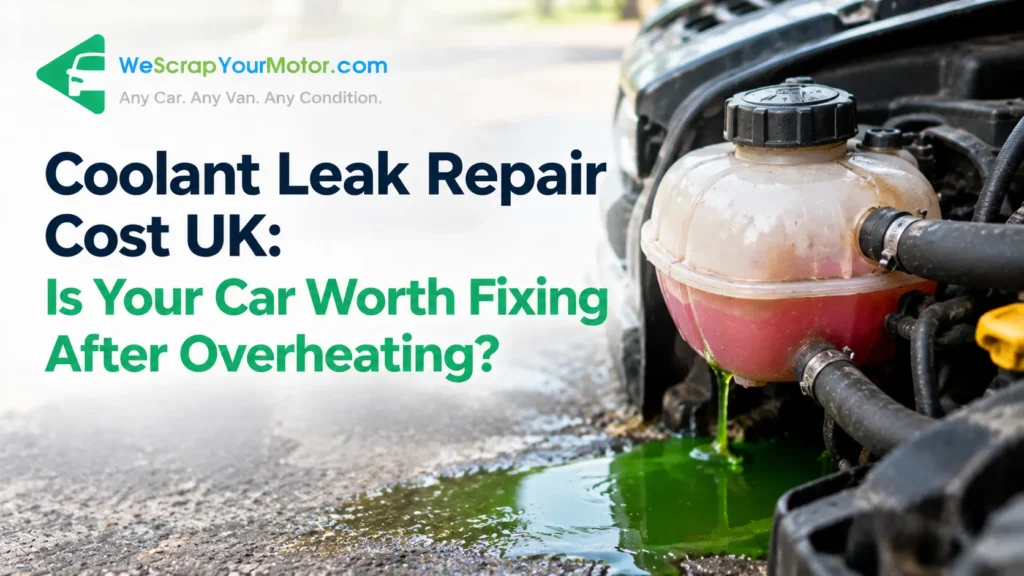
Your temperature warning light appears while driving. A few minutes earlier, the car seemed completely normal. Now, the engine is getting hotter, the coolant level may be falling, and you are worried about an expensive repair.
Could it be a leaking hose? A damaged radiator? Or has the engine already suffered serious damage?
The coolant leak repair cost in the UK typically ranges from about £50 to £2,000, depending on the underlying fault. A simple hose or connector can be relatively inexpensive to replace, while a head gasket failure or damage caused by severe overheating can require major engine work.
According to Checkatrade’s October 2026 cost guide, the average coolant leak repair is approximately £400. However, that figure does not tell you what your particular vehicle needs.
The bigger concern is whether the engine has overheated long enough to cause additional problems.
A car with a small, recently discovered leak may be well worth repairing. A vehicle that has repeatedly overheated could face a very different financial decision.
Here is how to assess the problem without paying for unnecessary work or scrapping a car that only needs a relatively affordable repair.
Your Car Is Overheating: What Should You Do First?
Imagine you are driving home when the temperature gauge suddenly rises towards the red section.
You notice a warning message and possibly steam coming from beneath the bonnet.
At this point, continuing to drive can turn an inexpensive coolant leak into serious engine damage.
Find a safe place to stop, switch off the engine and seek assistance.
Do not remove the coolant reservoir or radiator cap while the system is hot. Pressurised hot coolant can cause serious burns.
If the vehicle has lost coolant or overheated, it should be checked before being driven again.
A recovery service may be necessary.
The immediate priority is protecting people and preventing further engine damage, not reaching the nearest garage under your own power.
How Much Does Coolant Leak Repair Cost In the UK?
Your garage’s price depends mainly on where the coolant is escaping and whether overheating has damaged other components.
A damaged hose and a failed head gasket are completely different repairs, even though both may initially cause coolant loss.
UK Coolant Leak Repair Price Guide
| Fault or Repair | Typical Estimated Cost |
| Hose, connector or coolant cap repair | £50–£200 |
| Radiator replacement | £150–£900 |
| Water pump repair or replacement | £250–£700 |
| Head gasket repair | £700–£2,000 |
| Minor radiator sealant treatment | £50–£100 |
| Extensive overheating-related engine repairs | Potentially £2,000+ |
The first five ranges reflect Checkatrade’s October 2026 guide. The final figure is an illustrative indication of possible major engine expenditure, not a published average.
Actual quotations depend on the model, parts availability, garage labour and the condition of the engine.
The most important distinction is between repairing the original leak and repairing damage caused after the engine overheated.
Where Is the Coolant Actually Going?
A cooling system circulates coolant through the engine and radiator to help regulate operating temperature.
When the system develops a leak, it may lose its ability to control engine temperature effectively.
The location of the leak determines the repair.
A Split Coolant Hose
Rubber hoses deteriorate over time because of heat, pressure and ageing.
A damaged hose can allow coolant to escape, sometimes quite quickly.
If the leak is discovered before overheating damages the engine, replacing the hose and correctly servicing the cooling system may resolve the problem.
However, a mechanic should also investigate why the hose failed.
An underlying pressure or temperature problem may contribute to repeated failures.
A Leaking Radiator
The radiator helps remove heat from circulating coolant.
Corrosion, physical damage and deteriorated connections can cause leaks.
A replacement radiator can be a reasonable investment if the engine is healthy.
But the price depends on vehicle design, accessibility and replacement-part availability.
A garage should confirm whether the radiator itself is defective or whether coolant is escaping from a nearby hose or connection.
A Faulty Water Pump
The water pump is responsible for circulating coolant around the engine.
If it begins leaking or fails mechanically, the cooling system may not operate correctly.
Some water pumps are relatively accessible, while others require substantial dismantling.
On certain engines, the water pump is associated with the timing-belt system.
That can make the repair more involved and may affect which related parts the manufacturer recommends replacing.
A Damaged Coolant Reservoir
The expansion tank holds coolant as the system heats and cools.
Plastic reservoirs can develop cracks, and pressure caps can deteriorate.
A small crack may become more noticeable when the system reaches operating temperature.
Although some reservoir problems are comparatively inexpensive, the complete system should still be checked.
Simply replacing a visibly damaged tank will not solve an underlying cooling-system pressure fault.
A Leaking Heater Matrix
The heater matrix transfers heat from engine coolant to the cabin heating system.
A leak in this component can cause coolant loss inside the vehicle.
Possible symptoms include damp carpets, a sweet smell or persistent window misting.
The repair can involve considerable labour because some cars require dashboard components to be removed.
This means a relatively small component can produce a surprisingly large garage bill.
Has Overheating Already Damaged the Engine?
This is the question that matters most when deciding whether to repair or scrap.
A car can develop a coolant leak without suffering permanent engine damage.
However, if it continues operating at excessive temperatures, the consequences can be severe.
Possible problems include a damaged head gasket, distorted cylinder head or other internal engine damage.
These failures can result in coolant loss, reduced compression, poor running or repeated overheating.
The severity depends on factors such as engine design, temperature, operating conditions and how quickly the vehicle was stopped.
A mechanic should investigate the engine’s condition before promising that fixing the visible leak will solve everything.
The Difference Between a Simple Leak and a Blown Head Gasket
Two cars arrive at a garage with the same complaint: both have been losing coolant.
The first has a leaking radiator hose.
The engine has not overheated significantly, and there is no evidence of internal damage.
After replacing the hose and checking the cooling system, the car may return to normal service.
The second vehicle has overheated repeatedly.
The garage identifies combustion gases entering the cooling system and evidence of head gasket damage.
Repairing that car may involve removing the cylinder head, assessing its condition and replacing affected components.
The difference in labour can be enormous.
This explains why the coolant leak repair cost cannot be established reliably from a low-coolant warning alone.
What Are the Warning Signs of Head Gasket Damage?
A failing head gasket can produce several different symptoms.
These may include persistent coolant loss without an obvious external leak, overheating, unusual exhaust vapour after warm-up or coolant contamination.
Some vehicles may run roughly or develop misfires.
However, these symptoms do not automatically confirm head gasket failure.
Condensation can resemble exhaust smoke in cold weather.
Certain residue around an oil filler cap can have explanations unrelated to a head gasket.
A professional diagnosis may involve cooling-system pressure testing, combustion-gas testing or other appropriate checks.
The purpose is to identify the fault before committing to expensive engine work.
Replacing a head gasket without confirming the problem can lead to unnecessary expenditure.
Can a Coolant Leak Turn Into Complete Engine Failure?
Yes, severe overheating can cause substantial engine damage.
The original leak might have been inexpensive to repair, but prolonged overheating can affect components that are much more expensive.
For example, coolant loss may cause temperatures to rise beyond the engine’s normal operating range.
If operation continues, internal components may experience abnormal thermal stress.
The engine might eventually lose compression, operate poorly or become unable to run.
In severe cases, repair may require substantial rebuilding or a replacement engine.
That is why the response to overheating matters.
Stopping promptly and arranging professional assessment can reduce the risk of additional damage.
Is a Coolant Leak an MOT Failure In the UK?
Not every coolant leak automatically results in an MOT failure.
The DVSA inspection manual specifically distinguishes leaks such as coolant and screen-wash fluid from certain other fluid-leak defects.
However, excessive fluid leakage likely to create an environmental or safety risk can result in a Major defect.
A continuous leak creating a serious road-safety risk can be classified as Dangerous.
An MOT result also does not guarantee that the cooling system is mechanically healthy.
A small leak may not meet the threshold for an MOT failure while still presenting a risk of serious engine damage during normal driving.
For that reason, a coolant leak should be investigated even when the vehicle has a valid MOT.
How Garages Diagnose a Coolant Leak
A good diagnosis should establish both where coolant is escaping and whether the engine has sustained damage.
The mechanic may inspect hoses, radiator connections, the water pump and other cooling-system components.
A pressure test can help identify some leaks that are difficult to see during an ordinary inspection.
Where overheating has occurred, additional tests may be appropriate.
The garage may also check whether the cooling fan operates correctly and whether the thermostat or other components are contributing to the problem.
This is important because a coolant leak may be a symptom rather than the only issue.
Ask the garage to explain the diagnosis and provide a written quotation before authorising major work.
What Does a Proper Coolant Repair Quotation Include?
A detailed repair quotation is more useful than a single total with no explanation.
For example, a radiator replacement may require a new radiator, associated seals, coolant and labour.
The cooling system may also need correct filling, bleeding and post-repair verification.
If overheating occurred, the garage should explain whether any additional engine checks are necessary.
Compare quotations carefully.
One garage may quote only to replace the visibly damaged component.
Another may include the testing required to confirm that the cooling system operates correctly afterwards.
The cheaper quote is not necessarily better if it omits essential work.
Understanding what is included helps you avoid unexpected charges.
Should You Repair a Coolant Leak on a 10-Year-Old Car?
Age alone is not enough to answer this question.
Suppose your 10-year-old car has a market value of £3,500 and needs a £180 hose repair.
If the engine is otherwise healthy, replacing the hose is likely to be a sensible option.
Now consider a car of the same age worth £1,800.
The garage identifies head gasket damage and quotes £1,500, with possible additional cylinder-head work.
Suddenly, economics became much less attractive.
You should also consider how long you intend to keep the car and whether it has other expensive maintenance requirements.
Repair costs make more sense when viewed alongside the vehicle’s overall value and expected reliability.
Three Repair Scenarios Every Car Owner Should Consider
Scenario One: Minor Leak, Healthy Engine
A vehicle worth £4,000 develops a coolant hose leak.
A mechanic confirms there is no evidence of overheating damage.
The repair costs £140.
In this case, repairing the car is usually the obvious financial choice, assuming no other major problems are present.
Scrapping a car because of such a relatively small repair would normally sacrifice substantial remaining value.
Scenario Two: Radiator Failure on an Older Vehicle
A 13-year-old vehicle is worth approximately £1,900.
It needs a radiator replacement costing £450.
The car also requires £250 of additional maintenance.
The total immediate expenditure is £700.
Repairing may still be justified if the vehicle is otherwise dependable and a replacement would be significantly more expensive.
However, the owner should compare the repair estimate with the car’s condition and future maintenance expectations.
Scenario Three: Severe Overheating and Engine Damage
A high-mileage hatchback is worth around £1,200 in working condition.
After repeated overheating, the garage identifies major engine damage.
The estimated repair is £2,300.
In this situation, repairing the vehicle would cost substantially more than its assumed market value.
Unless there is a specific reason to retain it, selling or scrapping may make more financial sense.
These examples are illustrative calculations, not actual customer cases.
When Does a Coolant Leak Make a Car Uneconomical to Repair?
A car becomes uneconomical to repair when the financial and practical benefits of repairing it no longer justify the expense.
There is no universal percentage that works for every owner.
A £900 repair may be entirely sensible on a reliable car worth £6,000.
The same amount could be difficult to justify on a vehicle worth £1,000 with several other mechanical problems.
Consider your available repair budget, the condition of the engine, upcoming maintenance and realistic replacement costs.
The key is not simply whether the repair is expensive.
It is whether spending that money produces a vehicle that will be sufficiently reliable and useful afterwards.
If the garage cannot give reasonable confidence about the engine’s condition, factor that uncertainty into your decision.
Can Coolant Leak Sealant Save an Expensive Repair?
Products marketed as coolant leak sealants may temporarily reduce certain small leaks.
However, they are not suitable solutions for every cooling-system problem.
A sealant cannot reliably correct a failed water pump, serious head gasket damage or other substantial mechanical faults.
It may also interfere with parts of the cooling system, depending on the product and vehicle.
Repeatedly adding sealant instead of diagnosing the cause can delay an essential repair.
If a garage recommends a sealant treatment, ask whether it is compatible with your vehicle and whether the manufacturer approves its use.
A professionally completed repair is generally the more dependable long-term solution.
Can You Sell a Car That Has Overheated?
Yes, a car with overheating problems may still have value.
The amount depends on its overall condition and the nature of the fault.
If the vehicle has a simple cooling-system problem, it may be attractive to someone prepared to arrange a professional repair.
If the engine has sustained major internal damage, its value may be based primarily on reusable components or recycling.
Be transparent about the symptoms and any diagnostic findings.
For example, there is an important difference between saying the vehicle needs a radiator replacement and saying the engine has overheated and its internal condition is unknown.
Accurate disclosure helps buyers assess the vehicle and reduces the likelihood of disagreements.
How Much Is a Car Worth With a Coolant Leak?
There is no fixed amount.
A vehicle’s value depends on its make, model, age, weight, mechanical condition, location and demand for parts.
A large estate car with a repairable coolant leak may be worth more than a small hatchback with a completely damaged engine.
Current metal prices can also influence a basic scrap quotation.
The best approach is to obtain the garage’s repair estimate and compare it with a current offer for the vehicle in its existing condition.
If the vehicle has been recovered to a garage, ask whether the buyer can collect it there.
You should also clarify any storage charges and obtain permission before arranging collection from premises you do not control.
What If You Decide Not to Repair the Engine?
If your garage confirms that the car needs an expensive engine repair, you do not have to fund that repair simply to dispose of the vehicle.
We Scrap Your Motor accepts enquiries for vehicles with cooling-system problems, overheating damage and other mechanical faults.
You can obtain a vehicle-specific quotation through our Scrap My Car.
Provide details about the overheating problem and whether the engine still runs.
Also mention any known head gasket or other internal engine damage.
If the car is unsafe to drive, arrange appropriate collection rather than attempting to move it yourself.
For drivers who want a regional service, our Scrap My Car in Salisbury explains the local collection options.
Coolant Leak Questions Answered
How Much Does a Coolant Leak Repair Cost In the UK?
The price can range from approximately £50 for a relatively simple issue to £2,000 or more for major repairs. Checkatrade reports an average of around £400, but the actual fault determines the quotation.
Can You Drive a Car That Is Losing Coolant?
Driving with an unresolved coolant leak risks overheating and serious engine damage. If the temperature warning appears, steam is visible or the engine overheats, stop safely and arrange professional assistance.
Is a Coolant Leak Always a Blown Head Gasket?
No. Coolant can leak from hoses, radiator connections, the water pump, the reservoir and other components. A head gasket is only one possible cause.
How Do You Know if Overheating Has Damaged the Engine?
A mechanic may assess the cooling system, engine operation, compression and other indicators depending on the symptoms. The extent of damage cannot reliably be determined from the temperature warning alone.
Is Replacing a Radiator Worth It on an Old Car?
Often, yes, if the vehicle is otherwise reliable and the repair is affordable relative to its working value. Additional engine damage or several outstanding repairs may change that decision.
Does Car Insurance Cover Coolant Leaks?
Ordinary wear and mechanical breakdown are not generally covered by standard car insurance. Coverage may differ where damage results from an insured event, so review your specific policy.
Can a Car Be Scrapped With a Blown Head Gasket?
Yes. A vehicle does not need a functioning engine to be considered for scrapping. The actual offer depends on its condition and other valuation factors.
Is It Cheaper to Replace an Engine Than Repair a Head Gasket?
Not necessarily. Replacement engine costs vary considerably, and fitting a used engine introduces questions about condition, compatibility and warranty. Compare complete written quotations before making a decision.
Stop the Overheating Before It Becomes a Bigger Financial Problem
A coolant leak can be a small repair or the first visible sign of a serious engine problem.
The difference often depends on the source of the leak and how much overheating has occurred.
If the garage identifies a simple hose, reservoir or radiator fault and confirms that the engine remains healthy, fixing the car may be well worth the expense.
If severe overheating has caused major internal damage, compare the complete repair quotation with the vehicle’s working value and its value in the current condition.
Do not keep driving a car that is overheating in the hope that the problem will disappear.
A timely diagnosis can protect a repairable engine, while an accurate scrap valuation can help you avoid spending more than an ageing vehicle is worth.