
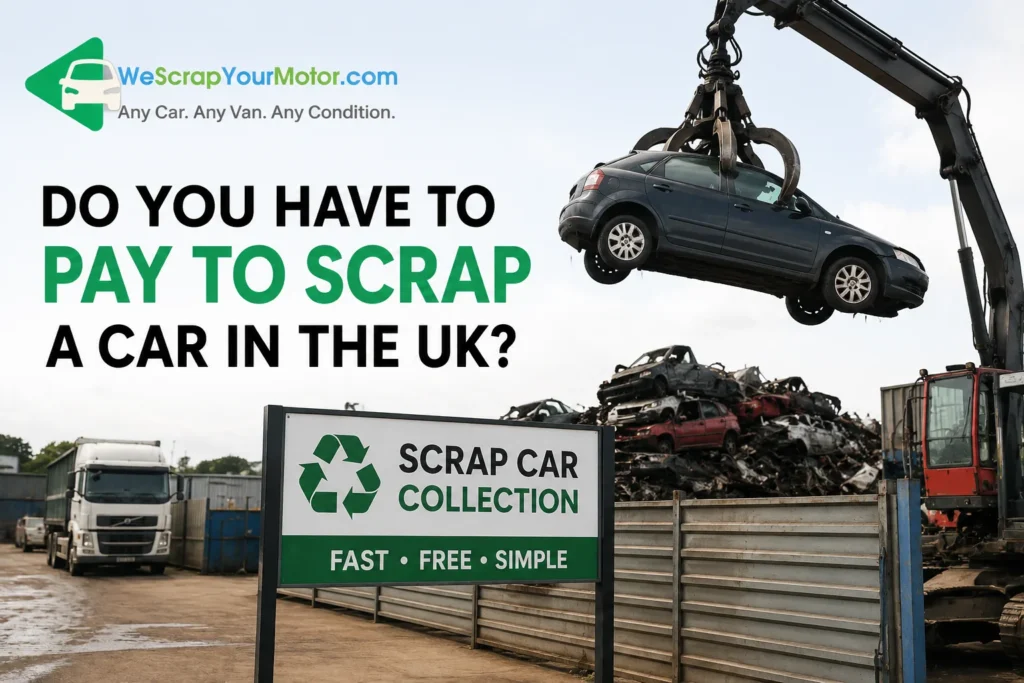
In most ordinary cases, you should not have to pay simply to hand over a complete end-of-life car to an authorised treatment facility. You may even receive money based on the vehicle’s scrap or salvage value.
However, that does not mean every vehicle can be collected from every location at no cost. Missing essential parts, specialist recovery, restricted access, unusual vehicle types, distance, and private commercial arrangements may affect the final amount.
So, do you have to pay to scrap a car? Usually not for standard disposal, but charges or deductions may be possible in particular circumstances. The important step is to separate the vehicle’s disposal from the cost of transporting and recovering it.
This guide explains when scrapping is normally free, why some collections cost more, what free take-back means, and how to identify hidden charges before collection day.
Do You Really Need to Pay to Scrap a Car?
GOV.UK describes scrapping a complete vehicle at an authorised treatment facility as usually free. It also states that the facility can charge a fee when essential parts such as the engine, gearbox, bodywork, or wheels have been removed.
A manufacturer’s approved end-of-life take-back network should offer free take-back for eligible vehicle brands. However, delivery, collection, access, and private buyer arrangements can still affect your practical costs.
When asking do you have to pay to scrap a car, always request a written breakdown showing the vehicle value, collection cost, deductions, and final amount payable to you.
Scrapping And Collection Are Not The Same Service
Vehicle owners often combine two separate activities:
- Accepting and processing the end-of-life vehicle
- Recovering and transporting it from its current location
An authorised treatment facility may accept an eligible vehicle without a disposal fee when you deliver it. A buyer arranging collection has additional costs, including fuel, driver time, recovery equipment, scheduling, insurance, and distance.
That buyer may absorb the cost because the car has enough value. Alternatively, it may deduct the recovery cost from the offer.
This is why one owner receives £350 with free collection while another is quoted £150 or asked to contribute to specialist recovery.
The question do you have to pay to scrap a car cannot be answered from the vehicle’s age alone. Its completeness, value, condition, location, and access all matter.
When Is Car Scrapping Usually Free?
Standard disposal is most likely to be free when the vehicle:
- Is a normal passenger car or small van
- Is reasonably complete
- Has its engine and gearbox
- Has wheels fitted
- Can be accessed safely
- Can roll, steer, or be recovered normally
- Is delivered to an authorised facility
- Falls within an approved free take-back arrangement
A complete vehicle normally has recoverable material value. The metal, catalytic converter, components, and recyclable materials may cover treatment costs and leave value available for the owner.
For an initial vehicle-specific assessment, We Scrap Your Motor can use the registration, postcode, condition, and access details to prepare a quote.
What Does Free Take-Back Mean?
Vehicle producers and importers must support approved networks through which eligible cars and small vans of their brands can be taken back at the end of their lives.
Under the government’s end-of-life vehicle guidance, manufacturer-affiliated authorised facilities offer free take-back for eligible vehicles.
Free take-back normally concerns acceptance and treatment of the vehicle. It does not automatically promise a free recovery truck from every private location.
Before using a scheme, confirm:
- Whether your make is covered
- Which facility is approved
- Whether you must deliver the car
- Whether collection is available
- Whether missing components affect eligibility
- What documents are required
- Whether a Certificate of Destruction will be issued
This distinction provides a more accurate answer to do you have to pay to scrap a car than a simple promise of “free scrapping everywhere.”
When Might You Pay Or Receive A Lower Offer?
Essential Parts Are Missing
GOV.UK specifically notes that an authorised facility can charge when essential components have been removed.
These may include:
- Engine
- Gearbox
- Wheels
- Significant bodywork
Other missing high-value components can reduce the commercial offer even when they do not create a separate disposal fee. Examples include the catalytic converter, battery, electronic modules, or factory alloy wheels.
Tell the buyer exactly what is missing.
The Vehicle Cannot Be Recovered Normally
A car with locked steering, seized brakes, missing wheels, or severe suspension damage may need specialist loading equipment.
Extra time and equipment can reduce the net offer.
Access Is Restricted
Collection may cost more when the vehicle is:
- In an underground car park
- Behind a locked gate
- On soft ground
- In a narrow lane
- Blocked by other vehicles
- Inside a height-restricted area
- Away from a safe recovery position
Photographs of the vehicle and access route can prevent misunderstandings.
The Collection Distance Is Unusually Long
A buyer may include collection within its normal coverage area but adjust the offer outside that area.
Provide the full postcode at the start rather than an approximate town.
The Vehicle Has Very Low Recoverable Value
A heavily stripped, burned, incomplete, or unusual vehicle may cost more to recover and process than its remaining material is worth.
In that case, the buyer should explain whether it is declining the vehicle, offering a reduced amount, or proposing a charge.
Do You Pay An Administration Fee?
There is no universal government administration fee that every private owner must pay to scrap a car.
A private business may have service terms, but any fee should be:
- Disclosed before booking
- Explained in plain language
- Included in the written calculation
- Connected to a real service
- Accepted before the collection proceeds
Be cautious of vague charges such as:
- Processing fee
- DVLA fee
- Certificate release fee
- Same-day payment fee
- Environmental fee
- Booking fee
Ask what each charge covers and whether it is mandatory.
The authorised facility issues a Certificate of Destruction for eligible vehicles that are completely scrapped. A collector should not surprise you with a hidden “certificate fee” after taking the car.
Does Free Collection Mean The Best Deal?
No. A free service is not always the highest-value offer.
Compare the final net amount:
| Quote Detail | Buyer One | Buyer Two |
| Headline Vehicle Value | £400 | £350 |
| Collection Charge | £80 | £0 |
| Administration Fee | £25 | £0 |
| Final Amount To Owner | £295 | £350 |
Buyer Two provides the better return despite showing a lower headline valuation.
When asking do you have to pay to scrap a car, focus on the amount you will actually receive after every disclosed adjustment.
How Vehicle Condition Affects Collection Cost
The buyer needs more than a registration number.
Explain whether the vehicle:
- Starts
- Rolls
- Steers
- Brakes
- Has inflated tyres
- Has keys
- Is unlocked
- Has all wheels
- Has collision damage
- Has loose or unsafe panels
- Has been dismantled
- Is leaking fluids
- Has restricted access
A vehicle that does not start is not automatically difficult to collect. Recovery companies routinely handle non-runners.
The important difference is whether it can be safely moved and loaded using ordinary equipment.
Should You Remove Parts Before Scrapping?
Removing parts can seem like a way to earn more, but it can reduce the final vehicle offer and create disposal complications.
Before removing anything, compare:
- The quote for the complete car
- The likely selling price of the part
- The time and fees required to sell it
- The reduced collection or scrap offer
- Whether removal creates an environmental risk
- Whether the remaining vehicle can still be moved
GOV.UK says parts must be removed without polluting the environment. If you buy a vehicle specifically to remove parts, dismantling requirements can also apply.
For most owners, obtaining complete-vehicle quotes first is the safer financial comparison.
What If The Car Has No Wheels?
A vehicle without wheels is harder to move, secure, and load.
The buyer may need:
- A crane-equipped recovery vehicle
- Skates or dollies
- Additional staff
- More collection time
- Clear access around the vehicle
This can result in a lower offer, a specialist recovery charge, or a declined collection.
If you ask do you have to pay to scrap a car without wheels, the answer is that a cost is more likely, but it should be confirmed before booking.
Send photographs showing how the car rests and the space around it.
What If The Car Has No Engine Or Gearbox?
The engine and gearbox account for substantial weight and may have component value.
Removing either can:
- Reduce metal weight
- Remove reusable value
- Change the centre of balance
- Complicate loading
- Trigger an authorised facility fee
- Make the original quote invalid
Do not describe the car as complete if either unit is missing.
A collector discovering the difference on arrival may reasonably need to recalculate the offer, but you should be free to review and accept or reject the revised terms before handover.
What If The Car Is Accident-Damaged?
Accident damage does not automatically create a charge.
Many collision-damaged cars retain value through:
- Undamaged components
- Engine and gearbox
- Catalytic converter
- Wheels
- Interior parts
- Metal recycling
- Salvage potential
Recovery becomes more expensive when the wheels, steering, suspension, or vehicle structure prevent normal loading.
Tell the buyer whether the car has an insurance write-off category and whether emergency services or a recovery company previously moved it.
What If The Car Is On Private Land?
Collection from a driveway or other accessible private land is often straightforward.
Problems can arise when:
- The landowner has not authorised access
- The vehicle is in a shared parking area
- Parking controls apply
- The recovery truck cannot stop safely
- A barrier or gate limits entry
- The surface cannot support the truck
- The car is in a locked building
Obtain any necessary access permission before collection.
For Wiltshire-area vehicles, the Scrap My Car In Salisbury explains how location, mobility, and recovery access can affect planning.
What If The Vehicle Has No V5C?
A missing V5C does not necessarily mean you must pay to dispose of the vehicle.
However, the buyer may require additional ownership and identity evidence. The transaction may take longer, and you will still need to notify DVLA correctly.
Prepare:
- Photo identification
- Proof of address
- Vehicle purchase evidence
- Registration details
- Written authority where applicable
- Finance-settlement evidence if relevant
Read our guide to Scrapping A Car Without A V5C for the documents and notification steps.
How To Check A Quote For Hidden Costs
Ask the buyer to confirm these points in writing:
- Gross vehicle value
- Collection cost
- Recovery surcharge
- Missing-part deduction
- Administration fee
- Payment method
- Payment timing
- Quote expiry
- Inspection conditions
- Cancellation terms
- Destination facility
- Paperwork provided
A sentence such as “collection included, subject only to the vehicle matching the supplied description” is clearer than “free pickup available” without conditions.
If the business cannot explain the net amount, do not book until it does.
What If A Charge Appears On Collection Day?
Do not feel pressured to accept an unexplained fee merely because the truck has arrived.
Ask the collector to identify:
- The specific condition that changed
- Where the original terms disclosed the possible charge
- The exact calculation
- Whether the buyer has reviewed your photographs
- Whether you can decline the revised offer without a fee
If the vehicle matches your description, refer to the written quote and messages.
If you accidentally omitted a major issue, a genuine adjustment may be reasonable. You should still receive a clear explanation before agreeing.
Can A Council Charge To Remove An Abandoned Car?
A council removal process is different from voluntarily arranging to scrap your own vehicle.
If a vehicle is abandoned, causing an obstruction, or removed under enforcement powers, statutory removal, storage, or disposal charges may apply.
Do not abandon an unwanted vehicle to avoid collection costs. Arrange an authorised disposal route and keep the handover evidence.
If you do not own the vehicle or do not have authority to dispose of it, contact the landowner, council, police, or DVLA as appropriate.
Ways To Avoid Paying Unnecessary Charges
Use these steps:
- Keep the car complete until you receive quotes
- Provide the exact postcode
- Describe every missing component
- State whether it rolls, steers, and brakes
- Send current photographs
- Explain access restrictions
- Compare net offers
- Request written terms
- Ask whether collection is included
- Confirm the payment method
- Remove personal belongings
- Prepare ownership and identity documents
Accurate information gives the buyer a fair chance to plan the correct recovery vehicle and price.
Frequently Asked Questions
Do You Have To Pay To Scrap A Car At An Authorised Facility?
Standard scrapping is usually free for an eligible complete vehicle, particularly when it is delivered through an approved route. Missing essential parts can result in a fee.
Will A Buyer Always Pay Me?
No. Most complete vehicles have value, but a heavily stripped or difficult-to-recover vehicle may produce a low offer or cost more to collect than it is worth.
Is Collection Always Free?
No. Many buyers include collection, but distance, access, vehicle mobility, or specialist equipment may affect the final offer.
Can A Scrapyard Charge If The Engine Is Missing?
Yes. GOV.UK states that an authorised facility can charge when essential parts, including the engine, have been removed.
Is A Certificate Of Destruction Free?
Ask the authorised facility to explain its process. Be cautious of an unexpected fee described only as payment to “release” a certificate.
Do You Have To Pay To Scrap A Car Without Keys?
Not automatically. A keyless vehicle can often be collected, but locked steering or access problems may reduce the offer or require specialist recovery.
Can I Avoid Collection Costs By Delivering The Car?
Possibly, but do not drive an untaxed, uninsured, unroadworthy, or unsafe vehicle. Arrange legal transport if it cannot be driven.
Should I Pay A Fee Before The Collector Arrives?
Avoid paying an unexplained upfront fee. Verify the business, request written terms, and understand exactly what the payment covers.
Arrange A Clear, Cost-Checked Vehicle Collection
The practical answer to do you have to pay to scrap a car is usually no for a normal, complete vehicle using an authorised route. Nevertheless, missing parts, difficult access, specialist recovery, and commercial collection terms can affect the amount.
Describe the vehicle accurately, compare final net offers, and obtain every fee or deduction in writing. A transparent buyer should tell you what you will receive, what collection includes, and which circumstances could alter the arrangement before sending a recovery vehicle.