
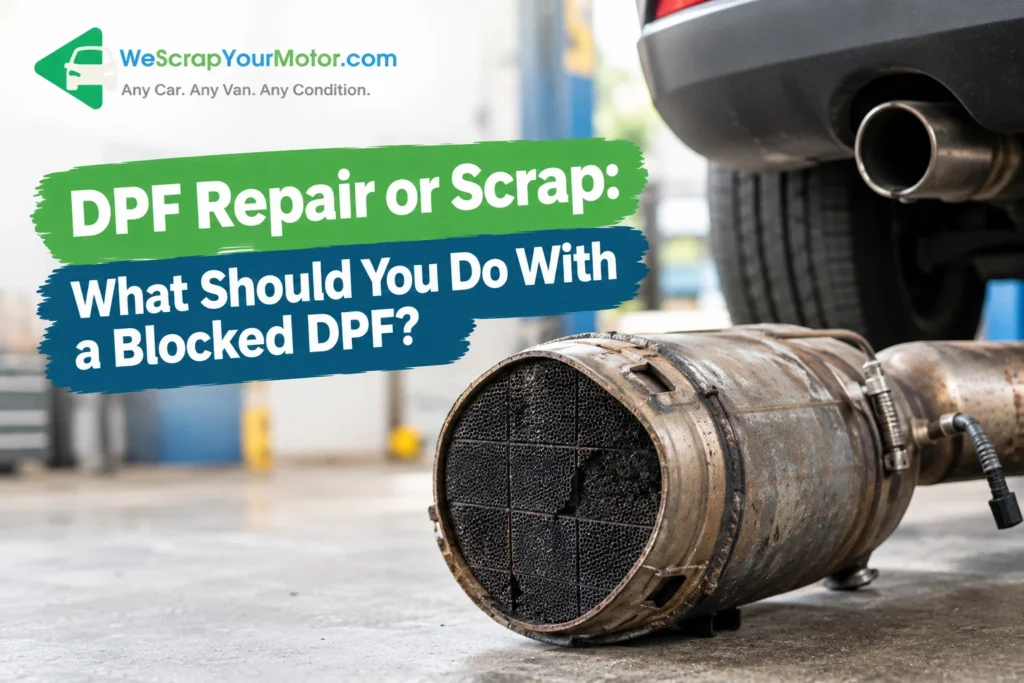
A blocked diesel particulate filter does not automatically make a car uneconomical to repair. The decision depends on what is actually wrong, whether the cause can be corrected, the complete repair bill and the condition of the rest of the vehicle.
The DPF repair or scrap question becomes difficult when an owner receives a large replacement quote without a clear explanation. It becomes even more frustrating when a warning returns after cleaning or regeneration.
Start with evidence rather than a dashboard light alone.
This guide works through the questions a useful diagnosis should answer, how professional repair routes differ and how to compare keeping, selling or scrapping the car. It also explains why repeated treatments can be poor value when the underlying cause remains unresolved.
It is an owner’s decision guide, not instructions for forced regeneration, dismantling or emissions-system modification. The appropriate technical procedure depends on the exact vehicle and should be assessed by a competent workshop.
Is The Filter Restriction Confirmed?
A DPF warning tells you that the vehicle has detected a relevant condition. It does not necessarily establish the entire repair required.
A workshop should interpret the warning and diagnostic information alongside appropriate checks.
Ask what evidence supports the statement that the filter is restricted. Is that conclusion consistent with the relevant measurements and operating behaviour? Are supporting faults present?
For DPF repair or scrap, a useful distinction is between an observed warning and an established physical or operational problem.
“The light is on” is not enough to explain a replacement invoice.
At the same time, do not demand certainty before reasonable diagnosis has taken place. Some findings require staged investigation.
The workshop should explain what is known, what remains uncertain and what the next check would establish. That lets you decide whether further assessment is worth paying for.
Is The Problem Soot, Ash Or Damage?
These conditions are not interchangeable.
The DPF traps soot, and regeneration burns accumulated soot under suitable conditions. Ash remains rather than being removed through ordinary regeneration.
HELLA’s technical guidance distinguishes the regeneration process from the ash retained in the filter.
Physical deterioration introduces another consideration. A filter that cannot be restored appropriately is different from one with treatable loading.
The DPF repair or scrap comparison therefore needs more detail than “it is blocked”.
Ask the workshop which condition it believes applies and why.
A regeneration recommendation should explain suitability. A cleaning recommendation should account for conditions. A replacement recommendation should explain why restoration is inappropriate or insufficient.
The exact thresholds depend on the vehicle and technical information. Do not substitute a generic online figure for an assessment of the actual car.
Why Has The Condition Developed?
Treating a filter without identifying the cause can leave the owner paying again.
The investigation may need to consider relevant sensors, operating conditions, engine faults, abnormal soot production or contamination.
Driving patterns can matter, but they should not become the automatic explanation for every warning.
If short journeys are blamed immediately, ask what supporting checks have been completed. Conversely, do not ignore usage if it is relevant to the manufacturer’s operating guidance.
A useful DPF repair or scrap assessment considers both restoring the filter and reducing recurrence.
Ask: “What caused this, what will correct that cause, and how will you verify the result?”
That question is more productive than asking only whether the light can be switched off.
A repair should have an explained outcome. A temporary reset without an established correction may simply postpone the decision while adding cost.
Which Professional Route Fits The Findings?
Several routes may be appropriate, depending on the diagnosis.
| Route | Main Purpose | Owner’s Question |
| Supporting-fault repair | Correct inaccurate information or operating problems | What testing identified the fault? |
| Approved regeneration | Address suitable soot loading | Why is it appropriate for this condition? |
| Professional cleaning | Restore a suitable restricted filter | How is success measured? |
| Filter replacement | Replace a unit that cannot be restored appropriately | Which part and terms are included? |
| Broader engine repair | Address the source of abnormal loading | Is this included in the total? |
These are not simply different prices for the same job.
For DPF repair or scrap, ask the garage to explain its recommended route and the alternatives it has ruled out.
The cheapest treatment can become expensive if it is unsuitable. Equally, the most expensive replacement should not be assumed necessary before the supporting system has been assessed.
What Does “Cleaning” Actually Include?
Cleaning offers can vary substantially.
Ask whether the quoted amount includes removal, cleaning, refitting, any required associated work and verification.
Find out how the provider decides that the filter is suitable for its process. Ask what happens if the unit cannot be restored.
A useful service should explain the result it measures rather than promising every DPF will become “like new”.
For DPF repair or scrap, cleaning is worth assessing as a defined procedure with conditions and evidence.
It is not automatically a bargain because it costs less than replacement.
If another fault is causing excessive loading, treating the filter alone may not offer lasting value.
Request the supporting-repair cost as well. Compare the complete repair plan, not a cleaning advertisement against a replacement invoice that includes substantially more work.
Does The Quote Address The Cause?
Read the quotation line by line.
Look for diagnosis, parts, labour, related repairs, required servicing and final checks. Ask whether taxes are included.
If the quote says only “DPF replacement”, request clarification about the evidence and supporting work.
For DPF repair or scrap, the important amount is the complete expected cost to achieve the stated outcome.
Also establish what remains conditional. Will the garage contact you if it discovers another issue? Does cleaning failure lead to another charge? Is replacement only an estimate until further inspection?
A clear quote can legitimately contain uncertainty, provided it explains the limits.
An unclear quote hides the decision.
You do not need every workshop detail, but you do need to know what you are authorising, what result is expected and when additional approval will be requested.
Has The Warning Returned After Previous Work?
A repeat warning changes the assessment.
Gather previous invoices, diagnosis summaries and dates. Identify whether the same symptoms returned immediately or after a period of normal use.
Contact the original business and check its terms before paying for duplicate work elsewhere.
Do not assume recurrence proves the first repair was incorrect. A different fault may have developed. However, repeated identical treatment without a cause review is not a convincing plan.
The DPF repair or scrap decision should now include confidence in the diagnosis.
Ask what is different about the proposed next repair and what evidence supports it.
If the answer is merely another reset or another cleaning attempt without further investigation, consider an independent opinion.
Paying for a better assessment may be more useful than paying for the same uncertain treatment again.
Is The Rest Of The Car Worth Keeping?
The filter is one part of the vehicle.
Check current condition, service history, known MOT defects and substantial upcoming maintenance.
Consider corrosion, transmission issues, cooling-system problems, suspension conditions and other documented work.
For DPF repair or scrap, these costs belong in the comparison because a successful emissions repair does not resolve them.
Avoid assuming every advisory needs immediate replacement. Ask which items are urgent, which require monitoring and which are planned maintenance.
A generally sound car may justify a significant repair. A car with several major issues may not.
The aim is a realistic whole-vehicle assessment rather than an argument built around age alone.
An older vehicle with clear history is not automatically of poor value, and a newer vehicle with multiple unresolved defects is not automatically worth saving.
Are You Repairing To Keep Or To Sell?
These decisions use different calculations.
If you intend to keep the car, compare the complete repair and known maintenance with the cost of obtaining a suitable replacement.
If you intend to sell after repair, compare realistic sale proceeds after repair and selling costs with current as-is offers.
The DPF repair or scrap answer can differ depending on your objective.
A repair that preserves useful transport may be sensible even if it would not add enough resale value to justify repair solely for sale.
Do not treat the highest asking price on an advertisement as guaranteed proceeds.
Use realistic values for the actual model, mileage and condition.
Also separate costs already incurred from additional spending still required. Money spent on diagnosis should not force approval of an uneconomical repair simply because you want to “get something back”.
What Is The Real Cost Of Replacing The Car?
An advertised replacement price is not always the complete cost of changing vehicles.
A replacement may need inspection, initial servicing, tyres or other immediate work. It may also have an unfamiliar history.
Compare those costs honestly with the vehicle you already know.
For DPF repair or scrap, the alternative should be a car that actually meets your needs and budget.
Do not compare repairing a useful family vehicle with buying the cheapest unrelated car you can find.
Equally, do not exaggerate replacement costs to justify an uncertain repair.
Write down the likely expenditure for both routes and identify the assumptions.
Where uncertainty is large, a proportionate inspection or additional quote may help. The goal is a decision based on comparable options, not a comparison between a fully cost repair and an unrealistically cheap replacement.
Does Diesel Still Suit Your Routine?
A change in driving pattern can affect the decision.
Perhaps the car previously covered regular longer journeys but now mainly makes short local trips. Discuss that usage with a competent workshop.
The issue is whether the vehicle, once repaired, fits the operating conditions you can realistically provide.
The DPF repair or scrap comparison should not depend on a promise to change your routine if that change is unlikely.
This does not mean every diesel needs identical journeys or one universal motorway schedule.
Use the exact vehicle’s guidance and the workshop’s findings.
If another vehicle type would suit your use better, assess it as an option. Do not assume changing fuel type removes all maintenance or reliability risks.
The useful question is suitability for your life, alongside repair confidence and cost.
Is The Proposed Driving Remedy Appropriate?
Generic advice to “drive it hard” can be unsuitable.
The response depends on the exact warning, vehicle condition and presence of other faults or symptoms.
A manufacturer may describe a driving response for a particular condition. That does not make it appropriate for severe power loss, additional warnings or uncertain mechanical health.
Professional forced regeneration is a workshop procedure with relevant checks. HELLA describes different regeneration routes and their relationship to system conditions and monitoring.
Do not make DPF repair or scrap depend on an improvised attempt to clear the warning.
Consult the handbook and seek competent advice where the situation is unclear.
Avoid continuing merely to escape recovery charges. An unsuitable attempt can leave the owner with a more difficult repair decision instead of a saving.
Are You Comparing Repair With a Delete?
A filter delete or bypass does not restore the system’s intended operation.
Government guidance states that a missing DPF, where originally fitted, results in an MOT failure. It also explains the implications of modifications that cause a vehicle to fail its designed emissions requirements.
For DPF repair or scrap, keep the options to genuine repair, an accurately disclosed sale or responsible disposal.
A deletion offer should not be presented as an equivalent lower-priced repair.
Likewise, a claim that the car can pass a particular test does not establish that every modification is suitable for road use.
If the vehicle already has unknown modifications, disclose them to the workshop and prospective buyers.
Establishing the actual system configuration may be necessary before a meaningful repair plan or valuation can be provided.
Would an As-Is Buyer Offer More Than Scrap Value?
A car with a DPF fault may interest a buyer considering repair or component reuse.
That does not guarantee a premium, but it is worth distinguishing an as-is salvage sale from metal recycling.
Describe the warning, diagnosis, previous repairs and any modifications honestly.
Our comparison of scrap and salvage car options explains the broader difference.
For DPF repair or scrap, request offers for the car in the same condition.
Do not remove components before comparing intact-vehicle offers.
If a buyer intends repair and resale, ask what transaction records it provides. Permanent destruction and a repair sale have different outcomes.
Make sure the buyer knows whether the car needs recovery. Starting normally does not, by itself, establish that it is suitable to drive.
What Happens If You Choose Disposal?
Gather the registration, vehicle condition, diagnosis and collection postcode.
Request an accurately described offer from We Scrap Your Motor.
Tell the business about the DPF issue and other known defects. Ask whether the car is being considered for repair and resale or permanent destruction.
For local arrangements, see Scrap My Car in Salisbury and disclose movement and access limitations.
The DPF repair or scrap choice should lead to a clear action: limited diagnosis, complete repair authorisation or an agreed transfer.
If the car is at a garage, clarify release and storage charges promptly.
Leaving it indefinitely can increase costs without improving the evidence.
Keep transaction records and follow the relevant notification requirements. The disposal process should be as clearly agreed as a repair would be.
Three Examples That Show Why The Answer Varies
Consider these illustrative situations, rather than treating them as predictions about your vehicle.
A sound car with a confirmed supporting fault: The workshop has identified the cause, selected an appropriate filter treatment and included verification. Repair deserves a fair financial comparison.
A car with several major defects: Filter replacement is only one part of substantial documented expenditure. Disposal or an as-is sale may be more sensible.
A car with repeated unsuccessful treatments: No one has established why the warning returns. The immediate priority is a better assessment, not automatically the same procedure again.
Each example reaches a different point because the evidence differs.
The repair decision is strongest when the proposed outcome is clear and the wider vehicle is worth keeping.
The disposal decision is strongest when it prevents additional expenditure that would not provide useful value.
Common Questions About Blocked Filters
Does a DPF Warning Mean The Engine Is Ruined?
No. It does not establish engine destruction. The filter condition and supporting faults require assessment.
Can Every Filter Be Cleaned?
No. Suitability depends on condition and the professional process. Ask how the provider assesses the unit and verifies the result.
Will Replacement Guarantee No Future Warning?
No. A supporting fault or later problem can affect operation. The quote should explain how the present cause is addressed.
Is There a Universal Repair Price?
No. Vehicle design, diagnosis, parts and related work vary. Obtain an itemised quote for the exact car.
Is a Second Opinion Worthwhile?
Often, when the first quotation is substantial or unclear. Share previous findings and compare scope and confidence rather than total price alone.
Put The Evidence On One Page Before Spending More
Write down the confirmed problem, underlying cause, complete repair price, other known costs and current as-is offers.
Then identify uncertainty.
If a limited assessment would change the decision, consider it. If the repair is clear and the car is sound, compare keeping it fairly. If the total spending is poor value, arrange a transparent sale or disposal.
The DPF repair or scrap decision should be based on the whole vehicle and a defined outcome.
A useful repair restores appropriate operation and addresses the cause. A useful disposal decision avoids further uneconomical spending while transferring the car through a clear, documented process.