
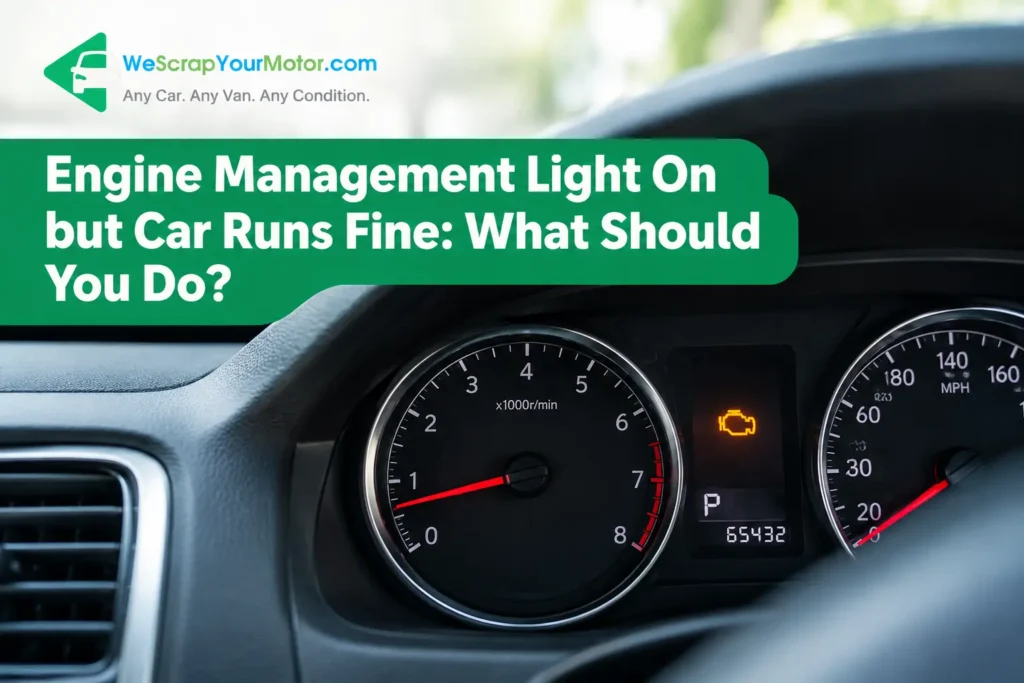
Your car starts normally, accelerates smoothly and makes no unusual noises. Yet an amber engine-shaped symbol remains illuminated on the dashboard.
Having the engine management light on but the car runs fine is surprisingly confusing because there may be no obvious indication of what needs repairing.
The engine management light, sometimes called the check engine light or malfunction indicator lamp, illuminates when the vehicle’s control system detects certain faults.
Some affect combustion or engine performance immediately. Others involve emissions, sensor readings or operating conditions that the driver may not notice.
Can you still drive? If the light is steady, the vehicle performs normally and there are no other warnings, a short necessary journey to obtain a professional diagnosis may be possible. However, you should arrange an inspection promptly.
A flashing light is different. It can indicate a more serious fault, potentially involving a misfire that could damage emissions equipment. Stop safely and seek assistance.
This guide explains what the warning means, how to distinguish different situations, what garages should investigate and how an illuminated warning can affect your UK MOT.
First, Identify Which Warning You Are Seeing
Dashboard symbols provide different information, and their meanings vary by vehicle manufacturer.
The engine management warning is commonly represented by an amber engine-shaped symbol.
It generally appears briefly when the ignition is switched on as part of the vehicle’s normal checks.
Once the engine starts, it should normally go out when the system has completed the relevant checks.
A warning that stays illuminated indicates that the vehicle has detected or retained information relating to a potential fault.
Steady Amber Light
A steady amber warning typically indicates a fault requiring investigation.
When the car otherwise behaves normally, the issue may not require an immediate roadside stop.
However, the absence of symptoms does not prove the problem is harmless.
The AA advises that a vehicle with a continuously illuminated engine management light and no power loss should be checked as soon as possible.
Flashing Amber Light
A flashing warning is more urgent.
Depending on the vehicle, it may indicate combustion problems that risk damaging the catalytic converter or other emissions equipment.
Avoid continuing a journey with an unresolved flashing warning.
Stop safely and seek advice from a breakdown provider or qualified technician.
Engine Light Accompanied by Another Warning
The situation changes when an engine light appears alongside other alerts.
A red oil-pressure warning, overheating message or severe loss of power takes priority over the fact that the engine management light is amber.
Follow the vehicle handbook and respond to the most serious warning.
Four Driver Scenarios That Need Different Responses
The phrase engine management light on but the car runs fine can describe several different situations.
To understand the correct next step, consider these illustrative examples.
Case 1: The Light Appears After Refuelling
Imagine a driver who notices the engine warning shortly after visiting a petrol station.
The vehicle feels completely normal.
On some vehicles equipped with fuel-vapour monitoring systems, an incorrectly secured fuel filler cap or an evaporative emissions fault can trigger a warning.
The driver can check the manufacturer’s instructions and ensure the filler cap is properly secured when the car is parked safely.
However, this does not mean every post-refuelling warning is caused by the cap.
Many UK vehicles use different fuel-system monitoring arrangements.
If the light remains illuminated or returns, a diagnostic inspection is appropriate.
Case 2: The Warning Appears After Starting on a Cold Morning
A driver starts the car on a cold morning and notices that the engine warning remains illuminated.
There is no hesitation or loss of performance.
Possible explanations include emissions-control operation, sensor irregularities or an electrical fault.
A weak battery or charging-system problem may contribute to certain recorded errors, although it should not automatically be blamed.
The temperature at which the warning first appeared is useful information for the mechanic.
A proper diagnostic scan can help determine whether the fault remains active or occurred under particular conditions.
Case 3: The Light Appears During an Ordinary Journey
A vehicle travelling at a normal road speed illuminates its engine management warning.
The driver notices no unusual behaviour.
This could involve an emissions sensor, engine-control fault or another issue that has not yet affected performance.
The correct response is to assess the warning, avoid unnecessary demands on the engine and arrange diagnosis promptly.
If the vehicle develops misfires, overheating, flashing warnings or loss of power, the risk assessment changes.
Case 4: The Light Goes Out the Next Day
A driver sees the warning one evening but notices it has disappeared the following morning.
That does not necessarily mean the problem has been permanently resolved.
Some vehicle systems extinguish the warning after specific conditions are met, while fault information may remain stored.
Intermittent electrical connections or operating-condition-dependent problems can also produce warnings that appear and disappear.
A diagnostic scan may still provide useful information, especially if the same warning has occurred repeatedly.
Why a Car Can Have a Fault Without Obvious Symptoms
Modern engine-control systems constantly monitor information from sensors and control modules.
These systems compare readings against expected values and operating conditions.
When certain conditions are not met, the vehicle can record a diagnostic trouble code.
The driver may not notice an immediate change because the problem does not necessarily interfere with normal acceleration or idling.
For example, an oxygen sensor can produce abnormal readings before fuel consumption or drivability changes become noticeable.
An emissions-control problem may also be identified during monitoring that does not involve a significant reduction in power.
Some vehicles can compensate for certain faults by adjusting their control strategies.
This does not mean the underlying problem has disappeared.
It explains why engine management lights on but the car runs fine is possible even when the warning is genuine.
Seven Faults That May Trigger the Warning
Rather than choosing a repair based on the dashboard symbol, focus on the systems that could generate the warning.
1. Oxygen or Lambda Sensor Problems
Oxygen sensors measure aspects of exhaust-gas composition.
The engine control system uses these readings to help manage fuel delivery and monitor emissions-control performance.
An ageing sensor, wiring problem or another underlying combustion fault can cause abnormal readings.
A driver may experience no obvious symptoms at first.
Over time, certain faults can affect fuel economy, emissions and engine performance.
The important distinction is that a fault code referring to an oxygen sensor does not always prove that the sensor needs replacing.
A garage should inspect the relevant circuit and live operating data before recommending work.
2. Catalytic Converter Efficiency Faults
The catalytic converter helps reduce harmful exhaust emissions.
The vehicle may monitor aspects of its efficiency using sensor readings.
If the system determines that performance has fallen outside the expected range, the engine management light may illuminate.
An example is diagnostic code P0420, which commonly refers to catalyst-system efficiency below the required threshold on a relevant bank.
However, such a code does not automatically mean the catalytic converter itself has failed.
Exhaust leaks, sensor issues and other engine faults may affect the monitoring results.
Replacing an expensive catalytic converter without investigating these possibilities may fail to correct the warning.
3. Mass Airflow Sensor Issues
The mass airflow sensor helps the engine control system determine how much air is entering the engine.
Incorrect measurements may affect the calculations used to manage combustion.
Sometimes the symptoms are subtle.
The engine may still idle and accelerate acceptably even when the monitoring system identifies inconsistent readings.
A mechanic should investigate the sensor, intake system and related wiring rather than assuming the component is defective.
4. Exhaust Gas Recirculation Faults
The exhaust gas recirculation system helps manage certain emissions.
EGR valves can develop electrical, mechanical or contamination-related problems.
Depending on the engine and severity, the vehicle might produce warning codes without a noticeable change in everyday performance.
Other vehicles may experience rough idling or hesitation.
A garage should examine the relevant operation and determine whether cleaning, repair or replacement is appropriate.
5. Diesel Particulate Filter Monitoring Problems
Diesel vehicles may illuminate warning lights because of particulate filter restrictions or problems affecting the regeneration process.
Related sensor faults can also trigger warnings.
A vehicle might initially drive normally before developing reduced performance as the underlying problem worsens.
A DPF-related code should lead to an assessment of the filter and associated systems.
Attempting to clear a fault through repeated high-speed journeys can be inappropriate, particularly when a serious warning or mechanical problem is already present.
6. Ignition or Intermittent Misfire Faults
Petrol engines depend on reliable ignition.
A worn spark plug or failing ignition coil can produce intermittent misfires.
Some are noticeable as jerking or hesitation. Others occur infrequently enough that a driver barely notices them.
The engine control system may still record the problem.
This situation deserves attention because repeated misfires can damage emissions equipment.
If the warning begins flashing, stop safely and seek assistance.
7. Wiring, Connectors or Electronic Control Faults
Modern cars contain extensive electrical wiring and multiple sensors.
Damaged connectors, corrosion, intermittent connections or incorrect signal readings can produce warnings.
The difficulty is that electrical problems may appear only under certain temperatures, vibration levels or operating conditions.
Replacing a sensor without checking the electrical circuit may not resolve the issue.
An experienced technician may need manufacturer-specific diagnostic information to identify the root cause.
What Does an OBD Fault Code Actually Tell You?
OBD stands for on-board diagnostics.
The system records certain faults so that technicians can investigate problems involving engine management, emissions and related components.
A scan tool can retrieve diagnostic trouble codes, often referred to as DTCs.
Examples include:
| Example Code | General Description | Important Limitation |
| P0300 | Random or multiple-cylinder misfire detected | Does not identify the exact defective component |
| P0171 | Fuel system running lean on Bank 1 | Could involve air leaks, fuel delivery or sensor information |
| P0101 | Mass airflow circuit range or performance issue | Does not automatically confirm a failed MAF sensor |
| P0420 | Catalyst efficiency below threshold on Bank 1 | Other faults can influence the result |
| P0401 | Insufficient EGR flow detected | Requires investigation of the EGR system |
| P0442 | Small evaporative emissions leak detected | Applicable only where that monitoring system is fitted |
| P0299 | Turbocharger or supercharger underboost condition | Could involve boost leaks or control faults |
The exact meaning and applicability of codes can vary with the manufacturer and engine.
A diagnostic code identifies the system or condition the vehicle has detected.
It does not necessarily identify a single part that should be replaced.
Why Clearing the Code Is Not a Repair
Some drivers use inexpensive scanners to erase stored warnings.
The dashboard light may disappear temporarily, making the car appear normal.
However, clearing a code does not repair a leaking intake hose, faulty sensor or emissions problem.
If the fault remains, the warning may return.
Clearing codes can also remove useful diagnostic information and reset readiness monitors.
For this reason, it is better to record relevant fault information and have the cause investigated before erasing it.
Is It Safe To Drive With a Steady Engine Management Light?
If you have the engine management light on but the car runs fine, the urgency depends on the warning behaviour and the car’s actual condition.
A steady light with normal performance may permit a short necessary journey to a garage, provided the manufacturer does not instruct otherwise.
However, that is not permission to ignore the light for weeks or months.
Continuing to operate the vehicle with an unresolved fault could increase fuel consumption, worsen emissions or allow another component to deteriorate.
Situations That Require More Urgent Attention
Stop safely and obtain appropriate assistance if the warning is accompanied by:
- Flashing engine management light
- Severe engine hesitation
- Sudden power loss
- Overheating
- Abnormal mechanical noises
- Red lubrication warnings
- Heavy exhaust smoke
- Strong fuel smell
These symptoms can indicate problems beyond a routine sensor fault.
The safety of the vehicle takes priority over completing the journey.
Will an Engine Management Light Fail an MOT in the UK?
An illuminated engine malfunction indicator lamp can cause an MOT failure.
The exact inspection requirements depend on factors including the vehicle’s fuel type and date of first use.
For relevant petrol vehicles, the DVSA inspection manual includes an engine malfunction indicator lamp indicating a fault as a major defect.
For applicable diesel vehicles, the manual also requires the malfunction indicator lamp to function correctly and not indicate a fault.
Different age-related requirements and exemptions apply, so the regulations should be checked against the specific vehicle.
Can the Car Pass If Emissions Are Normal?
Not necessarily.
An illuminated malfunction indicator lamp can constitute a relevant MOT defect independently of the measured emissions result.
That is why engine management lights on but car runs fine is an important concern before an MOT appointment.
A car may feel perfectly normal yet still fail because the warning indicates an unresolved problem.
Should You Reset the Light Before an MOT?
Simply erasing the warning is not a substitute for repairing the fault.
If the underlying condition remains, the light may illuminate again.
A proper repair, confirmed by testing, is the appropriate solution.
For an accurate assessment of the car’s MOT readiness, ask the garage to verify that any applicable faults have genuinely been resolved.
What To Expect From a Professional Diagnostic Appointment
The quality of the investigation matters more than the speed at which somebody reads a fault code.
A Technician Should Ask About the Warning History
When did the light first appear?
Was it after servicing, refuelling, starting or a long journey?
Does it remain on continuously?
Have you noticed changes in fuel economy or starting performance?
These details provide useful context.
The Garage Should Examine Stored and Pending Codes
Depending on the vehicle, diagnostic equipment may display current, stored or pending faults.
Some systems also record freeze-frame information showing operating conditions when a fault was detected.
A technician can use this information to understand whether the problem occurred under load, at idle or at a particular temperature.
Relevant Components Should Be Tested
For example, a code suggesting incorrect airflow might lead to intake-system checks and live sensor-data analysis.
A suspected emissions fault may require an examination of exhaust integrity and component operation.
Not every warning requires extensive dismantling.
Testing should be targeted towards the evidence.
The Original Problem Should Be Rechecked
After repair, the garage should confirm that the fault has been addressed.
Depending on the fault, this may involve checking live readings, completing manufacturer-specified procedures or verifying that the warning does not return under appropriate conditions.
Simply handing the vehicle back with the warning switched off is not sufficient evidence that every problem has been solved.
How Much Does Engine Management Light Diagnosis Cost in the UK?
Many garages charge separately for diagnostic testing and any subsequent repair.
A basic code scan may identify the recorded fault, while a more complex issue can require additional testing.
The following amounts are illustrative budgeting allowances.
| Work Required | Illustrative UK Budget |
| Initial fault-code diagnostic | £40–£100 |
| Extended electrical diagnosis | £80–£250+ |
| Oxygen sensor replacement | £100–£350 |
| MAF sensor replacement | £100–£350 |
| Ignition-related repair | £60–£350+ |
| EGR valve repair or replacement | £150–£700+ |
| Catalytic converter replacement | £300–£1,500+ |
| Major emissions-system work | £500–£2,000+ |
Repair costs vary considerably by engine, vehicle model, labour time and parts.
FixMyCar currently reports an average diagnostic test quote of approximately £52 across its network. This is a useful reference for basic diagnosis, but complex investigations can cost more.
How To Avoid Paying for Unnecessary Repairs
Ask the garage to explain the evidence connecting the fault code to the recommended component.
For example, if a catalytic converter is being replaced, ask whether exhaust leaks, sensor operation and underlying combustion issues have been assessed.
Request an itemised quotation.
Confirm whether further diagnostic charges are possible before work begins.
An accurate diagnosis can be worth considerably more than replacing a component based on guesswork.
How Long Can an Engine Light Stay On Without Obvious Problems?
There is no reliable universal answer.
Some faults remain largely unnoticed for a considerable period.
Others can deteriorate quickly or contribute to expensive secondary damage.
A vehicle’s ability to operate normally does not establish that the fault is stable.
For example, a developing ignition problem may become more noticeable under load.
A sensor-related issue may gradually affect fuel economy.
A blocked emissions component may eventually cause the vehicle to limit engine power.
For this reason, the best approach is to arrange diagnosis promptly rather than judge the problem by how comfortable the car feels.
Should You Repair a Car With a Persistent Engine Warning?
The decision depends on the confirmed fault, not the presence of the dashboard symbol alone.
An engine warning caused by a relatively inexpensive component can be economical to repair.
A warning linked to extensive engine or emissions-system damage may require a more difficult decision.
Compare the Repair With the Car’s Working Value
Imagine an older diesel car valued at £2,200 in good working condition.
A garage discovers several faults, including a heavily damaged emissions system and additional engine problems.
The total repair estimate reaches £2,600.
Spending more than the vehicle’s working value may not be attractive, particularly if other maintenance is approaching.
That does not mean every such vehicle should be scrapped. Some have greater value as repairable or salvage vehicles.
Compare several realistic options.
WeScrapYourMotor enables owners to scrap my car in the UK when a vehicle has become uneconomical to maintain.
For motorists based in Plymouth and nearby areas, the company also offers the option to get a free quote when scrapping a car in Plymouth.
An accurate quotation helps establish the vehicle’s current value before any final decision.
Can an Engine Management Light Lead To Limp Mode?
Yes.
Some vehicles reduce engine power after detecting faults that could affect performance, emissions or component protection.
This restricted operating state is often referred to as limp mode.
The driver may notice that acceleration becomes limited or the engine cannot respond normally.
A steady warning light does not mean the vehicle is necessarily already in limp mode.
Equally, a vehicle can operate in a restricted condition associated with particular faults even when the driver does not immediately identify the warning.
For further information, our separate guide explains what limp mode means and how to respond to it.
The underlying cause must be diagnosed rather than treating reduced power as a problem that can be permanently solved by resetting a warning.
Five Checks Before Booking a Garage Visit
These are simple information-gathering steps, not a replacement for mechanical diagnosis.
Check 1: Look at the Warning Behaviour
Is the light steady or flashing?
A flashing warning requires greater urgency.
Check 2: Identify Additional Dashboard Alerts
Check whether temperature, oil-pressure or other warning messages are present.
These can significantly change the appropriate response.
Check 3: Remember Recent Events
Consider whether the light followed an oil service, battery replacement, refuelling or another event.
Tell the technician about these circumstances.
Check 4: Note Any Subtle Changes
Even when the car appears normal, think about starting behaviour, fuel consumption, unusual sounds and idling.
Small details can be diagnostically useful.
Check 5: Arrange Proper Testing
Avoid buying replacement parts before the cause is understood.
A qualified garage can interpret fault information and examine the relevant systems.
Frequently Asked Questions
Why Is My Engine Management Light On but There Are No Symptoms?
The fault may involve emissions monitoring, electronic sensors or operating conditions that do not immediately affect driving.
Diagnostic testing is needed to determine the cause.
Can I Drive for a Week With the Light On?
There is no guaranteed safe period.
A steady light with normal performance may not require the same response as a flashing warning, but the fault should still be assessed promptly.
Follow the manufacturer’s guidance and obtain professional advice.
Can a Weak Battery Trigger an Engine Warning?
Electrical supply or charging problems can contribute to certain vehicle faults.
However, a battery should not be replaced solely because the engine warning appeared.
The actual fault information must be investigated.
Can Low-Quality Fuel Cause the Warning?
Fuel contamination or combustion-related problems can sometimes contribute to engine warnings.
The cause should be confirmed rather than blamed automatically on the most recent refuelling stop.
Is an OBD Scanner Enough To Diagnose the Problem?
A scanner is a useful starting point.
However, reading a code is not the same as identifying the defective component.
Live data, electrical tests and manufacturer-specific procedures may be needed.
Can the Light Turn Off Without a Repair?
Yes, some warnings can disappear after operating conditions change.
The problem may still be present or return later.
A recurring warning warrants professional assessment.
Does a Steady Light Mean the Catalytic Converter Is Faulty?
No.
Many different engine and emissions faults can activate the same warning.
The catalytic converter is only one possible cause.
Is It Expensive To Fix?
Not always.
Some repairs are relatively minor, while major emissions-system or engine faults can be expensive.
The cost cannot be determined from the dashboard symbol alone.
Should I Replace My Car Because the Engine Light Keeps Returning?
Not before obtaining a trustworthy diagnosis.
A recurring warning could result from an unresolved small fault or a more serious underlying problem.
Compare the complete repair cost with the vehicle’s value once the cause is confirmed.
Give the Warning the Attention It Deserves
Having the engine management light on but car runs fine does not necessarily mean the engine is suffering major damage.
It does mean that a vehicle system has detected information requiring attention.
The key distinction is between a steady warning with normal performance and a flashing light or warning accompanied by serious symptoms.
A proper diagnostic assessment can identify the fault, prevent unnecessary component replacement and help protect emissions equipment.
Once the cause is known, you can decide whether the repair is straightforward, whether further investigation is necessary or whether the vehicle’s condition makes disposal a more economical option.
The right response is based on diagnosis rather than guesswork.