
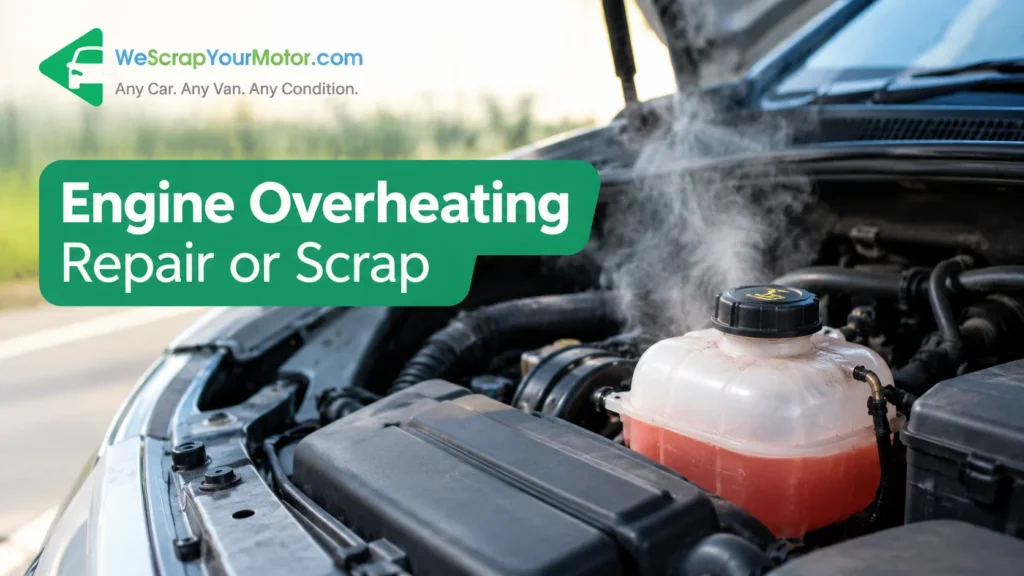
Your temperature warning appears. The needle rises. The engine becomes unusually hot and you are suddenly wondering whether you have a small cooling-system problem or a ruined engine.
That uncertainty is exactly what makes the engine overheating repair or scrap decision difficult.
An overheating car might need a thermostat, radiator or water pump. It might also have a failed head gasket or serious internal engine damage.
Those outcomes sit at completely different ends of the repair-cost scale.
RAC identifies cooling-system faults, low coolant, water-pump problems and low engine oil among causes of overheating and advises drivers to stop safely and switch off the engine when overheating occurs.
Before deciding what your car is worth, first establish what actually happened.
The First Question Is Not How Much the Car Is Worth
The first question should be:
Why did the engine overheat?
Overheating is a symptom.
It is not a complete diagnosis.
A mechanic needs to identify what caused the temperature to rise and whether the heat then damaged anything else.
This distinction is critical in an engine overheating repair or scrap assessment because repairing the cause may be relatively affordable while repairing the damage caused by overheating may be much more expensive.
What To Do When a Car Starts Overheating
If the temperature warning appears or the gauge moves into the danger area, continuing to drive can turn a cooling-system problem into an engine problem.
Move to a safe place as soon as possible.
Switch off the engine.
Do not open a pressurised coolant cap while the system is hot.
Arrange professional inspection if the vehicle cannot safely continue.
RAC’s February 2026 guidance also advises stopping safely and turning off the engine quickly when overheating occurs.
How quickly you respond can change the eventual engine overheating repair or scrap calculation.
The First Thirty Minutes Can Matter
Imagine two identical cars develop the same coolant leak.
Driver one notices the warning, stops promptly and has the car recovered.
The engine remains undamaged and the cooling-system fault is repaired.
Driver two continues for another twenty minutes because the destination is close.
The engine becomes severely overheated and later fails a compression test.
The original fault may have been identical.
The final repair bills are not.
This is why overheating should never be treated as something to monitor for a few more journeys.
The Cheapest Overheating Problems
Not every overheating car needs an engine rebuild.
- A thermostat can fail.
- A radiator can leak.
- A cooling fan can stop working.
- A hose can split.
- A water pump can lose its ability to circulate coolant.
Current UK figures show how different these repairs can be from major engine work. FixMyCar states that thermostat replacement commonly costs about £100 to £200 and currently lists average radiator repair at around £224. RAC reported an average water-pump repair cost of approximately £273 in July 2026.
If one of these is the only fault, the engine overheating repair or scrap decision may strongly favour repair.
When Overheating Becomes an Engine Problem
The risk increases when the engine remains too hot for too long.
Extreme heat can affect the cylinder head, head gasket and internal engine components.
A mechanic may then need to perform cooling-system pressure testing, compression testing, combustion-gas testing or other diagnostic work.
If the head gasket has failed, the job can involve significant labour.
RAC’s July 2026 guidance gives an average head-gasket repair figure of around £633, although prices vary considerably by vehicle.
Serious cylinder-head or engine damage can take costs far beyond that average.
At this stage, engine overheating repair or scrap becomes a value question rather than only a mechanical one.
One Overheating Event Does Not Automatically Ruin an Engine
Owners often assume that any movement into the red area means the engine has been destroyed.
That is not necessarily true.
The severity depends on how hot the engine became, how long it remained overheated, how much coolant was lost, the engine design and whether the car continued to be driven.
A vehicle that was switched off quickly may escape serious damage.
That is why diagnosis should happen before you accept either an expensive repair or an immediate scrap offer.
Signs That the Problem May be More Serious
After an overheating incident, look for continued coolant loss, repeated temperature rises, rough running, poor starting, loss of power or contamination where oil and coolant should remain separate.
These signs do not confirm one specific failure.
They tell you that further investigation is needed.
Do not rely on internet symptoms alone to determine whether the engine needs replacement.
A correct engine overheating repair or scrap decision needs evidence from the actual vehicle.
Stage One: Cooling-System Fault Only
This is the best-case situation.
A component has failed but the engine remains healthy.
For example, the water pump fails and coolant circulation stops. The driver notices the warning quickly and switches off.
The garage replaces the pump, refills the correct coolant and confirms that the engine operates normally.
RAC reported an average water-pump repair cost near £273 in July 2026.
On a car worth several thousand pounds, repair is normally far more rational than scrapping.
Stage Two: Possible Head-Gasket Damage
The situation becomes less certain when the car has continued to overheat or repeatedly loses coolant.
The mechanic may suspect a head-gasket problem.
Do not approve expensive work based only on suspicion.
Ask what testing supports the diagnosis.
If the cylinder head will be removed, ask whether it will be checked for warping or other damage.
The engine overheating repair or scrap comparison should use the complete expected bill rather than the cost of one gasket.
Stage Three: Confirmed Internal Engine Damage
The most difficult situation is where overheating has caused major damage.
The garage may recommend an engine rebuild or replacement unit.
Before agreeing, get the total fitted price.
A replacement engine quote should account for the engine itself, installation, fluids, related parts and any work recommended while access is available.
Then compare that figure with the value of the entire car.
A technically repairable car is not always an economically repairable car.
A Better Way To Judge Whether Repair Is Worth It
Take the value the car would realistically have in good working condition.
Do not use the highest advertised price you can find.
Look at cars with similar age, mileage, engine, specification and condition.
Then subtract the full cost of repairing the overheating damage.
Next subtract other essential work due soon.
The amount left gives you a much better idea of whether repairing preserves meaningful value.
This makes the engine overheating repair or scrap calculation far more realistic.
Example of a Car That Is Probably Worth Repairing
A seven-year-old hatchback has 65,000 miles and would realistically be worth £6,000 in normal condition.
It overheats because its water pump fails.
The driver stops quickly.
The garage finds no evidence of engine damage and quotes £450 for the complete repair and associated work.
The rest of the car is healthy.
Repairing is likely to preserve far more value than selling the car with a known overheating fault.
Example of a Car Where Scrapping Deserves Consideration
A fifteen-year-old diesel is worth about £1,900 when working correctly.
It has 155,000 miles.
Repeated overheating has resulted in poor compression.
The garage estimates that an engine replacement could cost around the same amount as the car’s healthy market value.
The MOT history also shows corrosion, worn suspension components and emissions advisories.
Here, the engine overheating repair or scrap equation changes substantially.
Before approving a large repair, compare what you could receive for the vehicle now through Scrap My Car UK.
Think In Twelve-Month Costs Rather Than Today’s Bill
Owners sometimes decide that a £900 repair is affordable without considering what arrives next.
Look at the next twelve months.
- Is the MOT approaching?
- Are tyres close to replacement?
- Is the clutch slipping?
- Does the DPF already cause trouble?
- Are brakes, suspension or timing components overdue?
A £900 repair followed quickly by another £1,400 of necessary work may make a low-value car difficult to justify.
Our Should I Repair Or Scrap My Car? guide can help you evaluate that broader decision.
What If the Head Gasket Has Failed?
A head-gasket failure is serious but does not automatically make a car scrap.
RAC reports an average UK head-gasket repair cost of around £633 based on May 2026 data, but manufacturer averages and individual jobs vary.
The important factor is what else has been damaged.
If the engine has not suffered serious secondary damage and the vehicle retains good value, repair may be sensible.
If the cylinder head or engine is badly damaged, the engine overheating repair or scrap calculation needs to include all of that work.
Should You Fit a Used Engine?
A used engine may sometimes reduce the cost compared with rebuilding your original one.
However, the price alone does not tell you whether it is good value.
Ask about the engine’s mileage.
Ask where it came from.
Check what warranty is included.
Find out which maintenance items will be replaced before installation.
Also ask what happens if the replacement engine develops a fault shortly after fitting.
A cheaper replacement without a meaningful warranty can create another expensive problem.
Can You Trust a Very Cheap Overheating Repair Quote?
Possibly, but check what is included.
An initial quote may cover diagnosis or the most obvious failed part.
The final repair might uncover additional problems.
Ask the garage whether the quotation is fixed or whether it could increase after dismantling.
Request an itemised estimate.
If the garage suspects serious engine damage, ask about best-case and worst-case figures before authorising work.
Does the MOT History Matter?
Yes.
The MOT history provides valuable context when deciding whether a car deserves another major investment.
Look for repeated corrosion advisories.
Check brake and suspension history.
Look for emissions problems.
Note whether several expensive issues are appearing together.
A vehicle with a strong MOT record may justify an engine repair more easily than one approaching several other failures.
What About a High-Mileage Car?
High mileage alone should not decide the outcome.
A well-serviced car with 130,000 miles can remain dependable.
A neglected vehicle with 80,000 miles can be a poor repair candidate.
What matters is the combination of mileage, maintenance, value, mechanical condition and expected future cost.
The engine overheating repair or scrap question should always consider the entire vehicle rather than one number on the odometer.
Can an Overheated Car Still be Sold Or Scrapped If It Does Not Run?
Yes.
A non-running car can still have value.
It contains recyclable metals and potentially reusable components.
Make, model, weight, completeness, catalytic converter, wheels and other factors may influence its value.
Collection can also be arranged when a vehicle cannot be driven.
For owners in Devon, compare your options through Scrap My Car in Plymouth.
What Happens Legally If You Scrap the Car?
GOV.UK requires end-of-life vehicles to be scrapped through authorised treatment facilities.
When a qualifying car is completely scrapped, the ATF supplies a Certificate of Destruction within seven days.
You should also notify DVLA.
Failing to tell DVLA that the car has been taken to an ATF can lead to a fine of up to £1,000.
If the car is scrapped in England or Wales, payment cannot legally be made in cash. GOV.UK states that payment must instead be made by bank transfer or cheque.
Frequently Asked Questions About an Overheating Car
Can an Engine Survive Severe Overheating?
It can, but the risk of damage increases with temperature and duration.
Testing is required before the engine’s condition can be confirmed.
Is an Overheating Car Automatically a Scrap Car?
No.
Many overheating problems are caused by repairable cooling-system faults.
Is a Head-Gasket Repair Worth It?
It can be when the vehicle is otherwise valuable and healthy.
The complete repair cost should be compared with the car’s realistic value.
Can I Drive Once the Engine Has Cooled Down?
Cooling down does not remove the underlying fault.
Driving again without understanding why the car overheated may lead to another overheating event and additional damage.
How Much Does a Water Pump Cost To Repair?
RAC reported an average UK water-pump repair cost of around £273 in July 2026, although prices vary by make and model.
Make the Next Move Before Overheating Costs More
An overheating warning is not enough information to decide whether a car should be repaired or scrapped.
Start with the cause.
Then determine whether overheating caused secondary engine damage.
After that, compare the full repair bill with the car’s realistic value and the other costs likely to arise over the next year.
The engine overheating repair or scrap decision usually favours repair when a cooling-system component has failed but the engine remains healthy.
The calculation can swing in the opposite direction when severe overheating causes major engine damage on a low-value vehicle already facing other repairs.
Act early, get evidence and judge the whole car.
That approach gives you a far better chance of avoiding both unnecessary scrapping and an expensive repair that never made financial sense.