
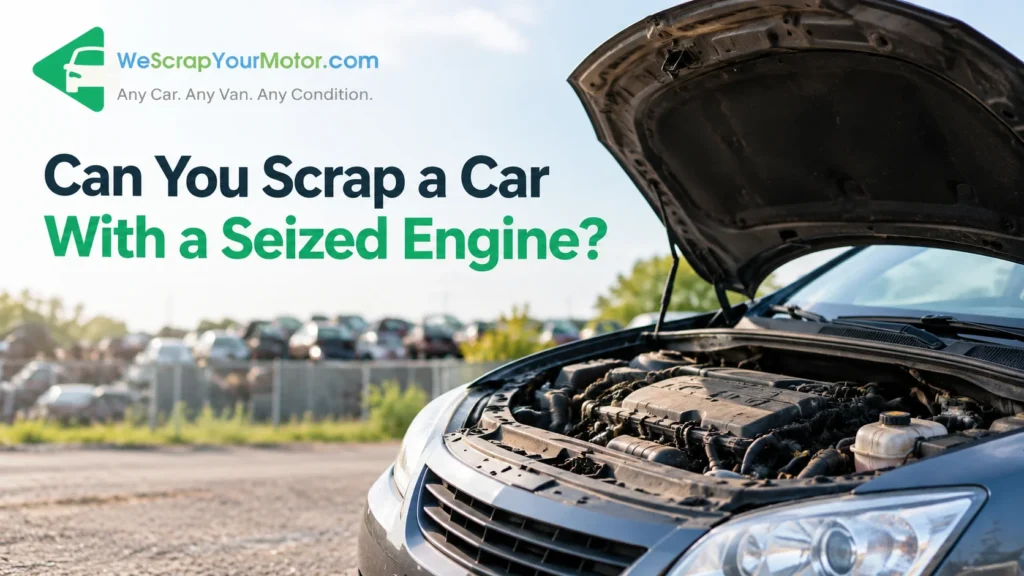
Yes, you can legally scrap a car with a seized engine in the UK. The vehicle does not need to start or drive before it can be collected. A suitable recovery vehicle can lift or winch it from an accessible location and transport it to an authorised treatment facility. Your offer may be lower than the value of a running car because the engine cannot be reused easily, but the vehicle still contains recyclable metal and potentially valuable components. The final amount depends on its make, model, weight, completeness, location, condition and current market demand.
What a Seized Engine Means
An engine is described as seized when its internal moving parts can no longer turn normally. The crankshaft may be locked because of heat, insufficient lubrication, internal corrosion, liquid inside a cylinder or serious component failure.
A seized engine is different from an engine that simply refuses to start. A flat battery, faulty starter motor, damaged immobiliser, failed fuel pump or electrical fault can prevent starting while the engine itself remains mechanically free.
This distinction matters because a vehicle with a non-starting but repairable fault could be worth more than one with confirmed internal engine damage.
How To Check Whether the Engine Is Actually Seized
Do not assume the engine is seized only because the key produces a click or the starter does not work. A professional inspection may include:
- Checking battery voltage
- Testing the starter motor
- Inspecting the auxiliary belt and driven components
- Turning the crankshaft manually
- Checking engine-oil level and condition
- Looking for coolant loss
- Inspecting for internal contamination
- Reading stored diagnostic codes
- Carrying out compression or internal inspections where appropriate
A jammed alternator or air-conditioning compressor can sometimes stop the engine from turning. Removing the auxiliary belt for a controlled diagnostic test can help a mechanic separate an accessory fault from internal engine seizure.
Owners should not attempt forceful testing without the right skills and equipment. Incorrect methods can damage components or create a safety risk.
Why Car Engines Seize
Several failures can lead motorists to scrap a car with a seized engine.
Insufficient Engine Oil
Low oil levels, oil leaks, blocked oilways or oil-pump failure can remove the protective film between moving components. Friction and heat then increase rapidly.
Serious Overheating
Cooling-system failure can distort or damage internal components. A failed water pump, broken hose, coolant leak, blocked radiator or head-gasket problem may be involved.
Water Entering a Cylinder
An engine can lock if enough liquid enters a combustion chamber. This may follow flood exposure, intake-system problems or certain internal failures.
Long-Term Storage
An unused vehicle stored in damp conditions can develop corrosion inside its cylinders. The risk increases when the engine is left exposed or poorly protected.
Timing-System Failure
A broken timing belt or failed timing chain can allow internal components to collide in some engine designs. The engine may then stop and refuse to rotate.
Internal Component Failure
A broken connecting rod, damaged piston, failed bearing or other major mechanical problem can physically lock the engine.
Identifying the cause helps determine whether repair is possible and whether the rest of the vehicle retains salvage value.
Is a Seized Engine Repairable?
Sometimes, but repair does not always make financial sense.
A lightly stuck engine following storage may be recoverable. A modern engine damaged by oil starvation, overheating or timing failure may require extensive rebuilding or complete replacement.
Repair options include:
- Releasing and repairing the existing engine
- Rebuilding the engine
- Installing a remanufactured unit
- Fitting a tested used engine
- Selling the car as a repair project
- Scrapping or dismantling the vehicle
Ask for a written diagnosis before choosing. A replacement-engine quote should include the engine, labour, fluids, timing components, filters, recovery, coding and any supporting work.
When Repair May Still Make Sense
Repair may be reasonable when:
- The vehicle is relatively new or valuable.
- Its body and interior remain in excellent condition.
- The gearbox and electrical systems are sound.
- The cause is known and limited.
- A suitable replacement engine is available.
- The repair includes a reliable warranty.
- The repaired value comfortably exceeds the total cost.
- You know the car’s history and want to keep it.
A rare, specialist or classic vehicle may also justify a repair that would not make sense for an ordinary high-mileage hatchback.
When Scrapping Is the Better Choice
It may be more practical to scrap a car with a seized engine when:
- The repair costs more than the car’s realistic value.
- Oil starvation has contaminated the engine.
- Severe overheating has affected multiple systems.
- The car also needs a gearbox, clutch or DPF.
- Structural corrosion is present.
- It has significant accident damage.
- It failed its MOT on numerous expensive items.
- A suitable replacement engine cannot be sourced.
- The car has been standing for a long period.
- Storage or recovery costs are increasing.
Look at the whole vehicle rather than treating the engine as an isolated problem.
How Much Is a Car With a Seized Engine Worth?
There is no fixed price. A quote normally reflects several sources of potential value.
Vehicle Weight
Heavier vehicles generally contain more recoverable material than very small cars. Weight is important when a vehicle has little reusable-parts value.
Make And Model
Common models can have strong demand for body panels, lights, wheels, interior parts and electronic modules. Less common vehicles may have valuable scarce parts, although demand can be slower.
Vehicle Completeness
A complete non-running vehicle may be worth more than one missing its catalytic converter, gearbox, wheels or body panels.
Condition Outside the Engine
A seized engine does not make every component useless. Clean panels, intact glass, alloy wheels, modern electronics and a usable gearbox may still add value.
Location And Access
Collection costs differ by area and vehicle position. A car parked on a firm driveway with clear access is normally easier to recover than one in an underground car park, locked garage or soft field.
Current Metal Market
Recyclable-material prices change according to wider market demand. This is one reason quotes can vary over time.
For a direct valuation based on the actual registration and location, request a quote from We Scrap Your Motor.
Will the Seized Engine Reduce the Quote?
It can, particularly if a functioning engine would otherwise have been reusable. However, it does not make the vehicle worthless.
A buyer should be told that the engine is seized or suspected of being seized. Concealing the fault can lead to a revised offer when the collector inspects the car.
If the cause is uncertain, say exactly that. For example:
“The car stopped after losing oil and now the engine will not turn. A garage is suspected of being seized, but it has not been dismantled.”
That description is more useful than claiming a confirmed diagnosis you do not have.
Can the Car Be Collected If It Does Not Move?
Yes, but the collector needs accurate information.
State whether:
- The wheels turn freely.
- The steering unlocks.
- The handbrake releases.
- The tyres are inflated.
- The car is in gear.
- An automatic gearbox can select neutral.
- The keys are available.
- Access is wide enough for a recovery vehicle.
- There are height or weight restrictions.
- The vehicle is on a slope or soft ground.
A car with a seized engine may still roll. Other vehicles cannot move because the brakes are stuck, the gearbox is locked or the wheels are damaged. These conditions require different recovery equipment.
For owners in Kent, the Scrap My Car In Kent can help explain the regional collection process.
What Documents Will You Need?
The V5C log book is the most useful document because it helps complete the transfer and DVLA notification correctly. You may also be asked for:
- Proof of identity
- Proof of address
- Vehicle registration details
- Keys, when available
- Finance-clearance evidence, if relevant
- Authority from the registered keeper when required
A missing V5C does not always prevent collection, but the correct identity, ownership and DVLA process still matter.
GOV.UK says an end-of-life vehicle must be scrapped at an authorised treatment facility. The owner should give the facility the V5C, retain the relevant section and tell DVLA. Failure to notify DVLA can result in a fine of up to £1,000. See the official vehicle-scrapping guidance.
Can You Scrap the Car If Finance Is Outstanding?
Do not dispose of a financed vehicle without resolving the lender’s legal interest. With hire purchase and similar agreements, the finance provider may own the vehicle until the agreement is settled.
Contact the lender, explain the mechanical condition and request a settlement figure or written instructions. A low-value seized vehicle can still have more finance outstanding than it is worth.
Scrapping the vehicle without permission does not automatically remove the debt and may breach the agreement.
Should You Remove Parts First?
Removing parts can appear to offer more money, but it creates practical risks.
You must consider:
- Safe storage of removed components
- Time required to advertise and sell them
- Unsold parts
- Environmental risks from fluids
- Reduced collection value
- Difficulty moving the remaining shell
- Legal requirements for handling end-of-life vehicles
GOV.UK notes that an authorised treatment facility may charge if essential components such as the engine, gearbox, wheels or bodywork have been removed.
Request quotes for the complete car before dismantling anything. The additional amount gained from selling parts separately may not compensate for the lower vehicle offer and extra work.
How To Prepare the Vehicle For Collection
Before you scrap a car with a seized engine, complete the following checks.
Remove Personal Items
Check the glove box, boot, under the seats, door pockets and any storage compartments.
Find the V5C And Keys
Tell the collector in advance if either is missing.
Remove Personal Data
Delete saved addresses, paired phones and account details from infotainment or navigation systems where possible.
Keep the Car Complete
Do not remove components after accepting a quote unless the buyer has agreed to the change.
Make Access Clear
Move bins, gates or other vehicles that could obstruct recovery. Do not attempt to move the vehicle manually if doing so is unsafe.
Take Photographs
Photograph the vehicle’s condition, registration, collection position and any existing damage.
Confirm Payment Details
Check the agreed payment method and when funds should arrive. Keep written confirmation of the quotation.
Step-By-Step Scrapping Process
The process to scrap a car with a seized engine is generally straightforward:
- Collect the registration, mileage and location details.
- Describe the engine problem accurately.
- Disclose missing parts or serious damage.
- Request a written quote.
- Confirm whether recovery is included.
- Explain access and mobility restrictions.
- Prepare identification, keys and the V5C.
- Allow the collector to verify the vehicle.
- Complete the correct transfer process.
- Notify DVLA.
- Keep proof of payment and collection.
- Retain the Certificate of Destruction when issued.
If the vehicle is being dismantled or destroyed, an authorised treatment facility is important because end-of-life cars contain oils, coolant, fuel, batteries and other materials that require controlled handling.
What Is a Certificate Of Destruction?
A Certificate of Destruction confirms that an eligible vehicle has been accepted for destruction through the authorised system. It is an important record showing that the vehicle reached the appropriate facility.
Do not confuse a collection receipt with the Certificate of Destruction. Keep both when they apply.
If the vehicle is sold for repair or salvage rather than destroyed, the paperwork route may differ. Ask the buyer what will happen to the vehicle and how the transfer will be recorded.
Common Mistakes To Avoid
Assuming a Starting Fault Means Seizure
A battery, starter or electrical diagnosis could completely change the car’s value.
Paying For Repairs Before Checking Value
Obtain repaired, damaged and scrap valuations first.
Hiding the Fault
An undisclosed seized engine may cause a quote reduction during collection.
Forgetting About Finance
The lender’s interest must be resolved before disposal.
Stripping the Vehicle Too Early
Removed parts can lower the quote and complicate recovery.
Choosing an Unauthorised Operator
Use an appropriate authorised route and retain records.
Failing To Notify DVLA
Do not assume the collector has completed every part of your responsibility.
Leaving the Car Where Charges Accumulate
Garage, recovery-yard and storage charges can quickly reduce the remaining value.
How To Compare Offers Fairly
When comparing offers to scrap a car with a seized engine, ask each company the same questions:
- Is the collection included?
- Is the quote based on the engine being seized?
- Could the location change the amount?
- Is the offer conditional on all major parts being present?
- When will payment be made?
- Where will the vehicle be taken?
- What documents will I receive?
- What happens if the car cannot roll?
- How long is the quote valid?
The largest headline figure is not necessarily the best offer if collection charges, deductions or unclear conditions appear later.
Could Salvage Be Worth More Than Scrap?
Possibly. A vehicle with a seized engine but a good body, gearbox and interior may have value as a repairable project or source of reusable components.
Salvage value is more likely when:
- The car is newer.
- The model has strong parts demand.
- The body is undamaged.
- The repair cause is understood.
- The vehicle has desirable trim or equipment.
- Replacement engines are readily available.
A very old car with corrosion and several missing parts is more likely to be valued mainly by weight.
For a wider comparison of options, see Should I Repair Or Scrap My Car?.
Make a Decision Before Costs Increase
You can scrap a car with a seized engine even when it cannot start, drive or move under its own power. Accurate information allows the buyer to arrange suitable recovery equipment and provide a more dependable quote.
First, confirm whether the engine is genuinely seized. Then compare the complete repair bill, realistic repaired value, salvage potential and available scrap offer. If the vehicle has a strong value and the damage is contained, repair may still be sensible. If it has multiple expensive faults or a repair bill close to its value, regulated scrapping can provide a simpler and financially safer outcome.