
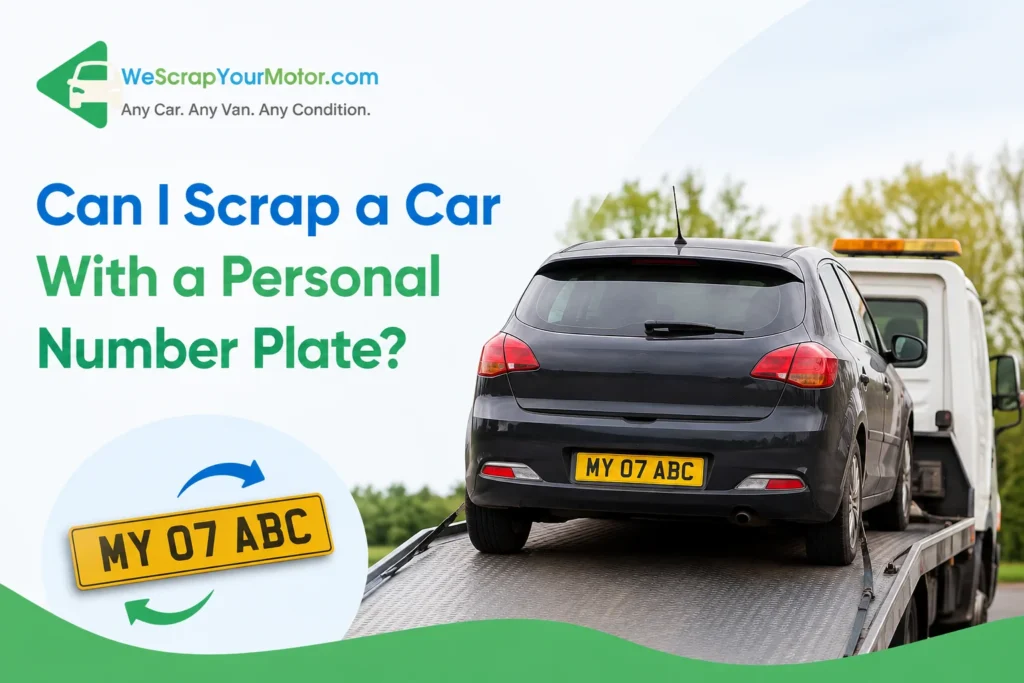
Yes, you can scrap a car that has a personal number plate, but you must remove the registration first if you want to keep it. Apply to DVLA to retain or transfer the number, wait until you have the V778 retention document and the replacement V5C, and only then allow the vehicle to be scrapped. If the vehicle is destroyed first, you can lose the right to the private number.
That short answer matters because a personalised registration and a vehicle are not the same asset. The number may be valuable, memorable or connected to your business, but while it is assigned to the car it remains tied to that vehicle’s DVLA record. Scrapping the physical car does not automatically place the number safely on retention.
If your aim is to scrap car with a personal number plate while keeping the registration, the order of events is the whole issue. Treat removal of the number as a separate task that must be completed before collection.
First decide what you want to happen to the number
There are three common intentions:
- You want to keep the registration and use it on another vehicle later.
- You want to move it directly to another eligible vehicle.
- You no longer want the registration and are prepared to let the car go with it.
The first two options require action before disposal. DVLA says a successful application normally results in a V778 retention document and a new V5C showing the replacement registration. It also warns that you must have the V778 and the new log book before you scrap or sell the vehicle. That is the safest practical stopping point: no collection should take place until both documents have arrived.
If you are not keeping the number, tell the collection company that the car still displays a personalised plate so its identity can be checked correctly. Do not assume the physical acrylic plates give you ownership of the registration. Keeping the pieces of plastic does not preserve your right to use the number.
Can every private registration be retained?
Not automatically. GOV.UK lists eligibility conditions for the vehicle. It must be registered with DVLA in the UK, able to move under its own power, of a type that needs an MOT or HGV test, and available for inspection if DVLA requests one. It must also meet the continuous tax or SORN conditions stated by DVLA.
Numbers beginning with Q or QNI cannot be retained through this process. Historic vehicles have an extra point to check: GOV.UK says a current MOT certificate is needed for the retention application even if the vehicle is normally MOT-exempt.
These rules create a possible difficulty for a badly damaged or non-running car. A vehicle that cannot move under its own power may not satisfy the normal eligibility test. Do not book destruction in the hope that the issue can be corrected afterwards. Contact DVLA first and explain the actual condition of the vehicle. The registration may have a substantial value, so an assumption made under time pressure can be expensive.
The safest order of actions
Use this sequence when the plate is to be saved:
- Check that the registration is eligible to be retained.
- Check that the name and address on the V5C are correct.
- Apply online or by post to take the number off the vehicle.
- Pay the current DVLA fee, which is £80 at the time of fact-checking.
- Wait for the V778 retention document and replacement V5C.
- Fit the replacement registration plates if the car will be driven again.
- Tell the insurer about the replacement registration if the cover is still active.
- Obtain a scrap quote using the replacement registration.
- Confirm that collection will be handled lawfully through an authorised treatment facility.
- Complete the DVLA disposal notification and retain your records.
If you want a straightforward collection after the paperwork is ready, start with We Scrap Your Motor and provide the registration that is currently shown on the replacement V5C.
Applying online or by post
The online route is usually the quickest when the vehicle is in your name, the V5C details are correct and DVLA does not require an inspection. GOV.UK says removal can be immediate if no inspection is needed, and the online reference can be used to assign the number to another vehicle.
The postal route uses form V317. You normally send the form, the V5C or the relevant alternative documents, and the £80 fee. Postal applications are also required in some situations, including when the vehicle is not registered in your name. Allow time for post, processing and delivery of the replacement documents.
Do not interpret an online confirmation as permission to hand the car over immediately. GOV.UK specifically says you must have the V778 and the new V5C before selling or scrapping it. The new V5C may take four to six weeks to arrive, even where the registration is removed straight away.
What changes after DVLA removes the plate
Once the application succeeds, the vehicle’s original registration is usually reassigned automatically. The new V5C will show the number that should be used for the scrap transaction. Your V778 proves your continuing right to assign the private number, usually for ten years from the document’s issue or renewal position.
Store the V778 carefully. If the number remains unassigned, monitor its expiry date and renew the right before it expires. DVLA states that a right to use a retained registration must be renewed every ten years. Missing that deadline can mean permanently losing the registration.
Update every record that still uses the old number
Removing a private plate changes more than the characters on the car. Before driving the vehicle under its replacement registration, fit the correct plates and notify your insurer. If you use automatic charging accounts, update them as well. These may include Congestion Charge, ULEZ, Dart Charge, Clean Air Zone or parking accounts.
This is especially important if the car remains driveable for a short period before collection. A camera system may read the replacement number while an old payment account still expects the private one. GOV.UK warns that failing to update relevant charging details can lead to a penalty charge.
For a car that will not be driven, collection on a suitable transporter avoids the need to put it back on the road. It does not, however, remove the need for correct DVLA records.
What if the car has no MOT or is on SORN?
A current MOT is not listed as a universal requirement for every online retention case, but the vehicle must satisfy DVLA’s eligibility rules. It must be of a type that needs an MOT or HGV test and meet the tax or SORN history conditions. If a SORN has been in place for more than five years, GOV.UK states that the vehicle must be taxed and have an MOT certificate for the application. Historic vehicles also need a current MOT for retention.
Because eligibility turns on the vehicle’s real record, avoid advice that says a number can always be retained regardless of condition. Check the current GOV.UK criteria and contact DVLA if the car cannot move, has been heavily damaged or has an unusual registration history.
After retention is complete, a SORN vehicle must remain off public roads. Arrange recovery rather than driving it to a yard. Owners in South Wales can use the planned Scrap My Car in Swansea.
What happens if the insurer has written the car off?
Tell the insurer immediately that you want to retain the personalised registration. GOV.UK’s write-off process starts with taking the number off if you want to keep it. The insurer will usually request the V5C and may control the vehicle’s disposal after settlement.
Do not sign away the vehicle, send every document or permit collection until the plate position is understood. Ask the insurer for written confirmation of the deadline and who is responsible for each step. A Category A or B vehicle may move quickly towards destruction, so early communication is essential.
If the car is Category S or N and you are keeping the salvage, the normal DVLA write-off and roadworthiness rules still apply. Retaining the plate does not change the category recorded against the vehicle or make the car safe to drive.
Can I take the physical plates off before collection?
You may remove the physical plates for security or disposal after DVLA has reassigned the vehicle’s registration, but the retention document is what protects the number. The collector will need to identify the vehicle using its VIN, V5C and current registration record.
Never obscure the vehicle’s identity or present an old V5C as if it were current. Give the collector accurate information and agree which plates, keys and documents will be handed over. Keep photographs of the vehicle, its VIN and mileage, plus copies of the collection and payment records.
Mistakes that can cost you the registration
The most serious error is letting the vehicle be destroyed before retention is complete. Other avoidable mistakes include:
- assuming the quote company will retain the number for you;
- applying after the insurer has already transferred or destroyed the car;
- relying only on the online reference and not waiting for the new V5C and V778;
- failing to check whether the vehicle can move under its own power;
- using the private number in a scrap quote after DVLA has reassigned the original registration;
- ignoring a DVLA inspection request;
- losing the V778 or allowing the right to expire;
- driving with plates or insurance details that do not match the updated record.
The practical rule is simple: pause the disposal until the registration position is documented.
Collection, evidence and final checks
When the replacement V5C arrives, request or update the quote using the correct registration. Explain whether the vehicle runs, where it is parked, whether access is restricted and whether a transporter will be needed. The quote should identify the vehicle, not the personalised number that has now been retained.
Use a lawful route to an authorised treatment facility. If the vehicle is completely scrapped, the ATF should issue a Certificate of Destruction within seven days for an eligible car. You must still make sure DVLA has been told that the vehicle has gone to an ATF. Keep the Certificate of Destruction and DVLA confirmation with the V778, but do not confuse their functions: one relates to the destroyed car; the other protects your right to the registration.
If you do not have the V5C, read Can I Scrap a Car Without a V5? before booking.
Your evidence file
Create one folder, digital or physical, containing:
- the V778 retention document;
- the replacement V5C or a secure copy of its relevant details;
- the DVLA online or postal confirmation;
- the quote and collection booking;
- the collector’s business details;
- payment evidence;
- photographs taken at handover;
- the Certificate of Destruction, if the car is destroyed;
- DVLA confirmation that you are no longer the registered keeper.
These records provide a clean timeline if a tax, parking, insurance or registration question appears later.
Quick decision guide
- The car runs and the plate is eligible: Apply to retain it, wait for the V778 and new V5C, then arrange scrapping.
- The car does not run: Do not assume the number can be retained. Ask DVLA how the own-power eligibility rule applies before disposal.
- The insurer has written the car off: Tell the insurer immediately, start retention before surrender and follow the insurer/DVLA document process.
- The plate begins with Q or QNI: It cannot be retained through the standard process.
- You do not want the plate: You may proceed with lawful disposal, but understand that destruction may end any opportunity to recover the registration.
Frequently asked questions
Can a scrapyard retain my private number for me?
Do not rely on a scrapyard to do it. The registered keeper or entitled person should complete the DVLA retention or transfer process before the vehicle is collected. Ask the operator to postpone collection until the paperwork is complete.
How much does it cost to take a private plate off a car?
The DVLA fee is £80 at the time of fact-checking. Check GOV.UK before publishing or applying because fees can change.
Can I scrap the car as soon as the online application is approved?
GOV.UK says you must have the V778 retention document and the new V5C before you sell or scrap the vehicle. Wait for both documents.
What happens to the car’s old registration?
The original registration is usually reassigned to the vehicle automatically. The replacement V5C confirms the registration to use for disposal.
Can I retain a private plate from a non-running car?
The normal eligibility rules say the vehicle must be able to move under its own power. Contact DVLA before disposal if the vehicle cannot do so.
Do I need to tell my insurer about the replacement number?
Yes, if the vehicle remains insured. GOV.UK says the insurer must be told the new registration before the vehicle is driven.
Will keeping the acrylic number plates preserve my registration?
No. Your right is evidenced by the DVLA record and V778, not possession of the physical plates.
How long can I keep a number on retention?
The V778 normally preserves the right for ten years. Renew it before expiry if the number is still not assigned.
Wrapping Up
You can scrap a car with a personal number plate, but the plate must be dealt with first if you want to keep it. Complete the DVLA retention process, receive the V778 and replacement V5C, update connected records, and only then release the car for collection. That sequence protects both the registration and the accuracy of the scrap transaction.