
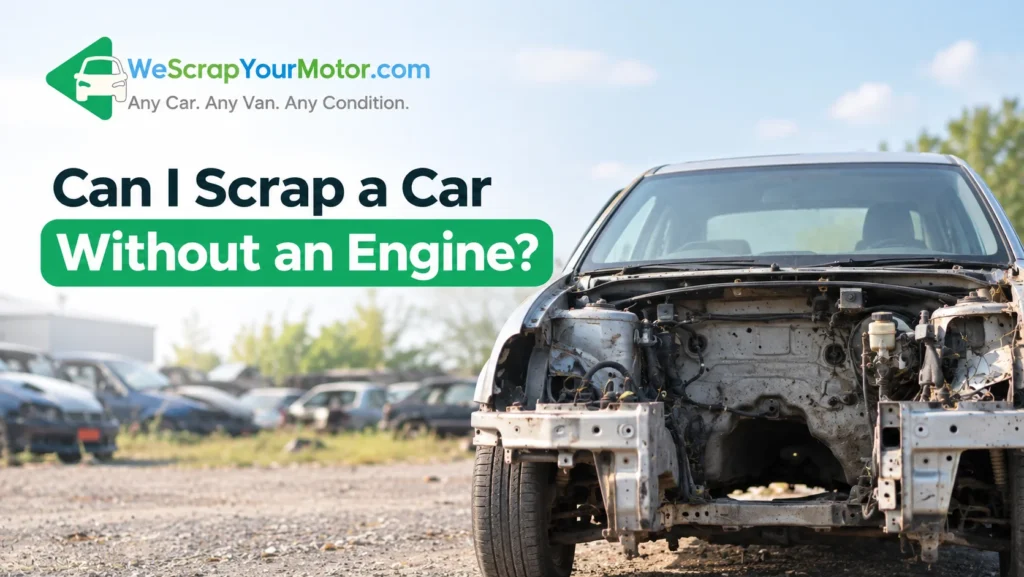
Yes, you can scrap a car without an engine in the UK. However, removing the engine can substantially reduce the vehicle’s value, affect whether collection is free and require the collector to use different recovery equipment.
The engine is one of a vehicle’s heaviest and potentially most valuable components. A complete engine may have reuse, reconditioning or metal-recovery value. Once it has been removed, the remaining car is lighter and may be treated as an incomplete end-of-life vehicle.
UK government guidance also states that an authorised treatment facility may charge a fee when essential components such as the engine, gearbox, bodywork or wheels have already been removed. That does not mean every engine-less car will attract a charge. It means you must describe the vehicle accurately before accepting a quote.
The simplest approach is to provide the registration number, postcode, photographs and a full list of missing parts. This allows the buyer to calculate a realistic price and send appropriate collection equipment.
Can You Legally Scrap a Car without an Engine
You can legally scrap a car without an engine when:
- You own the vehicle or have authority to dispose of it.
- The receiving facility is an authorised treatment facility, commonly called an ATF.
- You disclose that the engine has been removed.
- The vehicle can be collected safely.
- You complete the necessary DVLA notification.
- You receive payment through a lawful method.
- Any fluids or components removed from the car have been handled responsibly.
Do not advertise the vehicle as complete or running. An inaccurate description may cause the quote to be reduced or the collection to be cancelled when the recovery driver arrives.
If you want a vehicle-specific assessment, submit its details to We Scrap Your Motor. Mention the missing engine before accepting the offer.
Is It Legal to Scrap an Engine-Less Car?
There is no general UK rule requiring a scrap car to contain its original engine. A vehicle can reach the end of its useful life after an engine failure, restoration project, insurance loss, parts removal or abandoned repair.
The important legal requirement concerns where the end-of-life vehicle is processed. GOV.UK states that a vehicle being scrapped must be taken to an authorised treatment facility. It is illegal to scrap it somewhere that is not authorised to receive and process end-of-life vehicles.
An ATF has the controlled environment and permissions needed to deal with materials that may remain in the vehicle, including:
- Fuel and fuel vapour
- Engine or gearbox oil left in pipes and coolers
- Coolant
- Brake fluid
- Air-conditioning refrigerant
- Lead-acid batteries
- Tyres
- Airbags and other pyrotechnic components
- Contaminated filters and absorbent materials
Removing an engine does not turn the rest of the car into ordinary household metal. The shell and remaining systems must still be handled through the correct vehicle-treatment route.
Why Might a Car Have No Engine?
An engine may be absent for several legitimate reasons.
A garage may have removed it after diagnosing serious mechanical damage. The owner may have planned an engine replacement but decided the labour and parts cost was too high. An enthusiast may have bought the vehicle as a project and removed the power unit for another vehicle. A repairer may also have taken out a failed engine before the owner abandoned the repair.
Common situations include:
- A seized or badly damaged engine
- A failed timing belt or timing chain
- Severe overheating
- Oil starvation
- Flood or fire damage
- An unfinished engine-swap project
- A stripped donor vehicle
- A restoration that became unaffordable
- An insurance-damaged vehicle
- A car left at a garage after a repair dispute
The reason matters because it helps establish what else may be missing. If the engine was removed professionally, the wheels, steering and suspension may remain usable for loading. A partially dismantled project could have loose components, disconnected steering, missing driveshafts or exposed wiring.
How Much Is a Car without an Engine Worth?
A vehicle without an engine can still have scrap or salvage value. Its exact worth depends on more than the current price of metal.
A buyer may consider:
- Make, model and registration year
- Remaining vehicle weight
- Body and chassis condition
- Demand for reusable panels and interior parts
- Whether the gearbox is present
- Whether the catalytic converter is present
- Number and condition of the wheels
- Presence of the 12-volt battery
- Vehicle location
- Accessibility for a recovery truck
- Current ferrous and non-ferrous metal values
- Distance to the receiving facility
- Whether the vehicle rolls, steers and brakes
- Whether specialist loading equipment is required
An engine contains a considerable quantity of metal and may also have value as a complete used component. Its absence therefore affects both weight-based value and possible parts value.
A desirable or relatively modern model may still contain saleable doors, lights, seats, electronic modules, suspension parts and body panels. An older, damaged or heavily stripped shell may be valued mainly for its remaining metal.
Will Removing the Engine Always Reduce the Price?
In most cases, yes. If you scrap a car without an engine, you should expect a lower offer than you would receive for the same vehicle in complete condition.
However, there is no fixed deduction that applies to every car. A buyer cannot accurately value the missing engine without knowing the model, engine type and condition of the rest of the vehicle.
For example:
| Vehicle Condition | Likely Valuation Effect |
| Engine missing but car otherwise complete | Noticeable reduction based on weight and parts value |
| Engine and catalytic converter missing | Larger potential reduction |
| Engine, gearbox and wheels missing | Major reduction and possible collection complications |
| Engine removed but included separately | Assessment may improve if the engine can be collected safely |
| Modern vehicle with reusable body parts | Salvage demand may preserve some value |
| Heavily stripped or damaged shell | Value may be based mainly on remaining metal |
Ask for a quote based on the car’s present condition. Do not rely on an online valuation that assumes the engine is still installed.
Can an ATF Charge for an Incomplete Vehicle?
Potentially. GOV.UK explains that scrapping a complete end-of-life vehicle is usually free. It also says that an ATF can charge if essential components such as the engine, gearbox, bodywork or wheels have been removed.
Whether a fee applies will depend on the facility, the remaining value and the difficulty of collection and treatment. Some buyers may still pay for an incomplete car because its remaining metal and components exceed their recovery and processing costs. Others may offer a reduced amount, charge for specialist collection or decline the vehicle.
Before booking, request written confirmation of:
- The offered amount
- Whether collection is included
- Whether the offer assumes any parts are present
- The payment method
- Circumstances that could change the price
- Any access or loading conditions
- The intended treatment facility
This protects both parties from misunderstandings on collection day.
Can the Vehicle Still Be Collected?
Usually, collection must be planned around the vehicle’s condition.
An engine-less car cannot be driven onto a transporter. It will normally need to be winched, lifted or loaded using recovery equipment. The missing engine can also change the vehicle’s balance, especially when other front-end components have been removed.
Tell the collection provider whether the car:
- Rolls freely
- Steers normally
- Has working brakes
- Has all four wheels
- Has inflated tyres
- Has keys
- Is locked
- Is parked on a slope
- Is inside a garage
- Is in an underground car park
- Is surrounded by other vehicles
- Has loose or exposed components
- Can be approached by a recovery truck
A car that rolls and steers on four wheels is normally easier to collect than a shell resting on axle stands or blocks.
Never work underneath an unsupported vehicle to prepare it for collection. Do not try to move an unstable shell using improvised lifting or towing methods. Let the recovery provider decide what equipment is needed.
Drivers in South Wales can review the local collection process through the Scrap My Car in Swansea.
What Information Should I Provide for an Accurate Quote?
If you want to scrap a car without an engine, give the buyer enough information to assess both value and recovery requirements.
Provide:
- Registration number
- Make and model
- Registration year
- Exact collection postcode
- Location of the vehicle
- Confirmation that the engine is missing
- Whether the gearbox remains installed
- Whether the catalytic converter is present
- Number of wheels fitted
- Whether the car rolls, steers and brakes
- Whether the keys and V5C are available
- Photographs from every side
- Photographs of the empty engine bay
- Details of any other missing or loose parts
- Access restrictions around the vehicle
If the removed engine is still on the property, say whether it is included. Do not assume a standard recovery driver can lift or transport a loose engine. The buyer must confirm whether it can be accepted and how it should be prepared.
Accurate information supports a more dependable quote. It also reduces the risk of a last-minute price change.
How to Scrap the Vehicle Step by Step
Step 1: Confirm Your Authority
Make sure you own the vehicle or have the legal authority to dispose of it. A V5C records the registered keeper, but it is not conclusive proof of ownership.
If the vehicle is subject to outstanding finance, belongs to a business, is part of a deceased person’s estate or is registered to somebody else, obtain the correct authority before arranging collection.
Step 2: Record the Vehicle’s Condition
Photograph the entire vehicle and document every missing component. Keep any garage report, engine-removal invoice or repair estimate that explains its condition.
This creates a reliable record for the quote.
Step 3: Obtain a Condition-Based Quote
Tell the buyer from the beginning that you want to scrap a car without an engine. Confirm whether the quoted amount already reflects the missing component.
Ask whether collection is included and whether the vehicle must roll or have all its wheels.
Step 4: Verify the Legal Route
Ask for the identity of the collecting business and the receiving ATF. GOV.UK provides different official ATF registers for England, Wales, Scotland and Northern Ireland.
For further guidance, read this UK authorised treatment facility guide.
Step 5: Prepare the Vehicle
Remove personal possessions, parking permits, payment cards, documents and electronic accessories you are entitled to keep.
Do not remove additional components after accepting the quote unless the buyer agrees in writing. A quote for a car containing its gearbox, catalytic converter and wheels may no longer apply if those items disappear before collection.
Step 6: Check the Handover
Review the vehicle registration, collection receipt, buyer’s identity and payment terms. Do not sign incomplete paperwork.
Physical cash cannot legally be used to pay for scrap vehicles in England or Wales. Payment must be traceable, such as through bank transfer or cheque.
Step 7: Notify DVLA
You are responsible for ensuring DVLA is informed. If you have the latest V5C, the online service uses its 11-digit reference number. If you do not have the V5C, GOV.UK instructs you to write to DVLA with your name and address, the registration, make and model, exact transaction date, and the scrapyard’s name and address.
Keep the confirmation showing that you are no longer the registered keeper.
Step 8: Keep the Destruction Record
When an eligible car is completely scrapped, the ATF should issue a Certificate of Destruction within seven days. Keep it with the payment and collection records.
If the car is repaired and resold instead, a Certificate of Destruction will not be issued because the vehicle has not been destroyed.
What Documents Will I Need?
Prepare the following where available:
- V5C log book
- Photographic identification
- Proof of address
- Keys
- Finance-clearance evidence
- Company authorisation for a business vehicle
- Evidence of authority for an estate vehicle
- Garage paperwork showing removed components
- Bank details for traceable payment
A missing V5C does not necessarily prevent collection, but you must still prove that the transaction is legitimate and notify DVLA correctly.
Never hand over a vehicle using another person’s details without their authority.
Should I Sell the Remaining Parts First?
Selling more parts might appear to maximise the vehicle’s total return, but it can also reduce the final scrap offer and make collection more difficult.
Before removing anything else, compare:
- Realistic sale price of the part
- Time required to find a buyer
- Storage requirements
- Removal cost
- Risk of damage
- Reduced scrap value
- Additional recovery charges
- Environmental handling responsibilities
Wheels are particularly important because a vehicle without wheels may require lifting equipment. The gearbox, catalytic converter and battery can also influence value.
If the aim is quick, straightforward removal, leaving the remaining vehicle complete may be the better option.
Common Mistakes That Reduce an Offer
Hiding the Missing Engine
The collector will discover the empty engine bay. Hiding it does not preserve the original quote.
Removing More Parts after Booking
The offer is based on the declared condition. Removing additional items can invalidate it.
Assuming Collection Is Automatically Free
Free collection may depend on location, access, remaining value and mobility.
Forgetting About Private Registration
If you want to keep a personalised registration, complete the retention process before notifying DVLA that the vehicle has been scrapped.
Accepting Physical Cash
Cash payment for scrap metal is prohibited in England and Wales.
Failing to Notify DVLA
Notifying the collector is not the same as completing your keeper responsibilities. GOV.UK warns that failing to notify DVLA can lead to a fine of up to £1,000.
Frequently Asked Questions
Can I Scrap a Car after Its Engine Has Been Removed?
Yes. You can scrap a car without an engine, provided the car is collected and processed through a lawful route. Disclose the missing engine so the quote and recovery arrangements reflect the actual condition.
Will a Scrapyard Take an Empty Car Shell?
Some authorised operators accept shells, but acceptance depends on what remains, where it is located and how it can be loaded. A stripped shell may attract a low offer, a collection charge or no offer.
Is an Engine Considered an Essential Part?
Yes. GOV.UK names the engine as an example of an essential component. An ATF may charge when essential parts have been removed.
Can I Get a Free Collection?
Possibly. The provider will consider distance, access, vehicle mobility and residual value. Confirm collection terms in writing.
Can I Scrap the Car if the Engine Number Is Missing?
An absent engine number does not automatically prevent scrappage because the vehicle can be identified using its registration and vehicle identification number. The buyer will still need to verify the car and your authority to dispose of it.
Can I Leave the Removed Engine Inside the Car?
Do not place a loose engine inside the passenger compartment or boot without the collector’s approval. Its weight and movement can create loading and transport problems. Tell the buyer where the engine is and ask whether it can be collected separately.
Get an Honest Quote for Your Engine-Less Car
You do not need to rebuild an uneconomical vehicle simply to dispose of it. It is possible to scrap a car without an engine, but the offer must be based on the car’s actual weight, remaining components, location and collection requirements.
Prepare accurate photographs, disclose every missing part and confirm the payment and recovery terms before booking. A transparent description gives the collector the information needed to value the vehicle fairly and remove it safely.