
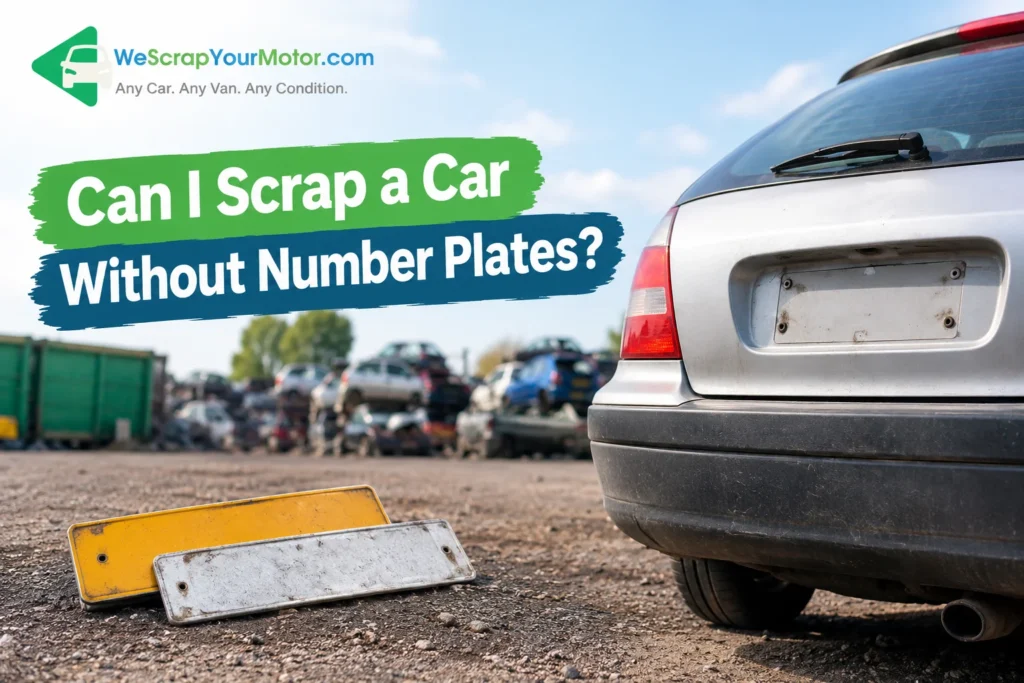
Yes, you can usually scrap a car without number plates, provided the receiving business can identify the vehicle and confirm your authority to dispose of it. Missing physical plates are not automatically a barrier. Missing or conflicting vehicle identification is a more serious issue.
Perhaps the plates were stolen while the car was parked. Maybe an accident damaged the bumper, or an old vehicle has been sitting on private land with both plates removed. Whatever the reason, explain the situation before arranging the collection.
The important questions are straightforward: which vehicle is being collected, who owns it, what evidence is available, and can it be transported appropriately?
This guide helps you answer those questions. It covers different missing-plate situations, the documents a collector may request, personalised registrations, quote conditions and the records you should retain. Acceptance requirements can vary, so confirm the arrangements for your particular vehicle rather than assuming every collector follows an identical checklist.
Start By Separating The Plate From The Registration
A number plate is the physical display attached to the car. The registration number is the identifier recorded against the vehicle. They are connected, but they are not the same thing.
A car can lose its physical plates while its registration record remains unchanged. The number might still appear on the log book, insurance correspondence, an old garage invoice or purchase paperwork.
This distinction is central when you want to scrap a car without number plates. You are not necessarily dealing with an unregistered vehicle; you may simply have a registered vehicle with missing displays.
The vehicle identification number, usually called the VIN, offers another reference for identifying the individual car.
Do not fit plates borrowed from another vehicle. That creates conflicting information and does nothing to establish ownership.
Instead, collect the accurate registration details you already hold and explain which physical plates are missing. A clear description gives the receiving business a useful starting point for verification.
Which Missing-Plate Situation Applies To Your Car?
Different circumstances call for different questions.
| Your Situation | What To Explain | What May Help |
| One plate fell off | Which plate is missing | Remaining plate and vehicle records |
| Both plates were stolen | When the theft was discovered | Incident reference and matching documents |
| Accident damage removed the plates | Relevant damage and vehicle condition | Photographs and insurance paperwork |
| Plates were removed during storage | Who removed them, if known | Registration records and ownership evidence |
| A private registration was retained | Whether DVLA completed the change | Current registration and updated documents |
| Neither registration nor VIN is clear | Identification uncertainty | Professional or official guidance |
Being able to scrap a car without number plates does not mean every situation is equally straightforward.
For example, missing plates on a documented vehicle you have owned for years are different from missing plates on a car with an unclear purchase history.
Give the collector facts rather than a guessed explanation. If you do not know why the plates are absent, say so.
Case One: You Have The Log Book And Know The Registration
This is often the simplest position.
Tell the collector the registration, make, model and location. Explain that the physical plates are missing and confirm whether the V5C details match the vehicle being offered.
The business may still request identity evidence and information establishing your authority to sell. The log book records the registered keeper; it is not, by itself, proof of ownership.
That distinction matters for leased vehicles, company cars and cars belonging to someone else.
If you plan to scrap a car without number plates, ask the business to confirm that it has accounted for their absence when arranging collection.
Do not assume a registration entered into an online quote form resolves every acceptance requirement. An automated estimate and final vehicle verification are different stages.
Keep the booking confirmation, particularly any written statement about documents, price conditions and collection. It gives both parties a common understanding before the recovery vehicle arrives.
Case Two: You Know The Registration But Have No V5C
A missing log book does not automatically make disposal impossible, but it can create additional verification work.
Explain the absence before booking. Ask what alternative evidence the receiving business will accept and whether it needs further information to match the vehicle to its records.
A purchase invoice, previous correspondence or relevant authority paperwork may help, depending on the circumstances. Do not assume one particular document will satisfy every business.
DVLA provides instructions for notifying a sale or transfer without a log book. Its guidance describes a written route using vehicle, transaction and receiving-party details. Check the current instructions applicable to your situation.
If you need to scrap a car without number plates and without a V5C, settle both issues before paying for transport.
Our guide to scrapping a car without a V5C explains the separate missing-document problem in more detail.
Case Three: The Plates Were Stolen
Tell the collector that the plates were stolen rather than describing them only as “not fitted”.
Use the appropriate police reporting channel and keep any incident reference. Record when you discovered the loss and retain relevant photographs or correspondence.
A plate-theft record may help if the registration is later associated with activity involving another vehicle. Respond promptly to any related correspondence rather than assuming disposal will automatically resolve previous misuse.
There is also an important distinction between stolen plates and a potentially stolen vehicle. A car you own whose plates have disappeared is one situation. A vehicle whose ownership is uncertain is another.
You can usually ask to scrap a car without number plates after plate theft, but the business still needs to establish the vehicle’s identity and your authority.
Do not replace missing plates merely to make the situation look ordinary. An accurate explanation is more useful than concealing the circumstances.
Case Four: The Car Has a Personalised Registration
Removing the physical plates does not protect your right to a private registration.
That right must be handled through DVLA’s retention or transfer process. Government guidance says you must have the retention document and new log book before selling or scrapping the vehicle, otherwise you can lose the right to use the private number. Eligibility conditions apply.
This is particularly important when the registration is valuable but the car is no longer running.
Do not assume every broken-down vehicle qualifies for retention. Check the actual eligibility position before arranging disposal.
If you want to scrap a car without number plates after completing retention, give the collector the vehicle’s current registration details.
Keep the retention paperwork separate from the disposal receipt. One relates to the right to use a registration; the other records the transfer of the vehicle.
Taking the plastic plates home is not a substitute for completing the administrative process.
Case Five: You Cannot Establish The Registration
Start with reliable records already available to you.
Old insurance correspondence, purchase documents and garage paperwork may identify the registration. Check that they refer to this vehicle rather than another car you have owned.
If the registration remains unknown, explain that to the receiving business and ask whether it can consider the available identification.
A readable VIN may assist verification, but an owner should not assume it solves every administrative question.
To scrap a car without number plates in this situation, the collector needs a defensible way to establish what it is receiving.
If the VIN is unreadable, damaged or inconsistent with the documents, pause the transaction. Do not alter, recreate or restamp an identification number.
A faster collection is not useful if it leaves an ownership or identity dispute unresolved. Where necessary, seek official or legal guidance before authorising disposal.
What Documents Should You Prepare?
Ask for the receiving business’s requirements rather than relying on a generic internet checklist.
Possible requests include photo identification, address evidence, the V5C, a purchase invoice or written authority from the owner.
For a company vehicle, the business may require confirmation that the person arranging disposal can act for the company. For an inherited car, estate-related documents may be relevant.
The evidence should establish both the vehicle and the seller’s authority.
Being able to scrap a car without number plates does not remove these checks.
Keep sensitive information out of public advertisements. Do not post complete identity documents, full log book reference numbers or financial details in an open social-media conversation.
Share necessary evidence through the receiving business’s appropriate process.
If the documents contain different names or addresses, explain why. An understandable change of address is easier to assess than unexplained inconsistencies discovered at the collection appointment.
What If The Car Is Not In Your Name?
Registered keeper status and ownership are separate matters, but a name mismatch needs clarification.
You might be acting for a relative, an employer or an estate. Alternatively, you may have bought the car recently and not yet received updated documents.
Tell the receiving business which situation applies. Obtain clear authority where someone else owns the vehicle.
Do not assume that possession of keys proves a right to sell. Similarly, owning the driveway on which a car is parked does not necessarily give you ownership of the car.
If you want to scrap a car without number plates on someone else’s behalf, agree what evidence is needed before booking.
Where ownership is disputed, stop and resolve that dispute first. A collector should not be expected to decide between competing ownership claims during loading.
This preparation protects the owner as well as the person arranging the transaction.
Should You Buy Replacement Plates?
Often, replacement plates are unnecessary solely for professional collection, if the receiving business accepts the vehicle without them and can verify its identity.
However, obtain that confirmation before deciding.
Replacement plates do not fix an ownership dispute, a mismatched registration record or a damaged VIN. Their usefulness depends on the actual problem.
Ask a direct question: “Can you accept and collect this vehicle without its physical plates, using the documents I have?”
That is more productive than assuming the absence requires a purchase.
You may be able to scrap a car without number plates without spending anything on replacements. Save the money unless there is a genuine reason they are required.
If someone proposes driving the car to its destination, the situation changes. Road-use requirements still apply, and missing plates may be only one of several reasons professional recovery is needed.
Collection Is Different From Driving To a Scrapyard
A car being disposed of does not receive a general exemption from normal road requirements.
Government guidance requires registration plates to display the registration correctly. Other requirements concerning insurance, vehicle condition and testing may also be relevant.
Do not assume a short journey is acceptable because the destination is a scrapyard.
If the car cannot lawfully or safely be driven, arrange a suitable professional collection and describe its condition accurately.
When you scrap a car without number plates, tell the operator whether it starts, rolls, steers and has accessible keys.
Also explain any missing wheels, seized brakes or locked steering. These issues can affect loading equipment.
An informal towing plan should not be assumed to solve the problem. Let a competent recovery operator determine a suitable transport method for the vehicle and location.
Will Missing Plates Affect Your Quote?
The physical plates generally contribute little to the material value of a car.
Other factors are more likely to influence an offer: completeness, reusable parts, model, condition, location and collection requirements.
However, identification uncertainty can affect whether a business is willing to make or honour an offer.
A quote generated using a registration may also assume the vehicle is complete and accurately described.
To scrap a car without number plates without avoidable price confusion, disclose their absence and ask which conditions could change the quoted amount.
Request confirmation that the offer applies to the car as it currently stands.
For a vehicle-specific enquiry, contact We Scrap Your Motor with the registration if known, the missing-plate explanation and the collection postcode.
Do not treat a provisional estimate as an unconditional final agreement unless the business has clearly stated that it is.
Give The Collector Enough Access Information
A straightforward identification process can still be undermined by an unsuitable collection booking.
Tell the operator where the car is actually parked. A postcode alone may not reveal a narrow gate, underground car park, height restriction or steep access.
Explain whether other vehicles block it and whether permission is needed to enter the property.
If the car is at a garage, confirm that it can be released and clarify outstanding charges before the collector arrives.
For local collection planning, see Scrap My Car in Salisbury and provide the actual access conditions.
When arranging to scrap a car without number plates, accurate vehicle details and accurate location details work together.
A booking should identify the person meeting the operator, the available time window and any practical restriction. That is more useful than promising the car is “easy to collect” without checking.
Know Whether The Vehicle Will Be Destroyed Or Resold
Ask what transaction is being agreed.
A receiving business may consider the car for repair and resale rather than permanent destruction. Those outcomes have different paperwork implications.
Government guidance explains that an authorised treatment facility can completely scrap a vehicle or repair and sell it. A qualifying car that is completely scrapped receives a Certificate of Destruction; a car repaired and resold does not.
Do not rely only on the phrase “scrap collection” to understand the outcome.
If you scrap a car without number plates, make sure the transaction records still identify the correct vehicle.
Keep the receiving business’s details, the date, amount and relevant reference numbers.
Where permanent destruction is agreed, ask how the evidence will be provided. Where the vehicle is sold for potential repair, make sure your receipt reflects that transfer instead.
Keep a Record That Makes Sense Months Later
A good disposal record should be understandable without relying on your memory.
Keep the quote, acceptance conditions, collection confirmation, payment evidence and receipt. Store any theft incident reference or private-registration paperwork separately but where it can be found.
Check the vehicle details for errors before filing the documents.
Follow the applicable DVLA notification process and retain confirmation where available. Government guidance places responsibility on the owner to notify DVLA when the vehicle is taken to an authorised treatment facility.
If you later receive unexpected correspondence, those records can help you establish the timeline.
This is particularly useful when you scrap a car without number plates because there was no visible registration during collection.
Do not assume the collector’s records are the only evidence you need. Keeping your own clear file is a small task that can prevent considerable uncertainty later.
Answers To The Questions Owners Ask Most
Can I Scrap a Car without Number Plates If Only One Is Missing?
Usually, yes, subject to acceptance and verification. Tell the collector which plate is absent and provide the registration. The remaining plate helps identification but does not replace checks on ownership or authority.
Can I Scrap a Car without Number Plates If It Has Been Stored For Years?
Potentially. Storage duration is not the main issue; reliable identification, ownership evidence and collection access are. Explain missing documents and the vehicle’s current condition before arranging a visit.
Is a Photograph Of The Old Plate Enough?
It may help establish the registration, but it should not be assumed to satisfy every check. A photograph does not establish ownership and might not show the vehicle’s current registration position.
Does Removing Plates Tell DVLA The Car Is Scrapped?
No. Physical removal does not complete the administrative notification. Follow the appropriate process for the transaction and retain the relevant confirmation.
Can I Keep The Plates As a Souvenir?
Ask the receiving business what it requires. Keeping a physical plate is separate from retaining the right to use a personalised registration, which must be dealt with through DVLA.
Confirm Acceptance Before You Book Collection
Prepare a short description: registration if known, missing-plate circumstances, available documents, ownership position, vehicle condition and access.
Send it to the receiving business and ask for confirmation of acceptance requirements and quotation conditions.
Then make sure the agreed paperwork identifies the car correctly when it leaves.
You can usually scrap a car without number plates without making the process complicated. The useful work is establishing identity, authority, transport and records.
Missing plates become a manageable detail when those points are clear. Uncertain ownership or inconsistent identification deserves attention before collection, regardless of how quickly someone offers to remove the vehicle.