
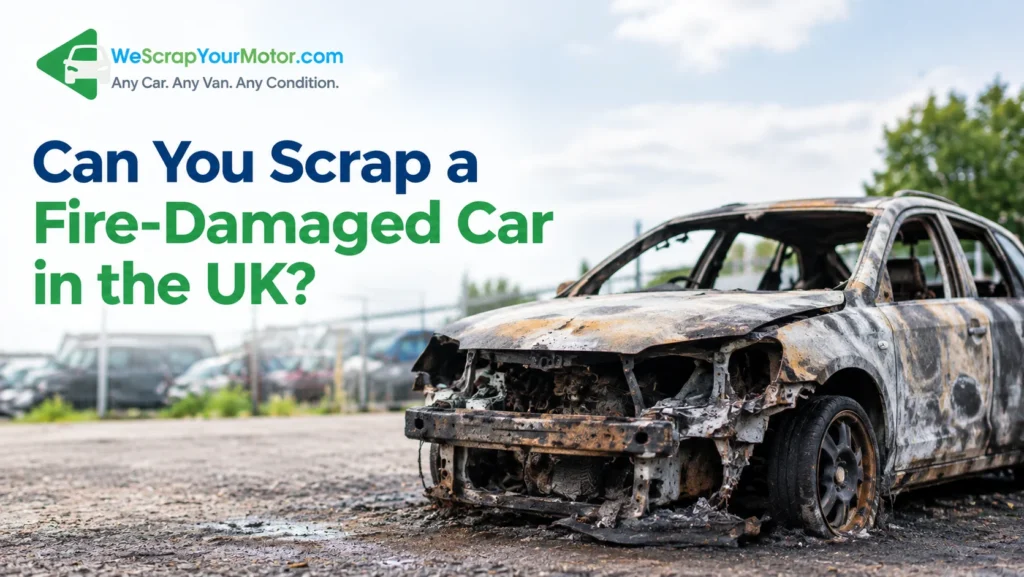
Yes, you can scrap a fire-damaged car in the UK, but it must be handled carefully. First establish whether an insurer, finance provider or police investigation has an interest in the vehicle. Do not touch or enter an unsafe vehicle, and never attempt to restart it. Once the relevant party releases it, a specialist recovery operator can transport the vehicle to an authorised treatment facility. The amount offered depends on the severity of the damage, vehicle completeness, recoverable metal, reusable components, accessibility and transport requirements.
Make the Area Safe First
A fire-damaged vehicle may contain weakened structures, broken glass, sharp surfaces, damaged electrical systems and leaking fluids. Electric and hybrid vehicles can present additional battery-related risks even after visible flames have gone.
Keep people away from the vehicle until the emergency services, insurer or a suitably qualified professional has confirmed what can happen next.
Do not:
- Open damaged battery packs.
- Touch exposed wiring.
- Attempt to reconnect the battery.
- Try to start the engine.
- Drain fluids yourself.
- Remove parts from an unsafe shell.
- Tow the vehicle using unsuitable equipment.
- enter a vehicle that has not been declared safe.
If the car is obstructing a public road or presents an immediate risk, follow the instructions of the emergency services or relevant authority.
Who Owns the Vehicle After an Insurance Claim?
Ownership does not necessarily change as soon as a claim is reported. The insurer may inspect the vehicle, decide whether it is repairable and make a settlement offer.
If the insurer settles the claim and takes ownership, you cannot independently scrap a fire-damaged car that now belongs to the insurer. Ask for written confirmation before arranging the collection.
Important questions include:
- Has the claim been accepted?
- Has the vehicle been categorised?
- Has the insurer taken ownership?
- Is an engineer’s inspection still required?
- Can the vehicle be moved?
- Has any investigation been completed?
- Does the insurer want to recover the vehicle?
- If you retain it, what restrictions apply?
Do not arrange disposal merely because the vehicle appears beyond repair.
Insurance Write-Off Categories
UK insurance write-off categories indicate what may legally happen to a damaged vehicle.
Category A
A Category A vehicle is intended for destruction. No parts should return to use. It requires controlled treatment through an appropriate authorised facility.
Category B
The body shell must be destroyed, although certain safe and serviceable components may be recovered by appropriately licensed operators.
Category S
The vehicle has sustained structural damage but may be repairable. It must be repaired safely before road use.
Category N
The damage is classed as non-structural, although significant safety-related systems can still be affected.
A severe fire can lead to Category A or B treatment, but the insurer or qualified assessor determines the category. Owners should not assign one themselves.
GOV.UK provides a separate process for insurance write-offs and scrapped vehicles. Check current official guidance and your insurer’s written instructions.
What If the Car Was Not Insured?
An uninsured owner may still be able to scrap a fire-damaged car, provided there is no finance interest, police restriction, ownership dispute or other legal hold.
Before arranging collection:
- Confirm the fire has been reported where necessary.
- Check whether police or fire investigators need access.
- Establish whether the landowner requires removal.
- Gather evidence of ownership.
- Contact an operator capable of handling fire damage.
- Describe the vehicle and access conditions accurately.
- Confirm that it will go through an authorised route.
Photographs can help the operator assess the required equipment, but do not approach an unsafe vehicle simply to take them.
What If the Car Is On Finance?
The finance provider may remain the legal owner under hire purchase, personal contract purchase or similar agreements.
Contact the lender immediately and provide:
- Registration number
- Agreement number
- Date and location of the fire
- Insurer details
- Claim reference
- Police or fire reference, if relevant
- Current storage location
Do not authorise dismantling or destruction until the lender and insurer have confirmed what you may do. Scrapping the vehicle does not automatically cancel the outstanding finance balance.
Can a Burnt Car Still Have Scrap Value?
Yes. Even a badly damaged vehicle may contain recoverable ferrous and non-ferrous metals. However, its offer may be affected by the cost and complexity of collection and treatment.
When valuing a request to scrap a fire-damaged car, an operator may consider:
- Make and model
- Vehicle weight
- Severity and location of the fire
- Whether the vehicle is complete
- Condition of the wheels and tyres
- Whether it rolls or steers
- Battery type
- Presence of the engine and gearbox
- Collection distance
- Accessibility
- Contamination or fluid leakage
- Insurer category
- Demand for any legally reusable components
A light engine-bay fire may leave more recoverable value than a fire affecting the entire shell. No component should be assumed safe for reuse without proper inspection.
Why Fire-Damaged Quotes Vary
Two burnt vehicles of the same model can require very different recovery plans.
One may be parked on an open driveway, roll freely and have only localised damage. Another may have melted tyres, locked brakes, collapsed suspension and restricted underground access.
The quote must account for:
- Recovery time
- Required lifting equipment
- Additional staff
- Storage restrictions
- Transport regulations
- Vehicle weight
- Disposal and treatment costs
- Remaining recoverable material
A responsible buyer may request detailed photos or an assessor’s report before confirming the final amount.
Electric And Hybrid Fire Damage
Extra precautions apply to electric and hybrid vehicles. A damaged high-voltage battery can remain hazardous even when the visible incident has ended.
Tell the collector:
- Whether the vehicle is electric, hybrid or plug-in hybrid
- Where the fire started, if known
- Whether the battery was involved
- Whether emergency services isolated the vehicle
- Where and how it has been stored
- Whether the manufacturer or insurer issued instructions
Do not touch orange high-voltage cables, open the battery casing or attempt to isolate the system yourself. Use a recovery and treatment route equipped for the specific vehicle.
Can You Remove Parts From the Vehicle?
You should not remove components from a fire-damaged car unless the vehicle has been declared safe and you are legally entitled and technically qualified to do so.
Heat can change the strength of metals and damage materials without leaving obvious surface evidence. Electrical modules, seat-belt systems, airbags, tyres, fuel components and structural parts may be unsafe.
Removing components may also:
- Interfere with an insurer’s assessment.
- Affect evidence needed for an investigation.
- Reduce the collection offer.
- Breach a finance agreement.
- Create environmental hazards.
- Make the remaining shell difficult to transport.
Obtain written permission where another party has an interest in the vehicle.
Documents Needed For Collection
The exact requirements vary, but prepare:
- V5C log book, if available
- Photo identification
- Proof of address
- Proof of ownership
- Insurer release or retention documents
- Finance-provider permission, where needed
- Police or fire reference, if relevant
- Vehicle keys, if available
- Write-off information
- Collection-location authority
A missing V5C may not make disposal impossible, but additional checks may be needed. The registered keeper remains responsible for ensuring DVLA records are updated correctly.
Step-By-Step Fire-Damaged Vehicle Process
Step 1: Follow Emergency Instructions
Do not approach the vehicle until the relevant authority says it is safe.
Step 2: Notify the Insurer
Report the event promptly and preserve requested evidence. Do not move the car if the insurer requires an inspection.
Step 3: Contact the Finance Provider
Obtain permission if the vehicle is subject to finance.
Step 4: Confirm Any Investigation Is Complete
Police, fire investigators or insurers may need to inspect the vehicle.
Step 5: Establish Ownership And Write-Off Status
Ask who owns the vehicle after settlement and whether you may retain or dispose of it.
Step 6: Request a Specialist Quote
Provide registration, location, fuel type, damage description and photographs when safe.
Step 7: Confirm Collection Equipment
Explain whether the vehicle rolls, steers and has usable wheels.
Step 8: Use an Authorised Treatment Route
End-of-life vehicles should reach an authorised treatment facility.
Step 9: Complete the Transfer And DVLA Notification
Keep written records and follow the official process.
Step 10: Retain Evidence
Save the quote, payment record, collection receipt, insurer release and Certificate of Destruction when applicable.
How To Obtain a More Accurate Quote
To scrap a fire-damaged car efficiently, give the operator a complete description:
- Exact postcode
- Parking position
- Vehicle registration
- Make, model and year
- Fuel or battery type
- Fire location and extent
- Write-off category
- Current owner
- Missing parts
- Wheel condition
- Whether the vehicle rolls
- Ground surface
- Height or width restrictions
- Availability of keys and V5C
- Investigator or insurer release status
You can request an initial assessment through We Scrap Your Motor. Make clear from the start that fire damage is involved.
Can the Quote Change On Collection Day?
It may change when the condition differs materially from the description. Examples include:
- Undisclosed missing parts
- Greater damage than shown
- Inaccessible parking
- Locked or collapsed wheels
- Incorrect vehicle identification
- Battery damage not previously disclosed
- Ownership documents not available as agreed
- A legal or insurer restriction
Reduce uncertainty by supplying current photographs and written information. Ask which conditions could cause the offer to change.
Where Can a Fire-Damaged Car Be Collected From?
Collection may be possible from:
- A private driveway
- An insurer’s storage compound
- A recovery yard
- A garage
- Private commercial land
- A secure car park, subject to access
- A roadside location under authority instructions
Permission may be required from the landowner, garage, insurer or storage operator. Clear any storage charges and release requirements before booking collection.
In South Wales, consult the Scrap My Car in Swansea for the local process and coverage.
What Happens At an Authorised Treatment Facility?
The facility records and processes the vehicle in accordance with the applicable end-of-life route. Treatment can include:
- Identifying the vehicle
- Removing hazardous fluids
- Handling batteries safely
- Removing regulated components
- Separating recyclable materials
- Recovering suitable materials
- Destroying the shell when required
- Issuing or arranging the appropriate records
For Category A or B vehicles, destruction requirements affect what can be reused. The owner should not rely on an informal collector who cannot explain the vehicle’s destination.
DVLA And Certificate Of Destruction Requirements
GOV.UK states that an end-of-life vehicle must be taken to an authorised treatment facility. The keeper must also notify DVLA. Failure to do so can lead to a fine of up to £1,000.
A Certificate of Destruction is evidence that an eligible vehicle entered the authorised destruction process. Keep it with:
- Collection receipt
- Payment confirmation
- Insurer correspondence
- Photographs
- Finance clearance
- DVLA confirmation
If the vehicle is retained for repair or handled as salvage rather than destroyed, different records may apply.
Common Problems That Delay Collection
The Insurer Has Not Released the Vehicle
Wait for written authority. Verbal assumptions can create ownership disputes.
The Car Is Still Under Investigation
Do not move or alter potential evidence.
Access Was Described Incorrectly
Restricted access may require a smaller recovery vehicle or specialist lifting equipment.
The Vehicle Cannot Roll
State whether brakes, wheels, steering or suspension are damaged.
Storage Fees Remain Unpaid
A garage or recovery yard may refuse release until charges are resolved.
The Vehicle Type Was Not Disclosed
Electric and hybrid vehicles require specific planning.
Parts Were Removed
Missing components can change both value and collection method.
Protecting Yourself From Unreliable Buyers
Before agreeing to scrap a fire-damaged car, check:
- The business identity
- The vehicle’s intended destination
- Whether collection is included
- How payment will be made
- Whether the quote accounts for the known damage
- Which paperwork will be supplied
- Whether the collector can handle the battery or fuel type
- How DVLA notification will be completed
- What could alter the final amount
Do not accept vague claims that paperwork is unnecessary. Keep a written record of the vehicle’s transfer.
For more detail about selecting a compliant operator, read How To Choose an Authorised Scrap Car Dealer.
Does Fire Damage Always Mean the Car Must Be Destroyed?
No. Limited damage may be repairable, depending on the insurer’s assessment, structural condition and safety-system checks.
Repair may be possible when:
- The damage is localised.
- The structure has not been compromised.
- Wiring and safety systems can be restored correctly.
- The insurer permits retention or repair.
- The repair cost makes financial sense.
- A qualified professional can verify roadworthiness.
Extensive fire exposure can affect wiring, electronics, paint, adhesives, glass, tyres, airbags and structural strength. Repairs based only on visible appearance may miss hidden damage.
Arrange a Safe And Documented Disposal
You can scrap a fire-damaged car in the UK once emergency, insurance, finance and investigation requirements have been resolved. The vehicle should be collected using suitable equipment and transferred through an authorised treatment route.
Do not rush to move the car before ownership and release are confirmed. Provide complete information about the damage, battery type, access and write-off category. A safe process, transparent quote and complete paper trail are more important than accepting the first offer.