
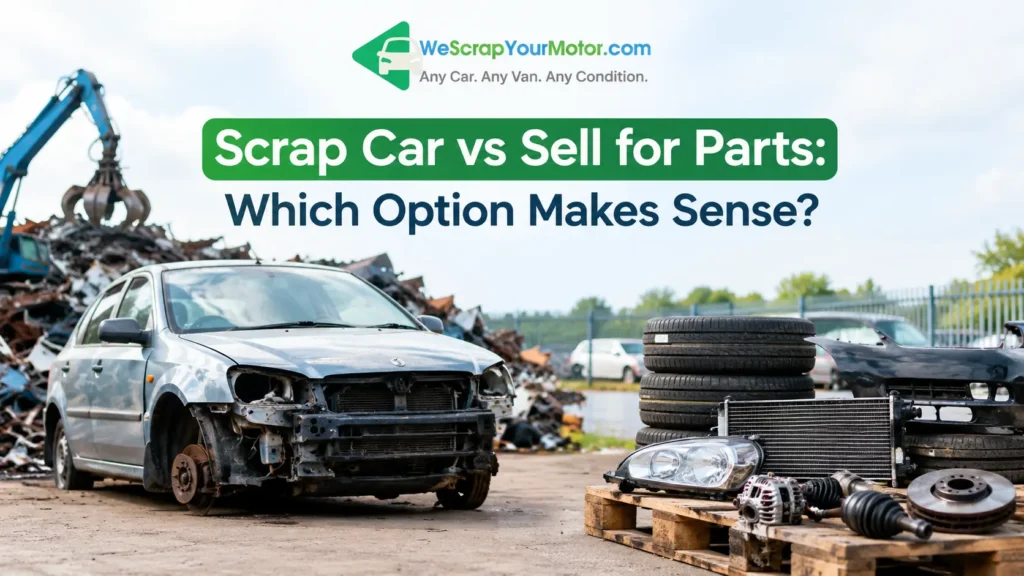
The scrap car vs sell for parts decision comes down to one question: will dismantling and selling individual components leave you with enough additional money to justify the time, tools, storage, effort and reduced value of the remaining vehicle?
Selling parts separately can sometimes produce a higher gross return because useful engines, gearboxes, wheels, lights, electronic modules and body panels may have individual demand.
But gross revenue is not the same as profit.
For many ordinary vehicle owners, selling a complete end-of-life car is faster and far less complicated. Before removing a single component, compare a quote for the complete vehicle with a realistic estimate of what the parts could actually return.
The Practical Difference Between Scrapping And Selling Parts
Understanding scrap car vs sell for parts begins with understanding what happens to the vehicle.
When you arrange legitimate permanent scrapping, an end-of-life vehicle enters an authorised treatment process. It is depolluted, suitable parts may be recovered, recyclable materials are separated and the remaining vehicle can be processed appropriately.
When you sell parts yourself, you effectively take on part of the dismantling and resale work.
That means you may need to:
- Identify components
- Remove them safely
- Store them
- Photograph them
- Advertise them
- Answer technical questions
- Arrange collection or delivery
- Handle unsold stock
- Eventually dispose of the remaining vehicle
The second option can generate extra value, but it also creates work that is easy to underestimate.
Start With the Complete-Car Quote
Before deciding on scrap car vs sell for parts, value the car exactly as it stands.
Do this before:
- Removing alloy wheels
- Taking out the battery
- Selling the catalytic converter
- Removing the engine
- Stripping body panels
- Taking electronic units out
A complete vehicle is easier to assess and can be easier to recover.
Once components are removed, the value and logistics can change.
If the car originally received an offer based on being complete, do not assume the same offer will remain available after major items disappear.
Why Some Parts Can Have Meaningful Value
Vehicles are made from more than bulk steel.
Depending on the make, model, age and condition, usable items can include:
- Engines
- Gearboxes
- Catalytic converters
- Alloy wheels
- Headlights
- Tail lights
- Doors
- Mirrors
- Infotainment systems
- ECUs and other modules
- Alternators
- Starter motors
- Interior trim
- Seats
- Bumpers
Your own existing guide to Which Car Parts Add the Most Value To a Scrap Car? explores the factors affecting component value in more detail.
The important word is usable.
A damaged component with no realistic buyer demand is not valuable merely because a new replacement is expensive.
Gross Parts Revenue Is Not Your Profit
This is where many scrap car vs sell for parts comparisons become unrealistic.
Imagine you identify ten components that appear to sell online.
Do not simply add the advertised prices together.
Instead calculate:
- Actual Sale Revenue
- Minus Tools
- Minus Packaging
- Minus Marketplace Or Payment Costs
- Minus Transport
- Minus Storage
- Minus Disposal Costs
- Minus Reduced Shell Value
- Equals Approximate Net Return
Then consider your time.
If dismantling, listing, answering messages and arranging deliveries consumes dozens of hours, the extra money may not be attractive.
For an enthusiast already equipped to dismantle vehicles, the calculation can look different from that of a household simply trying to clear an unwanted car from a driveway.
Which Cars Are More Suitable For Parts Selling?
The scrap car vs sell for parts equation may lean towards parts when the vehicle has several desirable, undamaged components.
Useful characteristics can include:
- A popular model with strong parts demand
- A good engine in a car damaged elsewhere
- An undamaged gearbox
- Desirable factory alloy wheels
- Rare trim
- Usable lights or panels
- Sought-after electronics
- A specialist or enthusiast model
- Recent replacement components
For example, an accident-damaged car with a working powertrain and clean rear body panels might have different reuse potential from an old vehicle suffering widespread corrosion and multiple mechanical failures.
Which Cars Usually Favour Whole-Vehicle Disposal?
Selling components may be much less attractive where the vehicle has:
- Extensive corrosion
- Flood contamination
- Serious fire damage
- Widespread accident damage
- Numerous missing parts
- A seized engine
- Damaged interior
- Weak demand for the model
- Very limited storage space around it
- Difficult recovery access
In those situations, dismantling can leave you with a shell that is harder and potentially more expensive to remove.
A complete quote should therefore be your baseline.
Does the Engine Make Selling For Parts Worthwhile?
Sometimes, but not automatically.
A used engine’s potential value depends on:
- Exact engine code
- Mileage
- Service history
- Whether it runs
- Known faults
- Demand
- Compatibility
- Ability to demonstrate condition
An engine that has not been tested is not equivalent to a verified working engine.
Removing it also requires appropriate equipment and leaves the car substantially less complete.
If you are comparing scrap car vs sell for parts because the engine still works, get a complete-vehicle valuation before assuming removal creates more profit.
What About the Gearbox?
The same principle applies.
A functioning gearbox for a model with strong replacement demand may attract interest.
But removing it takes time and equipment, and buyers may want confidence about its condition.
Automatic, CVT, dual-clutch and manual units also differ significantly.
Do not base the decision on the replacement cost of a new gearbox. The relevant figure is what a buyer will realistically pay for your particular used unit.
Catalytic Converters Need Careful Handling
Catalytic converters can influence end-of-life vehicle value because of the recoverable materials inside them.
However, the value varies significantly between vehicles and converter types.
Removing a converter before obtaining a whole-car quote can reduce the value of the remaining vehicle.
Also remember that provenance matters. Vehicle components associated with theft attract particular scrutiny, so keep clear records showing that any component you sell belongs to the vehicle you are legitimately disposing of.
For most owners, the safest commercial comparison is complete vehicle versus legitimate whole-car disposal, rather than removing high-value components first and asking questions afterwards.
Alloy Wheels Can Affect Value And Recovery
A set of genuine alloy wheels may have reuse or material value.
But if you sell all four before the car is collected, you may create a second problem:
How will the remaining shell be moved?
A vehicle that rolls is usually easier to recover than one resting on blocks.
If you are seriously considering selling wheels separately, ask the future collector whether the car can still be taken and whether its condition will change the quote.
Storage Is an Often-Ignored Cost
A major weakness in many scrap car vs sell for parts calculations is the assumption that every component sells immediately.
In reality, you may end up storing:
- Doors
- Bumpers
- Wheels
- Seats
- Engines
- Gearboxes
- Dashboards
- Trim
- Glass
- Electrical modules
Some items are large. Some are difficult to package. Some may remain unsold.
If you do not have secure, suitable space, dismantling a complete car can quickly turn one unwanted vehicle into dozens of unwanted objects.
Safety And Environmental Responsibilities Matter
An end-of-life vehicle can contain fuel, oils, coolant, brake fluid, refrigerants, batteries and other materials that require appropriate handling.
The Environment Agency describes unde-polluted end-of-life vehicles as hazardous waste and requires appropriate treatment through authorised facilities.
That is an important reason not to treat full vehicle dismantling like dismantling ordinary household equipment.
A professional authorised facility has processes designed to depollute and manage the vehicle safely.
What Happens When You Scrap the Complete Vehicle?
GOV.UK says a vehicle being scrapped must go through an Authorised Treatment Facility.
Once the ATF receives the vehicle, it may completely scrap it or decide to repair and sell it. For an eligible car or light van that is completely scrapped, a Certificate of Destruction should be issued within seven days.
That makes the whole-car route particularly useful for someone who wants a clear end point rather than an open-ended dismantling project.
In England and Wales, GOV.UK also states that payment for a vehicle being scrapped cannot legally be made in cash.
Scrap Car Vs Sell For Parts Comparison
| Factor | Scrap Complete Car | Sell Individual Parts |
| Time required | Usually lower | Potentially high |
| Dismantling required | No owner dismantling needed | Often substantial |
| Storage | Minimal | Can be significant |
| Number of buyers | Usually one | Potentially many |
| Revenue potential | One complete-vehicle offer | Potentially higher gross revenue |
| Certainty | Higher once terms are confirmed | Depends on parts actually selling |
| Remaining shell | Collected as agreed | Still needs disposal |
| Technical knowledge | Limited | Often useful or necessary |
| Safety considerations | Managed by authorised route | Owner assumes more responsibility |
This table is a better starting point than assuming either route always pays more.
Run a Break-Even Test
For scrap car vs sell for parts, calculate your break-even point before removing anything.
Suppose the complete vehicle has an agreed value of £X.
Your parts strategy only becomes more profitable when:
money actually received for parts + final shell value – all associated costs
is greater than £X by enough to justify your additional time and effort.
Do not use optimistic advertised prices.
Use realistic sale prices.
Also apply a probability to each component.
If you think an unusual interior part might sell for £100, that is not the same as already having a buyer offering £100.
Consider the Parts That May Never Sell
It is easy to focus on the strongest components.
But dismantling also produces items with weak demand.
You may sell:
- The wheels
- A headlight
- The engine
Then be left with dozens of components nobody wants.
Disposal of the remainder still has to be arranged.
This is why the scrap car vs sell for parts calculation should be based on the entire project rather than three attractive components.
What If You Only Remove One Or Two Parts?
Selective removal can appear to offer the best of both worlds.
Sometimes it can.
But ask the scrap buyer first.
Removing a battery, converter, wheels or major mechanical component may change the vehicle’s quotation or collection requirements.
Get two values where possible:
Value As Complete Vehicle
and
Value In Proposed Stripped Condition
You can then see whether selling the component separately produces a genuine improvement.
Do Not Forget the Value of Your Time
Imagine you earn an extra £250 by dismantling and selling components.
That sounds worthwhile until you discover the process required:
- 25 hours of work
- Repeated buyer messages
- Failed collections
- Packaging
- Cleaning
- Storage
- Arranging disposal of the shell
For some people, that is still worthwhile.
For others, it is not.
The right answer to scrap car vs sell for parts therefore differs according to the owner’s circumstances as well as the vehicle.
When Selling the Whole Car For Salvage Can Bridge the Gap
There is another option worth exploring.
Instead of individually selling parts, you may be able to sell the complete vehicle to a buyer who values its reusable components.
That can combine:
- Simpler collection
- One transaction
- No owner dismantling
- Potential recognition of salvage value
A complete car with desirable usable parts should therefore not automatically be valued only by raw metal weight.
Describe the vehicle accurately and ask what the offer is based on.
Get the Condition Recorded Before Collection
Whichever whole-car route you choose, record the vehicle’s condition.
Useful information includes:
- Registration
- Mileage
- Photographs
- Missing components
- Accident damage
- Whether it runs
- Whether it rolls and steers
- Keys
- V5C availability
This reduces disagreements later.
If you want to start with a complete-vehicle quote, use Scrap My Car UK before dismantling anything.
Think About Recovery Before Removing Wheels Or Running Gear
Recovery becomes especially important when the car cannot move normally.
Tell the collector if it:
- Has no wheels
- Has locked brakes
- Does not steer
- Is parked in a confined location
- Sits underground
- Is at a garage
- Has parts stored inside it
- Has been partially dismantled
For vehicles in Devon, Scrap My Car In Plymouth provides the relevant local collection route.
Do this planning before dismantling, not after.
Seven Questions To Ask Before Selling Parts
Is There Proven Demand?
Look for actual buyer interest in your exact model and specification.
Can You Remove the Component Safely?
Some jobs require specialist knowledge and equipment.
Can You Demonstrate That the Part Works?
Untested parts can be harder to value.
Where Will You Store It?
Large components need secure space.
How Will It Reach the Buyer?
Heavy or fragile parts can create transport problems.
What Will Happen To the Shell?
You still need a lawful disposal route.
Does the Extra Net Money Justify the Work?
This is the key question.
Frequently Asked Questions
Is It Better To Scrap a Car Or Sell Its Parts?
It depends on the vehicle and your circumstances. Selling parts can generate more gross revenue in some cases, while whole-car scrapping can be much simpler and more predictable.
Which Parts Can Increase a Car’s Value?
Engines, gearboxes, catalytic converters, wheels, electronic equipment and good body panels can sometimes have reuse or material value, depending on condition and demand.
Should I Remove the Catalytic Converter Before Scrapping?
Do not assume doing so increases your overall return. Get a quote for the complete vehicle first and ask how a missing converter would affect it.
Can I Scrap a Car After Removing Parts?
Incomplete cars may still be accepted, but missing components can affect both valuation and recovery. Disclose everything before accepting the quote.
Is Selling Parts Quickly Easy?
Not necessarily. High-demand items may sell relatively easily, while less desirable components can remain unsold for long periods.
What Happens To a Completely Scrapped Car?
An authorised treatment facility manages the end-of-life process, including depollution and material recovery. Qualifying completely scrapped vehicles receive a Certificate of Destruction.
Choose the Route Based On Net Value, Not Individual Part Prices
The smartest scrap car vs sell for parts decision starts before the spanners come out.
First find out what the complete vehicle is worth. Then identify the parts with genuine buyer demand, estimate realistic sale prices, subtract every cost and consider the value of your time.
If the additional net return is substantial and you have the skills, equipment and storage to dismantle responsibly, selling parts may deserve consideration.
If the difference is small, uncertain or dependent on dozens of components finding buyers, disposing of the complete vehicle through an appropriate authorised route can be far simpler.
The goal is not to extract the highest theoretical value from every nut and bolt. It is to achieve the strongest realistic result for the whole vehicle.