
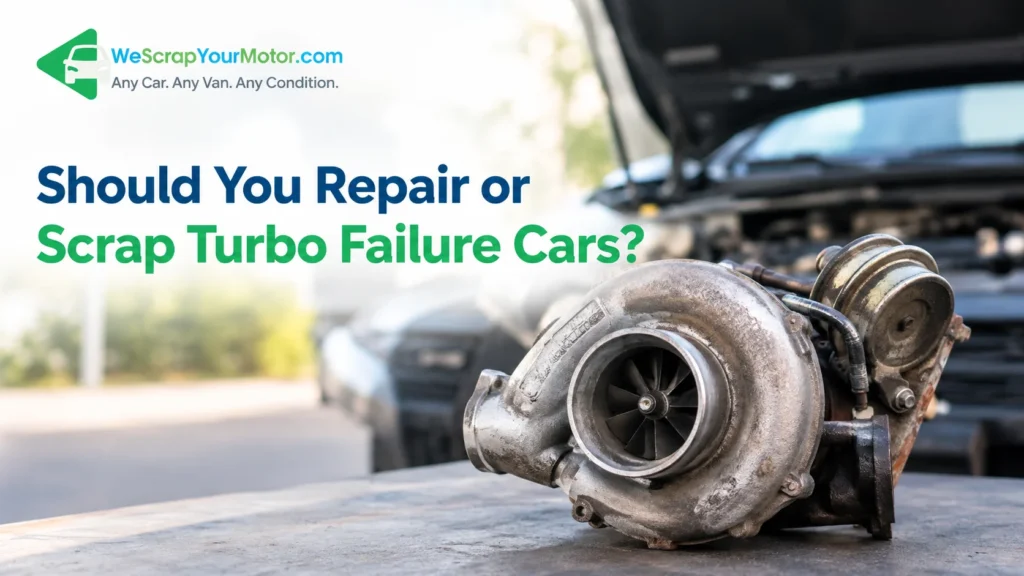
A failed turbocharger can turn an otherwise usable car into an expensive problem. The right choice depends on more than the price of a replacement turbo. You must consider why it failed, whether the engine has suffered further damage, the car’s current value and the likelihood of another costly repair. In many cases, it makes sense to scrap turbo failure cars when the total repair bill approaches or exceeds their realistic value. Newer or well-maintained vehicles may still justify a professional repair. This guide helps UK motorists compare both options using practical costs, risks and vehicle-value checks.
Quick Answer: Is Turbo Repair Worth It?
Repairing a failed turbo may be worthwhile when:
- The car is otherwise mechanically sound.
- Its body and interior remain in good condition.
- It has a complete service history.
- The engine has not suffered oil starvation or internal damage.
- The repair costs substantially less than the car’s post-repair value.
- You intend to keep the vehicle for several more years.
It may be better to scrap turbo failure cars when the vehicle is old, has high mileage or already has several expensive faults. Scrapping may also make sense when the turbo failure has contaminated the intake system, damaged the diesel particulate filter or affected the engine.
The most important rule is not to compare the turbo quote only with the car’s advertised retail price. Compare the total repair cost with what your particular car would genuinely be worth after repair.
What a Turbocharger Does
A turbocharger uses exhaust gases to compress air entering the engine. More air allows the engine to burn fuel efficiently and produce additional power without requiring a much larger engine.
Modern petrol and diesel cars often rely heavily on turbocharging. When the unit develops a fault, the driver may notice reduced performance, unusual sounds, exhaust smoke or a warning light. However, these symptoms do not always confirm that the complete turbo has failed.
A split boost hose, blocked oil feed, faulty actuator, worn sensor or vacuum-system problem can produce similar symptoms. A proper diagnosis is therefore essential before agreeing to an expensive replacement.
Common Signs Of Turbo Failure
Possible warning signs include:
- A sudden loss of engine power
- Slow acceleration
- Whining, scraping or siren-like noises
- Blue, grey or black exhaust smoke
- Rapid oil consumption
- An engine-management warning light
- Limp mode
- Oil inside boost pipes
- Low or irregular boost pressure
Stop driving and obtain professional advice if the engine starts producing heavy smoke, loses oil quickly or makes a mechanical grinding noise. Continuing to drive could turn a limited turbo problem into major engine damage.
These signs should be treated as diagnostic clues rather than proof. A garage should check fault codes, oil pressure, boost pressure, hoses, the intercooler, turbo shaft condition and the oil-supply system.
Why Turbochargers Fail
Understanding the cause helps you decide whether to repair or scrap turbo failure cars. Simply fitting another unit without correcting the original problem can cause the replacement to fail prematurely.
Poor Oil Supply
Turbochargers operate at extremely high speeds and rely on clean oil for cooling and lubrication. Low oil levels, blocked oil-feed pipes, incorrect oil or long service intervals can damage the bearings.
If oil starvation has affected other engine components, replacing only the turbo may not solve the wider problem.
Contaminated Oil
Dirty oil can carry carbon, metal particles and sludge into the turbo bearings. This creates wear and may restrict oil flow. A replacement job may therefore require fresh oil, filters, cleaned pipes and possibly a new oil-feed line.
Foreign-Object Damage
Debris entering through the air intake can damage the compressor wheel. Material from a deteriorating component can also reach the exhaust side of the turbo. The intake and exhaust systems must be inspected before a replacement is installed.
Blocked DPF Or Exhaust Restriction
On a diesel car, an overloaded diesel particulate filter can increase exhaust pressure and place additional stress on the turbo. If both components require attention, the combined cost may make repair uneconomical.
Age And Normal Wear
A high-mileage turbo can wear even when the car has received regular maintenance. Wear may appear gradually through reduced boost, oil leakage or increasing noise.
Poor Previous Repairs
An incorrectly fitted turbo, reused contaminated pipes or failure to prime the new unit can lead to repeat failure. This is why the quality and scope of the repair matter as much as the replacement part.
How Much Does Turbo Repair Cost In the UK?
There is no single UK price because labour time, engine layout, turbo type and related damage differ. A simple actuator or hose repair may cost far less than replacing the entire assembly. A full job can include:
- Diagnostic labour
- A new, remanufactured or used turbo
- Oil and oil filter
- Air filter
- Oil-feed and return pipes
- Gaskets and seals
- Intercooler cleaning
- Intake-system cleaning
- DPF diagnosis or cleaning
- Additional engine repairs
Obtain an itemised written estimate. Ask whether the quote includes VAT, diagnostic work, fluids, pipes and the correction of the original cause.
A cheap headline price can become much higher once the vehicle is dismantled. If a garage cannot explain why the old unit failed, paying for a replacement involves a significant risk.
New, Remanufactured Or Used Turbo
New Turbocharger
A new manufacturer-quality unit is normally the lowest-risk option, but it is usually the most expensive. Check the warranty terms and required fitting procedures.
Remanufactured Turbocharger
A properly remanufactured unit can cost less while still offering dependable service. Quality varies, so look for traceable components, balancing documentation and a meaningful warranty.
Used Turbocharger
A used turbo may reduce the immediate bill, but its history and remaining life may be unknown. It can be a poor choice when labour costs are high because the same labour may need to be paid again if it fails.
For an older low-value vehicle, fitting the cheapest possible part does not automatically make repair sensible. The complete financial risk must still be compared with the car’s value.
Calculate the Car’s Real Value
Before choosing to scrap turbo failure cars, estimate three different values:
- The car’s value in sound working condition
- Its value now as a non-running or faulty vehicle
- Its available scrap or salvage value
Do not rely only on dealer adverts. Advertised prices are not necessarily completed sale prices, and a dealer-prepared vehicle may carry a warranty and have better condition than yours.
Compare vehicles with the same model, year, engine, mileage, trim, service history and general condition. Then subtract any other work your car needs, such as tyres, brakes, suspension, body repairs or an upcoming timing-belt replacement.
You can also request a no-obligation valuation from We Scrap Your Motor to establish an alternative figure before authorising repairs.
Use the Repair-To-Value Test
A useful decision method is:
Total immediate repairs + likely near-term repairs ÷ realistic post-repair value
Imagine a car would be worth £3,000 in good condition. The confirmed turbo-related work costs £1,300, and it will soon need £500 of additional maintenance. The total exposure is £1,800, or 60% of its value.
That does not automatically mean the car must be scrapped. However, the decision becomes difficult when a large share of its value must be spent without eliminating the risk of other age-related faults.
The calculation should include:
- Confirmed turbo work
- Diagnostic charges
- Recovery or transport
- DPF or catalytic-converter work
- Overdue servicing
- MOT repairs
- Tyres and brakes
- Timing-belt or chain concerns
- Any warning lights or fluid leaks
This wider assessment explains why some owners scrap turbo failure cars even when a replacement turbo alone appears affordable.
Repair the Car When These Conditions Apply
Repair is more likely to make financial sense when the vehicle has a strong value, sound engine and clean maintenance history.
It may be reasonable to repair when:
- The problem is limited to a hose, sensor or actuator.
- The turbo failed before causing secondary damage.
- The garage has identified and corrected the root cause.
- The vehicle has no serious rust or MOT problems.
- You know the car’s maintenance history.
- The total cost remains comfortably below its value.
- A good warranty covers parts and labour.
- Replacing the car would cost considerably more.
Keeping a known car can sometimes be safer financially than buying another used vehicle with an unknown history. That advantage disappears if your current vehicle already has several unresolved problems.
Scrap the Car When These Warning Signs Apply
It may be sensible to scrap turbo failure cars when several of the following conditions are present:
- The engine ran with insufficient oil.
- Metal contamination is present.
- The engine has low compression.
- The DPF and turbo both require replacement.
- The car has severe corrosion.
- It recently failed its MOT on several expensive items.
- The gearbox, clutch or timing system also needs work.
- The repair approaches the car’s full market value.
- The vehicle has very high mileage and limited service history.
- A previous replacement turbo has already failed.
- The car cannot be driven or safely tested.
One expensive fault does not always end a vehicle’s useful life. Several interacting faults often do.
Does a Failed Turbo Damage the Engine?
It can. The level of risk depends on how the turbo failed and how long the vehicle continued running.
Possible secondary issues include oil loss, contaminated intake pipes, damaged intercoolers, excessive exhaust smoke, restricted DPF performance and internal engine wear. In some diesel failures, engine oil entering the intake can create an immediate safety risk. Switch off the vehicle if it behaves abnormally and seek professional help.
Do not repeatedly restart a severely affected engine simply to test it. A recovery vehicle is usually safer than attempting to drive it to a garage or collection point.
Can You Sell a Car With Turbo Failure?
Yes, provided you describe the fault honestly. Possible routes include:
- Private sale as a repair project
- Sale to a trader
- Specialist salvage sale
- Sale for reusable parts
- Scrapping through an authorised route
A private sale may return more than basic scrap value, but it can take longer and involves enquiries, viewings and transport arrangements. Buyers may also negotiate heavily because the full extent of the damage is unknown.
A straightforward collection service may suit owners who value speed and certainty over attempting to obtain the highest theoretical price.
How Turbo Failure Affects Scrap Value
The turbo itself is only one part of the valuation. A complete vehicle may retain value through its weight, reusable panels, wheels, electrical components and other mechanical parts.
The following details can affect an offer:
- Make, model and age
- Vehicle weight
- Location
- Whether access is suitable for collection
- Engine and gearbox completeness
- Catalytic converter or DPF presence
- Alloy wheels
- Overall condition
- Current metal demand
- Reusable-parts demand
Removing valuable components before obtaining a quote may lower the offer. GOV.UK also explains that an authorised treatment facility may charge when essential parts such as the engine, gearbox, bodywork or wheels have been removed. Official guidance says end-of-life vehicles must be handled through an authorised treatment facility.
If you are located in South Wales, the Scrap My Car in Swansea can be used to check the local collection process.
What Information To Provide For an Accurate Quote
When asking whether to repair or scrap turbo failure cars, provide accurate information from the beginning:
- Registration number
- Postcode
- Make and model
- Current mileage
- Whether the car starts
- Whether it moves and steers
- Turbo diagnosis, if available
- Warning lights
- Missing components
- Accident or fire damage
- Wheel and tyre condition
- V5C availability
- Exact collection location
Clear information reduces the risk of a quote changing when the vehicle is inspected. Photos can be useful when damage or access conditions are difficult to describe.
How the Legal Scrapping Process Works
A reputable route should include the following:
- Obtain a quote using accurate vehicle information.
- Confirm whether the collection is included.
- Check who will collect the vehicle.
- Ensure it goes to an authorised treatment facility.
- Prepare the V5C when available.
- Remove personal possessions.
- Keep the relevant evidence and payment record.
- Notify DVLA as required.
- Retain the Certificate of Destruction when one is issued.
GOV.UK states that owners can face a £1,000 fine for failing to tell DVLA that a vehicle has been taken to an authorised treatment facility. The official service also provides separate ATF lists for England, Wales, Scotland and Northern Ireland.
For a full overview, read How To Scrap a Car In the UK.
Mistakes That Can Cost You Money
Replacing the Turbo Without Finding the Cause
A new unit may fail if blocked pipes, contaminated oil or exhaust restrictions remain.
Comparing the Repair With an Unrealistic Sale Price
Use the value of your actual car, not the highest online advert for the model.
Ignoring Additional Work
A turbo repair can seem viable until DPF, clutch, tyre and MOT costs are included.
Driving After Serious Symptoms Appear
Continuing to drive may expand the damage and reduce the vehicle’s remaining value.
Removing Parts Before Valuation
Missing components can reduce an offer or create collection complications.
Accepting an Unclear Quote
Confirm whether the figure includes collection and whether disclosed faults could change it.
A Practical Decision Checklist
Ask these questions before you scrap turbo failure cars or approve a repair:
- Has the turbo failure been professionally confirmed?
- Has the original cause been identified?
- Is there evidence of engine damage?
- What is the complete written repair cost?
- What other work is due within 12 months?
- What is the realistic repaired value?
- What is the current faulty-car value?
- What is the available scrap or salvage offer?
- Does the repair include a suitable warranty?
- Would you trust the car after work?
- Can you afford an unexpected second repair?
If most answers support the car’s condition and long-term value, repair may be reasonable. If the diagnosis remains uncertain and the vehicle already has several expensive problems, scrapping may protect you from further losses.
Choose the Option That Protects Your Budget
Turbo failure does not automatically mean a car has reached the end of its life. A focused repair can be worthwhile on a valuable, well-maintained vehicle when the underlying cause is known. The situation changes when engine damage, DPF problems, high mileage and other overdue repairs appear together.
Before deciding to scrap turbo failure cars, obtain a diagnosis, a complete repair estimate and a realistic vehicle valuation. Then compare those figures with a transparent collection quote. The best choice is the one that limits total financial risk, not simply the option with the lowest cost today.