
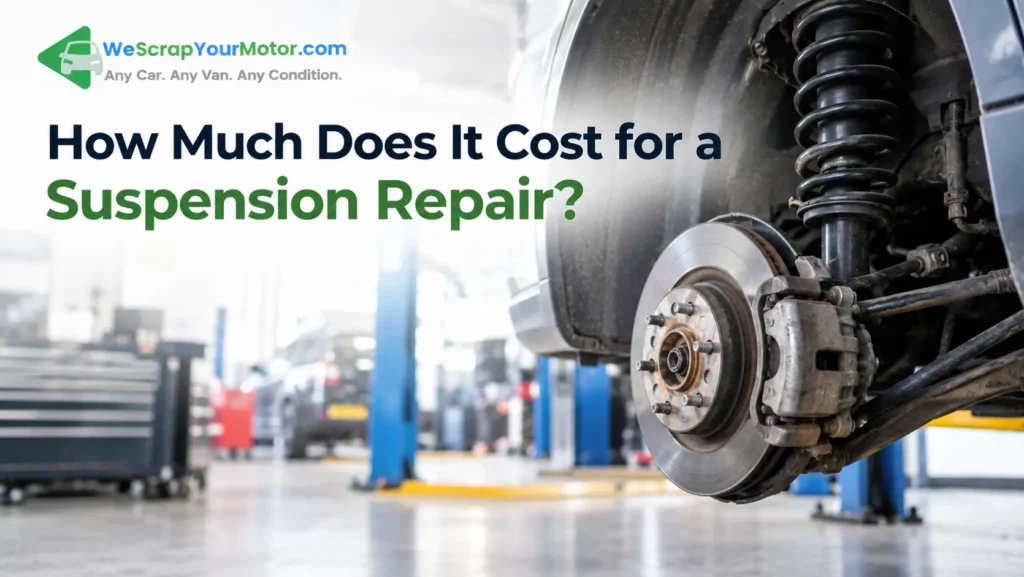
Your car’s suspension does more than make journeys comfortable. It helps keep the tyres in contact with the road, maintains stability when cornering and supports predictable steering and braking. When something goes wrong, you may notice knocking noises, unusual bouncing, uneven tyre wear or a car that no longer feels secure on the road.
The worrying part is not always the fault itself. It is the uncertainty about how much the garage will charge.
Suspension repair cost in the UK typically ranges from around £100 for a relatively straightforward component repair to £600 or more for extensive work. Replacing two shock absorbers commonly costs approximately £300-£450 fitted, while suspension bushes may cost around £100-£250 per repair.
More complex suspension systems, particularly those fitted to premium SUVs and vehicles with air suspension, can cost considerably more.
This guide explains what you might pay in 2026, how garages calculate their quotes, which warning signs matter and when repairing an older vehicle makes financial sense.
Average Suspension Repair Cost in the UK
There is no universal price for repairing a car’s suspension because the system contains several separate components.
A worn bush is very different from a leaking shock absorber, broken coil spring or failed air suspension unit.
The following table provides indicative UK garage prices.
| Suspension Component or Repair | Estimated UK Cost |
| Suspension inspection | £40–£100 |
| Suspension bush replacement | £100–£250 |
| Lower suspension arm replacement | £120–£350 per arm |
| Coil spring replacement | £150–£300 per spring |
| Shock absorber replacement | £300–£450 per pair |
| Anti-roll bar drop link replacement | £60–£160 per link |
| Ball joint replacement | £100–£250 |
| Wheel alignment | £40–£100 |
| Air suspension component replacement | £400–£1,500+ |
Pricing note: These are broad budgeting estimates, not fixed national averages. Costs can be higher for premium vehicles, specialist suspension designs, seized components or substantial additional work. Always obtain a vehicle-specific quotation.
For example, a Vauxhall Corsa requiring a replacement drop link may have a relatively modest repair bill. A Range Rover with a failed air suspension strut may require a substantially larger budget.
Therefore, the most useful question is not simply how much suspension repairs cost. It is which component has failed and what needs to be replaced alongside it.
What Does Your Car’s Suspension Actually Do?
A suspension system connects the vehicle’s wheels to its structure while allowing controlled movement over uneven surfaces.
Its main responsibilities include:
- Supporting the car’s weight
- Absorbing road impacts
- Controlling body movement during acceleration and braking
- Maintaining tyre contact with the road
- Helping the vehicle remain stable through corners
- Reducing vibration transmitted to passengers
Most conventional passenger cars use a combination of springs, dampers, suspension arms, bushes and joints.
Some vehicles have more complicated arrangements, including adaptive dampers, multilink suspension or electronically controlled air suspension.
Each design has different repair requirements.
Importantly, suspension components work together. A worn bush may cause movement that changes wheel alignment, while a damaged damper may contribute to irregular tyre wear.
This is why an accurate inspection matters before anyone approves replacement parts.
Suspension Repair Costs by Component
Understanding which part needs attention can help you interpret a garage quotation.
1. Coil Spring Replacement Cost
Coil springs support the vehicle and absorb movement as the suspension compresses and extends.
Over time, corrosion, fatigue and repeated impacts can cause a spring to crack or break.
Common symptoms include:
- One corner of the car sitting lower
- A metallic noise over bumps
- Changes in ride height
- A visible broken spring section
- An MOT failure caused by a defective spring
Replacing a conventional coil spring may cost around £150–£300 per spring.
However, the price depends heavily on accessibility and whether other parts must be removed.
Garages may recommend replacing springs in axle pairs to maintain balanced suspension characteristics.
Ask whether the quotation covers one spring or both.
Never attempt to compress or remove a loaded suspension spring without professional equipment and training. Stored spring energy can cause serious injury.
2. Shock Absorber Replacement Cost
Shock absorbers, also called dampers, control spring movement.
Without effective damping, a car can continue bouncing after encountering a bump.
Worn shock absorbers may cause excessive body movement, poorer stability and uneven tyre contact.
Typical symptoms include:
- Repeated bouncing after road undulations
- Excessive nose-diving during braking
- Reduced stability around corners
- Oil leakage from a damper
- Irregular tyre wear
Replacing a pair of shock absorbers typically costs approximately £300–£450 fitted.
Front suspension assemblies can be more expensive than rear dampers because they may involve additional components and labour.
For some vehicles, the damper is integrated into a complete strut assembly.
A garage may recommend replacing both dampers on the same axle even if only one has obviously failed.
This helps preserve balanced performance.
3. Suspension Bush Replacement Cost
Suspension bushes are flexible components that reduce vibration and allow controlled movement between metal parts.
As rubber deteriorates, the suspension can develop excessive movement.
Drivers often describe a knocking sound when crossing speed bumps or travelling over uneven surfaces.
Suspension bush replacement commonly costs around £100–£250, depending on the component.
Some bushes can be removed separately.
Others are integrated into suspension arms, making a complete arm replacement more practical.
Before accepting a quotation, ask whether the mechanic intends to replace the bush alone or the entire assembly.
The difference can significantly affect the final suspension repair cost.
4. Suspension Arm Replacement Cost
Suspension arms help position the wheels correctly as the suspension moves.
They commonly incorporate bushes and ball joints.
A damaged arm can affect steering accuracy, tyre wear and overall road stability.
Replacement usually costs approximately £120–£350 per arm for many conventional vehicles.
Prices increase when the suspension uses several control arms or specialised aluminium components.
Wheel alignment may also be required after replacement.
If a garage recommends multiple suspension arms, ask it to identify which joints or bushes have excessive wear and explain why each arm requires replacement.
A thorough diagnosis protects you from unnecessary expenditure.
5. Anti-Roll Bar and Drop Link Repair Cost
The anti-roll bar helps control body roll during cornering.
Drop links connect it to parts of the suspension.
Worn drop links frequently cause rattling or knocking sounds over uneven roads.
A drop link replacement might cost approximately £60–£160 per side.
However, a damaged anti-roll bar, seized mounting or inaccessible component can increase the bill.
A knocking noise does not automatically mean the drop link has failed.
Similar noises can come from shock absorber mountings, ball joints and other suspension components.
A garage should confirm the source rather than replacing parts based on sound alone.
6. Ball Joint Replacement Cost
Ball joints permit suspension movement while maintaining wheel positioning.
When worn, they may produce knocking, steering looseness or uneven tyre wear.
Replacing a ball joint can cost approximately £100–£250 on many vehicles.
Some cars have independently replaceable joints.
Others require replacement of the complete suspension arm.
Severe ball joint wear is a safety concern because a failed joint can compromise wheel control.
Avoid driving a vehicle that a qualified mechanic has identified as having a dangerously defective joint.
7. Air Suspension Repair Cost
Air suspension replaces or supplements conventional springs with air-supported components.
It is found on certain luxury vehicles, SUVs and cars designed to maintain ride height under varying loads.
Potential faults include:
- Leaking air springs
- Damaged air lines
- Failed compressors
- Faulty height sensors
- Electrical control problems
- Valve block faults
Repairs can range from a relatively modest sensor repair to £1,500 or more for major component replacement.
Some vehicles require specialised diagnostic equipment and calibration.
A car sitting unusually low after parking does not prove that the compressor has failed.
The fault could be a leaking air spring, pipework issue or control problem.
Proper diagnosis is essential before authorising an expensive replacement.
What Makes Suspension Repairs More Expensive?
Two garages can quote different prices for the same vehicle without either quotation necessarily being unreasonable.
Several factors explain the variation.
Vehicle Make and Model
Mass-produced family cars generally have widely available replacement parts.
Luxury, performance and specialist vehicles may require more expensive components.
For example, an ordinary rear damper on a small hatchback may be substantially cheaper than an electronically controlled damper on a premium SUV.
The suspension design matters more than the brand name alone.
Labour Time
A straightforward drop link replacement may require relatively little labour.
Replacing complex front suspension assemblies or removing heavily corroded components can take much longer.
Suspension bolts are exposed to water, dirt and road salt.
Seized fixings can increase labour time, especially on older UK vehicles.
Parts Quality
Garages may offer genuine manufacturer parts or suitable aftermarket alternatives.
Premium aftermarket parts can provide good performance, but quality and compatibility vary.
Ask for the part manufacturer and warranty.
Do not assume the cheapest replacement is automatically the best long-term option.
Wheel Alignment
Changing certain suspension components may affect wheel geometry.
If alignment is required, the garage may charge separately.
Ignoring incorrect alignment can cause premature tyre wear and may undermine the benefit of the repair.
Additional Damage
A damaged spring might also have affected a tyre or nearby suspension component.
Similarly, prolonged driving with worn bushes can contribute to other problems.
The original quotation may change if the mechanic discovers further damage.
A reputable garage should explain and seek your approval before undertaking additional chargeable work.
How Can You Tell If Your Suspension Is Failing?
Suspension problems are not always obvious.
Some appear gradually, while others develop suddenly after striking a pothole.
| Warning Sign | Possible Explanation | Recommended Action |
| Knocking over bumps | Bushes, drop links or joints | Arrange an inspection |
| Excessive bouncing | Worn shock absorbers | Have dampers checked |
| One corner sitting low | Broken spring or air suspension fault | Avoid driving until assessed |
| Uneven tyre wear | Suspension wear or incorrect alignment | Check tyres and suspension |
| Steering feels loose | Worn joint or suspension component | Seek urgent professional inspection |
| Metallic noise after a pothole | Damaged spring or mounting | Stop if handling is affected |
| Car leans unusually | Spring or suspension fault | Arrange a safety assessment |
Symptoms can overlap with steering, wheel-bearing and tyre faults.
For example, vibration through the steering wheel might result from wheel imbalance rather than damaged suspension.
That distinction matters because replacing the wrong component wastes money.
Can You Drive a Car With Damaged Suspension?
It depends on the severity of the fault.
A minor suspension advisory is different from a broken spring or dangerously worn ball joint.
However, suspension faults affect components responsible for keeping the vehicle stable.
You should not continue driving if the car has severe steering instability, a wheel sitting at an unusual angle, a collapsed corner or a known dangerous suspension defect.
Arrange professional recovery if the vehicle cannot safely be driven.
The UK government’s vehicle safety guidance makes clear that a car must remain roadworthy even when it has a valid MOT certificate.
A current MOT is not a guarantee that newly developed suspension faults are safe to ignore.
Can Suspension Problems Cause an MOT Failure?
Yes.
Suspension components are examined during the MOT inspection.
The DVSA’s MOT inspection manual covers springs, dampers, joints, bushes and other relevant components.
A defect may be classified as minor, major or dangerous depending on its condition and risk.
For example, excessive wear in a suspension joint can result in a major defect.
A joint likely to become detached can be classified as dangerous.
A vehicle fails its MOT when major or dangerous defects are recorded.
If your car receives a dangerous defect, it must not be driven until the issue has been repaired.
If the MOT identifies suspension problems, ask the garage to explain the precise defect rather than approving a general suspension replacement.
How Long Does a Suspension Repair Take?
The time required depends on the part, vehicle design and condition of the fixings.
A simple drop link replacement may be completed relatively quickly.
Replacing suspension arms, coil springs or strut assemblies may take several hours.
Complex air suspension repairs can require more time because diagnosis, installation and calibration may all be necessary.
The garage may also need additional time if:
- Replacement parts are not immediately available
- Corroded fasteners are difficult to remove
- Several components require attention
- Wheel alignment is necessary
- The vehicle needs an additional inspection after repair
Ask whether the quoted turnaround includes parts delivery and testing.
A short labour estimate does not always mean the vehicle will be ready for collection on the same day.
How to Get an Accurate Suspension Repair Quote
Instead of requesting a generic suspension price, provide the garage with information that helps narrow down the fault.
Useful details include your registration, make, model, mileage and a description of the symptoms.
Explain when the problem occurs.
For example, does the car knock when turning, while braking or only when crossing uneven surfaces?
Tell the garage if the symptoms appeared after a pothole impact.
Also mention any recent MOT advisory notices.
When you receive a quotation, check the following:
- Which component is being replaced?
- Is the price for one side or an axle pair?
- Are parts, labour and VAT included?
- Is wheel alignment included if required?
- Are the parts genuine or aftermarket?
- What warranty applies?
- Could corrosion or further damage increase the bill?
- Will additional work require approval?
A detailed quotation allows meaningful comparisons.
One garage may quote for a single damper while another includes replacement of both dampers on the axle.
Those quotations are not directly comparable until you understand the work involved.
Is It Worth Repairing Suspension on an Older Car?
Suspension repairs are often worthwhile because many components are replaceable without rebuilding the entire vehicle.
For example, a £180 suspension repair may be sensible on a car worth £2,000 if its engine, gearbox and bodywork remain in reasonable condition.
But the decision becomes more complicated when the suspension is only one of several expensive problems.
Consider two illustrative situations.
Situation One: a Repairable Family Hatchback
An older hatchback is worth approximately £2,500 in working condition.
It needs £250 of suspension work and has no major mechanical problems.
Repairing the suspension may be a sensible investment if the owner intends to continue using the car.
Situation Two: Multiple Expensive Faults
Another vehicle is worth approximately £1,200 when fully roadworthy.
It requires £600 of suspension repairs, £500 of brake work and further attention to corrosion.
The combined repair bill exceeds its likely usable value.
Scrapping or selling the car as damaged may be a more practical option.
These are examples, not real vehicle valuations.
For a structured comparison, read our guide on Should I Repair or Scrap My Car?
Consider the complete condition of the vehicle rather than focusing on a single suspension bill.
When Scrapping Becomes More Practical Than Repairing
Suspension problems alone rarely justify scrapping a car.
However, some older vehicles have several simultaneous faults.
Common warning signs include:
- Extensive structural corrosion
- Multiple dangerous MOT defects
- Significant engine or gearbox problems
- Repeated breakdowns
- Repair estimates higher than the car’s realistic value
- Uncertainty about additional hidden damage
If the vehicle is no longer financially practical to restore, you can explore Scrap My Car in the UK to understand an alternative to further repairs.
Owners in Wiltshire can also explore Scrap My Car in Salisbury when considering collection for an unwanted vehicle.
Always compare the actual repair quotation against a realistic scrap or salvage offer.
A damaged but repairable vehicle may have more value as salvage than as scrap metal.
How to Reduce Your Suspension Repair Bill
Saving money should not mean compromising on safety.
Instead, focus on avoiding unnecessary repairs and obtaining appropriate parts.
Compare Written Quotations
Ask independent garages for estimates that cover the same work.
A quote from a suspension specialist may also be useful for complex systems.
Ask About Suitable Aftermarket Parts
Reliable aftermarket components can sometimes cost less than genuine manufacturer replacements.
Check quality, compatibility and warranty terms before agreeing.
Repair Problems Before They Spread
A worn suspension component can contribute to tyre damage and other problems.
Early inspection may prevent additional costs.
Check the MOT History
Review previous advisories through the official UK MOT history service.
Repeated advisories may help identify components that have deteriorated over time.
Avoid Paying Twice for Alignment
If several suspension components need replacing, ask the garage whether wheel alignment should be performed after all relevant work is completed.
This may avoid unnecessary repeat charges.
Frequently Asked Questions
How Much Does a Full Suspension Replacement Cost?
Replacing most major suspension components can cost considerably more than an individual repair.
On a conventional car, extensive front and rear suspension work may run into four figures.
Premium vehicles or cars using air suspension can cost significantly more.
A garage should itemise every component rather than providing an unexplained full-system price.
Is Suspension Repair Expensive in the UK?
It depends on the fault.
A drop link or individual bush may be relatively affordable, while multiple suspension arms, dampers or electronic air suspension components can be expensive.
The cost of replacing a part is often more useful than a generic suspension repair average.
Should Shock Absorbers Be Replaced in Pairs?
Garages commonly recommend replacing shock absorbers in axle pairs to maintain consistent damping.
The manufacturer’s recommendations and the condition of the remaining component should guide the decision.
Does Suspension Repair Include Wheel Alignment?
Not always.
Some garages include alignment when it is necessary, while others charge separately.
Ask for written confirmation before booking.
Can a Pothole Damage the Suspension?
Yes.
A severe pothole impact can damage springs, dampers, joints, suspension arms, wheels or tyres.
If the car begins pulling to one side, making new noises or handling differently after an impact, arrange an inspection.
Is a Knocking Suspension an MOT Failure?
Not automatically.
The sound itself does not determine the MOT result.
The tester assesses the condition and function of the relevant components.
A worn or insecure joint, for example, may lead to a major or dangerous defect.
Can I Replace Only One Suspension Spring?
It may be technically possible, depending on the vehicle and manufacturer’s recommendations.
However, replacing axle pairs is often recommended to maintain consistent spring characteristics.
Ask the garage to explain whether the second spring genuinely needs replacement.
Does a Suspension Repair Increase My Car’s Value?
Repairing defective suspension may improve saleability and restore the vehicle’s roadworthiness.
However, the vehicle’s market value will not necessarily increase by the full repair amount.
Buyers generally expect a roadworthy car to have functioning suspension.
Make the Right Decision Before Paying for Suspension Work
A suspension fault does not automatically mean your car is beyond economical repair.
Many common problems involve individual components that can be replaced at a manageable cost.
The important steps are identifying the defective part, understanding the complete quotation and checking whether the rest of the vehicle justifies the expenditure.
If the fault is isolated and the car remains reliable, repairing it is often the most economical choice.
If expensive suspension work is accompanied by major corrosion, engine trouble or repeated MOT failures, compare the full repair bill against the realistic value of the vehicle.
That way, your decision is based on safety, evidence and cost rather than an alarming noise or an unexpected garage estimate.