
A wet belt replacement cost can look surprisingly high when you first receive a garage quotation. After all, how can replacing a belt become a bill approaching £1,000 or more?
The answer is that you are paying for access, correct installation, associated components and the work needed around an oil-immersed timing system. Comparing only the price of the belt misses most of the job.
For a Ford 1.0 EcoBoost, one UK specialist currently publishes an indicative range of around £700 to £1,200 or more. That is a useful reference for that particular application, not a universal price for every wet-belt engine. Other engines, dealer labour rates and additional faults can produce substantially different quotations.
The most useful question is therefore not simply whether your quote is expensive. It is whether the quotation covers the right work for your engine and whether the car justifies the investment.
This guide explains how to read the bill, recognise important exclusions and make a decision without treating routine maintenance as an automatic reason to scrap an otherwise useful vehicle.
What Makes a Wet Belt Different?
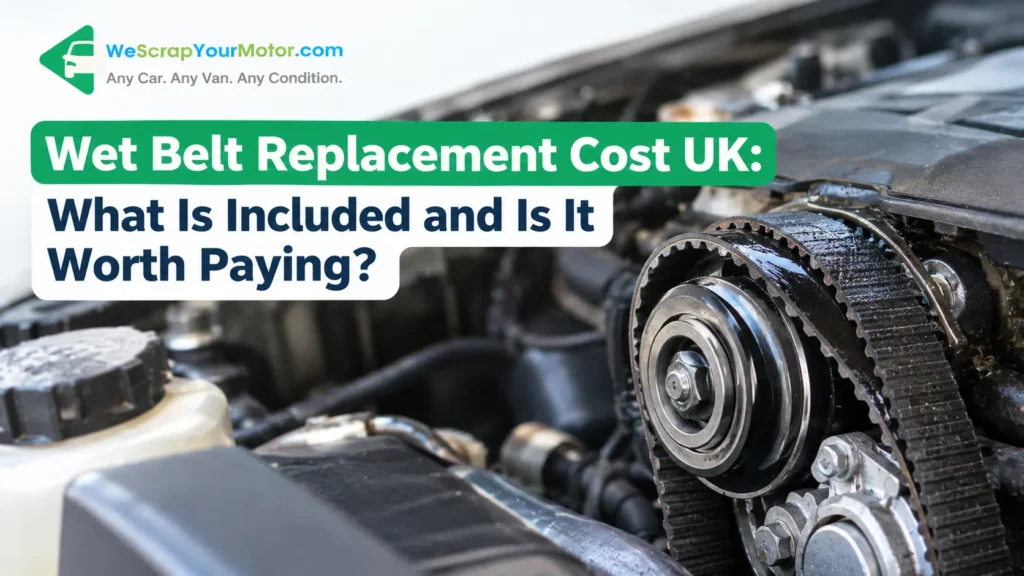
A wet belt operates inside an engine’s oil environment. A conventional dry timing belt works outside that environment, behind protective covers.
Where fitted as the timing drive, the belt helps synchronise the crankshaft and camshaft movement. Some engines also use a separate belt for another function, such as driving the oil pump. These components must not be confused when discussing a service package.
Gates describes belt-in-oil systems as presenting additional challenges involving oil exposure, heat and servicing complexity. Its replacement kits are application-specific, which reinforces why a generic belt quotation is not enough.
A car’s badge does not identify its exact belt arrangement. Two vehicles sold under the same model name may have different engines or production specifications.
Before comparing wet belt replacement cost quotations, give the garage your registration, mileage and service history. Ask it to confirm the engine version and the components included.
That small clarification can prevent a large misunderstanding later.
How Much Should You Budget?
There is no reliable single price covering every UK vehicle with a wet belt. A small petrol hatchback, a different petrol engine family and a commercial diesel application should not automatically share the same estimate.
Use the following table to understand the type of quotation you need.
| Situation | What the Price Should Represent |
| Scheduled Replacement on a Healthy Engine | The Defined Belt Service, Required Parts and Labour |
| Replacement After Visible Belt Deterioration | Belt Work Plus Assessment of Contamination and Related Problems |
| Low Oil Pressure or Suspected Internal Damage | Diagnosis Before a Final Repair Quotation |
| Confirmed Engine Damage | a Separate Repair or Engine Replacement Proposal |
| Unclear Service History | Inspection and a Vehicle-Specific Maintenance Recommendation |
The published £700 to £1,200-plus EcoBoost reference is a starting point for discussion. It does not establish what a Peugeot, Citroën, Vauxhall or different Ford application should cost.
Your wet belt replacement cost should also be expressed as the total payable. Ask whether VAT, oil, filter, disposal charges and necessary consumables are included.
A headline figure of £850 plus VAT becomes £1,020 at 20% VAT. Comparing it with an inclusive £980 quotation without checking the tax treatment gives the wrong impression.
Read the Quote as a Scope of Work
A useful quotation tells you what the garage will do, not merely what it will charge.
“Replace wet belt” leaves too many questions unanswered. A more informative description identifies the engine, replacement kit, associated items, oil specification and relevant inspection work.
Ask for the parts manufacturer or part references where available. You do not need to become a mechanic, but you should be able to establish whether both garages are pricing an equivalent job.
The wet belt replacement cost may include several items grouped under one package. That is perfectly acceptable if the garage explains the package clearly.
It becomes harder to compare when one business includes a complete service scope while another quotes only the central belt operation.
Also distinguish a fixed quotation from an estimate. Ask what discoveries could alter the price and whether additional work requires your approval.
An agreed authorisation limit helps you retain control if dismantling reveals something unexpected.
Which Components Deserve Particular Attention?
The Belt Kit and Associated Hardware
Ask whether the quotation includes the relevant tensioning components and any required single-use fasteners, seals or gaskets.
The correct list depends on the engine and repair procedure. A workshop should follow the applicable technical information rather than assume every wet-belt job uses an identical collection of parts.
A recognised parts brand is useful information, but it does not replace competent fitting. Equally, an aftermarket component is not automatically unsuitable merely because it lacks the vehicle manufacturer’s packaging.
The important points are compatibility, quality, traceability and a clear parts-and-labour warranty.
Other Belts in the Engine
Where a separate oil-pump drive belt is fitted, establish whether replacement is included or recommended.
Do not accept an assumption that “the belt has been done” means every relevant belt has been renewed. Ask the garage to identify which components the invoice will record.
This is particularly important when you later sell the vehicle. A detailed invoice gives a future buyer much more useful information than a handwritten note saying “timing belt changed”.
Oil, Filter and Reassembly Materials
The wet belt replacement cost should account for the fluids and materials required by the actual procedure.
Ask for the oil specification, not simply a viscosity such as 5W-30. Oils sharing a viscosity label can meet different manufacturer requirements.
Your invoice should ideally record the product used. That creates a useful maintenance trail and makes future servicing easier to arrange consistently.
Why Sump and Oil-Pickup Work Can Matter
On relevant engines, deteriorating belt material can become a contamination concern. That is why some specialist packages include sump removal and inspection or cleaning of the oil pickup.
The Timing Co specifically includes this issue in its explanation of Ford 1.0 EcoBoost servicing. However, its package should not be treated as a universal procedure for every engine design.
Ask your garage how it addresses contamination on your exact engine and what happens if material is discovered.
The answer should explain both the planned work and the limits of that work. Removing debris does not automatically prove that an engine previously exposed to low oil pressure has escaped damage.
This distinction is important when assessing wet belt replacement cost. Preventive servicing on a healthy engine is a different purchase from attempting to recover an engine after a lubrication problem.
If there has already been a warning light, unusual noise or breakdown, make sure the quotation starts with diagnosis.
Is the Water Pump Automatically Included?
No. You should ask rather than assume.
On some timing-belt jobs, water-pump replacement offers useful labour overlap. On other applications, the layout and procedure make the decision different.
Request the additional cost, the reason for recommending replacement and the consequences of leaving the existing pump in place.
A pump with a confirmed leak deserves a different discussion from a sound pump being offered as an optional preventive item.
The same reasoning applies to auxiliary belts, coolant hoses and unrelated service work. Combining jobs can be convenient, but each item should have an identifiable purpose.
A higher wet belt replacement cost is not necessarily poor value when it includes worthwhile additional work. It is poor comparison practice to treat that higher package as identical to a belt-only quotation.
If your budget is limited, ask the garage to separate essential work, sensible preventive work and items that can reasonably wait.
When Should the Belt Be Replaced?
Use the current schedule for the actual vehicle, including both mileage and time limits.
Do not apply a replacement interval from a forum discussion to an engine merely because the model name looks familiar. Production changes and engine variants matter.
Ford directs owners to their service information, Ford account or dealer for the exact schedule. It also explains that service intervals vary by model and engine.
A maximum scheduled interval is not a guarantee that an engine with unknown maintenance or an emerging problem needs no earlier attention.
Conversely, a garage suggesting earlier replacement should explain why. Ask whether the recommendation follows updated manufacturer information, observed condition, missing history or its own preventive policy.
The wet belt replacement cost becomes easier to plan when you know the actual deadline. You can obtain comparable quotations and arrange transport before the work becomes urgent.
If the history is incomplete, try retrieving previous invoices before assuming the belt has never been changed.
Can You Wait Until Symptoms Appear?
Waiting for a clear symptom is a poor maintenance strategy.
A quiet engine does not establish the remaining life of a belt. Similarly, a limited visual inspection cannot necessarily establish the condition of every part of the belt or the lubrication system.
If an oil-pressure warning appears while the engine is running, stop safely and switch off. Ford’s dashboard guidance treats this as a fault requiring attention. Do not continue driving merely because the oil level appears normal.
Oil level and oil pressure are different measurements.
For a healthy car approaching scheduled maintenance, the decision concerns prevention. For a car showing warning signs, the decision concerns diagnosis and protection from further damage.
Do not let an apparently attractive wet belt replacement cost persuade you to book a routine package when the vehicle needs investigation first.
Describe symptoms accurately when requesting the appointment, including when they occurred and whether the vehicle was driven afterwards.
Compare Two Quotations Properly
Consider this hypothetical example.
Garage A quotes £820, while Garage B quotes £1,050. At first, Garage A appears £230 cheaper.
You then discover that Garage A excludes oil, the filter and specified additional inspection work. Garage B includes those items and provides a written parts-and-labour warranty.
Neither quotation can be judged fairly until the scope is aligned.
Ask Garage A for the price of the same work. Ask Garage B whether any optional items are included that your vehicle does not need.
The objective is not to force both prices into the same number. It is to understand what the difference buys.
When comparing wet belt replacement cost, also consider recovery, travel and time without the vehicle. A distant workshop may offer an attractive price, but the total saving can shrink if you need paid transport or another day away from work.
Convenience has value, provided it does not replace technical suitability.
Is the Work Worth Paying for on an Older Car?
An older vehicle can still justify a substantial maintenance bill.
Imagine a car you know well, with sound bodywork, a dependable gearbox, a useful MOT history and no major unresolved faults. Paying for scheduled belt work may cost much less than replacing it with another used vehicle of uncertain condition.
Now consider a car needing structural repairs, transmission work and several other expensive jobs. The same belt quotation sits within a very different ownership decision.
The wet belt replacement cost should therefore be assessed alongside the next year’s likely needs, not against age alone.
Do not assume the bill must be lower than a fixed percentage of the car’s value. That shortcut ignores replacement costs and your intended ownership period.
Our guide to whether you should repair or scrap your car explains the wider comparison when several expenses arrive together.
If you plan to keep a healthy car for several years, preventive work may provide more value than its immediate effect on resale price suggests.
Calculate the Cost of Keeping the Car
A practical comparison starts with three figures: the work needed now, other reasonably foreseeable expenditure and the cost of obtaining a suitable replacement.
Suppose the belt quotation is £1,050 and known tyres and servicing add £450. Your immediate keeping budget is £1,500.
If replacing the car requires £5,000 after selling your current vehicle, the difference matters. The cheaper vehicle you already own may remain the sensible choice.
However, do not count uncertain future reliability as guaranteed savings. Ask whether the inspection has identified any major outstanding concerns.
Equally, do not assume a replacement car will need no servicing or repairs. Include its inspection, initial maintenance and any finance costs in your comparison.
You can use Scrap My Car to obtain a disposal valuation as one input. An offer helps establish your alternative, but it does not determine whether preventive maintenance is worthwhile.
The best decision uses actual quotations and your transport needs.
Questions to Ask Before Booking
Keep the conversation focused on the details that affect the job.
- Which engine and belt arrangement have you identified?
- What parts, fluids and inspection work are included?
- Does the total include VAT and required consumables?
- What happens if deterioration or another fault is found?
- What warranty covers the supplied parts and fitting?
Ask who will contact you if the work changes and how approval will be recorded.
For wet belt replacement cost comparisons, written answers are more useful than verbal reassurance. They allow you to return to the agreed scope if an invoice includes an unexpected item.
You should also ask when the car will be ready, whether parts are already available and whether a courtesy vehicle is included or charged separately.
A realistic completion estimate is preferable to a rushed promise that leaves you arranging emergency transport later.
What Should You Receive After Work?
Collect a detailed invoice showing the date, mileage, engine-related work and parts supplied.
Ask for the servicing recommendation going forward. If the workshop recommends an earlier check or a particular follow-up, have it recorded.
Photographs of removed components can be useful, especially if deterioration was found. However, photographs do not replace measurements or a written explanation when internal damage is suspected.
Keep the paperwork with your vehicle records. It can support future maintenance decisions and explain the work to a prospective buyer.
The wet belt replacement cost buys more than the installation itself. Clear documentation, an understandable warranty and proper handover help you obtain lasting value from the expenditure.
If the car behaves differently afterwards, report the issue promptly with a description of the conditions. Avoid assuming that every new symptom is normal after major work.
What If the Car Is No Longer Worth Keeping?
Sometimes the inspection confirms that belt maintenance is only one part of a much larger bill.
If the car has serious mechanical problems or other expensive defects, compare repair, sale in its current condition and disposal. Be accurate about what has failed and what remains uncertain.
Owners arranging Scrap My Car in Salisbury should explain whether the vehicle starts, rolls and is accessible for collection. A car stored at a garage may require arrangements with that business before release.
Do not authorise dismantling simply to obtain a higher valuation without understanding the effect on completeness and collection.
Also establish whether diagnostic or storage charges remain payable. Selling the car does not automatically remove those costs.
Your decision should be based on the complete financial position rather than frustration with one repair estimate.
Book the Right Work for Your Engine
A fair wet belt replacement cost is a price for a clearly defined, appropriate job.
Start by confirming the engine, then compare inclusive quotations covering the same scope. Check the relevant schedule, the condition of the wider vehicle and the arrangements for unexpected findings.
A healthy older car may deserve the investment. A vehicle with confirmed internal damage requires a different assessment before money is committed.
Most importantly, separate prevention from breakdown repair. That distinction helps you avoid buying too little work, authorising unnecessary extras or disposing of a useful car simply because the first quotation felt expensive.