
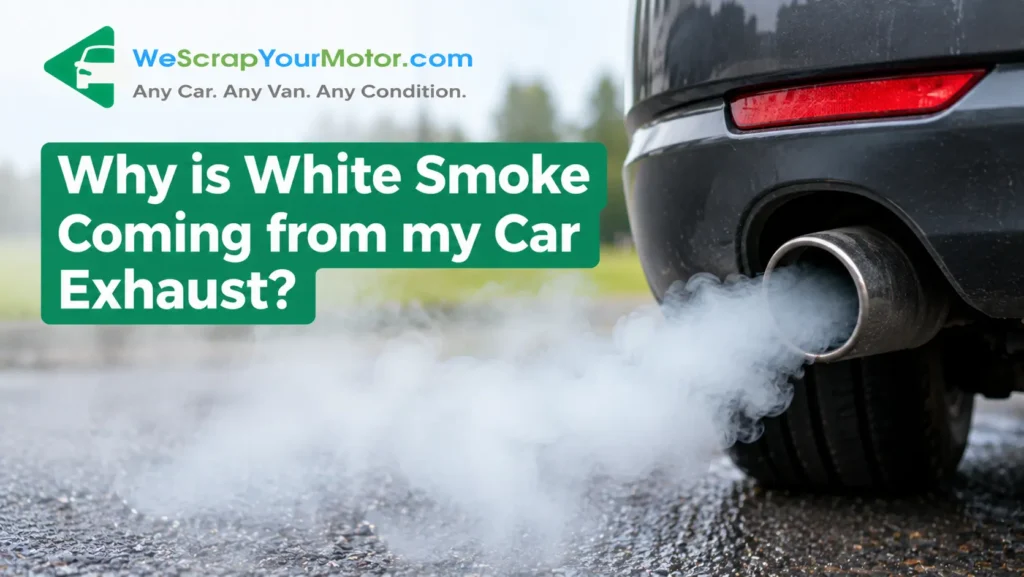
You start your car on a cold morning and notice a white cloud behind the exhaust. A few minutes later, it disappears, and the car drives normally.
That is usually nothing to worry about.
But what happens when the cloud stays visible after the engine warms up? What if the vehicle is losing coolant, overheating or struggling to start?
These details can change the diagnosis completely.
White smoke from exhaust pipes is often harmless condensation when it appears briefly after a cold start. However, thick white exhaust emissions that persist after the engine warms up may indicate coolant entering the combustion chambers or another engine fault.
Petrol and diesel engines can also produce similar-looking exhaust emissions for different reasons.
The appearance, duration and accompanying symptoms provide useful clues, but they cannot establish the cause with certainty.
This guide helps UK drivers distinguish normal exhaust vapour from warning signs, understand potential repair costs and decide when a mechanic should inspect the vehicle.
Is White Smoke from Exhaust Normal?
Sometimes, yes.
Combustion produces water vapour as one of its normal by-products.
When an exhaust system is cold, moisture can condense inside it.
As the engine starts and the exhaust heats up, this moisture turns into visible vapour.
On cold, damp mornings, the effect can be particularly noticeable.
Normal exhaust condensation usually has these characteristics:
- Appears shortly after starting a cold engine
- Looks like a light white mist
- Disappears quickly into the surrounding air
- Reduces as the exhaust system warms up
- Is not accompanied by persistent overheating or coolant loss
A small amount of water dripping from the exhaust during warm-up can also be normal.
However, appearance alone cannot establish whether a problem is harmless.
If white emissions continue after the engine has reached normal operating temperature, further checks are appropriate.
White Exhaust Smoke: Quick Symptom Guide
Use this table as an initial guide rather than a definitive diagnosis.
| What You Notice | Possible Explanation | Recommended Action |
| Thin white mist on a cold morning | Normal condensation | Monitor whether it clears |
| White vapour disappears after warming up | Moisture evaporating | Usually no repair needed |
| Thick white smoke continues when warm | Coolant entering combustion chambers | Stop using the car and arrange inspection |
| White smoke and falling coolant level | Internal coolant leak | Arrange urgent diagnosis |
| White smoke and engine overheating | Potential cooling or engine damage | Stop safely and switch off |
| White smoke on diesel start-up | Possible fuel combustion issue | Book diagnostic inspection |
| White smoke and rough running | Misfire or combustion problem | Investigate promptly |
| White smoke with persistent power loss | Engine or emissions-system fault | Seek professional diagnosis |
The most important distinction is between temporary condensation and persistent abnormal emissions.
A vehicle that repeatedly produces dense smoke and loses coolant needs much more attention than one producing brief morning vapour.
Why Does White Smoke Appear on Cold Mornings?
Cold weather makes water vapour easier to see.
When hot exhaust gases meet cooler outside air, moisture condenses into tiny droplets.
These droplets form a visible white cloud.
The same basic effect makes your breath visible on a cold morning.
Short journeys can make exhaust condensation more noticeable because the system may not remain hot for long enough to dry completely.
A car used for frequent short trips may therefore produce visible vapour on several consecutive mornings.
The fact that the cloud looks dramatic does not automatically mean the engine is damaged.
What matters is whether the vapour disappears as temperatures stabilise.
If it does, and the vehicle has no other symptoms, condensation is a likely explanation.
Eight Possible Causes of White Smoke from a Car Exhaust
Persistent white exhaust emissions can have several causes.
Some are relatively minor, while others require substantial mechanical work.
1. Normal Exhaust Condensation
Condensation is the most common harmless explanation.
Moisture collects within the exhaust system when temperatures fall.
When the engine starts, the water warms up and leaves the tailpipe as vapour.
The key signs are temporary emissions, normal engine temperature and no unexplained coolant loss.
You may also see a small amount of clear water beneath the exhaust outlet.
However, condensation should not be used to explain continuous thick smoke from a fully warm engine.
When in doubt, arrange an inspection.
2. A Blown Head Gasket
A blown head gasket is one of the better-known serious causes of persistent white exhaust emissions.
The head gasket sits between the engine block and cylinder head.
Its purpose includes maintaining separation between combustion gases, coolant and engine oil.
If the gasket fails, coolant may enter one or more combustion chambers.
The coolant can then turn into vapour and leave through the exhaust.
Possible symptoms include:
- Persistent thick white exhaust emissions
- Unexplained coolant loss
- Engine overheating
- Rough running
- Misfiring
- Cooling-system pressure problems
Not every failed head gasket produces all these symptoms.
Similarly, white smoke alone does not prove the gasket has failed.
A technician may need to perform cooling-system and combustion-related tests.
If you are facing an expensive diagnosis, our guide to Is It Worth Repairing a Blown Head Gasket? explains how to assess repair costs against the vehicle’s value.
3. A Cracked Cylinder Head
The cylinder head forms the upper part of the engine’s combustion chambers.
It contains important components and passages for coolant and oil.
Severe overheating can damage the cylinder head.
In some cases, cracking can allow coolant to enter areas where it should not be.
This may cause persistent white exhaust vapour and coolant loss.
A cracked cylinder head can be expensive to repair.
However, it cannot be reliably diagnosed from exhaust appearance alone.
A specialist may need to remove and inspect components or carry out pressure testing.
The repair depends on the location and extent of the damage.
4. A Cracked Engine Block
The engine block forms the main structure of the engine.
Cracks can occasionally develop because of severe overheating, freezing damage or other mechanical stresses.
If a crack allows coolant to enter a combustion chamber, white exhaust vapour may result.
This is generally a more serious possibility.
Repair may require specialist work or complete engine replacement.
Nevertheless, cracked engine blocks are not the most likely explanation for every car emitting white smoke.
More common causes should be properly investigated first.
5. Diesel Fuel Injection Problems
White smoke from exhaust systems on diesel vehicles can sometimes result from fuel that has not burned properly.
Unlike visible water vapour, this type of exhaust emission may involve unburned fuel or incomplete combustion.
Potential contributing faults include:
- Injector problems
- Poor fuel atomisation
- Injection timing problems
- Insufficient combustion temperature
- Engine compression problems
These issues can also cause rough idle, difficulty starting and poor performance.
A garage should check the relevant fuel and engine systems before recommending injector replacement.
Diesel injection equipment operates at very high pressures and requires specialist handling.
6. Diesel Glow Plug Problems
Glow plugs help support cold starting in many diesel engines.
If the glow plug system is not operating correctly, fuel combustion during a cold start may be less efficient.
The result can include rough running and pale exhaust emissions.
This issue may be more noticeable in cold weather.
However, glow plug faults do not explain every instance of white diesel exhaust smoke.
Injectors, compression and engine control systems may also need checking.
A suitable diagnostic assessment can help distinguish these possibilities.
7. EGR Cooler Problems
Some diesel engines use an exhaust gas recirculation cooler.
This component helps control the temperature of recirculated exhaust gases.
An internal EGR cooler leak can sometimes allow coolant into the exhaust or intake path.
Depending on the engine design, the result may include white vapour and falling coolant levels.
This can resemble the symptoms of a failed head gasket.
That distinction matters because the repair requirements may be different.
A competent mechanic should consider the engine’s specific design before concluding that the cylinder head must be removed.
8. Other Cooling-System or Combustion Faults
White-looking exhaust emissions may occasionally be associated with additional problems involving engine cooling, combustion or emissions controls.
For example, a cooling-system leak may eventually lead to overheating and secondary engine damage.
On some vehicles, a combination of poor combustion and exhaust-system conditions can produce pale emissions.
It is important not to treat every visible white cloud as evidence of the same fault.
A reliable diagnosis considers the complete pattern of symptoms.
White Smoke from Exhaust on Petrol vs Diesel Cars
Petrol and diesel engines can show similar symptoms, but the likely causes are not always identical.
Petrol Engines
With petrol vehicles, temporary white vapour after cold starting is often condensation.
Persistent thick white vapour accompanied by coolant loss raises concern about an internal coolant leak.
A head gasket problem, cylinder head defect or related fault may need investigation.
Misfiring or rough running can provide additional clues.
However, a mechanic should confirm the cause through testing rather than assuming head gasket failure.
Diesel Engines
Diesel vehicles can produce temporary condensation just like petrol cars.
However, incomplete diesel combustion may also create pale or white-looking smoke.
This can occur alongside starting difficulties, irregular engine operation or fuel-system faults.
Certain EGR cooler problems may also create coolant-related exhaust vapour.
DPF regeneration changes exhaust operating conditions but should not automatically be blamed for thick, persistent white smoke.
If your diesel repeatedly emits unusual smoke, a proper diagnosis is preferable to guessing that it is normal regeneration.
Is White Smoke Different from Blue or Black Smoke?
Yes, although lighting conditions can make colours difficult to identify.
Exhaust colour offers useful clues, but it is not a substitute for mechanical diagnosis.
White Exhaust Emissions
White vapour is often associated with moisture.
It can be normal condensation or, in more serious cases, coolant entering the engine or exhaust path.
Poor combustion can also produce white-looking emissions.
Blue or Blue-Grey Smoke
Blue or blue-grey exhaust smoke often suggests engine oil is entering the combustion process.
Potential causes include worn piston rings, valve stem seals or turbocharger-related problems.
Oil consumption may accompany this symptom.
Black Exhaust Smoke
Black smoke often indicates excessive soot production.
On diesel vehicles, this can be associated with incomplete combustion or fuel-air management problems.
Petrol engines can also produce dark smoke under certain fault conditions.
The presence of smoke does not automatically identify the defective component.
How to Check Whether Your Car Is Losing Coolant
Unexplained coolant loss is an important clue when investigating persistent white exhaust vapour.
Only inspect the coolant level when the engine is switched off and has cooled sufficiently, following the manufacturer’s instructions.
Many vehicles have a translucent expansion tank marked with minimum and maximum levels.
If the coolant level is repeatedly dropping, there may be a leak.
Some leaks are external and leave visible traces beneath the car.
Others may be internal and produce fewer obvious signs.
A normal-looking driveway does not rule out coolant loss.
If the car also overheats or produces persistent thick white smoke, avoid driving it until a mechanic has inspected it.
Never remove the cap from a hot, pressurised cooling system. Hot coolant and steam can cause serious injuries.
A garage may perform a cooling-system pressure test to locate the problem.
What If White Smoke Appears Only When Starting the Engine?
Timing can provide useful information.
Only on Cold Mornings
If the vapour disappears promptly and the engine runs normally, condensation is a likely cause.
During Cold Starting on a Diesel
White-looking smoke combined with difficult starting or rough idle can suggest incomplete combustion.
Glow plug or fuel-system problems may need investigation.
After the Engine Has Warmed Up
Persistent white emissions from a warm engine are more concerning.
Coolant loss, overheating or irregular engine operation strengthens the case for professional diagnosis.
When Accelerating
Smoke that becomes more visible during acceleration can be associated with several engine or combustion faults.
The garage may need to evaluate the engine under appropriate controlled conditions.
At Idle
Continuous smoke while idling can also indicate an underlying problem.
However, observing emissions alone cannot reliably distinguish coolant vapour from other pale exhaust gases.
Record the symptoms and arrange an inspection rather than repeatedly revving the engine to reproduce the smoke.
When Should You Stop Driving?
Not every white cloud requires stopping the car.
Temporary condensation with no other symptoms is usually harmless.
However, stop safely and seek help if the vehicle has:
- Persistent heavy white smoke
- A high-temperature warning
- Rapid or unexplained coolant loss
- Severe engine misfiring
- Significant loss of power
- Unusual mechanical noises
- Any warning suggesting serious engine damage
Do not continue driving an overheating engine.
Even if the engine appears to recover after cooling, the cause may remain unresolved.
For suspected major internal coolant leaks, recovery is often safer than driving to a garage.
How Do Mechanics Diagnose Persistent White Smoke?
The diagnostic process should focus on confirming the source of the emissions.
A mechanic may begin by asking when the smoke occurs.
The technician may also check the vehicle’s service history and any previous overheating incidents.
Depending on the symptoms, professional testing can involve:
- Inspecting coolant levels and visible leak evidence
- Checking relevant engine fault codes
- Assessing cooling-system pressure
- Testing for combustion gases in the cooling system
- Performing compression or cylinder leak-down tests
- Investigating diesel fuel-system operation
- Inspecting relevant EGR cooler components
- Assessing cylinder head condition where justified
Not every vehicle requires all these tests.
The appropriate diagnostic sequence depends on the evidence.
For example, a diesel with difficult cold starts and no coolant loss may require different testing from a petrol engine with overheating and persistent white vapour.
Avoid approving cylinder head removal until the garage has explained why the available evidence supports it.
How Much Does It Cost to Fix White Exhaust Smoke in the UK?
The cost depends on the diagnosed problem.
Condensation requires no repair.
A failed head gasket or damaged engine can require substantial expenditure.
| Possible Cause or Repair | Indicative UK Cost |
| Normal exhaust condensation | £0 |
| Initial diagnostic check | £30–£180 |
| Minor coolant hose or connector repair | £50–£200 |
| Thermostat replacement | £100–£300+ |
| Glow plug-related repair | £100–£350+ |
| Diesel injector replacement | £200–£600+ per injector |
| EGR cooler replacement | £300–£900+ |
| Head gasket repair | £700–£1,850 |
| Severe engine damage | Vehicle-specific, potentially several thousand pounds |
These prices are broad estimates rather than fixed quotations.
The head gasket range reflects published UK cost guidance for 2026, but some vehicles may cost substantially more.
The diagnosis itself can be particularly important.
Replacing an expensive component without confirming the fault may not stop the smoke.
Ask the garage for a written estimate covering parts, labour, fluids, VAT and any additional tests.
Can White Smoke Cause an MOT Failure?
Visible exhaust emissions can be relevant to an MOT, but the result depends on the applicable testing requirements.
Petrol and diesel vehicles have different emissions-testing procedures.
A diesel vehicle may fail if it exceeds the applicable smoke-opacity limit or meets other relevant failure criteria.
A petrol vehicle may fail applicable emissions checks if engine or combustion faults cause excessive emissions.
The DVSA’s MOT emissions inspection guidance explains the rules.
A brief cloud of normal condensation does not automatically mean the car will fail.
However, a vehicle with persistent abnormal smoke, misfiring or overheating needs attention regardless of its MOT status.
A current MOT certificate does not make an unsafe engine problem harmless.
Should You Repair or Scrap a Car Producing White Smoke?
The answer depends on what is causing the emissions.
If the smoke is normal condensation, there is no fault to repair.
If a relatively inexpensive coolant hose or sensor is responsible, replacing it may be worthwhile.
But an older vehicle with substantial engine damage presents a different decision.
Consider the car’s realistic market value after repair.
Then compare that value against the complete cost of restoring it.
For example, a car worth £4,000 in good condition may justify a £900 head gasket repair if the rest of the engine is healthy.
A car worth £1,000 may be less economical to repair if the head gasket has failed and further overheating damage is suspected.
That does not mean every low-value car should be scrapped.
Replacement transport also costs money, and a familiar repaired car may provide value beyond its resale price.
However, repeated engine faults, serious corrosion or other expensive repairs can change the calculation.
If restoration is no longer practical, explore Scrap My Car in the UK as an alternative.
For drivers in Kent, Get Free Quote While Scrapping My Car in Kent provides a location-specific enquiry option.
Always obtain a confirmed diagnosis before deciding that an engine is beyond economical repair.
Frequently Asked Questions
Is White Smoke from Exhaust Always a Head Gasket Problem?
No.
Cold-weather condensation is common and harmless.
Diesel combustion faults, EGR cooler problems and other issues can also produce white-looking emissions.
A failed head gasket is only one possible explanation.
Why Is My Car Producing White Smoke but Not Overheating?
Some engine faults develop before obvious overheating appears.
Other causes, such as condensation or diesel combustion problems, may not involve overheating at all.
Persistent smoke still needs investigation.
Can a Car Produce White Smoke Because of Low Engine Oil?
Low engine oil is not a typical direct explanation for thick white coolant-related exhaust vapour.
Oil entering the combustion chambers more commonly produces blue or blue-grey smoke.
Exhaust colour can be misleading, so an inspection may still be necessary.
Why Is My Diesel Car Producing White Smoke When Cold?
Condensation is one possibility.
Incomplete combustion during cold starting is another, particularly if the engine runs roughly or struggles to start.
Glow plugs and fuel-system components may require testing.
Is White Smoke from Exhaust Dangerous?
Temporary condensation is generally harmless.
Persistent thick white smoke associated with overheating, coolant loss or poor running can indicate serious mechanical problems.
A vehicle showing these symptoms should be inspected promptly.
Can a Faulty Turbo Cause White Smoke?
Some turbocharger or related system faults can cause visible exhaust emissions, often blue-grey when oil is involved.
However, a turbocharger fault is not the first explanation for every white-looking exhaust cloud.
A technician should confirm the cause.
How Long Should Normal Exhaust Condensation Last?
It typically reduces as the exhaust system warms.
There is no exact universal duration because outside temperature, humidity, journey length and exhaust design all affect the result.
Persistent heavy emissions after warm-up deserve attention.
Can Head Gasket Sealer Permanently Fix White Smoke?
Sealant products are not equivalent to a properly diagnosed mechanical repair.
Their effectiveness and suitability vary, and they may not address the cause of the damage.
Seek professional advice before relying on a temporary product.
Will White Smoke Disappear After an Engine Service?
Only if the cause is addressed.
Routine servicing may resolve some maintenance-related problems, but it cannot be expected to repair a failed head gasket, cracked cylinder head or damaged engine.
Is a Little White Smoke After Starting Normal?
Yes, a brief amount of white vapour during a cold start can be normal.
What matters is whether it clears and whether other warning signs are present.
Know When a White Exhaust Cloud Needs Professional Attention
Seeing white smoke from exhaust pipes is not automatically a sign of major engine damage.
Many drivers notice harmless water vapour during cold British mornings, particularly after the vehicle has been parked overnight.
The more important warning signs are persistence, coolant loss, overheating and abnormal engine performance.
If the vapour disappears as the exhaust warms up and the car behaves normally, condensation is often the explanation.
If thick emissions continue or the vehicle begins losing coolant, arrange professional diagnosis before further driving causes damage.
An accurate assessment can prevent unnecessary repairs, identify serious faults early and help you make an informed decision about the future of the vehicle.