
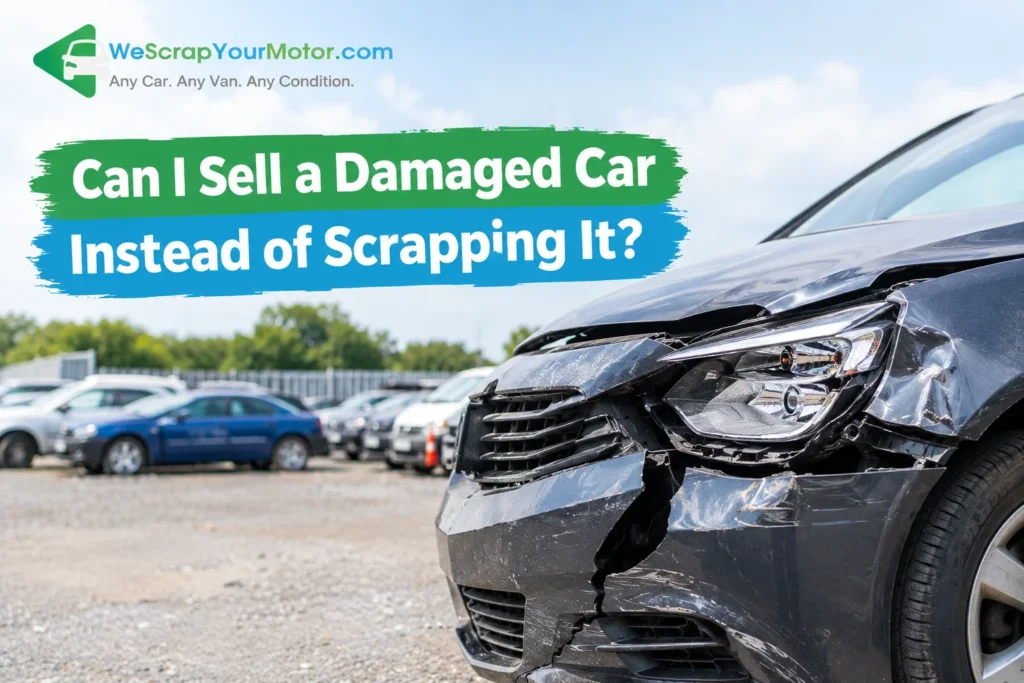
A damaged vehicle is not automatically a scrap vehicle.
A car can be damaged by an accident, engine failure, gearbox trouble, flooding, vandalism, fire or simple bodywork damage.
These situations can produce completely different valuations.
If you want to sell a damaged car, the first step is determining what remains usable and what kind of buyer would realistically want the vehicle.
Some damaged cars are still suitable for repair.
Others have valuable reusable parts.
Some have reached the point where permanent recycling is the appropriate route.
Understanding the difference can prevent you from accepting a basic scrap valuation for a vehicle that still has greater salvage value.
First Identify the Type Of Damage
Before you sell a damaged car, identify exactly what is wrong.
Damage may include:
- Cosmetic Dents
- Scratched Paint
- Broken Bumpers
- Accident Damage
- Engine Failure
- Gearbox Failure
- Flood Damage
- Fire Damage
- Electrical Failure
- Suspension Damage
- Broken Glass
- Missing Components
- Structural Damage
A dented door does not create the same situation as a severely damaged body shell.
Your selling strategy should reflect the actual condition.
Understand the Four Possible Routes
There are generally four routes to compare.
Repair And Sell
You pay to restore the vehicle and then sell it as a functioning car.
Sell As-Is
You disclose the faults and sell the vehicle in its current condition.
Sell For Salvage
A specialist buyer purchases the vehicle because repairing it or recovering reusable components has commercial value.
Permanently Scrap It
The vehicle enters the end-of-life recycling process through an Authorised Treatment Facility.
The highest advertised selling price is not always the route that leaves you with the most money.
Calculate the Vehicle’s Pre-Damage Value
Estimate what the car would have been worth immediately before the damage.
Use comparable vehicles with similar:
- Age
- Mileage
- Specification
- Service History
- MOT Status
- General Condition
This provides your maximum realistic ceiling.
If a healthy example is worth £4,000, spending £5,000 repairing yours purely for resale is unlikely to make financial sense.
Calculate the Current Damaged Value
The next step before you sell a damaged car is obtaining genuine as-is quotations.
Imagine:
Healthy value = £5,000
Current damaged offer = £2,600
Repair quote = £2,800
Repairing and then selling would leave approximately £2,200 before additional expenses.
Selling damages for £2,600 would produce a stronger financial result.
That is why quotations should come before repairs.
Cosmetic Damage Can Leave Plenty Of Value
Minor body damage may have relatively little effect on mechanical condition.
Examples include:
- Scratches
- Small Dents
- Bumper Damage
- Broken Trim
- Mirror Damage
- Paint Defects
If the car remains roadworthy, mechanically healthy and desirable, you may still be able to sell a damaged car through a conventional sale route.
Some buyers prefer paying less and arranging cosmetic repairs themselves.
Accurate disclosure remains important.
Mechanical Failure Can Still Leave Strong Salvage Value
A failed engine can make a vehicle useless for normal driving while leaving almost everything else intact.
Potentially reusable components may include:
- Body Panels
- Wheels
- Interior Trim
- Lights
- Electronics
- Doors
- Catalytic Converter
- Gearbox
- Suspension Components
A popular newer model with one failed system may therefore be worth more than its basic recycling value.
For a deeper explanation, read Scrap Vs Salvage Car.
Accident Damage Needs Proper Assessment
Accident damage can range from cosmetic to structural.
Ask:
- Does the Vehicle Start?
- Does It Roll?
- Does It Steer?
- Have Airbags Deployed?
- Are Wheels Misaligned?
- Is the Cooling System Damaged?
- Are Fluids Leaking?
- Is Structural Damage Suspected?
- Has the Insurer Categorised the Vehicle?
Do not judge structural safety solely from exterior appearance.
Modern vehicles can hide significant damage behind panels.
Insurance Write-Off Status Can Change Your Options
If an insurer has written off the vehicle, understand its category.
Different write-off categories have different implications for repair and future road use.
Some vehicles can potentially be repaired and returned to the road when properly restored.
Others face permanent destruction requirements.
Before you sell a damaged car with write-off history, make sure you understand its official status and disclose it accurately.
Selling Privately Can Produce More Work
Private sale may generate stronger offers in certain cases.
It can connect you with:
- Enthusiasts
- Repairers
- Project Buyers
- Model Specialists
However, it may also involve:
- Advertising
- Photography
- Repeated Messages
- Negotiation
- Viewings
- No-Shows
- Collection Arrangements
Do not judge an option only by the highest possible price.
Time and inconvenience have value too.
Specialist Buyers Can Evaluate More Than Metal
A specialist damaged-vehicle or salvage buyer may consider:
- Make
- Model
- Age
- Mileage
- Specification
- Parts Demand
- Repairability
- Mechanical Condition
- Collection Cost
This can create a higher valuation than treating the entire vehicle as basic scrap metal.
When Repairing Before Sale Can Work
Repairing may make sense if the increase in sale price comfortably exceeds the cost.
Example:
Current damaged offer = £2,500
Repair cost = £700
Expected selling price = £4,000
£4,000 minus £700 equals £3,300.
That may justify the repair.
Now increase repair cost to £1,800.
£4,000 minus £1,800 equals £2,200.
Selling damage for £2,500 would be financially stronger.
Repairs Do Not Add Their Full Cost To Value
Do not assume spending £2,000 automatically increases the car’s market value by £2,000.
Repairs normally restore lost value.
They do not create unlimited new value.
If healthy vehicles of the same model sell for £4,500, spending £3,000 repairing yours does not make it worth £7,500.
Missing Components Can Reduce the Whole-Car Offer
Before you sell a damaged car, avoid removing parts until you have compared whole-vehicle quotations.
Removing valuable components may reduce the buyer’s offer and make collection more difficult.
Parts that can matter include:
- Catalytic Converter
- Battery
- Wheels
- Engine
- Gearbox
- Electronics
A completely damaged car can sometimes have greater commercial value than a partially stripped vehicle.
Flood Damage Requires Extra Caution
Flooding can affect systems long after the visible water disappears.
Possible issues include:
- Wiring
- Electrical Modules
- Connectors
- Interior Materials
- Safety Systems
- Mechanical Fluids
If you sell a damaged car after flooding, disclose the known history.
Do not claim that the vehicle is completely safe or fault-free unless that has been properly established.
Fire Damage Can Reduce Value Quickly
Fire exposure can affect:
- Wiring
- Seals
- Plastics
- Tyres
- Interior Components
- Fluids
- Structural Materials
A locally damaged vehicle may still retain substantial salvage value.
Severe fire damage may make permanent recycling more appropriate.
What If the Damaged Car Has No MOT?
A car without a valid MOT may still have value.
However, road use becomes restricted.
If the vehicle is also damaged or unroadworthy, collection is generally safer than trying to move it normally.
Make sure potential buyers understand that the car may require recovery.
What If the Vehicle Is Already at a Garage?
A garage can provide valuable information before you sell a damaged car.
Ask for:
- Written Diagnosis
- Repair Estimate
- Confirmation Of Whether It Starts
- Confirmation Of Whether It Rolls
- Information About Missing Parts
- Storage Fees
- Collection Rules
Providing accurate information can improve quotation reliability.
Give Every Buyer the Same Information
To compare offers properly, give buyers consistent details.
Provide:
- Registration
- Mileage
- Postcode
- Exact Damage
- MOT Status
- Warning Lights
- Starting Condition
- Driving Condition
- Write-Off Category
- Missing Parts
- Key Availability
- V5C Status
- Collection Restrictions
If one buyer believes the car drives and another knows the gearbox has failed, their prices cannot be compared fairly.
Look Beyond the Headline Price
Before accepting an offer to sell a damaged car, ask what the quotation includes.
Confirm:
- Whether Collection Is Included
- Whether Towing Costs Extra
- When Payment Is Made
- Whether the Price Can Change
- What Documentation Is Provided
- Whether the Vehicle Is Being Repaired Or Scrapped
A transparent offer can be more valuable than an unrealistic high quote followed by deductions.
When Permanent Scrapping Is More Appropriate
Scrapping becomes more likely when:
- Structural Damage Is Severe
- Fire Damage Is Extensive
- Major Components Are Missing
- Corrosion Is Advanced
- Repair Is Economically Unrealistic
- Reusable Parts Demand Is Limited
- The Vehicle Has Reached Genuine End Of Life
In these circumstances, spending weeks trying to sell a damaged car privately may offer little benefit.
What Happens When a Car Is Permanently Scrapped?
GOV.UK states that end-of-life vehicles must go through an Authorised Treatment Facility.
An ATF can decide to completely scrap a vehicle or, depending on the situation, repair and sell it.
When a qualifying vehicle is completely scrapped, the ATF provides a Certificate of Destruction within seven days.
You should also ensure that the DVLA is correctly notified.
Does a Scrap Buyer Have To Destroy the Car?
Not necessarily.
GOV.UK explains that an ATF may completely scrap a vehicle or decide to repair and sell it.
The Certificate of Destruction applies when the qualifying vehicle is completely scrapped.
Therefore, understand the type of transaction you are entering.
Can You Receive Cash For the Vehicle?
If the vehicle is actually being scrapped in England or Wales, cash payment is illegal.
GOV.UK states that payment for a scrapped vehicle must be made by bank transfer or cheque.
Do not confuse a genuine used-vehicle sale with a permanent scrap transaction.
When Selling Damaged May Produce More Money
You may receive more when you sell a damaged car instead of scrapping it if:
- The Vehicle Is Relatively New
- Damage Is Localised
- The Engine Remains Healthy
- The Gearbox Remains Healthy
- Valuable Parts Are Intact
- The Model Has Strong Demand
- Repair Is Commercially Viable
Get real quotations instead of estimating.
Get a Scrap Baseline Before Deciding
Even if you intend to sell rather than scrap, obtain a scrap or salvage quotation.
It gives you a minimum benchmark.
You can use Scrap My Car UK to establish an initial figure before deciding whether selling elsewhere is worth the additional work.
If you are in Devon, compare local collection options through Scrap My Car In Plymouth.
Frequently Asked Questions
Can I Sell a Damaged Car Privately?
Potentially. The vehicle’s condition must be described accurately and you should not misrepresent its roadworthiness or known damage.
Is a Damaged Car Worth More Than Scrap?
Sometimes. A repairable vehicle or one containing desirable reusable components can have salvage value above basic recycling value.
Should I Repair the Car Before Selling It?
Only when the likely increase in selling price exceeds the repair cost and associated risk.
Can I Sell a Non-Running Car?
Yes. Specialist buyers and salvage businesses may purchase non-running vehicles and arrange collection.
Does Accident Damage Automatically Mean Scrap?
No. The severity, structural condition, insurance status, vehicle value and repair economics all matter.
Should I Remove Valuable Parts First?
Get whole-vehicle quotations first because removing components can reduce the total offer.
Find the Vehicle’s Full Value Before Choosing Its Future
Before you sell a damaged car, understand exactly what remains valuable.
A damaged car may still have roadworthy value, repair-project value, salvage value or reusable parts value.
Another vehicle with apparently lighter visible damage may have serious structural problems that make recycling the more sensible route.
Identify the damage.
Confirm any insurance category.
Calculate repair economics.
Compare as-is quotations.
Understand what each buyer intends to do with the vehicle.
Then choose the route that provides the strongest combination of value, convenience and legal compliance.
Damage does not automatically mean scrap.
The right valuation tells you what the vehicle is still worth.