
Have you ever pressed the accelerator only to hear your engine rev higher while your car struggles to gain speed?
This is one of the most common signs of a slipping clutch.
Understanding What is Clutch Slipping is important because it can affect your vehicle’s performance, fuel economy, safety, and overall value. While some clutch problems can be repaired relatively affordably, others may result in repair bills that exceed the value of an older vehicle.
For many UK drivers, clutch slipping begins gradually and becomes worse over time. What starts as occasional loss of power can eventually lead to complete clutch failure, leaving you unable to drive the vehicle at all.
In this guide, you’ll learn What is Clutch Slipping, what causes it, how to identify the warning signs, how much repairs typically cost in the UK, and when it may be more economical to scrap your vehicle instead of fixing it.
What Is Clutch Slipping?
A slipping clutch occurs when the clutch disc cannot maintain enough friction against the flywheel to transfer engine power effectively to the transmission.
When this happens, some of the engine’s power is lost before it reaches the wheels.
As a result:
- Engine RPM increases.
- Acceleration decreases.
- Fuel consumption rises.
- Vehicle performance suffers.
The easiest way to understand What is Clutch Slipping is to imagine riding a bicycle with a loose chain. You can pedal harder, but not all of your effort reaches the wheels.
The same thing happens when a clutch begins to wear out.
Many drivers first notice What is Clutch Slipping while driving uphill, overtaking another vehicle, or towing a trailer.
Quick Answer
A slipping clutch occurs when the clutch disc fails to properly grip the flywheel, causing the engine to rev higher without transferring full power to the wheels.
How Does a Clutch Work?
Before understanding why clutch slipping occurs, it helps to know how the clutch system works.
In manual transmission vehicles, the clutch connects and disconnects the engine from the gearbox.
This allows drivers to:
- Change gears smoothly.
- Stop without stalling the engine.
- Control power delivery.
The clutch system consists of several important components.
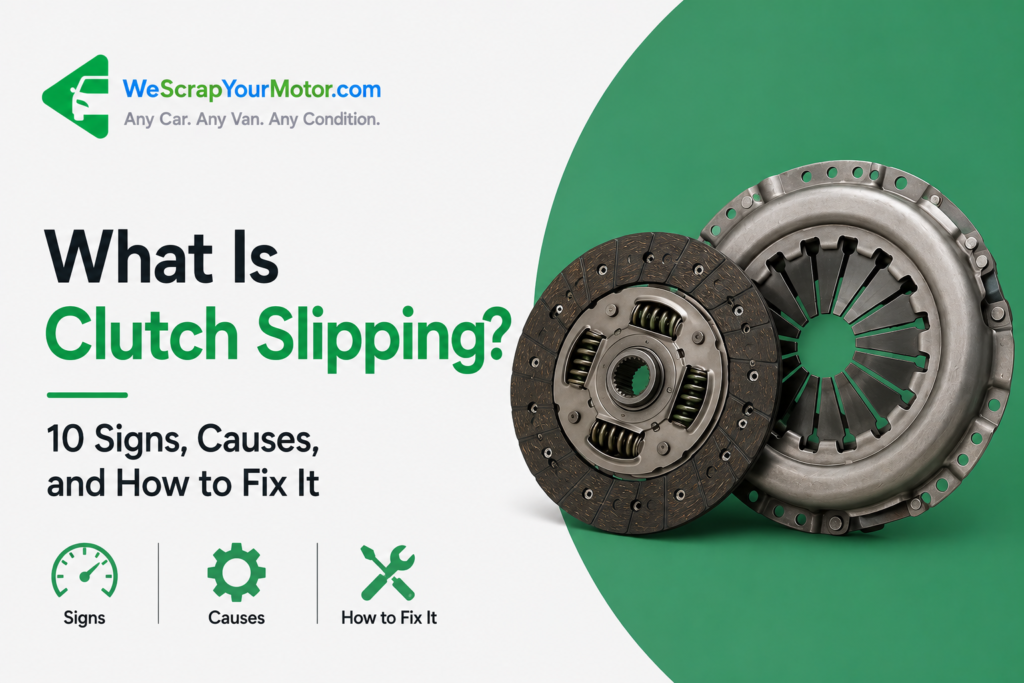
1. Clutch Disc
The clutch disc contains friction material that grips the flywheel and transfers power from the engine to the transmission.
2. Pressure Plate
The pressure plate applies force to the clutch disc and helps maintain proper contact with the flywheel.
3. Flywheel
The flywheel stores rotational energy from the engine and works together with the clutch disc.
4. Release Bearing
The release bearing helps disengage the clutch when the pedal is pressed.
When any of these components wear out or become damaged, What is Clutch Slipping becomes a common problem.
10 Signs of a Slipping Clutch
Recognising clutch slipping symptoms early can help you avoid expensive repairs.
Here are the most common slipping clutch signs.
1. Engine Revs Increase Without Acceleration
This is often the first symptom drivers notice.
You press the accelerator and the engine RPM rises rapidly, but the vehicle doesn’t gain speed as expected.
This symptom becomes especially noticeable during motorway driving.
2. Burning Smell While Driving
A slipping clutch generates excessive friction and heat.
Many drivers describe the smell as similar to burning paper or overheated brakes.
A burning smell after driving should never be ignored.
3. Poor Acceleration
A worn clutch prevents full power transfer from the engine to the wheels.
This can make overtaking slower and more dangerous.
4. Difficulty Climbing Hills
Steep inclines require additional power.
If your vehicle struggles on hills, clutch wear could be responsible.
5. High Clutch Bite Point
As the clutch disc wears, the engagement point often moves higher.
If the clutch only engages near the top of the pedal travel, inspection may be necessary.
6. Reduced Towing Performance
Vehicles used for towing caravans, trailers, or heavy loads often show clutch slipping symptoms sooner.
Additional weight places more strain on the clutch system.
7. Poor Fuel Economy
Many drivers don’t realise that What is Clutch Slipping can significantly affect fuel efficiency.
Because power isn’t transferred efficiently, the engine must work harder.
8. Soft or Spongy Clutch Pedal
Changes in pedal feel may indicate clutch or hydraulic system issues.
A soft clutch pedal should always be investigated.
9. Delayed Acceleration
You may notice a delay between pressing the accelerator and the vehicle responding.
This is a common sign of clutch wear.
10. Vibrations During Driving
Worn clutch components may create vibrations through the pedal or floor of the vehicle.
These vibrations often become worse as the problem progresses.
Common Vehicles That Experience Clutch Slipping
While clutch problems can affect any manual vehicle, some of the most common cars seen by UK garages include:
- Ford Fiesta
- Ford Focus
- Vauxhall Corsa
- Vauxhall Astra
- Volkswagen Golf
- BMW 1 Series
- BMW 3 Series
- Audi A3
- Peugeot 208
- Nissan Qashqai
Heavy city driving, frequent gear changes, and stop-start traffic often accelerate clutch wear.
What Causes Clutch Slipping?
Now that you understand What is Clutch Slipping, let’s look at the most common causes.
Normal Wear and Tear
This is the most common cause.
Over time, friction material wears away and loses its ability to grip the flywheel.
Most clutches last between 60,000 and 100,000 miles depending on driving habits.
Riding the Clutch
Many drivers rest their foot on the clutch pedal without realising it.
Even slight pressure can accelerate clutch wear.
Oil Contamination
Oil leaks from the engine or gearbox can contaminate the clutch disc.
When oil reaches the friction material, slipping often occurs.
Damaged Pressure Plate
A weak or damaged pressure plate may not provide enough force to hold the clutch disc securely.
Overheating
Heavy towing, aggressive driving, and prolonged stop-start traffic can overheat clutch components.
Hydraulic System Problems
Vehicles with hydraulic clutch systems can develop leaks or pressure problems that affect clutch performance.
Frequent Heavy Loads
Commercial vehicles and cars used for towing frequently experience faster clutch wear due to increased stress.
Is Your Clutch Slipping? Here’s How to Tell
Many drivers don’t notice clutch problems until performance becomes significantly worse.
Ask yourself these questions:
- Does your engine rev higher than normal?
- Has acceleration become slower?
- Do you smell burning after driving?
- Does your clutch pedal feel different?
- Has fuel economy decreased?
If you answered yes to several of these questions, your clutch may be slipping.
For a more detailed guide, see: Is Your Clutch Slipping?
How to Test for a Slipping Clutch at Home
There are several simple tests you can perform.
1. Handbrake Test
- Apply the handbrake firmly.
- Start the engine.
- Select third gear.
- Slowly release the clutch.
A healthy clutch should stall the engine.
If the engine continues running, clutch slipping may be occurring.
2. Hill Start Test
Attempt to accelerate uphill.
If RPM increases rapidly without matching acceleration, your clutch may be worn.
3. High Gear Test
Drive at a moderate speed in a high gear and accelerate firmly.
If the rev counter climbs quickly while speed remains relatively unchanged, clutch slipping is likely occurring.
Can You Drive with a Slipping Clutch?
Technically, yes. However, it is not recommended.
Many drivers continue driving after noticing the first signs of clutch slipping because the vehicle still moves. Unfortunately, this often leads to bigger and more expensive problems.
Driving with a slipping clutch can:
- Increase repair costs.
- Cause complete clutch failure.
- Damage the flywheel.
- Put additional strain on gearbox components.
- Leave you stranded unexpectedly.
The longer you continue driving with a slipping clutch, the more likely you are to face a larger repair bill.
One of the biggest mistakes drivers make after discovering What is Clutch Slipping is assuming the problem will stay the same. In reality, clutch wear usually accelerates once slipping begins.
Can a Slipping Clutch Damage the Gearbox?
Yes.
Although the clutch and gearbox are separate components, they work closely together.
When the clutch cannot transfer power correctly, additional strain may be placed on transmission components.
Potential consequences include:
- Increased gearbox wear.
- Difficulty changing gears.
- Additional transmission repairs.
- Reduced vehicle reliability.
This is why mechanics recommend diagnosing clutch issues as early as possible.
Can Clutch Slipping Affect Fuel Economy?
Absolutely.
Many drivers are surprised to learn that What is Clutch Slipping can directly affect fuel consumption.
When power isn’t transferred efficiently:
- The engine works harder.
- More fuel is consumed.
- Overall efficiency decreases.
Over time, increased fuel costs can become significant, especially for drivers covering long distances.
Can Low Clutch Fluid Cause Clutch Slipping?
In some vehicles, yes.
Hydraulic clutch systems rely on fluid pressure to operate correctly.
Low fluid levels can lead to:
- Poor clutch engagement.
- Difficulty selecting gears.
- Soft clutch pedals.
- Inconsistent performance.
If fluid levels are low, a leak may be present and should be inspected immediately.
Can Clutch Slipping Cause an MOT Failure?
Clutch slipping itself is not specifically listed as an MOT inspection item.
However, severe clutch problems can indirectly contribute to MOT-related concerns if they affect vehicle control or safety.
For example:
- Poor drivability.
- Difficulty changing gears.
- Transmission-related faults.
If your vehicle is already facing MOT issues alongside clutch problems, it may be worth considering whether further repairs are financially worthwhile.
How to Fix a Slipping Clutch
The correct repair depends on the underlying cause.
1. Clutch Adjustment
Some older vehicles use adjustable clutch cables.
Improper adjustment can sometimes contribute to clutch slipping.
2. Repairing Oil Leaks
If oil contamination is the cause, leaks must be repaired before replacing clutch components.
3. Replacing Individual Components
Depending on the diagnosis, mechanics may replace:
- Clutch disc.
- Pressure plate.
- Release bearing.
4. Full Clutch Replacement
In most cases, a complete clutch replacement is recommended.
Replacing the entire clutch kit often provides better long-term value than replacing individual components separately.
Clutch Replacement Cost UK
One of the most common questions drivers ask after learning What is Clutch Slipping is how much repairs will cost.
The answer depends on several factors:
- Vehicle make and model.
- Labour rates.
- Parts quality.
- Flywheel condition.
- Vehicle complexity.
Average UK clutch replacement costs:
| Vehicle Type | Average Cost |
| Ford Fiesta | £450–£700 |
| Vauxhall Corsa | £500–£800 |
| Volkswagen Golf | £700–£1,100 |
| BMW 3 Series | £900–£1,500 |
| Mercedes C-Class | £1,000–£2,000+ |
Premium vehicles often cost more because labour times are longer and parts are more expensive.
For more information, see our guide on clutch replacement cost
Should You Repair or Scrap Your Car?
This is where many UK drivers face a difficult decision.
Repairing a vehicle isn’t always the most economical option.
The right decision depends on:
- Vehicle value.
- Repair costs.
- Mileage.
- MOT history.
- Overall condition.
Repair Your Vehicle If:
- The vehicle is relatively new.
- Mileage is low.
- It has recently passed its MOT.
- No major faults are present.
- Repair costs are reasonable.
Consider Scrapping Your Vehicle If:
- Repair costs exceed vehicle value.
- The vehicle has high mileage.
- Multiple faults are present.
- Rust damage is significant.
- MOT failures are becoming frequent.
Repair vs Scrap Comparison
| Vehicle Value | Repair Cost | Recommended Action |
| £500 | £900 | Scrap |
| £700 | £1,200 | Scrap |
| £1,500 | £600 | Repair |
| £3,000 | £800 | Repair |
| £6,000 | £1,000 | Repair |
This simple comparison can save drivers hundreds or even thousands of pounds.
When Should You Scrap a Car with a Slipping Clutch?
Many older vehicles simply aren’t worth repairing.
You may want to consider scrapping your vehicle if:
- Repair costs exceed £1,000.
- The vehicle has over 150,000 miles.
- Significant rust is present.
- Multiple warning lights are active.
- Gearbox repairs are also needed.
- The vehicle repeatedly fails MOT inspections.
At this point, spending additional money may only delay the inevitable.
Instead, many owners choose to sell the vehicle for scrap and put the money towards a replacement car.
What Happens After You Scrap Your Vehicle?
Many people assume scrapping a car is complicated.
In reality, the process is usually straightforward.
A reputable scrap vehicle service will typically:
- Provide a quote.
- Arrange collection.
- Complete DVLA paperwork.
- Process payment.
- Recycle the vehicle responsibly.
At We Scrap Your Motor, we help drivers across the UK scrap unwanted vehicles quickly and legally.
Do You Need to Cancel Insurance Before Scrapping Your Vehicle?
Yes.
Many drivers forget this important step.
Once your vehicle is scrapped, you should contact your insurer and inform them that the vehicle is no longer in use.
You may also be eligible for a partial refund depending on your policy.
If you’re unsure how the process works, see: can you cancel car insurance at any time?
Expert Tips to Extend Clutch Life
Although clutch wear is inevitable, good driving habits can significantly increase lifespan.
1. Avoid Riding the Clutch
Keep your foot off the pedal unless changing gears.
2. Use the Handbrake on Hills
Avoid balancing the vehicle using clutch control.
3. Don’t Overload the Vehicle
Heavy loads increase clutch wear.
4. Shift Smoothly
Aggressive gear changes place additional stress on clutch components.
5. Address Problems Early
Small issues are usually cheaper to fix than major failures.
Wrapping Up
Understanding What is Clutch Slipping can help you identify problems early, avoid costly breakdowns, and make smarter financial decisions.
Common symptoms include rising engine RPM, poor acceleration, burning smells, reduced fuel economy, and difficulty climbing hills. While many clutch problems can be repaired, replacement costs in the UK often range from £400 to £1,500 or more.
For newer vehicles, repairs are usually worthwhile. However, for older cars with high mileage, MOT issues, or multiple mechanical faults, scrapping may be the more cost-effective solution.
By recognising the warning signs, comparing repair costs with vehicle value, and understanding all available options, you can decide whether repairing or scrapping your vehicle is the right choice.